
The TikTok Shop Algorithm in 2026: Why Some Products Explode While Others Die in Silence
- 2026-08-06
-
 0
0
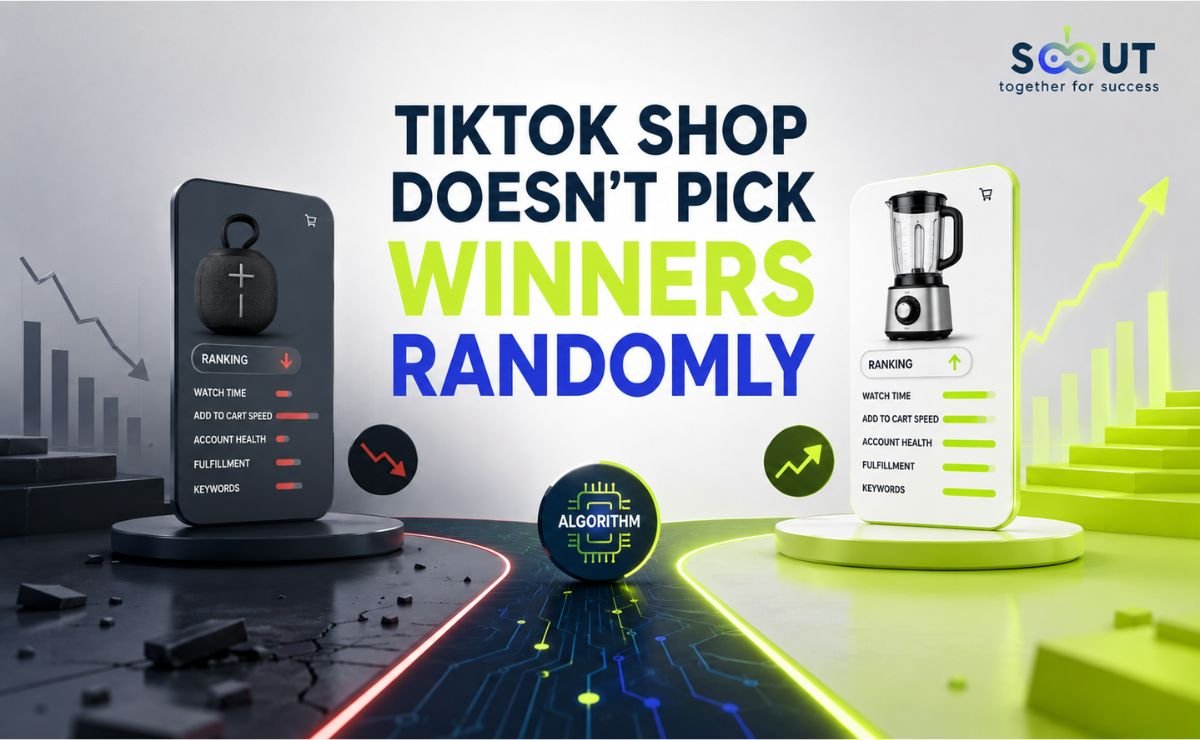
If you've watched a near-identical product outsell yours by 10x on TikTok Shop with worse photos and a higher price, you already know the platform isn't ranking on luck. TikTok Shop algorithm 2026 decisions run on a small set of measurable signals, video engagement, add-to-cart behavior, fulfillment health, listing completeness, and affiliate content volume, and every one of them is influenceable before you spend a single dollar on ads. This matters even more if you don't hold your own stock, because the platform treats fulfillment risk as your problem the moment a supplier or 3PL slips. In this guide, you'll see how TikTok Shop's own published policies define what gets pushed and what gets restricted, including account health rules that changed this year. You'll also get a step-by-step framework for engineering a launch that earns organic distribution before you ever touch a paid campaign. If you've ever asked how the TikTok Shop algorithm works and gotten a vague answer about "posting consistently," this is the version grounded in what TikTok Shop actually publishes about its own systems. Let's start with the shift that makes all of this possible.
How Does the TikTok Shop Algorithm Actually Work in 2026?
TikTok Shop runs two related but distinct systems, and confusing them is why many sellers optimize the wrong thing.
|
System |
What it optimizes for |
What it rewards |
|
For You Page (FYP) |
Session watch-time |
Completion, rewatch behavior, engagement velocity |
|
Search |
Text relevance to a query |
Keyword match in title, caption, on-screen text, spoken audio |
According to TikTok's own support documentation on how TikTok Shop recommends content, the platform layers commerce-specific signals, listings, product cards, creator content, inventory, and fulfillment quality, on top of its general recommendation logic. TikTok Shop's own seller education material adds a useful mechanical detail: new videos typically enter a limited initial audience pool before stronger watch time, likes, comments, and completion behavior unlock progressively larger pools, according to TikTok's seller academy guide on how content is recommended to new users.
TikTok Shop's own data shows a majority of Gen Z shoppers have used the platform as a search tool at some point, though most still turn to Google first when they want a preferred result with https://www.adobe.com/express/learn/blog/using-tiktok-as-a-search-engine
What Signals Determine Whether TikTok Shop Pushes Your Listing?
How Much Does Video Engagement Rate Affect Ranking?
Watch-time and completion behavior in the opening seconds are consistently described, across TikTok's own creator-facing materials, as some of the strongest signals in the recommendation pipeline. TikTok has not published a single universal completion-rate number that guarantees wider distribution, thresholds behave more like a moving bar shaped by video length, niche, and account history than a fixed pass/fail line, so treat any specific percentage you see cited elsewhere as an industry estimate, not a platform-confirmed figure.
What TikTok Shop's own guidance does confirm is the mechanism: content that holds attention and earns rewatches is tested with progressively wider audiences, while content with early drop-off stalls in a small pool. Practical takeaway: a slower demo that holds attention to the end will generally outperform a punchy clip that loses viewers before the payoff.
Why Does Early Add-to-Cart Activity Matter?
Sellers and marketers who track TikTok Shop performance closely tend to report that how quickly a product earns add-to-carts after a video goes live matters as much as the total volume over time, a fast early response signals a strong product-content match, which can support a wider test audience. This is a widely observed pattern rather than a number TikTok has published, so the practical lesson is directional: front-load your strongest offer into your first content push rather than spreading it evenly over a week.
What Is the Account Health Rating (AHR) and How Does It Control Your Visibility?
TikTok Shop's Account Health Rating (AHR) Requirements documentation, published in TikTok Shop's US Seller Academy, lays out the mechanics directly:
-
Scale: 0–1,000 points, tracked over a rolling 180-day window
-
Starting point: every seller begins at 200 points
-
Earning points: points are added for fulfilled orders and for passing policy quizzes
-
Losing points: points are deducted for policy or performance issues
-
Enforcement milestones: dropping to 150, 100, or 50 points triggers escalating restrictions, 7, 14, or 28-day blocks on new listings and campaign enrollment, with 0 points risking permanent deactivation
AHR replaces TikTok Shop's earlier Violation Points system. If your AHR is trending down toward 150, it's worth treating as an early warning rather than waiting for a formal restriction, since TikTok Shop frames account health as an ongoing, continuously recalculated status rather than a one-time compliance check.
Why Is Fulfillment Riskier When You Don't Hold Stock?
If you run a hybrid model, self-fulfillment plus a 3PL, plus TikTok's own Fulfilled-by-TikTok option, TikTok Shop's own Fulfillment Policy confirms that performance is tracked at the shop level across fulfillment methods, meaning a struggling 3PL's shipping delays show up against your account's standing, not in isolation.
Two specific metrics matter here, and TikTok Shop publishes hard thresholds for both:
-
Seller-Fault Cancellation Rate (SFCR): TikTok Shop's Seller-Fault Cancellation Rate Requirements state that sellers must keep SFCR at or below 2.5%. This metric specifically captures cancellations tied to stock shortages, delayed shipments, or pricing errors, the exact failure mode a non-stockholding seller risks when a supplier runs out before a listing catches up.
-
Late Dispatch Rate (LDR): per TikTok Shop's Late Dispatch Rate Requirements, shops must keep LDR at or below 10%, or risk AHR point deductions, order volume limits, or extended settlement periods.
Fix it before it costs you: sync inventory in real time so listings auto-pause at low stock, and don't treat the published thresholds as targets to hover near, build in margin above them. If sourcing reliability is the weak link, our guide to Top Sources for Fast Shipping and Higher Profits covers vetting suppliers for consistent lead times, and our breakdown of TikTok Shop's 48-Hour Shipping Rule walks through the dispatch window itself and how it interacts with SFCR and LDR.
What Does "Listing Completeness" Actually Mean to the Algorithm?
TikTok Shop's search system draws on multiple surfaces of a video at once, title, caption, on-screen text, and spoken audio (via automatic transcription), which is consistent with TikTok's own confirmation that recommendations weigh video information alongside user interactions. The practical implication is straightforward: if your target keyword only appears in one of those places, you're leaving search visibility on the table. On-screen text matters especially early in a video, since text introduced in the first few seconds is more likely to register before a viewer scrolls past. Recent, active reviews also tend to signal a healthy, currently-selling product, TikTok Shop's own Shop Performance Score documentation folds review-related metrics into ongoing seller standing, reinforcing that review activity is treated as a live signal rather than a one-time total.
Why Does Affiliate Content Volume Move the Needle, and What's the Hidden Risk?
More creators posting about your product means more content the algorithm can test across audience segments, which is why affiliate volume functions as a ranking lever in its own right. But there's a liability worth understanding clearly: TikTok Shop's Content Policy requires that all content promoting a seller's products, including creator content, stay accurate and compliant, and TikTok Shop's Affiliate Marketing Policy confirms that a shop can be disqualified from Affiliate Marketing entirely if its Shop Performance Score falls too low or its account is deactivated for a policy violation. In practice, this means a non-compliant claim from a creator you never briefed can still land on your account's standing. If you're building an affiliate program, our guide to the TikTok Shop affiliate creator programme covers vetting and briefing creators properly. A written content brief with explicit compliance sign-off is one of the few things standing between someone else's video and your account health.
How Do You Engineer a Launch That Gets Algorithmic Distribution Before Spending on Ads?
Phase 1, Pre-Launch (Signal Foundation): Confirm your listing places your target keyword across title, caption, on-screen text, and voiceover. Verify inventory sync is real-time rather than a nightly batch, and set your handling-time promise honestly, better to promise three days and ship in one than promise one and slip to two.
Phase 2, Launch Window (Creator Burst): Coordinate several affiliate creators to post within the same short window rather than staggering over weeks. Concentrated content volume gives the algorithm more simultaneous test data.
Phase 3, The First 60 Minutes: This window tends to disproportionately shape whether a video gets tested with a broader pool. Respond to comments and seed initial engagement through your own network. A slow first hour can signal weak content-audience fit even if the video improves later.
Phase 4, Content Velocity System: Sustained ranking tends to come from steady cadence rather than one big push. This is where product research pays off before you commit a budget: identifying which product angles are already gaining organic traction lets you brief creators around proven demand instead of guessing. This is the exact gap the TS Scout TikTok Shop Scanner is built for, it surfaces trending TikTok Shop products and fast-moving market signals so you can launch content around demand that's already building, rather than finding out weeks later that a competitor beat you to it. (See our guide to the top 10 TikTok Shop trending products for how this plays out by category.)
Phase 5, When to Introduce Paid Ads: Wait until organic content is generating consistent add-to-carts and holding viewer attention well. Ads layered onto a proven organic signal amplify what's already working; ads layered onto an unproven listing just buy a faster, more expensive way to find out it doesn't convert. Our piece on TikTok Shop vs TikTok Ads breaks down this tradeoff in more depth.
What Mistakes Are Quietly Killing Your Visibility?
Three patterns account for most of the "invisible listing" cases we see:
-
Treating a 3PL's performance as separate from your own. It isn't, TikTok aggregates it into your AHR regardless.
-
Letting affiliate content go live unreviewed. One non-compliant claim from a creator you never briefed can cost you AHR points earned over months.
-
Chasing review count instead of review velocity. A thousand old reviews won't outrank twenty fresh ones.
If your listings have gone quiet despite decent traffic, our guide to why my TikTok Shop's listings still invisible walks through a fuller diagnostic checklist.
What Would Change If You Stopped Guessing What TikTok Shop Wants Next?
Every signal in this article is measurable, which means every one of them is a decision you can make differently starting with your next upload, not a mystery you have to wait out. The sellers pulling ahead in 2026 aren't posting more; they're treating AHR, fulfillment aggregation, and affiliate compliance with the same rigor they give their content calendar.
Start your $1, 14-day full-access trial of TS Scout and see which TikTok Shop products are building organic momentum right now, before you commit a budget to a guess.
FAQ
1. Is TikTok Shop's algorithm the same as the regular FYP algorithm?
No. FYP ranks primarily on behavioral signals like watch-time and completion, while TikTok Shop's search system ranks on text relevance, keyword match in your title, caption, on-screen text, and spoken audio.
2. How long does it take to recover from a low Account Health Rating?
AHR tracks a rolling 180-day window, so points tied to resolved issues age out over time. TikTok Shop's own AHR documentation notes that passing policy quizzes can also help offset point loss faster than waiting alone.
3. Can affiliate creators hurt my seller account even if my own listings are compliant?
Yes. TikTok Shop's Content Policy and Affiliate Marketing Policy both tie content compliance and affiliate eligibility to the seller's account, which is why a written compliance brief for every affiliate matters.
4. Does using a 3PL protect me from fulfillment-related account health penalties?
No. TikTok Shop's Fulfillment Policy tracks performance metrics like SFCR and LDR at the shop level across fulfillment methods, so a 3PL's late shipments still count against your account.
5. Do TikTok Shop reviews need high volume to help ranking?
Not necessarily. A steady pace of recent reviews is generally treated as a stronger signal of an actively selling, trustworthy listing than a large but inactive review history.
6. What fulfillment thresholds does TikTok Shop actually publish?
TikTok Shop's published requirements set Seller-Fault Cancellation Rate at or below 2.5% and Late Dispatch Rate at or below 10%, with enforcement actions triggered when either is breached.
like?


Table of Contents
- How Does the TikTok Shop Algorithm Actually Work in 2026?
- What Signals Determine Whether TikTok Shop Pushes Your Listing?
- How Do You Engineer a Launch That Gets Algorithmic Distribution Before Spending on Ads?
- What Mistakes Are Quietly Killing Your Visibility?
- What Would Change If You Stopped Guessing What TikTok Shop Wants Next?
- FAQ