
Walmart WFS vs 3PL Fulfillment: Which One Actually Wins You the Walmart+ Badge in 2026?
- 2026-08-09
-
 0
0
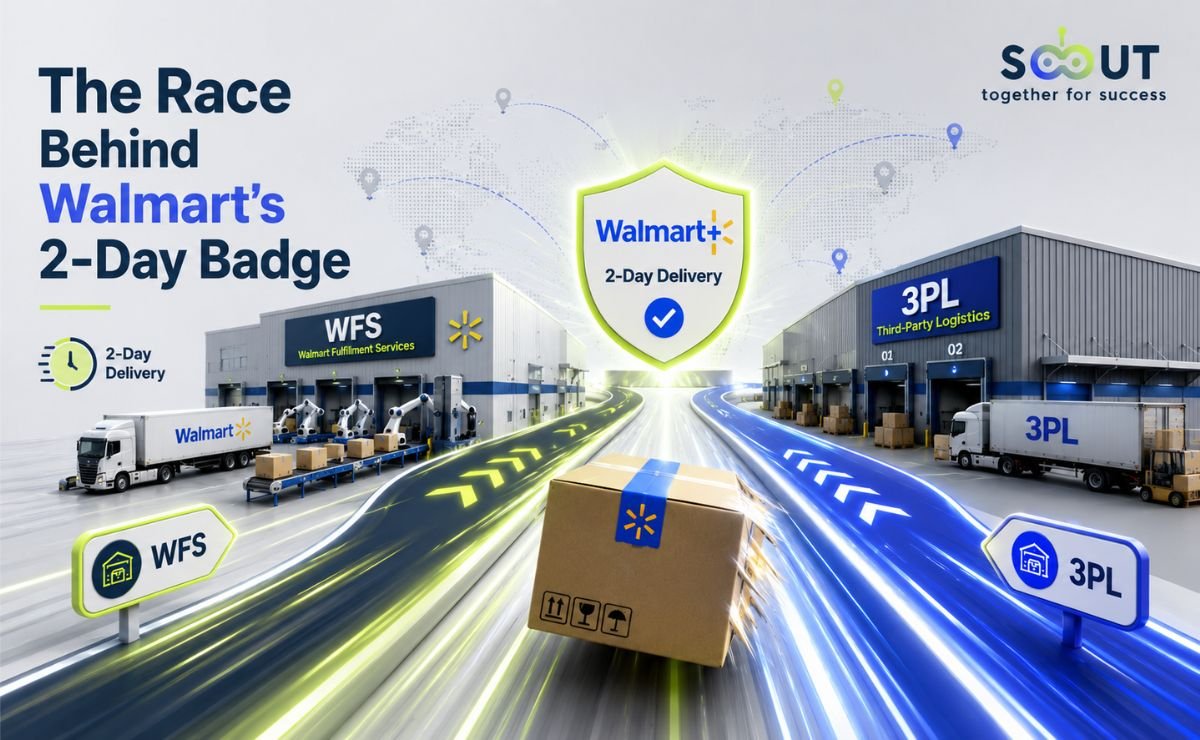
More than 200,000 third-party sellers are competing for the same shelf space on Walmart.com right now, and the ones pulling ahead almost all have one thing in common: a badge sitting next to their price. If you've ever wondered how a seller with no warehouse and no inventory piling up in a spare room still manages to ship free, in two days, with a trust badge attached to the listing, the answer isn't luck, it's fulfillment strategy. Walmart's own first-party data shows sellers see an average 50% GMV growth on items carrying the "Fulfilled by Walmart" and 2-day shipping tags, too large a number to ignore if you're still shipping out of your kitchen table.
This guide breaks down the three real fulfillment paths available to non-stockholding sellers in 2026, Walmart Fulfillment Services (WFS), third-party logistics (3PL), and self-fulfillment, with sourced costs, the exact badge requirements, and a decision framework built for sellers who don't want to tie up cash in inventory. Let's start with what the badge actually requires, because most sellers get this part wrong.
What Does It Actually Take to Earn Walmart's Free-Shipping Badge in 2026?
The badge you're chasing is the Walmart+ badge, a designation that appears on a listing when an item ships free to Walmart+ members and meets Walmart's speed and reliability bar. According to the Walmart+ badge program guide on Marketplace Learn, the badge is automatically applied to every item fulfilled through WFS. For items you fulfill yourself, you have to earn it.
To qualify a self-fulfilled item for the badge, Walmart requires:
-
Two-calendar-day shipping or less to Walmart+ members (Walmart waives the shipping fee once this is met)
-
90%+ On-Time Delivery (OTD) rate
-
Under 2.5% Seller Cancellation Rate
-
Meeting Walmart's Seller Performance Standards for the trailing 30 days
That last point matters more than sellers realize, Walmart doesn't grant the badge once and forget about it. Eligibility is reassessed on a rolling basis, which means a bad week of late shipments can pull the badge off your listing exactly when you can least afford to lose the visibility boost. And visibility is the real prize here: badged listings rank higher in search and get pulled into more of Walmart's promotional placements, which is where that 50% GMV lift comes from in practice.
The one requirement that trips up sellers who don't hold inventory is the two-day window, because reaching that speed without your own warehouse means someone else's warehouse has to do the work.
Can You Earn the Badge Without Holding Any Inventory Yourself?
Yes. This is the part most guides skip: a 3PL partner can get you to badge-eligible speed without you ever touching a box.
Before the shipping mechanics, there's an eligibility gate sellers miss. Per the Walmart+ badge program guide on Marketplace Learn, you need to have met Walmart's Seller Performance Standards for the trailing 30 days before you can enroll, in practice, this means having enough shipping history on your account for Walmart to actually measure you against those standards. A brand-new account with no order history won't show a meaningful 30-day performance snapshot, so sellers just starting out should expect a short track record requirement before enrollment is even possible, regardless of which fulfillment method they choose.
Once you clear that bar, here's the mechanics of getting a 3PL-fulfilled item to badge speed. Your supplier ships inventory directly to your 3PL's warehouse. The 3PL stores it, and when an order comes in, they pick, pack, and ship it, usually same-day or next-day, using carrier accounts fast enough to hit Walmart's 2-day window. A 3PL with a distributed U.S. warehouse network can reach the large majority of the country within two days on ground shipping alone, which is exactly the math the badge requirement is built around.
Walmart gives sellers five shipping method options to configure this: Value, Standard, TwoDay, OneDay, or Freight. To route a 3PL-fulfilled item into badge territory, here's the practical sequence:
-
Confirm your 30-day performance history is measurable in Seller Center before attempting enrollment, check the Walmart+ Seller Fulfilled page to verify eligibility rather than assuming it
-
Choose a 3PL with Walmart Marketplace experience, not every warehouse partner ships fast enough or integrates with Seller Center order feeds cleanly
-
Set your shipping method to TwoDay or OneDay in Seller Center and configure your lag time to 0 days
-
Confirm your 3PL's carrier mix actually supports 2-day delivery to the ZIP codes your customers are in, regional 3PLs sometimes fall short outside their core coverage area
-
Track your OTD and cancellation rate weekly, not monthly, since Walmart reviews performance on a rolling basis, a slow week can quietly cost you the badge before your next scheduled check-in
If any one of those steps slips, the badge disappears from the listing even if everything else is set up correctly, which is why sellers running 3PL fulfillment tend to treat performance monitoring as a weekly habit, not a monthly report..
How Much Does Each Fulfillment Method Really Cost in 2026?
This is where sellers usually decide, and where vague numbers do the most damage. Here's what each path actually costs, sourced where Walmart publishes it directly.
Note: WFS requires you to purchase and ship inventory to Walmart's fulfillment centers upfront, it's not compatible with a pure dropshipping model, but works well if you're ready to pre-position a small amount of stock.
WFS fees, per the WFS fees guide on Marketplace Learn, break down as a base fulfillment fee by weight, plus separate storage charges, with no signup or monthly subscription cost:
|
Item weight |
Base fulfillment fee |
|
Up to 1 lb |
$3.45 |
|
Up to 2 lb |
$4.95 |
|
Up to 3 lb |
$5.45 |
|
4–20 lb |
$5.75 + $0.40 per lb over 4 lb |
Add-on fees apply for apparel (+$0.50), hazmat (+$0.50), items priced under $10 (+$1), and oversized items (+$3 to +$20 depending on tier).
Storage runs $0.75 per cubic foot per month from January through September. From October through December, the first 30 days still cost $0.75, but every additional day adds $1.50 per cubic foot per month a real cost driver if inventory sits through peak season. And as of June 30, 2026, Walmart introduced a steep long-term storage penalty: items stored 366–450 days cost $2.25 per cubic foot per month, and anything stored beyond 450 days jumps to $7.50 per cubic foot per month. That's a number worth building into your inventory turnover plan, not discovering after the fact.
3PL costs aren't published by Walmart since they're set independently by each provider, but typical market rates for U.S.-based 3PLs run roughly $2.50–$8 per order depending on item size and volume commitments, plus separate receiving, storage, and pick-and-pack line items that vary by warehouse. The lower end of that range is generally reserved for sellers with meaningful volume commitments, if you're just starting out without those commitments, budget closer to $4–$8 per order. Treat any 3PL quote as provider-specific, always request an itemized rate card rather than a single "per order" number.
Self-fulfillment has no per-order fulfillment fee, but you're paying retail carrier rates instead of negotiated bulk rates, plus your own packaging, labor, and storage space, which is usually the most expensive path per order once time is factored in, even though it looks free on paper.
Case Study: One Product, Three Fulfillment Paths
Picture a seller, call her Alex, selling a 2 lb kitchen gadget at $25 retail, doing about 150 orders a month with no warehouse of her own.
|
WFS |
3PL (typical) |
Self-fulfilled |
|
|
Fulfillment cost per unit |
$4.95 (published rate) |
~$4.50 (mid-range estimate) |
$0 fee, but retail shipping ~$7–9 |
|
Badge status |
Automatic |
Must be earned via 2-day setup |
Must be earned via 2-day setup |
|
Branding control |
None (Walmart packaging) |
Full |
Full |
|
Monthly fee |
$0 |
Varies by provider |
$0 |
At this volume, WFS is the cheapest and the only option that grants the badge automatically, which is exactly why Walmart steers new sellers toward it. The trade-off Alex has to weigh is control: WFS ships in Walmart's own packaging, and a 3PL lets her keep her brand on the box while still hitting 2-day speed.
Which Fulfillment Method Actually Fits Your Business?
There's no universally "right" answer; it depends on your channel mix, order volume, and how much you value control over the unboxing experience.
When do you choose WFS?
-
Walmart is your primary or only sales channel
-
You want the badge without configuring shipping settings yourself
-
Branded packaging isn't a priority
-
Your items fall within WFS's standard-size limits (150 lb or less, longest side under 108 inches)
When do you choose 3PL?
-
You sell across multiple channels and want one inventory pool instead of splitting stock by platform
-
Branded packaging and customer experience matter to your business
-
You want to avoid WFS's escalating long-term storage fees on slower-moving SKUs
-
You're an international seller who needs a U.S. fulfillment point without committing all your inventory to Walmart exclusively
When do you choose self-fulfillment?
-
You're testing a new product at low volume (under 20 orders a month)
-
You already run your own warehouse or fulfillment operation
-
You can consistently hit the 90% OTD and sub-2.5% cancellation thresholds without outside help
Or run a hybrid: many established sellers use WFS for their Walmart-specific, fast-moving SKUs and route everything else through a 3PL, capturing the automatic badge where it's cheapest while keeping flexibility for slower or multi-channel items.
Whichever path you choose, the decision only works if you're stocking the right products in the first place. This is where demand data earns its keep, TS Scout Walmart Scanner tracks which products are actually gaining traction across Walmart Marketplace in real time, so you're committing 3PL or WFS inventory dollars to items with confirmed upward demand instead of a hunch. Compared to relying on Walmart's own generic catalog-recommendation widget, which surfaces broad category suggestions, Walmart Watch is built specifically to flag emerging demand patterns before they peak, the kind of lead time that matters most when you don't hold your own warehouse and can't restock overnight.
What Performance Standards Do You Need to Maintain After You Qualify?
Earning the badge is the easy part. Keeping it requires holding these numbers steady, every rolling 30-day window:
-
On-Time Delivery: 90% minimum
-
Seller Cancellation Rate: under 2.5%
-
Shipping speed: 2 calendar days or less to Walmart+ members, consistently, not just on your best week
Because Walmart re-evaluates continuously rather than on a fixed monthly cycle, sellers using a 3PL should ask their provider for weekly performance exports, not just an end-of-month summary. A single bad batch of late deliveries, a carrier delay, a warehouse backlog during a promotion, can pull the badge off a listing right as demand spikes, which is the worst possible timing to lose your search ranking boost.
Does This Work the Same Way for UK and International Sellers?
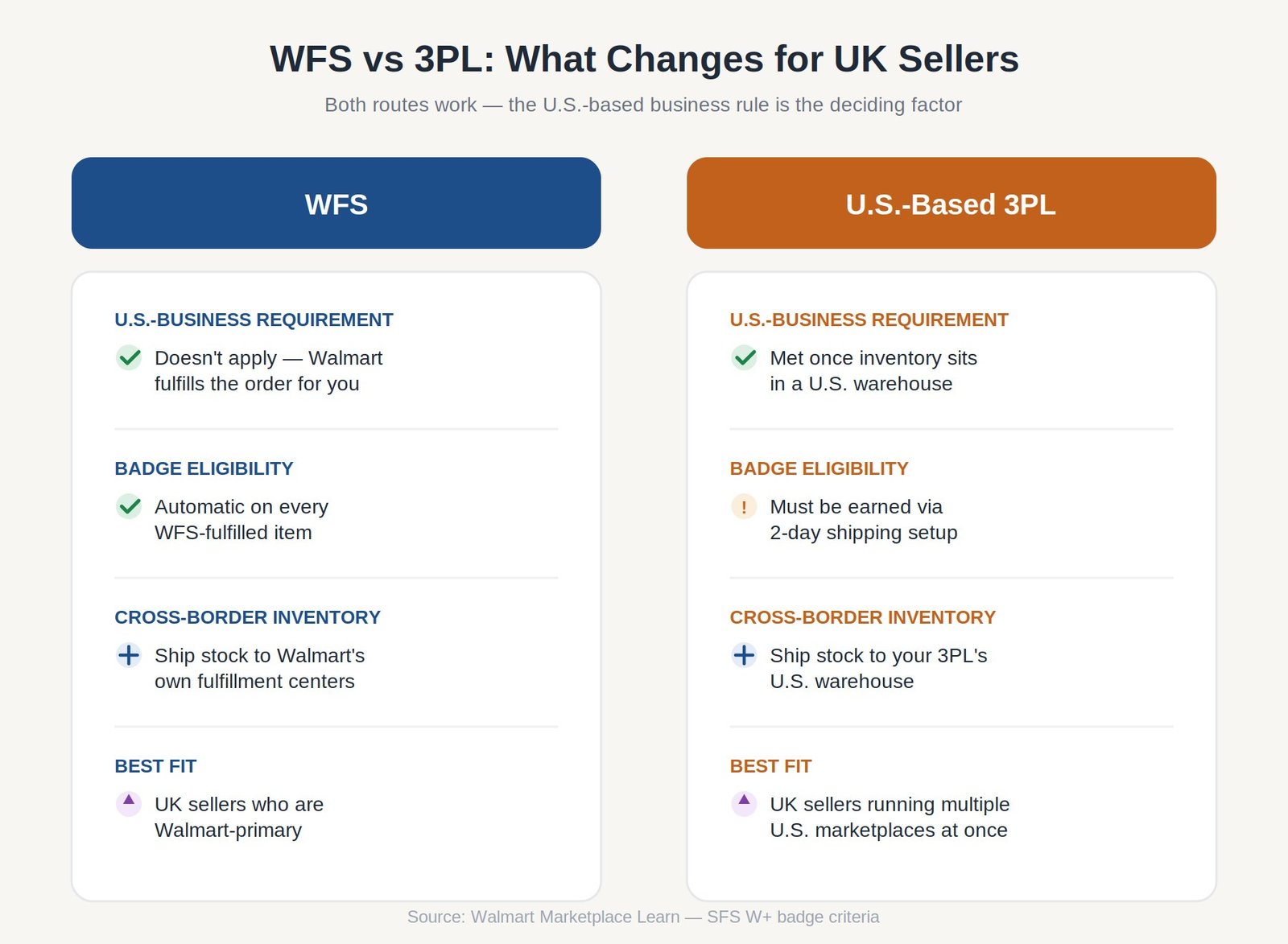
Mostly, with one important catch. Walmart's self-fulfilled badge program requires the seller's business to be U.S.-based, per the SFS W+ badge criteria. That means a UK-based seller can't qualify for the self-fulfilled badge by shipping directly from the UK, no matter how fast the delivery is.
The workaround is the same one that solves the inventory problem: route fulfillment through a U.S.-based 3PL, or use WFS, which has no such restriction since Walmart itself is the one fulfilling the order. Here's how the two options actually compare for a UK seller specifically:
If you're still working through the broader account and shipping setup as a UK seller, our guide to Walmart Marketplace for UK sellers walks through the account and tax requirements this fulfillment decision sits on top of.
So Which Fulfillment Path Actually Pays for Itself Faster?
For most sellers who don't hold their own inventory, the honest answer is: start with WFS for your highest-volume SKUs to capture the automatic badge and the 50% average GMV lift that comes with it, then layer in a 3PL for anything multi-channel or brand-sensitive once volume justifies the extra setup. The mistake to avoid is guessing, check your actual OTD and cancellation numbers in Seller Center before committing to either path, because neither WFS nor a 3PL will save a badge that your current shipping speed can't support.
If you want to test this without committing to a full subscription, TS Scout's product research and demand tools, including Walmart Watch, are available on a $1, 14-day full-access trial, so you can validate demand before you commit inventory dollars to either fulfillment method.
FAQ
-
Can I use a 3PL and still qualify for the Walmart+ badge?
Yes. The badge isn't tied to who fulfills the order, it's tied to hitting 2-day shipping, 90%+ On-Time Delivery, and under 2.5% cancellations. A 3PL that meets those speeds qualifies the same as fulfilling it yourself.
-
Do I need to hold inventory to use WFS?
You send inventory to Walmart's fulfillment centers rather than storing it yourself, so you're not holding stock in a personal warehouse, but you do need to own the inventory and ship it to Walmart before it can sell.
-
What happens if my On-Time Delivery rate drops below 90%?
The badge is removed from affected listings until your rolling 30-day performance meets the threshold again, which can mean a real drop in search visibility during the time it takes to recover.
-
Is WFS or a 3PL cheaper for a low-weight item?
For items under 3 lb, WFS's published base fees ($3.45–$5.45) are often competitive with or below typical 3PL per-order rates, but 3PL pricing varies enough by provider that it's worth getting an itemized quote before assuming either is cheaper.
-
Can UK sellers earn the self-fulfilled Walmart+ badge by shipping from the UK?
No, the self-fulfilled badge requires a U.S.-based business. UK sellers need to fulfill through a U.S. 3PL or use WFS to qualify.
like?


Table of Contents
- What Does It Actually Take to Earn Walmart's Free-Shipping Badge in 2026?
- Can You Earn the Badge Without Holding Any Inventory Yourself?
- How Much Does Each Fulfillment Method Really Cost in 2026?
- Which Fulfillment Method Actually Fits Your Business?
- What Performance Standards Do You Need to Maintain After You Qualify?
- Does This Work the Same Way for UK and International Sellers?
- So Which Fulfillment Path Actually Pays for Itself Faster?
- FAQ