

How to Spot a Reliable Amazon Seller in 2026 (Before You Regret the Order)?
- 2025-03-15
-
 0
0
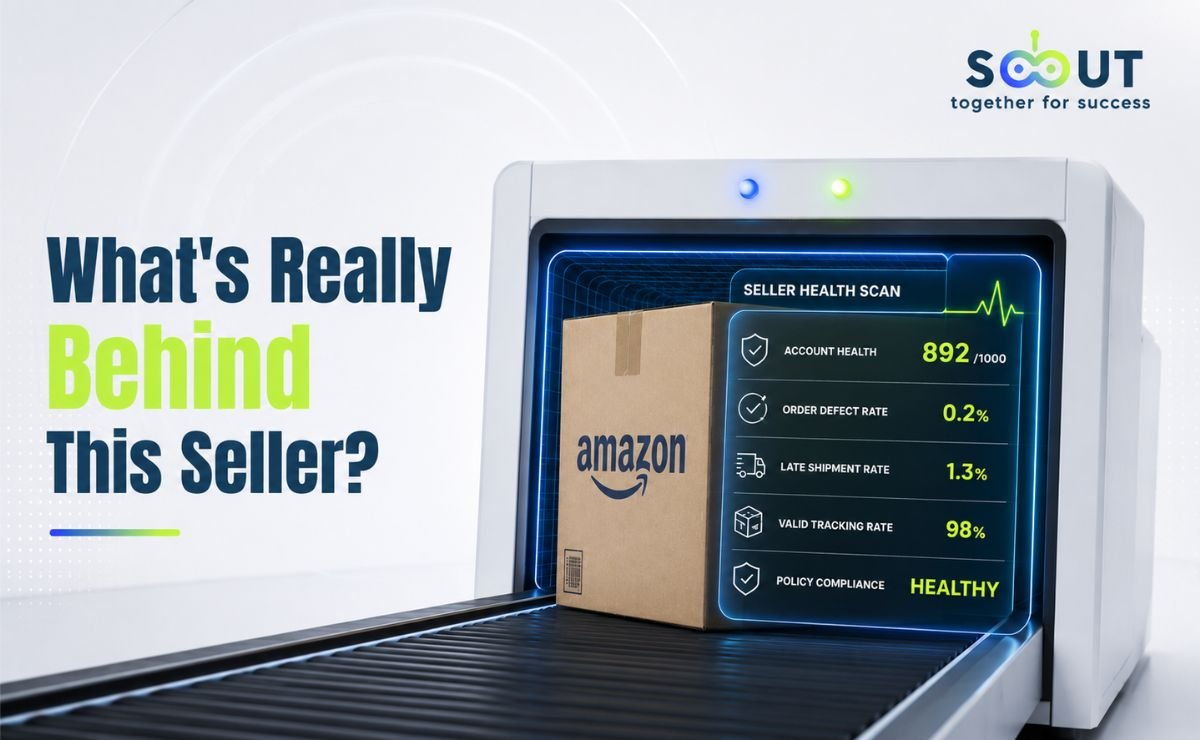
Most UK and US sellers who source and fulfill without holding their own inventory learn the hard way that a supplier's star rating tells them almost nothing about whether that seller will actually protect their account health. Amazon doesn't score sellers' trust the way most articles online describe it, and a lot of that confusion comes from mixing up Amazon's rules with a completely different platform's system. If you've ever wondered why a supplier with great reviews still got suspended mid-season, or why "Amazon's Choice" didn't guarantee a reliable shipment, the answer sits inside a scoring system most sellers never open until something goes wrong.
This guide breaks down what Amazon actually tracks behind the scenes to judge a seller's standing, the real framework, the practical benchmarks sellers keep an eye on, and the warning signs that matter most when your own storefront's reputation depends on someone else's fulfillment. By the end, you'll know how to check a seller's actual standing in under two minutes, not guess from stars alone. Let's start by clearing up the biggest myth first.
Why "Top Rated" Won't Tell You Who to Trust on Amazon
Amazon does not have a seller-facing badge called "Top Rated." That system belongs to eBay, and the confusion between the two platforms is one of the most common (and most damaging) mix-ups in seller-research content. Amazon's actual trust system runs on a completely different mechanism: a numerical score called the Account Health Rating, tracked continuously in Amazon Seller Central. This score, not a badge, not a title, is what determines whether a seller stays active, gets restricted, or loses their account entirely. Understanding it is the actual shortcut to judging reliability.
What Is Amazon's Account Health Rating, and What Does It Score?
The Account Health Rating (AHR) is a live score from 0 to 1,000 that reflects a seller's compliance and performance over a rolling window. Every new seller starts at 200, and the score moves up or down based on real activity, not manual reviews or customer votes.
|
AHR Range |
Status |
What It Means |
|
200–1,000 |
Healthy |
Account in good standing |
|
100–199 |
At Risk |
Needs immediate attention |
|
0–99 |
Unhealthy |
Eligible for deactivation |
Three categories feed this score: customer service performance, shipping performance, and policy compliance. A seller can look strong on two of these and still be one weak category away from real risk, which is why the next metric matters so much.
Why Does Order Defect Rate Decide Whether a Seller Can Be Trusted?
Order Defect Rate (ODR) is the metric that carries the most weight inside a seller's Customer Service Performance pillar. It combines three signals into one number:
-
Negative feedback (1 or 2-star ratings only, a 3-star rating is neutral and doesn't count)
-
A-to-z Guarantee claims filed against the seller, whether granted or not
-
Credit card chargebacks
Sellers generally treat keeping ODR under roughly 1% as the safe zone, since crossing that line is widely understood to trigger warnings or restrictions. It's also worth factoring in a prevailing belief in seller communities: that star-only ratings with no written comment may now count toward ODR the same way a written negative review does, with less room to dispute them than in past years. It hasn't been something we could confirm against an authoritative source, but it's a reasonable thing to plan around rather than assume away. For a UK or US seller who relies on outside fulfillment rather than holding stock themselves, this metric matters more than it might for a traditional retailer, a supplier's shipping delay or quality issue shows up as your defect, not just theirs.
Which Other Metrics Separate Reliable Sellers From Risky Ones?
Beyond ODR, three shipping-related metrics round out the picture, and they're just as revealing. The specific numbers below reflect benchmarks sellers commonly aim to stay within, rather than figures pulled from a single official table:
|
Metric |
Typical Benchmark |
What It Signals |
|
Late Shipment Rate |
Sellers generally aim to stay under 4% |
Fulfillment speed and reliability |
|
Pre-fulfillment Cancellation Rate |
Commonly kept under 2.5% |
Inventory accuracy |
|
Valid Tracking Rate |
Usually kept above 95% |
Shipment transparency |
|
On-Time Delivery Rate |
Widely targeted at 90%+ |
Consistent delivery promise |
A seller who's clean on ODR but sloppy here is still a risk, late, untracked, or cancelled orders erode trust just as fast as bad reviews do. For sellers who don't hold their own stock, these four metrics are effectively a proxy for a supplier's reliability, since fulfillment speed and accuracy sit largely outside your direct control, checking them before committing to a sourcing relationship matters as much as checking the product itself. This is exactly where product-level research pays off before account-level research even starts: TS Scout's Amazon Scanner tracks trending and high-demand products over time, so before you commit to a seller or a listing, you can see whether the demand around it is real and sustained rather than a short-lived spike, a useful first filter before you ever open a seller's health dashboard. Sellers building a long-term storefront rather than chasing one-off sales tend to treat all four metrics above as a single dashboard to check weekly, the same discipline that matters if you're working to build an ecommerce brand around your Amazon presence rather than a single listing.
Is Amazon's Choice Proof That a Seller Is Reliable?
Not on its own. Amazon's Choice is awarded at the product-and-search-term level, not the seller-account level, it reflects an algorithm matching a specific search query to a specific listing, factoring in rating, availability, and price. A seller cannot apply for it, and it can change per search term without reflecting anything about that seller's actual account standing. A product can carry the badge while the seller behind it sits in "At Risk" territory. If reliability is the question, Account Health Rating is the answer, Amazon's Choice answers a different one entirely.
How Can You Check a Seller's Real Health Score Before You Buy or Partner With Them?
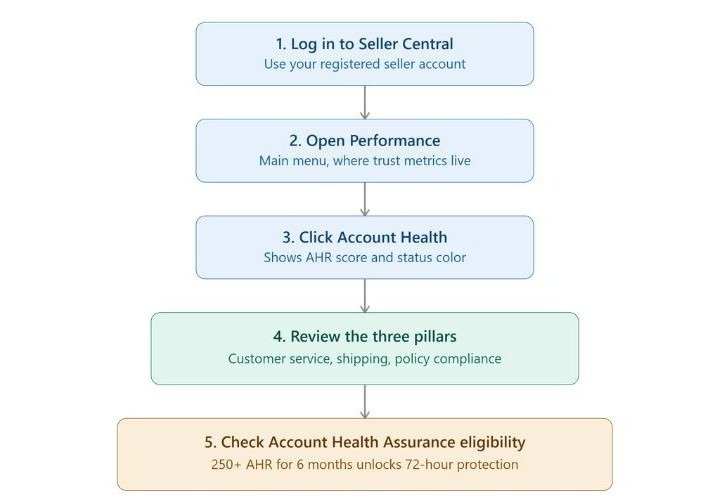
For sellers auditing their own account, or brands vetting a manufacturing/fulfillment partner who sells on Amazon, the check takes under two minutes:
-
Log in to Amazon Seller Central.
-
Open the Performance tab from the main menu.
-
Click Account Health to see the current AHR score and status color.
-
Review the three pillars individually, a healthy overall score can still hide one weak category.
-
Check whether the account has sustained a strong score long enough to be considered a low-risk, established seller rather than a newer or borderline one.
On that last point: sellers who maintain a consistently strong AHR over an extended stretch are generally understood to earn some additional protection or grace period before facing deactivation action, treat this as a reasonable signal of a proven track record rather than a one-off good month, even though the exact qualifying threshold isn't something we could pin to a source we'd stand behind. For UK-based sellers working with US-based suppliers (or the reverse), it's worth checking this dashboard against both Amazon.com and Amazon.co.uk listings separately if the seller operates on both, account health can differ by marketplace even under the same seller name.
What Red Flags Signal a Seller's Account Health Is Slipping?
Watch for these concrete signs rather than vague "bad vibes" cues:
-
AHR sitting in the 100–199 "At Risk" band
-
Listings suddenly suppressed with no clear reason given
-
ODR trending upward over consecutive weeks, even if still within the seller's usual safe range
-
Unresolved policy violations sitting for more than a few days
-
No sign of a sustained strong track record despite months of activity
Any one of these alone isn't fatal. Two or more together, especially rising ODR plus an At Risk status, is the combination that actually predicts trouble.
So Which Signal Should You Actually Trust Before You Hit Buy?
Star ratings and Amazon's Choice badges are surface-level, and even less reliable when your own account's standing depends on a supplier's fulfillment rather than your own warehouse. The real answer sits in Account Health Rating, Order Defect Rate, and the shipping metrics behind them, and now you know exactly where to look and what the numbers mean. Start your $1, 14-day full-access trial with TS Scout to track seller and product reliability signals in one place.
FAQ
-
What is a good Order Defect Rate on Amazon?
Sellers generally treat anything meaningfully under 1% as safe, with well-run accounts often sitting far below that line.
-
Can a seller apply for Amazon's Choice?
No. It's assigned algorithmically per product and search term, and sellers cannot request or purchase it.
-
What happens when an Amazon account becomes "At Risk"?
The account's AHR has dropped to the 100–199 range, meaning it needs corrective action to avoid moving into deactivation-eligible territory.
-
How often does Account Health Rating update?
It updates continuously based on ongoing order activity, feedback, and policy compliance, not on a fixed monthly or quarterly schedule.
-
Does a long track record protect a seller from sudden deactivation?
A sustained, healthy history is generally seen as protective, though the exact mechanics of any formal grace period are best confirmed directly in a seller's own Seller Central account.
like?


Table of Contents
- Why "Top Rated" Won't Tell You Who to Trust on Amazon
- What Is Amazon's Account Health Rating, and What Does It Score?
- Why Does Order Defect Rate Decide Whether a Seller Can Be Trusted?
- Which Other Metrics Separate Reliable Sellers From Risky Ones?
- Is Amazon's Choice Proof That a Seller Is Reliable?
- How Can You Check a Seller's Real Health Score Before You Buy or Partner With Them?
- What Red Flags Signal a Seller's Account Health Is Slipping?
- So Which Signal Should You Actually Trust Before You Hit Buy?
- FAQ