
AliExpress Shipping to Saudi Arabia and the UAE in 2026: Can You Dropship There?
- 2026-10-01
-
 0
0

A customer in Riyadh pays you on the 1st and is still asking "where's my order?" on the 28th. That gap between what a listing promises and what the Gulf delivers is where most plans for AliExpress shipping to Saudi Arabia fall apart. In 2026 the gap widened, because Maersk says Gulf routings can still change at short notice, and WAM reports that Dubai raised its e-commerce duty exemption threshold in August. So the real question for anyone running dropshipping Dubai or Riyadh stores isn't "does AliExpress ship there?" It's "can I still make money once shipping time, customs, VAT and payment habits are priced in?"
This guide answers that with figures from official customs, tax, ministry and platform sources, and it labels our own calculations. You'll get the real delivery window, who pays what at the border, which products get seized, how Gulf shoppers pay, and which licences and taxes apply. The short version: dropshipping Middle East stores are viable, but only if you promise 21–42 days, show VAT-inclusive prices and stay off the banned list. One Saudi rule about delivery delays changes how you should write every product page, so we'll get to it right after a quick snapshot.
Does AliExpress Ship to Saudi Arabia and the UAE, and What Do Both Markets Regulate?
Yes. AliExpress shipping to Saudi Arabia and the UAE both work, and neither market bans the model itself. What they regulate is the store (licence, pricing, delivery promises) and the parcel (duty, VAT, permitted goods). Sellers running dropshipping Dubai stores and sellers targeting Riyadh can plan around the same delivery window (section 2.1). If you searched for "dropship Saudi Arabia AliExpress 2026", this table is the two-minute version.
|
Saudi Arabia |
UAE |
|
|
Realistic delivery to plan for |
21–42 days |
21–42 days |
|
Duty relief |
Under SAR 1,000 total, no permit from another authority needed, per ZATCA |
Up to AED 1,000 on eligible Dubai cross-border e-commerce shipments since 3 August 2026, per WAM |
|
VAT |
15%, per ZATCA's FAQ |
5%, per the UAE Ministry of Finance |
|
Store setup |
Commercial register or freelance certificate, plus Business Platform registration, per the Ministry of Commerce |
Trade licence; the eTrader route is limited to UAE and GCC nationals in Dubai, per the UAE Government portal |
Each row gets its own section below. We'll start with the one that hurts most: time.
How Long Does AliExpress Shipping to Saudi Arabia Really Take in 2026?
The promise on the listing and the reality of AliExpress shipping to Saudi Arabia are two different numbers.
What does the 3–6 week window actually contain?
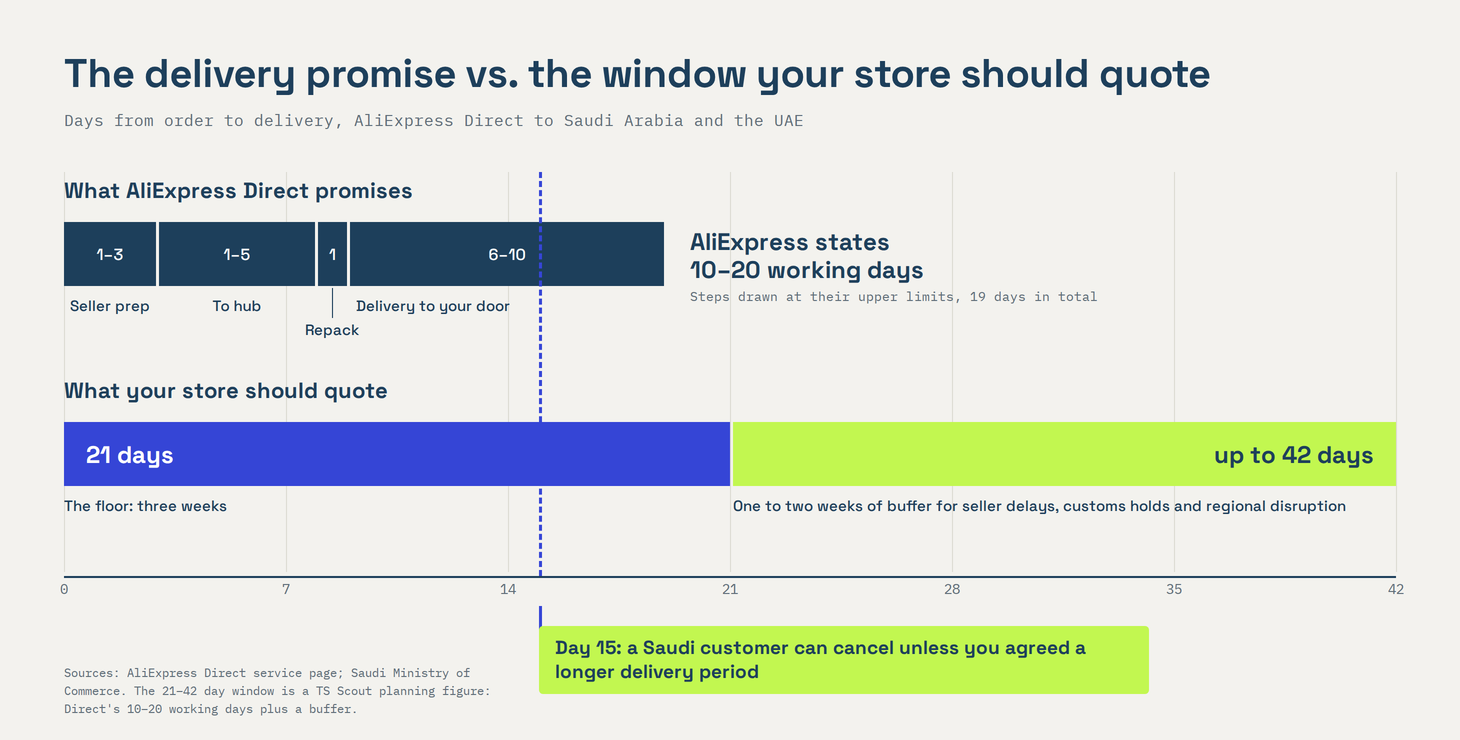
AliExpress publishes the journey for its Direct service to the UAE and Saudi Arabia. Sellers take 1–3 days to prepare the order and 1–5 days to send it to the AliExpress hub. Repacking takes 1 day, and delivery to your door takes 6–10 days, which AliExpress summarises as 10–20 working days, with tracking and two delivery attempts. Free Direct shipping needs a basket of at least US$40 in the UAE or US$50 in Saudi Arabia.
That's the good-day promise. Ten to twenty working days is roughly two to four weeks. Add one to two weeks of buffer for the things the promise doesn't cover, and you get 21–42 days. That window is TS Scout's planning figure, not an official one. Three things stretch the promise:
-
Seller delays. The two seller-side steps (preparation and the trip to the hub) are the most elastic part of the chain.
-
Customs holds. Thin paperwork or a missing permit stops a parcel at the border.
-
Regional disruption. More on this in 2.3.
How do AliExpress KSA shipping times compare with AliExpress shipping to Dubai?
|
Method |
Promised time |
What to know |
|
AliExpress Direct (KSA, UAE) |
10–20 working days |
One published window for both countries; free above US$50 (KSA) or US$40 (UAE); tracked; two delivery attempts |
|
AliExpress Standard and express couriers |
Shown per listing at checkout |
Quote from the estimate on each product page |
|
Global 5-Day (Cainiao) |
Marketed as 5 days |
Saudi Arabia was added on 19 March 2024, per the Hangzhou municipal government portal; availability depends on the item |
On the same method, AliExpress KSA shipping times and AliExpress shipping to Dubai run close together, because Direct publishes one window for both. For AliExpress shipping to Saudi Arabia, Direct is the only method with a published window. If even 21–42 days doesn't fit your customers, some sellers keep a second marketplace as a fallback, and AliExpress vs Temu lays out the trade-offs.
Is the 2026 Gulf disruption still affecting delivery times?
Yes, though less sharply than earlier in the year. Maersk said in its 9 September market update that the security situation tied to the Middle East has eased since earlier this year, but Gulf routings, fuel costs and airspace conditions can still change at short notice. Two carrier updates show what that looks like on the ground:
-
Customs: Expeditors said on 2 September that UAE customs systems are fully functional, but delays continue, particularly at Sharjah Customs. It described Saudi Arabia as operational with varying constraints.
-
Sea routing: Maersk's Middle East update of 9 September says cargo booked to the UAE transships via Salalah and Khor Fakkan, then moves by landbridge to Sharjah, while Saudi import cargo continues through Jeddah.
These are logistics operators' notices, not government sources, and they change often, so treat them as a mid-September snapshot. Your supplier chooses how each parcel travels, not you. Don't build your promise around a good month.
What delivery promise can your store make without losing orders?
This is the rule that matters most for AliExpress shipping to Saudi Arabia. The Saudi Ministry of Commerce has confirmed, as reported by Gulf Insider, that a customer can cancel an online order if the store delays delivery by more than 15 days, unless another delivery date was agreed. The customer can also get a refund unless the store had a strong reason for the delay. The E-Commerce Law also gives buyers a 7-day right to return an unused product, and requires an invoice that states the total price, delivery charges, delivery date and location, as described by Saudipedia, the Ministry of Media's national encyclopedia.
So a store that never states a delivery period is exposed after 15 days. The fix is contractual, not logistical:
-
Agree the window in writing. Show "Estimated delivery: 21–42 days" on the product page, cart, confirmation email and invoice, so it becomes the agreed period.
-
Calculate it, don't guess. Use the Direct window of 10–20 working days plus a one-to-two-week buffer.
-
Collect what customs needs. ZATCA says the declaration needs the importer's full name and civil ID number, without a copy of the ID card, so warn customers the courier may ask for them. Also collect a complete address and a working phone number, including the Saudi short address if the customer has one. That last part is practical advice, not an official requirement.
-
Send tracking on dispatch, plus a proactive message the moment a parcel stalls.
-
Escalate silent sellers fast. A stalled supplier is the classic scenario in AliExpress Supplier Unresponsive?, and it can burn your whole buffer in days.
Can you shorten the wait for your customers?
Sometimes, at the listing level. AliExpress shows estimates for its Standard and express couriers per listing at checkout, so compare them product by product, and check each listing's shipping details for where the item ships from. A listing that ships from inside the Gulf changes the maths. A local fulfillment partner is another route, at the cost of holding stock, which most non-stockholding sellers avoid. Global 5-Day (Cainiao) is listed as reaching Saudi Arabia, but availability depends on the item.
Treat a faster option as upside, not as your promise. Keep the 21–42 day window on the page even when a listing offers something quicker, because the 15-day cancellation right applies to whatever period you agreed. Confirm the real speed with your own test orders (section 9, week 3) before you tighten the wording.
What Are the Customs Rules for AliExpress Orders Entering Saudi Arabia?
Customs is where AliExpress shipping to Saudi Arabia gets expensive.
When is a Saudi parcel duty-free, and when does VAT apply?
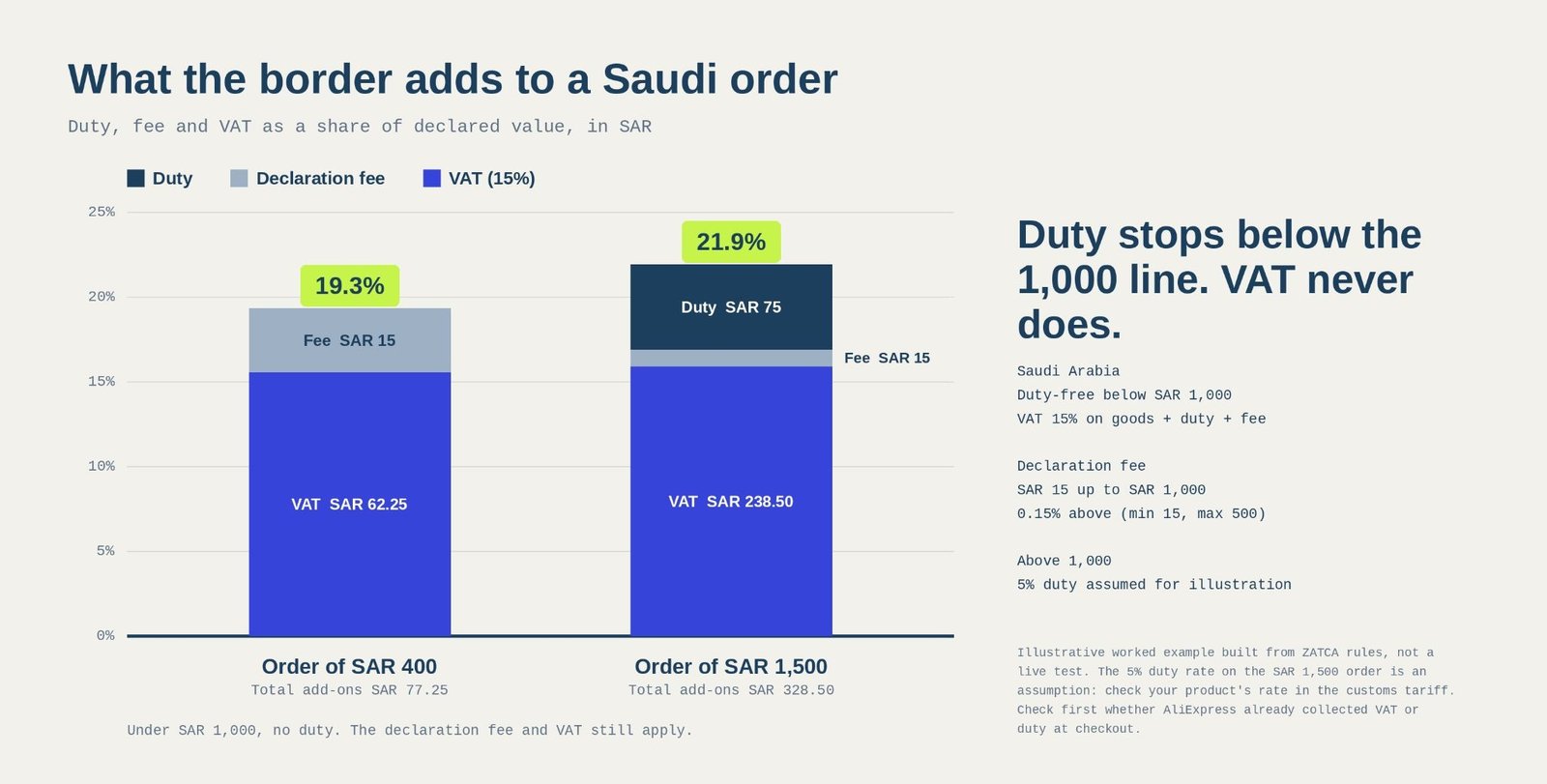
ZATCA says personal purchases from foreign e-stores are exempt from customs duty when the total value is less than SAR 1,000, calculated on goods, shipping costs and insurance, and no clearance permission from any party is required. VAT works differently: it isn't waived, and it applies to all amounts on the customs declaration, including customs duties and fees.
Fees also apply. ZATCA's fee rules set a SAR 15 declaration fee for individual shipments through online stores worth up to SAR 1,000. Above that, the fee is 0.15% of the value of incoming goods, including insurance and shipping, with a SAR 15 minimum and a SAR 500 maximum.
Before you rely on the tables below, check on your own test order whether AliExpress has already collected any VAT or duty at checkout for your chosen shipping method. The tables show what is left for the border.
What does that cost on a real order?
Duty, VAT and fees are worked out on the declared value of the parcel: goods, shipping and insurance. For a supplier order that is what you pay AliExpress, not what your customer pays you. Confirm the declared value with your courier before you price.
This is a worked example built from the official rules above, not a live test. It assumes a 5% duty rate on the SAR 1,500 order for illustration. Look up your product's actual rate in the customs tariff before you price.
|
Declared value (incl. shipping) |
Duty |
Declaration fee |
VAT (15%) |
Total add-ons |
Share of declared value |
|
SAR 400 |
0 |
15 |
62.25 |
77.25 |
19.3% |
|
SAR 1,500 |
75 |
15 |
238.50 |
328.50 |
21.9% |
Crossing SAR 1,000 ends the exemption for that order. Late add-ons are also what turn a sale into a refused parcel. It's the same feeling behind Your AliExpress Price Increases at Checkout, so show your customers the full total up front.
Which products lose the exemption?
Anything that needs another authority's clearance loses the SAR 1,000 exemption. Trade.gov, the U.S. government's export portal, lists pharmaceutical products, wireless equipment, radio-controlled model airplanes and products containing alcohol, such as perfume, among the imports that need special approval from Saudi authorities. ZATCA also says a shipment with completed documents doesn't wait at the port, so delays trace back to paperwork and permits.
4. What Are the Customs Rules UAE Dropshipping Stores Must Follow in Dubai and Abu Dhabi?
What duty and VAT do UAE parcels pay?
The UAE Government portal puts customs duty at 5% of the value of goods plus cost, freight and insurance (CIF), with 50% for alcohol and 100% for cigarettes. VAT is 5%, per the Ministry of Finance. The customs rules UAE dropshipping stores must follow look simpler than Saudi Arabia's on paper. The complication is that customs are run by each emirate, and Dubai Customs and Abu Dhabi Customs publish their own lists of prohibited and restricted goods (section 5). Parcels for dropshipping Dubai stores look cheaper at the border, but Dubai's own list still decides what clears.
What changed in Dubai in August 2026?
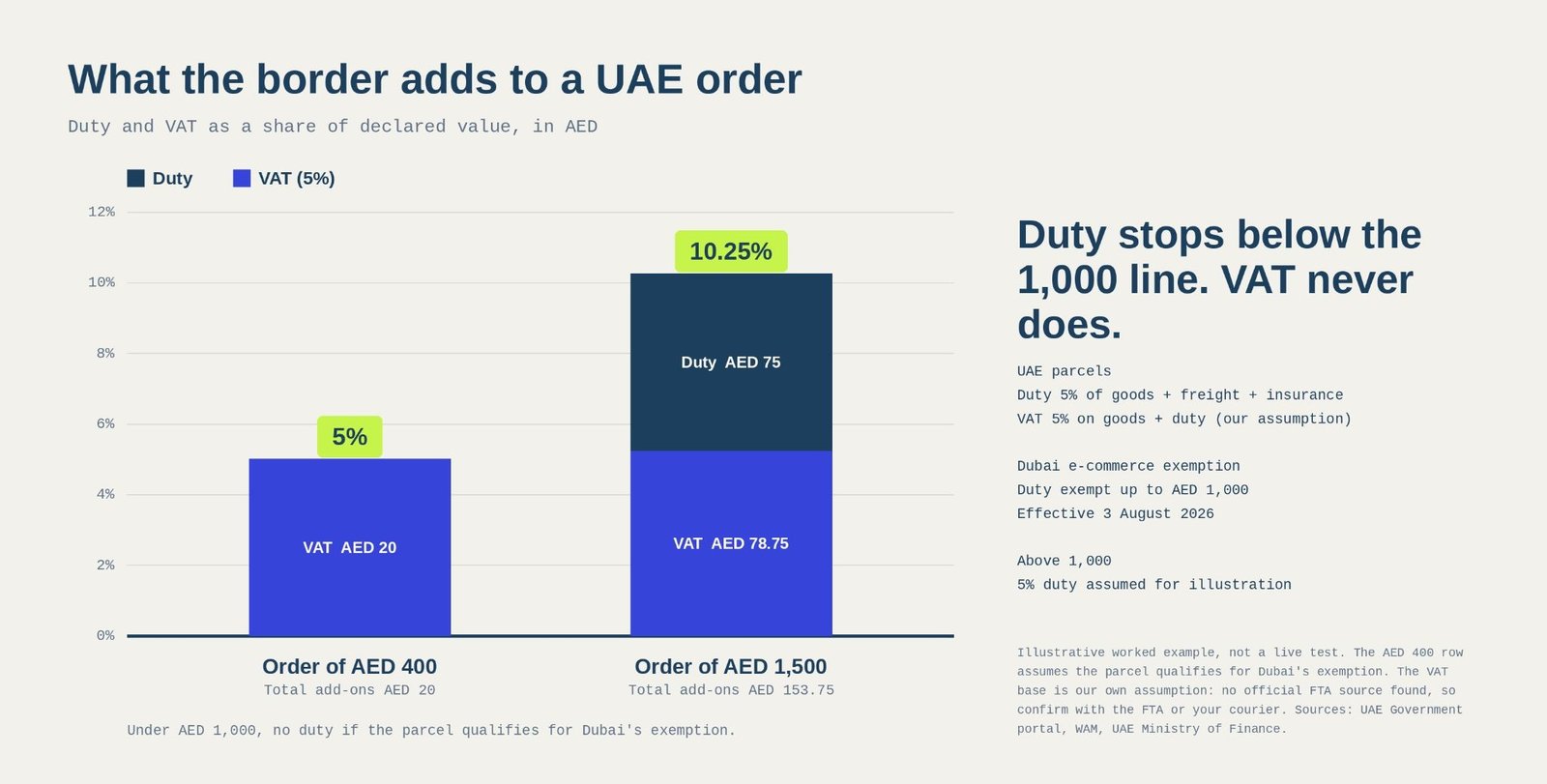
Older guides may quote different Dubai thresholds, so check the date on anything you read. WAM, the Emirates News Agency, reports that Dubai Customs raised the duty exemption threshold for eligible goods in cross-border e-commerce shipments to AED 1,000, effective 3 August 2026. Not every product or shipment qualifies, so check the exclusions and eligibility conditions in Dubai Customs' own notice before you rely on the exemption. For dropshipping Dubai parcels, ask your courier or fulfilment partner whether their Dubai e-commerce set-up covers your shipments. The announcement concerns customs duty only, and VAT stays a separate 5% tax. The change helps stores that sell low-ticket products.
Same worked example, UAE version. It is illustrative: it assumes 5% duty on the AED 1,500 order and, as our own assumption, calculates VAT on goods plus duty. We found no official FTA source for the VAT base on e-commerce parcels, so confirm it with the FTA or your courier before you price. The AED 400 row assumes the parcel qualifies for Dubai's exemption.
|
Declared value |
Duty |
VAT (5%) |
Total add-ons |
Share of declared value |
|
AED 400 |
0 |
20 |
20 |
5% |
|
AED 1,500 |
75 |
78.75 |
153.75 |
10.25% |
Which Banned Products Saudi Arabia and the UAE Enforce Can Get Your Parcels Seized?
Not every product qualifies for AliExpress shipping to Saudi Arabia. The banned products Saudi Arabia enforces on parcels come from Saudi Post and ZATCA. One caution: the ZATCA list used below is its list of prohibited items for travellers, not for parcels, so the Saudi Post, ZATCA FAQ and Trade.gov rows are the closest guide for what you ship. In the UAE, each emirate's customs department publishes its own list. Lists change, so check the current version before you list a product. A seized parcel means a lost sale, a refund and an angry customer, all on your side of the ledger.
|
Product type |
Saudi Arabia |
UAE |
|
E-cigarettes, vapes, e-liquids |
Listed as prohibited by Saudi Post |
Restricted category; needs approval from the competent authority, per Dubai Customs |
|
Medicines, supplements, beauty tools |
Saudi Post lists prescription and non-prescription medicines, food supplements and beauty tools; ZATCA's traveller list bars pills, creams, herbs and lotions not registered with the Food and Drug Administration |
Restricted; Ministry of Health and Prevention approval for medications, and Dubai Municipality checks for foodstuffs, personal care and cosmetics (Dubai Customs) |
|
Weapons and ammunition |
Prohibited per ZATCA's traveller list and Trade.gov |
Restricted category; approval from the competent authority, such as the Ministry of Defence or Ministry of Interior (Dubai Customs) |
|
Pens, watches or glasses with hidden cameras; eavesdropping devices |
ZATCA's traveller list bars items containing a secret camera, such as watches, pens, glasses and airplanes, and eavesdropping devices of all shapes |
Check the emirate's current list; transmitters and radio equipment need Telecommunications Regulatory Authority approval (Dubai Customs) |
|
Laser pens |
ZATCA allows travellers one red laser pen up to 5 milliwatts, so treat other lasers as high risk |
Abu Dhabi Customs lists laser pens emitting red light beams |
|
Drones, wireless and radio-controlled equipment |
ZATCA's FAQ says all remote-control aircraft are restricted goods that need clearance from the General Authority of Civil Aviation; Trade.gov lists wireless equipment as needing special approval |
Transmitters and radio equipment need Telecommunications Regulatory Authority approval (Dubai Customs); check the emirate's list for drones |
|
Electric-shock devices, speed radar detectors |
On ZATCA's traveller list |
Check the emirate's current list |
|
Items against Islamic values or public morals |
ZATCA's traveller list bars discs and storage devices with immoral material and sexual tools and devices; Trade.gov lists pornographic materials as prohibited |
Prohibited: items that contradict Islamic faith and public morals, and gambling tools (Dubai Customs) |
|
Alcohol and alcohol-containing products such as perfume |
Alcohol prohibited; perfume needs special approval (Trade.gov) |
Restricted category; Dubai Police is among the controlling authorities for alcoholic drinks (Dubai Customs) |
Abu Dhabi Customs' list isn't identical to Dubai Customs'. The emirate that receives the parcel decides which list applies, so check the emirate your parcels enter through. Use this three-question filter before you add any product:
-
Does it contain nicotine, alcohol, medicine, or anything ingestible?
-
Does it look like a weapon, project a laser, hide a camera, fly, or transmit wirelessly?
-
Does its design or imagery touch religion, gambling or adult themes?
A "yes" to any of them means get the permit or skip the product.
One more Saudi check for consumer electronics and similar goods: product conformity runs through SASO and its SABER platform, which Saudipedia's SABER page describes as the platform for registering conformity certificates for consumer products, imported or locally produced, before they enter the Saudi market. We haven't confirmed how SABER applies to individual e-commerce parcels, so ask SASO or a licensed adviser before you sell regulated consumer products.
Which Payment Methods Do Gulf Customers Expect?
Gulf shoppers pay digitally, and dropshipping Dubai customers are no exception. The Saudi Central Bank (SAMA) reported that electronic payments made up 85% of retail payments in 2025, up from 79% in 2024, and credited growth in mada transactions across point-of-sale and e-commerce payments. That figure covers all Saudi retail, not just online, but it shows why a checkout without local methods feels incomplete.
In practice, that means offering mada to Saudi customers next to international cards. For the UAE, plan around international cards through your gateway. Whether you add wallets or instalment options such as Apple Pay, STC Pay, Tabby or Tamara depends on what your payment gateway supports, so check its documentation before you commit.
Two practical notes:
-
How you pay vs. how your customer pays. You pay AliExpress with your own card. Your customer pays you with local methods, so your gateway decides what you can offer.
-
COD moves the risk to you. A refused parcel means return shipping or a write-off. If you offer cash on delivery, treat it as a switch you turn on deliberately, and confirm each order by phone or WhatsApp first.
What Licences and Taxes Apply to Selling Into Saudi Arabia and the UAE?
Is dropshipping legal in Saudi Arabia, and what does the store need?
Saudi rules attach to the store, not to the sourcing model. We found nothing in the official sources that bans selling goods you buy from a supplier per order, but the E-Commerce Law sets duties for every online store. The Ministry of Commerce says violators face penalties starting with a warning, then fines of up to SAR 1,000,000, temporary or permanent suspension of e-commerce activity, and partial or total blocking of the store, per its 2019 statement.
-
Register the store on the right platform. The Ministry of Commerce asked e-store owners to register through the Business Platform run by the Saudi Business Center instead of Maroof. It requires a commercial register or a valid freelance certificate and an active bank account. Check the Ministry's current registration page before you file.
-
Show the required store details. Saudipedia lists the store's name, address and contact details, plus terms such as the total price including delivery fees and taxes, warranty details and the delivery schedule, among the disclosures required before the contract.
-
VAT registration. ZATCA sets a mandatory VAT registration threshold for businesses established in Saudi Arabia. Don't assume it protects a non-resident seller, and ask ZATCA or a licensed adviser before you sell.
-
Your own legal set-up. The parcel in a typical AliExpress order is addressed to the consumer, but the store's own structure is still yours to check, so confirm it with a licensed adviser before launch.
Is dropshipping UAE legal, and which taxes apply?
Yes, with a licence: dropshipping Dubai starts with a trade licence from Dubai's economy department (DET). Its eTrader licence, described on the UAE Government portal, allows UAE nationals and GCC nationals residing in Dubai to trade through social media networks. It is registered under a single owner and doesn't allow a shop or visas. Eligibility can change, so confirm your position with DET before you apply. Founders who don't qualify should look at a company licence, mainland or free zone, and ask a licensed adviser which fits.
Then the tax side:
-
VAT registration. The Federal Tax Authority (FTA) sets the mandatory threshold for UAE-resident businesses at AED 375,000 in taxable supplies and imports, with voluntary registration from AED 187,500. For non-resident businesses, it says registration is mandatory if they make taxable supplies in the UAE, even below the threshold, unless another party in the UAE is responsible for settling the VAT.
-
Corporate tax. It's 0% on taxable income up to AED 375,000 and 9% above that, per the Ministry of Finance's corporate tax page.
-
VAT-inclusive prices. Show VAT-inclusive prices so the total at checkout matches what the customer expects to pay.
What happens when a customer returns or disputes an order?
Your customer's contract is with your store, not with AliExpress. In Saudi Arabia that means the 15-day delay cancellation right from section 2.4 applies to you. So does the 7-day return right for unused products, which Saudipedia describes with exceptions for items such as newspapers and magazines, software downloaded online, CDs and DVDs, and products made to a consumer's specifications, and it also excludes transport and catering services. Write your return terms so the 7 days count from delivery, which is the safer reading for a 3–6 week parcel, and confirm the wording with a licensed adviser.
Shipping a parcel from Saudi Arabia back to China is rarely practical, so decide before launch when you will refund without a return, and write it into your return terms. Check what AliExpress Buyer Protection covers on your own supplier order, including its refund conditions for orders that don't arrive, before you rely on it. It protects your supplier order, not your customer's rights.
Whichever market you sell into, publish clear return terms and honest delivery windows.
Can you sell into the Gulf if you're based in the UK or US?
Possibly, but the rules above were written with local entities in mind, and plans for dropshipping Middle East stores run from the UK or US start with this question. Here is what changes for an overseas seller:
-
Saudi Arabia: store registration asks for a commercial register or freelance certificate, and non-resident VAT is not covered by the threshold that applies to businesses established in the Kingdom.
-
UAE: the eTrader route is closed to most foreign founders, and the FTA treats non-resident businesses differently for VAT.
-
Both: we found no single official page that answers this for an overseas seller, and whether your parcels count as supplies made in the Gulf depends on your set-up. Get written advice for each market before you launch.
How Do You Choose AliExpress Products That Survive Gulf Shipping and Customs?
Which checks should every product pass?
Every risk above is a product-level risk, so build a filter and run it before you spend on ads:
-
Ban check. Run the item against the section 5 table, including the banned products Saudi Arabia enforces.
-
Speed check. Prefer listings that offer AliExpress Direct or faster options to your target country, especially for AliExpress shipping to Saudi Arabia, and note where each listing ships from.
-
Duty-line check. Keep the declared order value (with shipping) under SAR 1,000 or AED 1,000.
-
Margin check. Subtract VAT and fees using the tables in sections 3 and 4 (worked example in 8.3).
-
Supplier check. Look for real volume, ratings and consistency. The AliExpress Product Sourcing Guide walks through how to vet a supplier.
Which tools speed up the shortlist?
TS Scout's AliExpress tools map onto the shortlist steps:
-
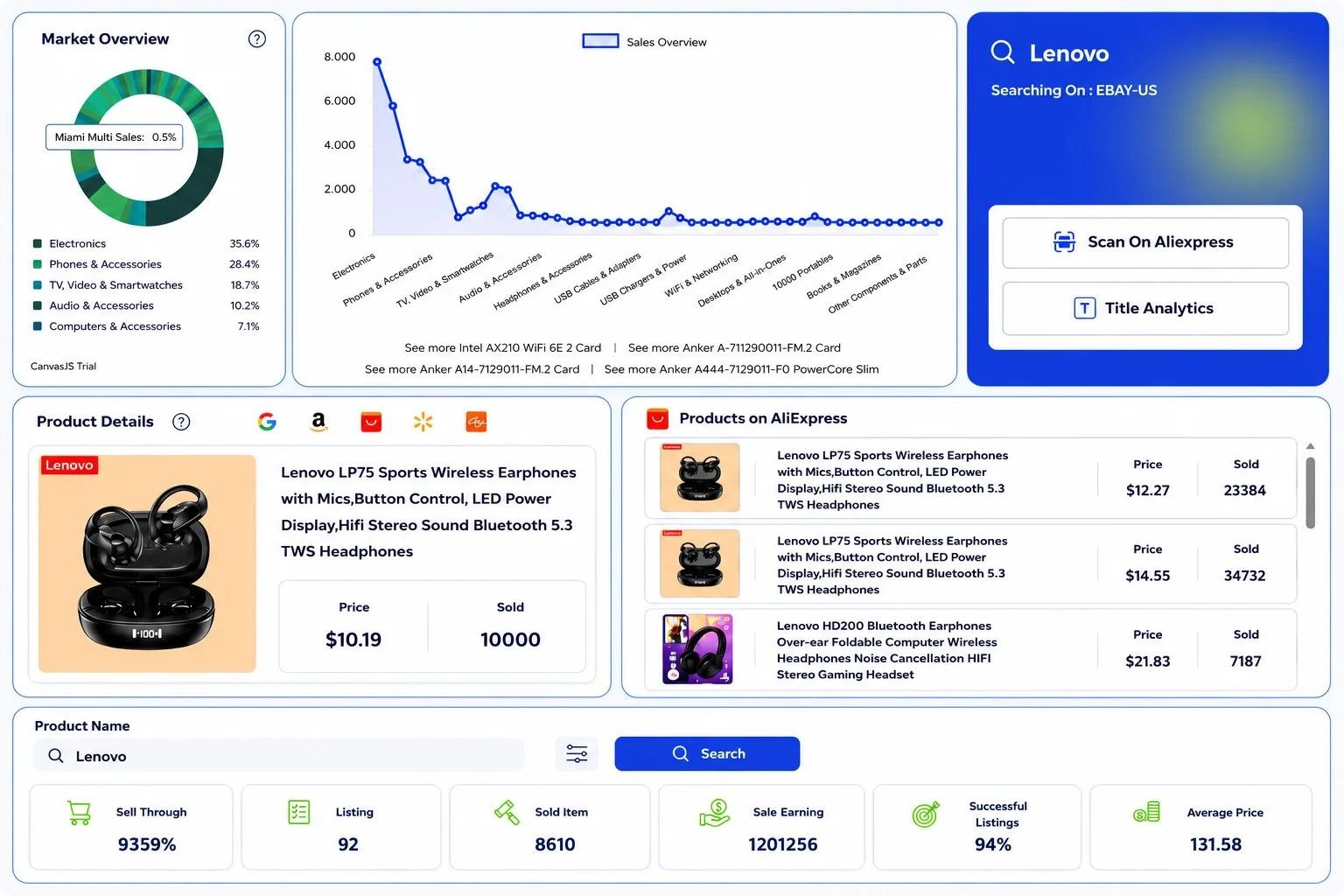
Express Scanner scans AliExpress to surface trending and top-performing products with strong demand and consistent sales activity, so your shortlist starts with items that already move.
-
Product Research lets you search AliExpress by product name and refine results by price, category, and sales performance. It returns detailed product-level data, which makes it the tool for deeper research once you have candidates.
-
Source Finder analyzes any AliExpress store from its shop URL. You get a full report with product listings, prices, ratings, and total units sold, so you can judge a seller's performance and spot strong product opportunities based on real data.
-
Match Image starts from any product image on the web. Right-click the image, copy its URL, paste it into the search box, and click search to get all the information about that image, including matching AliExpress listings. That lets you compare suppliers instead of accepting the first listing.
The three tools together answer "which product, from which seller, is worth testing?" If you're matching a competitor's photo, What AliExpress Reverse Image Search Actually Tells You explains why an image match is only the first filter.
What does the margin check look like on a real order?
This is an illustrative calculation, not a live test. It assumes you sell at 400 (SAR or AED) including shipping, pay your supplier 160 in the same currency including shipping, and that the declared value equals that supplier cost. It applies the border rules from sections 3.2 and 4.2 and assumes the UAE parcel qualifies for Dubai's exemption. It ignores ad spend, payment-gateway fees and refunds, which you must subtract too.
|
Saudi Arabia (SAR) |
UAE (AED) |
|
|
Selling price |
400 |
400 |
|
Supplier cost (declared value) |
160 |
160 |
|
Border add-ons |
41.25 (15 fee + 26.25 VAT) |
8 (VAT) |
|
Margin before ads and fees |
198.75 (49.7%) |
232 (58%) |
The same product leaves a wider margin in the UAE because VAT is lower and Dubai's exemption removes duty. If your UAE parcel doesn't qualify, add 5% duty (8) and VAT on the higher base (8.40), which leaves a margin of 223.60 (55.9%). If you are VAT-registered, import VAT may be recoverable as input tax, so ask an accountant before you treat it as a pure cost. If you'd rather pass the add-ons on, show them to the customer as a VAT-inclusive total before payment.
What Should Your First 30 Days Look Like?
Searching "dropship Saudi Arabia AliExpress 2026" ends with a product list, not a plan, so here is one.
|
Week |
Actions |
Output |
|
1. Legal and pricing |
Pick the licence path, draft the delivery policy (21–42 days, 7-day returns), run the banned-product check |
Registered or planned entity, policy page |
|
2. Shortlist |
Express Scanner surfaces candidates, Express Finder and Source Finder match products and compare sellers; A Smarter Approach to Product Research covers the method |
3 candidate products |
|
3. Test orders |
Order to a Riyadh and a Dubai address; log every date, every charge, and whether AliExpress collected any VAT or duty at checkout |
A real timeline and landed cost |
|
4. Soft launch |
Enable mada and international cards, limit COD, show VAT-inclusive prices |
Live store, first 10 orders |
Week 3 is your own AliExpress shipping to Saudi Arabia case study, and your own dropshipping Dubai test order, using your products and your couriers.
Which Product Will Be Your First Safe Bet in the Gulf?
The Gulf isn't closed to orders from AliExpress. It's closed to guesswork. Promise 21–42 days, because Saudi customers can cancel after 15 days unless you agreed otherwise. Price in VAT and duty around the SAR/AED 1,000 line, and keep products off the restricted lists. Do that and you compete on selection instead of surviving on luck.
Finding that first product is the fastest way to test all of it. Start your $1 trial (14 days, full access) with TS Scout and put your first shortlist through the checks above before you spend on ads.
FAQs
-
Does AliExpress shipping to Saudi Arabia and the UAE work in 2026?
Yes. AliExpress Direct promises 10–20 working days for both, but plan on 21–42 days to cover seller delays, customs and regional disruption.
-
Do I pay customs duty on AliExpress orders in Saudi Arabia?
Not if the total, including shipping and insurance, is less than SAR 1,000 and no permit is required. VAT applies regardless of value.
-
Is there VAT on AliExpress orders to the UAE?
Yes, 5%. Dubai's AED 1,000 duty exemption from August 2026 covers customs duty only, not VAT.
-
Is dropshipping UAE legal, and do I need a trade licence?
Yes, with a licence. The eTrader route is limited to UAE and GCC nationals residing in Dubai, so other founders should look at a company licence.
-
Is dropshipping legal in Saudi Arabia?
We found nothing in the official sources that bans the model itself. The E-Commerce Law regulates the store: registration, disclosures, delivery and return rights. Confirm your structure with a licensed adviser.
-
Can I offer cash on delivery?
You can, but a refused parcel is your cost. Start with a limited set of products and confirm each order before dispatch.
-
What are the banned products Saudi Arabia enforces on AliExpress orders?
E-cigarettes, weapons, hidden-camera items and immoral material are prohibited, and medicines, supplements, beauty tools, drones and wireless equipment are barred or need approvals. See the section 5 table.
-
Can a customer cancel if delivery takes longer than promised?
In Saudi Arabia, yes: the Ministry of Commerce says customers can cancel after 15 days unless another delivery date was agreed. State your 21–42 day window before payment.
-
Why is my order stuck in customs?
ZATCA says a shipment with complete documents doesn't wait at the port. It lists four causes of delay: a late customs declaration, false information, too little information to prepare the declaration, and a clearance permit still pending from another authority. Ask the courier which one applies.
10. Do I need to register my online store to sell to Saudi customers?
The Ministry of Commerce asks e-stores to register through the Business Platform, which requires a commercial register or freelance certificate and an active bank account. If you operate from abroad, get advice on how this applies to you first.
11. Can I sell to the Gulf from the UK or US?
It depends on the market. The FTA treats non-resident VAT differently, Saudi non-resident VAT isn't covered by the threshold for businesses established in the Kingdom, and Saudi store registration asks for a commercial register or freelance certificate. Confirm your structure with a licensed adviser in each country.
like?


Table of Contents
- Does AliExpress Ship to Saudi Arabia and the UAE, and What Do Both Markets Regulate?
- How Long Does AliExpress Shipping to Saudi Arabia Really Take in 2026?
- What Are the Customs Rules for AliExpress Orders Entering Saudi Arabia?
- 4. What Are the Customs Rules UAE Dropshipping Stores Must Follow in Dubai and Abu Dhabi?
- Which Banned Products Saudi Arabia and the UAE Enforce Can Get Your Parcels Seized?
- Which Payment Methods Do Gulf Customers Expect?
- What Licences and Taxes Apply to Selling Into Saudi Arabia and the UAE?
- How Do You Choose AliExpress Products That Survive Gulf Shipping and Customs?
- What Should Your First 30 Days Look Like?
- Which Product Will Be Your First Safe Bet in the Gulf?
- FAQs