

Best eCommerce Sites for Small Business: The Ultimate Data-Driven Guide for Scaling
- 2026-04-22
-
 0
0
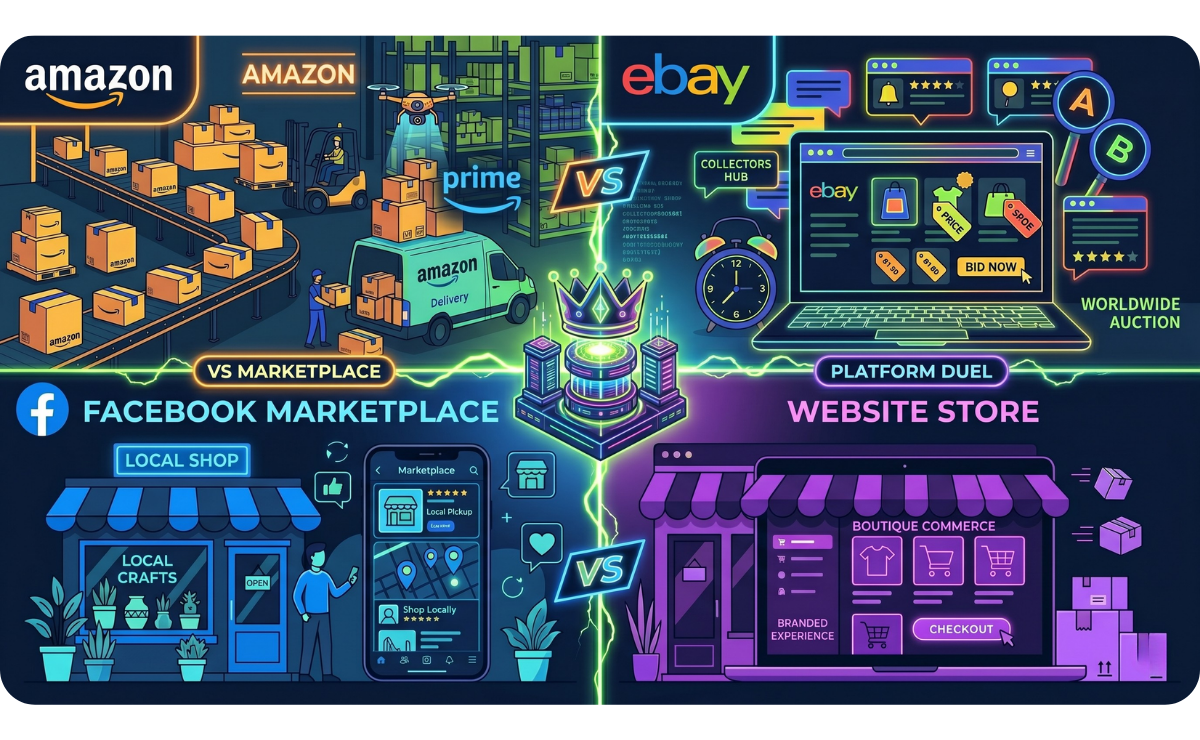
You have a product. You have ambition. You have ten browser tabs open comparing ecommerce sites for small business. And you still don’t know where to sell first.
That hesitation is expensive. Choosing the wrong platform doesn’t just cost you fees; it costs you months of lost momentum, frustrated customers, and profit you’ll never get back.
Amazon. eBay. Facebook Marketplace. Your own website on Shopify or WooCommerce. Each one looks like the right answer until you dig deeper.
This guide isn’t a feature list. It’s a decision framework. You’ll learn which ecommerce sites for small businesses match your actual business model, not the ones with the loudest marketing.
Let’s cut through the noise.
What Defines the Best E-commerce Method?
Forget “best overall”. That doesn’t exist. Instead, judge every platform on five real-world metrics that affect your bank account.
Total Cost of Selling: Beyond Listing Fees and Hidden Expenses
Not just listing fees. Think about:
-
Transaction & payment processing – Every sale takes a cut.
-
Monthly subscriptions – Store fees or platform store plans.
-
Advertising to get seen – On marketplaces, organic reach is shrinking.
-
Hidden costs – Returns, disputes, chargebacks, and storage fees.
A “free” platform becomes expensive if you need paid ads to generate any traffic.
Control Over Your Business: Data, Pricing, and Rules
Can you set your own shipping rules without platform restrictions? Own the customer’s email address after a sale? Change prices instantly without waiting for algorithm approval or facing penalties?
On a marketplace, the answer is often no. Amazon decides if your price is competitive. eBay holds your funds based on feedback scores. Facebook changes reach overnight.
Control means you decide:
-
Customer data : Who gets the email? You or the platform?
-
Pricing : Can you run flash sales, bundle products, or adjust for demand instantly?
-
Rules : Your return policy, your shipping timelines, your dispute resolution process.
Without control, every sale is a rental. With control, a one-time buyer becomes a repeat customer you can reach anytime. That is the difference between building an asset and just generating transaction fees for someone else.
Scalability: Growing from 10 to 1,000 Sales
Will this platform grow with you from 10 sales a month to 1,000? Or will you have to rebuild later?
Scalability matters when:
-
Volume limits: Does the platform throttle you after a certain point?
-
Costs at scale: Fees might stay flat or rise with ad dependency.
-
Automation: Can you integrate shipping and support tools?
Hidden risk: Facebook works at 50 sales. At 500, the lack of automation hurts. Your website scales beautifully, but only if you bring traffic.
Ease of Use: Listing Speed and Simplicity
Can you list a product in 10 minutes? Or do you need a developer, a designer, and a spreadsheet of category codes?
Ease of use means:
-
Time to first listing : Marketplace listings take minutes. A custom website takes hours or days.
-
Technical skills required : Amazon and eBay need none. Shopify is beginner-friendly. WooCommerce needs basic tech comfort.
-
Ongoing maintenance : Marketplaces handle servers and security. Your own site is your responsibility.
Hidden risk: A "simple" platform might limit customization. Facebook is easy but chaotic. Your own site is flexible but requires learning. Choose what you can actually manage.
Profit Margins: What You Actually Keep
After all costs and marketing, what percentage of each sale stays yours? This is where marketplaces shock most beginners.
What eats your margin:
-
Platform fees (referral, transaction, monthly)
-
Payment processing (2–3% per sale)
-
Advertising costs (often required to stay visible)
-
Returns, disputes, and chargebacks
The reality: A $30 product on Amazon might leave you with $8. The same product on your own site could leave $20 – but only after you pay to drive traffic.
The core insight: The “best platform” depends entirely on your business model—not on popularity. A vintage furniture seller and a new electronics brand should never choose the same starting point.
Platform Breakdown: The Real Trade-Offs
Every platform promises the world. But each one forces a different trade-off between traffic, control, and profit. Below is the honest breakdown of Amazon, eBay, Facebook Marketplace, and your own website store – starting with the hidden costs and ending with the platform that builds long-term wealth.
-
Amazon – The Traffic King with a Heavy Tax
Amazon is a search engine for people holding credit cards. Over 2.5 billion monthly visits. You don’t need to market—you just need to rank.
Why Amazon Works: Key Advantages for Small Business Sellers
-
Massive built-in traffic. List a product, and it can sell within hours.
-
Prime badge builds instant trust. Customers click “Buy Now” without hesitation.
-
FBA handles storage, packing, shipping, and customer service.
The Hidden Costs and Risks of Selling on Amazon
-
High fees (referral 6–20% + FBA + storage + advertising). Your margin disappears fast.
-
Zero customer ownership. Amazon owns the buyer relationship. You never get their email.
-
One policy change or suspension can end your business overnight.
Example: Selling a $20 Wireless Charger on Amazon
|
Cost |
Amount |
|
Selling price |
$20.00 |
|
Amazon referral fee (15%) |
-$3.00 |
|
FBA fulfillment fee |
-$3.22 |
|
Advertising (estimated) |
-$4.00 |
|
Product cost (supplier) |
-$5.00 |
|
Your profit |
$4.78 |
That’s only 24% of the sale price.
Amazon keeps more than half of your revenue before you even pay for the product.
On your own website: same $20 charger → you keep ~$14 after payment processing.
Which Sellers Thrive on Amazon?
Sellers with standard, non-unique products who want fast validation and are willing to pay for convenience. Think phone cases, batteries, kitchen gadgets.
The Unspoken Amazon Trap: When the Platform Becomes Your Competitor
The “you vs. Amazon” trap. If your product sells well, Amazon can launch their own Basics version, undercut you, and push you to page two. No warning. No appeal.
How do smart sellers prepare ?
Before listing, they use Amazon Scanner (a trend detection tool) to spot products with rising demand but low Amazon-brand competition. It’s not about guessing, it’s about data intelligence.
2. eBay – The Underdog for Used, Niche, and Overstock
eBay is older, less polished, but quietly profitable for millions. It’s an auction + fixed-price hybrid that rewards sellers who understand product condition and collector demand.
eBay Pros: Lower Fees, More Control, Global Reach
-
Lower fees than Amazon (typically 10–13% final value fee + optional store subscription).
-
You control shipping and customer communication more directly.
-
Massive international reach without complex setup.
Example: Selling the Same $20 Wireless Charger on eBay
|
Cost |
Amount |
|
Selling price |
$20.00 |
|
eBay final value fee (12%) |
-$2.40 |
|
Payment processing fee |
-$0.60 |
|
Your profit before product cost |
$17.00 |
|
Product cost (supplier) |
-$5.00 |
|
Your final profit |
$12.00 |
Compare to Amazon: Same $20 charger → Amazon profit was $4.78.
On eBay, you keep $12.00 – more than double.
eBay’s lower fees leave you with a healthier margin, even before considering advertising costs.
eBay Cons: Branding Limits, Buyer Bias, and Declining Traffic
-
Perceived as a “garage sale” platform. Premium branding is difficult.
-
Buyer-friendly dispute resolution often leaves sellers holding the loss.
-
Traffic has declined, though category-specific demand remains strong.
Which Sellers Win on eBay?
eBay is not for everyone. It works best for sellers who offer products where condition, rarity, or uniqueness matters more than brand prestige.
Exact seller types who win on eBay:
-
Collectibles sellers – Trading cards, coins, vintage toys, stamps. Buyers trust eBay’s category expertise.
-
Refurbished electronics sellers – Phones, laptops, gaming consoles with certified refurbished labels.
-
Auto parts sellers – New, used, or aftermarket parts. eBay Motors has a dedicated, high-intent audience.
-
Liquidation stock sellers – Overstock, customer returns, pallet resellers who sell by the unit.
-
Any product where condition varies – "Grade A" vs "Grade B" items, open-box goods, or one-off vintage finds.
If your product is identical to hundreds of others (like phone cases or batteries), eBay is not your best first stop. But if condition and description drive the sale, eBay outperforms Amazon.
The eBay Feedback Trap: One Bad Review Can Cost You Months
The feedback hostage situation. One negative review from an unreasonable buyer can tank your seller rating for months. eBay rarely removes them, even when you’re right.
How Smart Sellers Reduce Risk on eBay (Using Data, Not Luck)
Before investing in the product line. They use eBay Product Research to analyze listing volume, average price, and total units sold across specific markets. They study successful stores with eBay Competitor Analysis to see top listings and pricing strategies. Then they optimize titles using eBay Title Builder (real search volume data) and identify emerging demand via Best Items and Niche Finder. These tools turn eBay from a gamble into a predictable channel.
3. Facebook Marketplace & Shop – The Local + Social Impulse Machine
Facebook Marketplace is the modern classifieds. Facebook Shops are native storefronts inside the app. Together, they serve a different buyer: local, impulsive, and socially influenced.
Why Facebook Marketplace Works?
-
Zero listing fees on Marketplace. You only pay if you boost posts.
-
Hyperlocal – sell furniture, cars, bulky items without shipping.
-
Social proof – friends’ likes and shares act as free advertising.
The Downsides of Facebook Selling:
-
Algorithm-dependent. Reach can collapse overnight with no explanation.
-
No dedicated seller support. Scams and time-wasters are common.
-
Lower conversion rates than Amazon because users aren’t always in buying mode.
Who Succeeds on Facebook Marketplace?
Local sales, handmade goods, vintage items, and sellers with an existing Facebook audience.
Wasted Time and No Purchase Intent
The “is this available?” ghost buyer. You’ll waste hours responding to messages from people who never buy. Unlike Amazon, there is no purchase intent filter.
How experienced sellers adapt?
They cross-list high-demand items identified through marketplace intelligence (comparing trends across eBay, TikTok Shop, and Facebook) to ensure they’re selling where buyers are actually active.
4. Your Own Website Store (Shopify / WooCommerce) – The Long-Term Asset
This is not a platform. It’s digital real estate you own. You control the design, the data, the email list, and the profit margin. But you also bring every single visitor.
Why Own a Website Store?
-
100% customer ownership. Every email address, every purchase history, every retargeting opportunity.
-
No per-sale marketplace fees. Only payment processing (~2.9% + fixed).
-
Full brand control – design, upsells, subscriptions, your rules.
The Hard Part of Selling on Your Own Site:
-
Zero built-in traffic. You need marketing (ads, SEO, social, partnerships).
-
Technical maintenance (especially WooCommerce) and security risks.
-
Slow start. It takes time to build trust without a marketplace reputation.
Who Should Build Their Own Store?
-
Brand-builders : You want to tell a story, control packaging, and create an emotional connection with customers.
-
Subscription businesses : Monthly boxes, memberships, or recurring billing models that need flexible checkout options.
-
High-margin products : Items where you can absorb marketing costs (e.g., $100+ products) and still keep 70–80% profit.
-
Anyone who wants to own their future : Sellers tired of algorithm changes, sudden suspensions, or renting an audience from marketplaces.
The First Month on Your Own Site:
The empty store depression. You launch a beautiful site. Nobody visits for three weeks. That feeling makes many founders quit.
How smart founders shorten the curve?
Before building, they validate product demand using Shopify Insight to see what’s already selling on Shopify stores. They analyze competitor strategies with Shopify Spy to understand pricing, bundling, and positioning. And they map the competitive landscape using Shopify Store Finder. This way, they don’t build a store for a product nobody wants.
Comparison: Which Platform Wins on the Metrics That Matter?
|
Factor |
Amazon |
eBay |
Facebook Marketplace |
Website Store |
|---|---|---|---|---|
|
Fees (per sale) |
15–30% |
10–13% |
0% (Marketplace), ~5% (Shops) |
~3% (payment only) |
|
Built-in traffic |
Very high |
Medium |
High (local) |
Zero |
|
Competition level |
Extreme |
Medium |
Low to medium |
Depends on your marketing |
|
Branding control |
Very low |
Low |
Medium |
Full |
|
Customer ownership |
None |
Low (possible via messages) |
Medium |
Full |
|
Profit margin potential |
Low (after ads) |
Medium |
Medium to high |
High (if traffic acquired) |
|
Risk of ban/suspension |
High |
Medium |
High (algorithm changes) |
Low (your own hosting) |
Real insights that change decisions
-
High traffic does not equal high profit. Amazon’s traffic comes with extreme competition and high ad costs. A smaller platform with lower fees can yield better net profit per sale.
-
Marketplace dependency risk is real. If eBay or Facebook changes its algorithm, your income can drop 50% overnight. A website diversifies that risk.
-
Beginners underestimate fees. That $20 product on Amazon might leave you with $3 after fees, shipping, and ads. On your own site, the same product could net $12.
Which Platform Should You Choose? (Scenarios, Not Guesswork)
Beginner with no budget and no audience
Choose: Facebook Marketplace + eBay
Why: No upfront costs. Test product demand with local or niche buyers. Learn customer service and listing basics without financial risk.
Beginner with $500–$1,000 to invest
Choose: Amazon (single product, using FBA for a small test batch)
Why: Use the budget for a small product test and modest PPC campaign. Amazon’s traffic gives you a clear pass/fail signal. If it sells, you scale. If not, you learn fast without losing years.
Small business scaling (already doing $5k–$20k/month)
Choose: Your own website + Amazon
Why: Amazon provides cash flow and volume. Your website captures emails and builds repeat buyers. This hybrid is how sellers escape the marketplace trap.
Brand-focused business (unique product, strong identity)
Choose: Own website first (Shopify or WooCommerce), then scale with paid traffic
Why: Marketplaces commoditize unique products. A website lets you tell your story, charge premium prices, and own the customer relationship from day one. You control landing pages, shipping expectations, and post-sale follow-up. No platform can change your rules overnight. Once you have consistent traffic, you can explore wholesale or partnerships, but your owned store remains the anchor.
Selling used, vintage, or one-off items
Choose: eBay + Facebook Marketplace
Why: Amazon is terrible for used goods. eBay buyers understand condition variability. Facebook covers local pickup for bulky items.
Pro Strategy: The Hybrid Method That Actually Works
The most profitable small sellers don’t choose one platform. They build a data-informed funnel across multiple channels.
Here is the exact strategy, step by step.
Step 1: Launch on a marketplace first
Start with Amazon or eBay. Their built-in traffic gives you immediate feedback. If you can’t sell there with basic optimization, you won’t sell on your own site either.
Step 2: Validate with product research tools
Before sourcing products or building a store, use eBay Niche Finder, and Amazon Scanner tool to identify market gaps. Look for products with steady demand, low competition, and price stability. This eliminates the biggest risk, selling what nobody wants.
Step 3: Analyze competitors without copying
Use eBay Competitor Research and Shopify Spy to study successful sellers in your niche. Look at their pricing, bundling strategies, and top listings. You are not stealing—you are identifying opportunities they missed.
Step 4: Build your website with AI assistance
Use AI Shopify Builder to generate a functional store layout based on your product data. No developer needed. Focus your time on product photography and copywriting.
Step 5: Capture those buyers to your owned website
Include a simple insert card in every marketplace shipment: Register your product at [YourSite.com] for a 10% discount code. Now you own their email.
Step 6: Retarget and scale
Run small Facebook or Google retargeting campaigns to your email list. Offer bundles or subscription options that aren’t available on Amazon. Your margins on the website will be 2–3x higher.
This hybrid model works because it uses marketplaces for traffic acquisition and your website for profit retention.
Conclusion: No Single Best Platform, Only the Best Strategy for You
If you need fast cash flow and have no audience → Amazon is the best e-commerce site for small business starting out.
If you want long-term brand equity and customer ownership → a website store is the best e-commerce method for patient founders.
If you sell unique or used items → eBay and Facebook Marketplace are your friends.
The mistake is staying on one platform forever. Start where the traffic is. Use product research tools and competitor analysis to make data-driven decisions. Build your owned asset on the side. Then slowly shift the balance toward higher margins and lower risk.
Your first sale can happen this week. Choose the platform that matches your budget and your business model, not the one with the flashiest success story.
Ready to stop guessing? Get a $1 trial and let TS Scout give you the marketplace intelligence, competitor insights, and AI-powered tools to launch smarter. No hype. Just data.
like?


Table of Contents
- What Defines the Best E-commerce Method?
- Platform Breakdown: The Real Trade-Offs
- Comparison: Which Platform Wins on the Metrics That Matter?
- Which Platform Should You Choose? (Scenarios, Not Guesswork)
- Pro Strategy: The Hybrid Method That Actually Works
- Conclusion: No Single Best Platform, Only the Best Strategy for You


