

Build a Successful Dropshipping Empire in 2026: The Data-Backed Playbook
- 2026-06-10
-
 4
4

Most guides promise you an empire and hand you a checklist. Ninety percent of dropshipping stores that fail don't die from a bad niche, they die from decisions made on gut feeling instead of real market data. The global dropshipping market is projected to grow from $155.6 billion in 2021 to $1,670.1 billion by 2031, a compound annual growth rate of 27.1%, according to Allied Market Research, which means the opportunity is real, but so is the competition chasing it.
This guide skips the recycled advice and walks you through exactly how experienced sellers validate niches, vet suppliers, and scale across platforms using actual data instead of guesswork. You'll see where most beginners quietly bleed money, which platforms are worth your time in 2026, and how to build a successful dropshipping empire without repeating the mistakes that sink 7 out of 10 first-year stores. Here's the one distinction almost every beginner gets wrong first.
What Is Dropshipping in 2026, and Why Do Sellers Still Choose It Over Traditional Retail?
Dropshipping is a fulfillment method, not a business category. You list a product, a customer buys it, and a third-party supplier ships it directly to them, you never touch inventory. This is different from What Is Ecommerce in 2026?, which covers every online selling model, including holding stock, private labeling, and wholesale.
Sellers still choose this model in 2026 for one reason: capital efficiency. You can test a product idea for under $50 instead of pre-ordering hundreds of units. That said, the model isn't risk-free, margins are thinner, and you don't control shipping timelines. If you're weighing whether this trade-off fits your goals, Dropshipping Pros and Cons in 2026 breaks down exactly where the model wins and where it doesn't.
The sellers who actually build a successful dropshipping empire treat this as a real operation from day one, registered business, dedicated supplier relationships, and a system for tracking margins per product, not per sale.
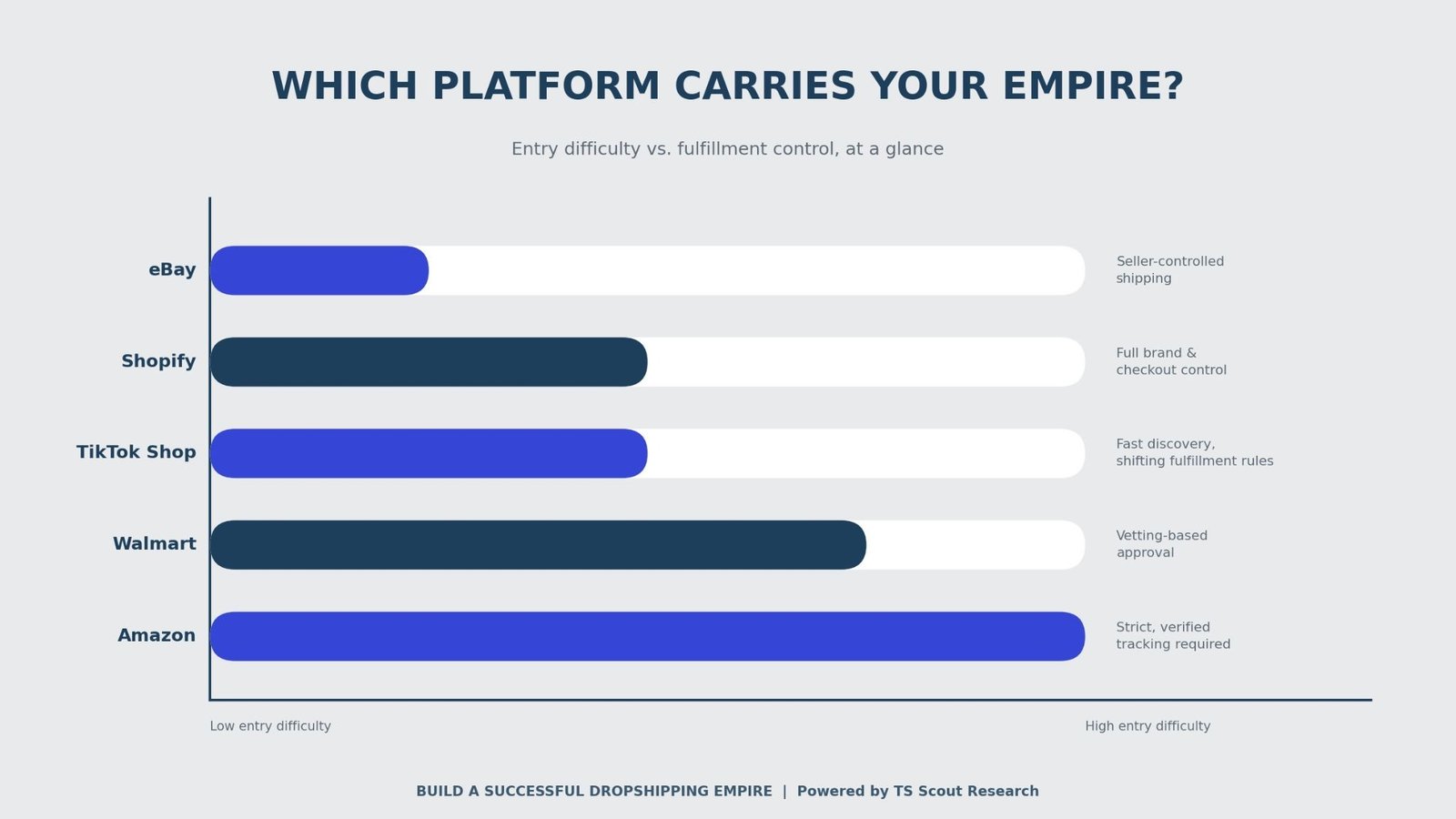
Which Platform Should Carry Your Dropshipping Empire, eBay, Shopify, Amazon, Walmart, or TikTok Shop?
|
Platform |
Best For |
Entry Difficulty |
Fulfillment Note |
|
eBay |
Fast product testing, low fees |
Low |
Seller handles shipping directly |
|
Shopify |
Brand-building, full control |
Medium |
You own the checkout experience |
|
Amazon |
High-intent buyers, existing traffic |
High (strict policies) |
Requires fast, verified tracking |
|
Walmart Marketplace |
US-based demand, less saturation |
Medium-High |
Vetting-based approval |
|
TikTok Shop |
Viral discovery, younger audience |
Low-Medium |
Fulfillment rules are shifting fast |
One important, easy-to-miss update: in early 2026, TikTok announced it would phase out independent "Seller Shipping" in the US in favor of its own logistics network, then paused that plan after seller pushback. A TikTok spokesperson confirmed to Adweek that "Seller Shipping remains unchanged, and previously shared deadlines are not going into effect." If you're planning to sell there, check your fulfillment options before you commit inventory strategy, because Adweek reports this could still change with little notice.
Choosing the right platform is the first infrastructure decision behind every seller who manages to build a successful dropshipping empire instead of juggling five disconnected experiments. If eBay is your starting point, Set Up Your eBay Seller Account and the full eBay dropshipping guide 2026 cover the account requirements you'll need before listing your first product.
How Do You Find a Profitable Niche Before the Market Gets Saturated?
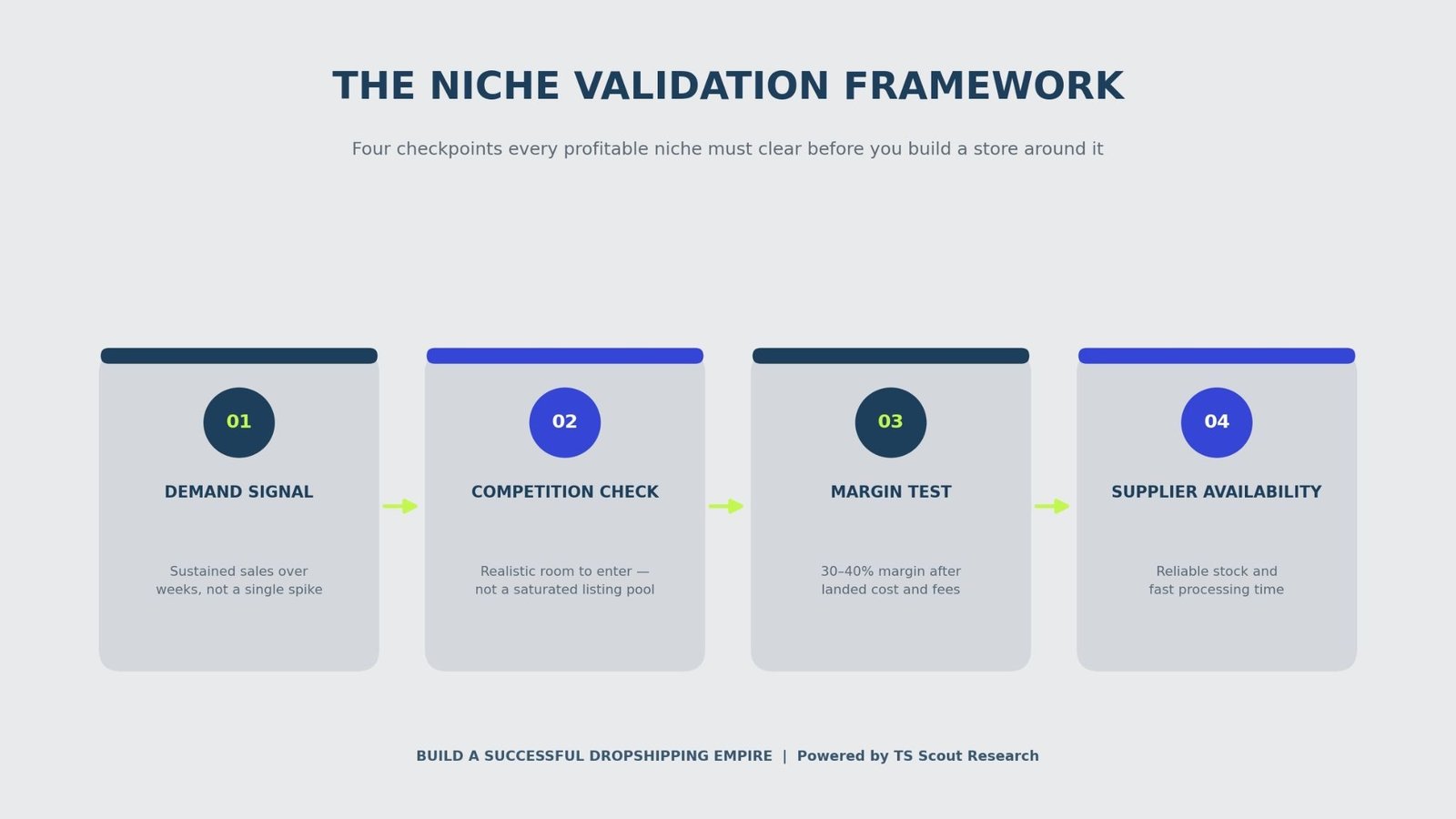
Guessing a niche based on what "feels trendy" is the single biggest reason beginners burn ad spend with nothing to show for it. Validation needs three data points before you commit: consistent search or sales demand, a competition level you can realistically break into, and margin room after fees and ad costs.
This is where product research tools earn their place. Instead of manually scrolling marketplaces, eBay Segment Insight shows category-level demand and competition data before you pick a single product, and Express Scanner flags AliExpress items with sustained sales activity rather than a short-lived spike, the difference between a niche you can build a successful dropshipping empire around and one that dies in six weeks.
For a curated shortlist, 6 Profitable Niche Products in 2026 and the eBay Niche Finder Method walk through categories with active, sustained demand this year.
What Separates a Winning Product From One That Will Drain Your Ad Budget?
A "winning product" isn't the one with the most views on a trending video, it's the one with a repeatable sales pattern. Look for three signals together: consistent units sold over weeks (not days), a price point that leaves at least 30–40% margin after landed cost and fees, and low listing saturation across competing stores.
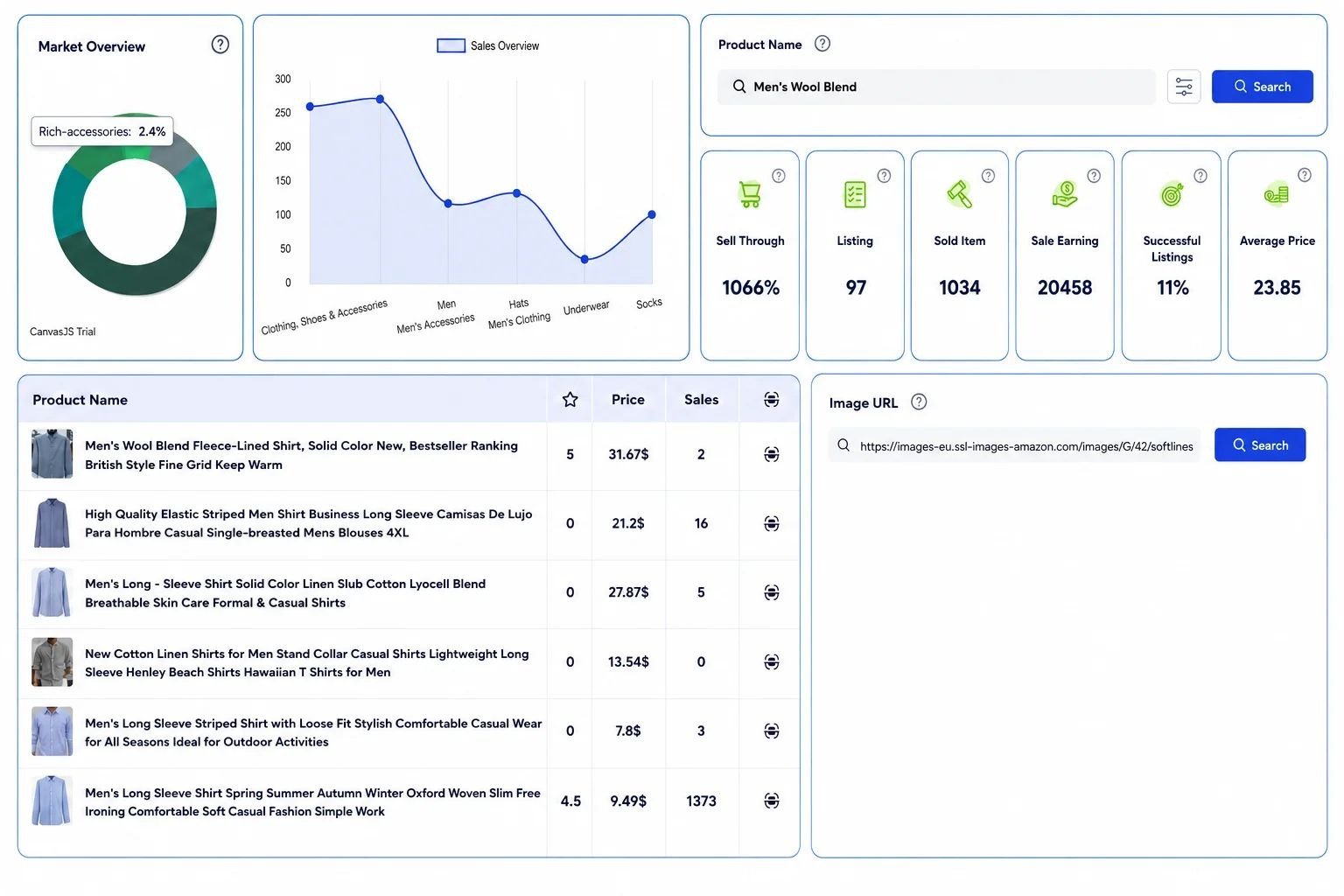
Shopify Insight filters by price range, shipping origin, and time period, so you can see whether a product's demand is actually holding or just spiking around a single viral moment. Express Product Research then lets you cross-check that same product's performance directly on AliExpress by price and sales history. If you ever find a promising product image with no listed source, Image Match pulls up where else it's being sold, at what price, and how many units have moved, useful for confirming a product is proven before you invest in creatives. This kind of product-level discipline is what quietly separates sellers who build a successful dropshipping empire from sellers restarting with a new "hot" product every month.
Before locking in a supplier for that product, run it against the sourcing checklist in the AliExpress Product Sourcing Guide.
How Do You Analyze Competitors Without Just Copying Their Store?
Copying a competitor's store rarely works, you're copying their execution without their supplier relationships, ad data, or timing. What actually helps is understanding their pattern: which products anchor their catalog, how they price against shipping cost, and how long their bestsellers have stayed in rotation.
eBay Competitor Research shows a seller's top-performing listings and pricing structure, while Shopify Competitor Research does the same for any Shopify store by URL, pricing strategy, product mix, and estimated performance in one view. If you want to go broader than one store, Shopify Find Stores and Express Source Finder map every store selling a specific product or operating in your niche, which is how you spot whether a market is still open or already crowded.
Consider a seller testing a home-organization niche who used competitor research to notice that three top stores all priced the same product within $2 of each other, a sign the market had settled on a price ceiling. Instead of matching that price, they bundled two smaller accessory items with it, increased perceived value, and undercut the effective per-unit cost. That single adjustment, informed by real competitor data rather than a guess, moved their conversion rate meaningfully within the first month.
How Do You Vet Suppliers So They Don't Wreck Your Store's Reputation?
Your supplier is your reputation, whether customers know it or not. A late shipment or a mismatched product shows up as a review on your store, not theirs. Vet suppliers against four criteria: processing time under 48 hours, a return/refund policy you can actually honor, consistent seller ratings over time (not just recent), and responsiveness to test messages before you commit volume.
A single unreliable supplier can quietly undo months of work, which is exactly why supplier vetting sits at the center of every real plan to build a successful dropshipping empire, not as an afterthought handled once and forgotten. Express Source Finder gives you a supplier's full listing history, ratings, and total units shipped in one report, far more reliable than a five-star badge alone. If you're deciding between the two largest cross-border sourcing options, AliExpress vs Temu breaks down where each one holds an edge on shipping speed and pricing.
What Actually Makes a Zero-Inventory Store Convert Visitors Into Buyers?
Traffic without conversion is a leaking bucket. Two factors matter more than most sellers realize: page speed and listing clarity. web.dev, Google's own developer resource, documented how ecommerce retailer Rakuten 24 saw conversion rates increase by up to 61.13% after improving Largest Contentful Paint (LCP), a direct, measurable link between site speed and lost sales, confirmed by web.dev's own case study data.
On the listing side, your title is doing more selling work than your product photos. eBay Smart Titles generates optimized titles using real search volume data instead of guesswork, which directly affects whether your listing surfaces in relevant searches at all. Site speed and listing clarity are unglamorous, but they're exactly the fundamentals behind sellers who build a successful dropshipping empire while competitors chase flashier tactics. Combine that with genuine customer reviews, a visible return policy, and mobile-first product pages, and you've addressed the two biggest silent conversion killers most sellers never diagnose.
How Do You Market a Brand-New Store With No Audience and No Reviews?
Cold traffic converts differently than warm traffic, and most new sellers make the mistake of running the same ad strategy regardless of where their audience actually is. In 2026, short-form video discovery still outperforms static ads for cold audiences in most consumer niches, which is exactly why TikTok Shop Ecommerce Without Stock is worth reading before you allocate ad budget.
TikTok Shop Scanner tracks which products are gaining traction on the platform in real time, which matters because viral products on TikTok Shop have a short window before saturation sets in. Marketing a brand-new store with no audience is where most attempts to build a successful dropshipping empire either gain early traction or quietly stall, so pairing that signal with retargeting through email once you have even 100 email captures typically outperforms cold-only ad spend for new stores.
What Makes the Difference Between Sellers Who Scale and Sellers Who Quit by Month Three?
It's rarely the product. It's usually the reaction to the first bad week. A store that sees zero sales for ten days and pivots niches entirely is starting over, not scaling. A store that sees the same ten days and instead checks whether the issue is pricing, listing visibility, or supplier delay is actually running a business.
This behavioral pattern is explored in depth in Why Do Some Stock-Free Sellers Build a Successful Dropshipping Business While Others Quit in Month Three?, the short version is that sellers who track weekly data, even when it's discouraging, consistently outlast sellers who rely on motivation alone.
How Do You Scale One Store Into a True Multi-Platform Dropshipping Empire?
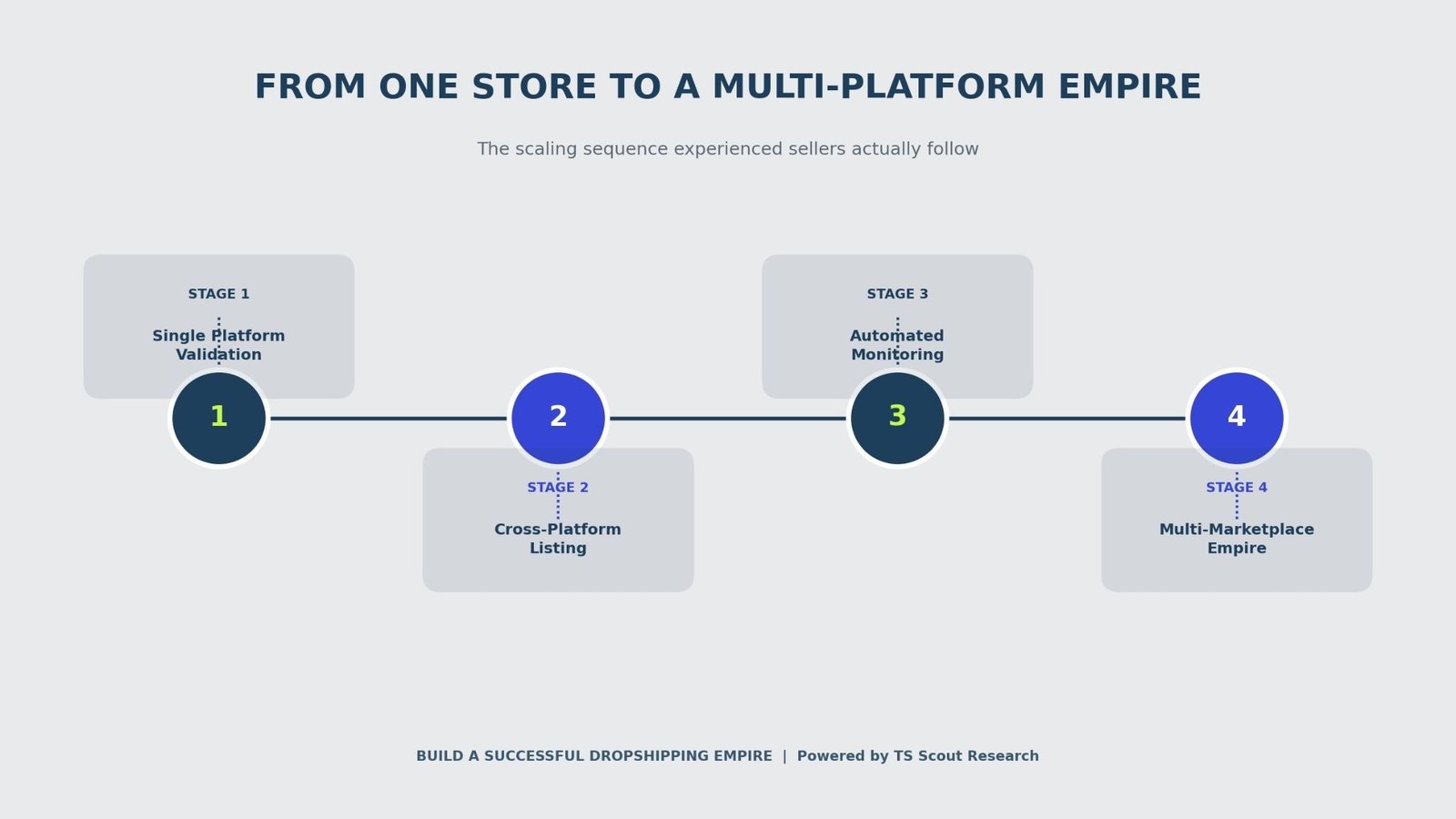
Scaling isn't opening five stores at once, it's proving a product on one platform, then expanding distribution without multiplying your manual workload. This is where most sellers hit a wall: manually checking trends across eBay, Amazon, Walmart, and TikTok Shop separately eats the time you should be spending on margin and supplier decisions.
Amazon Scanner and Walmart Scanner extend the same demand-tracking logic you used for your first product to two of the highest-intent marketplaces in the US, without requiring you to learn each platform's research tools from scratch. Running one connected system across platforms, rather than switching between five disconnected tools and spreadsheets, is what actually lets a single seller build a successful dropshipping empire instead of five underperforming stores.
For the exact sequence experienced sellers follow when adding a second platform, The Blueprint Sellers Wish They Had on Day One lays out the order that avoids the most common scaling mistakes.
What Are the Silent Mistakes That Kill a Dropshipping Empire Before It Starts?
-
Pricing without landed cost math: Sellers who price off the supplier's listed price alone, ignoring shipping and payment processing fees, often discover their "profitable" product is break-even at best.
-
Ignoring supplier response time until an order fails: A supplier who takes four days to answer a pre-sale question will take longer once you're sending them real order volume.
-
Chasing five niches at once: Splitting ad budget and research time across multiple untested niches simultaneously slows validation on all of them instead of speeding it up.
-
Treating one bad week as proof the niche is dead: As covered above, sellers who quit at the first dip rarely gather enough data to know whether the problem was the product, the price, or the listing.
Catching these early is really what separates sellers who build a successful dropshipping empire from sellers rebuilding the same store for the third time.
Ready to Build the Dropshipping Empire You Keep Postponing?
Everything in this guide, niche validation, competitor analysis, supplier vetting, and multi-platform scaling, comes down to one thing: making decisions from real data instead of guesswork. That's the actual gap between sellers who build a successful dropshipping empire and sellers who restart every few months.
TS Scout puts every research function covered in this guide,niche insight, product research, competitor tracking, and supplier vetting across eBay, Shopify, AliExpress, Amazon, Walmart, and TikTok Shop — into one connected system. Unlock full access for $1 for 14 days and validate your next product with data instead of guesswork.
FAQs
-
Is dropshipping still profitable in 2026?
Yes, for sellers who validate demand before listing. Margins have tightened as more sellers enter the market, but sellers using real product and competitor data still consistently outperform those relying on trends alone.
-
How much money do I need to build a successful dropshipping empire?
Most sellers begin meaningfully with 200–500, covering platform fees, initial ad testing, and a small buffer for supplier samples. This is not a guarantee of profit, it's the minimum to properly test a niche.
-
Which platform is best for beginners, eBay, Shopify, or TikTok Shop?
eBay generally has the lowest barrier to entry for testing products quickly. Shopify suits sellers ready to build a brand. TikTok Shop offers fast discovery but currently carries more fulfillment-policy uncertainty, as noted earlier.
-
How long does it take to see real profit?
Sellers who validate a niche properly before launch often see their first consistent profit within 60–90 days. Sellers who skip validation frequently take longer, if they get there at all.
-
Do I need a business license to start dropshipping?
Requirements vary by country and platform, but treating your store as a registered business, not a side hobby, from the start avoids tax and payment-processing complications later.
like?


Table of Contents
- What Is Dropshipping in 2026, and Why Do Sellers Still Choose It Over Traditional Retail?
- Which Platform Should Carry Your Dropshipping Empire, eBay, Shopify, Amazon, Walmart, or TikTok Shop?
- How Do You Find a Profitable Niche Before the Market Gets Saturated?
- What Separates a Winning Product From One That Will Drain Your Ad Budget?
- How Do You Analyze Competitors Without Just Copying Their Store?
- How Do You Vet Suppliers So They Don't Wreck Your Store's Reputation?
- What Actually Makes a Zero-Inventory Store Convert Visitors Into Buyers?
- How Do You Market a Brand-New Store With No Audience and No Reviews?
- What Makes the Difference Between Sellers Who Scale and Sellers Who Quit by Month Three?
- How Do You Scale One Store Into a True Multi-Platform Dropshipping Empire?
- What Are the Silent Mistakes That Kill a Dropshipping Empire Before It Starts?
- Ready to Build the Dropshipping Empire You Keep Postponing?
- FAQs


