
eBay Niche Finder Method: Find Untapped Niches Before Everyone Else Does
- 2026-09-08
-
 0
0

Most "best eBay niches" articles hand you a list, and by the time you've read it, that list is already dying. A niche that was quiet last month can be flooded with new sellers by the time a blog post about it gets indexed; that's the trap of relying on someone else's snapshot instead of your own process.
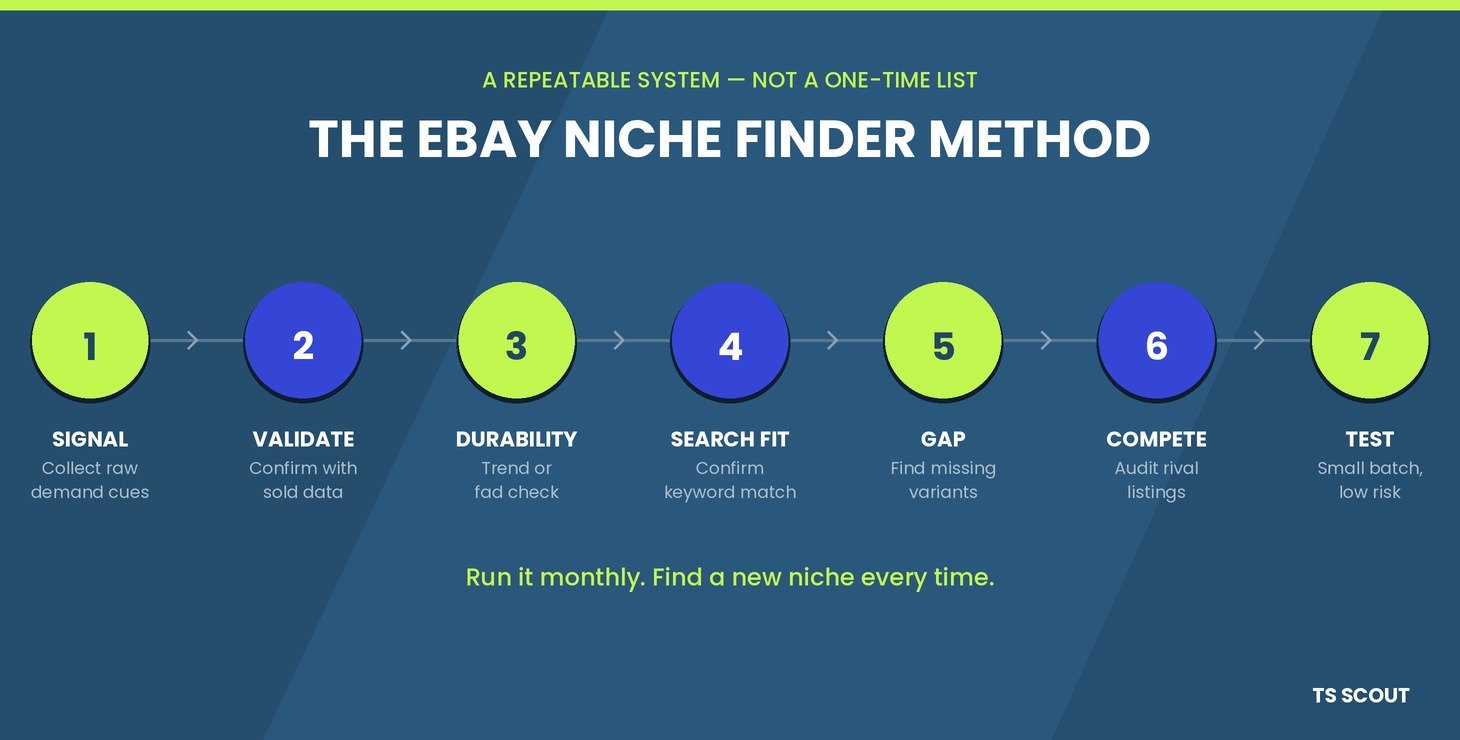
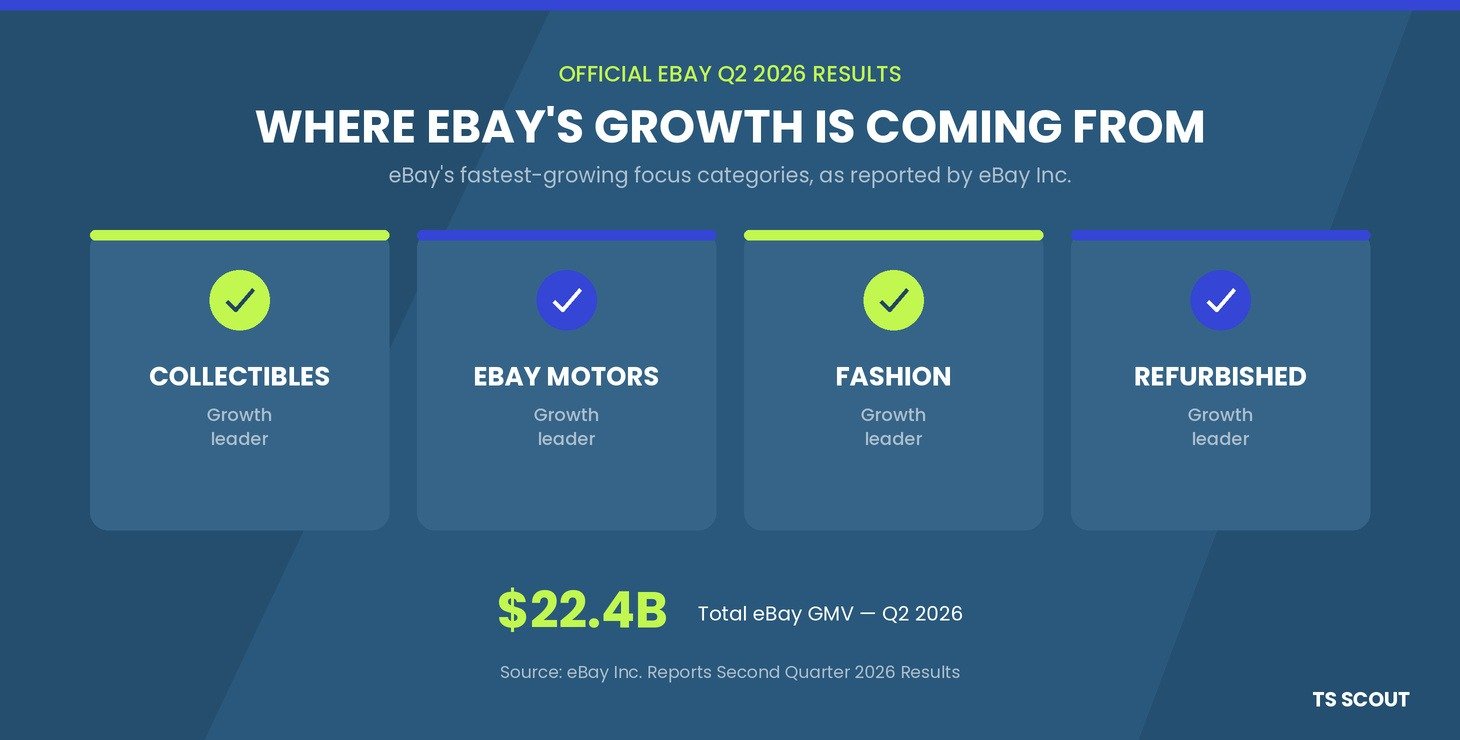
This article isn't another list. It's a repeatable eBay niche finder method: a sequence of checks you can run every single month to surface untapped eBay niches 2026 has real demand for, before the rest of the market catches on. It's built specifically for UK and US sellers who don't hold stock, where speed of testing matters more than warehouse space. eBay itself just gave sellers a clue about where that demand is moving: in its official second-quarter results, eBay Inc. Reports Second Quarter 2026 Results confirms GMV reached $22.4 billion. That single data point is the starting proof this method works, now let's build the system around it.
What Does "Untapped" Actually Mean on eBay, and Why Do Most Niche Lists Fail?
"Untapped" doesn't mean nobody is selling it. On a marketplace with billions of active listings, almost nothing is literally unsold. What "untapped" actually means is a demand-per-seller imbalance, more buyers searching and purchasing than there are sellers competently serving that demand. That distinction matters, because it's exactly where most niche-list content gets it wrong.
Here's the structural problem with any published list of "hot eBay niches": the moment it goes live, every reader who acts on it becomes a new competitor in that same niche. A list is a snapshot; a method is a process you can re-run once that snapshot expires. If your research approach can't survive being repeated a month from now, it was never really research, it was a countdown timer on someone else's homework.
Where Do You Pull Raw Niche Signals From?
Before you validate anything with hard sales data, you need raw signals, early indicators that something is shifting. Treat this as a wide net, not a decision point.
-
On-platform signals: eBay's own Trending Deals page, and patterns in which categories keep surfacing when you browse Seller Hub's category breadcrumbs
-
Search-trend signals: Google Trends, filtered to your target region (UK or US), to see whether interest in a product term is rising, flat, or seasonal
-
Community signals: Reddit threads and niche forums where buyers complain about not being able to find something, or ask "where can I get X", unmet demand voiced in plain language
-
Cross-platform crossover: a product category gaining traction on TikTok Shop or Amazon often reaches eBay a few weeks later, giving you a lead-time window
None of these signals are proof on their own. They're candidates. The next step is where most sellers skip straight to sourcing, and that's the mistake.
How Do You Validate a Signal With Real eBay Sales Data, and What Is Demand-per-Seller?
This is where the method separates from guesswork. eBay's own eBay research tools, the Product Research and Sourcing Insights suite built into Seller Hub, free to Store subscribers (worth reviewing eBay Store benefits if you're not currently subscribed), give you up to three years of actual sold-item data: sales trends, average sold price (including accepted Best Offers, which public search hides), sold price range, and sell-through rate.
Sell-through rate (STR) is the ratio of items sold to items listed. As a rough guide:
|
STR range |
What it signals |
Sourcing implication |
|
Above ~60% |
Demand outruns supply |
Price with confidence, expect fast turnover |
|
~30–60% |
Balanced, competitive market |
Listing quality and price decide the outcome |
|
Below ~30% |
Supply swamps demand |
Only worth it if margin covers a slow sell cycle |
But STR alone still misses the trap most lists fall into. Here's a quick side-by-side to make the point concrete:
|
Niche A |
Niche B |
|
|
Units sold (90 days) |
1,200 |
1,150 |
|
Active sellers |
40 |
6 |
|
Sell-through rate |
58% |
61% |
|
Demand per seller |
30 units |
192 units |
Both niches look almost identical on STR alone. But Niche B has roughly six times the sold volume per seller, that's the one worth pursuing. This is demand-per-seller: weighing sold volume against the number of active sellers competing for it, not just the raw sales number.
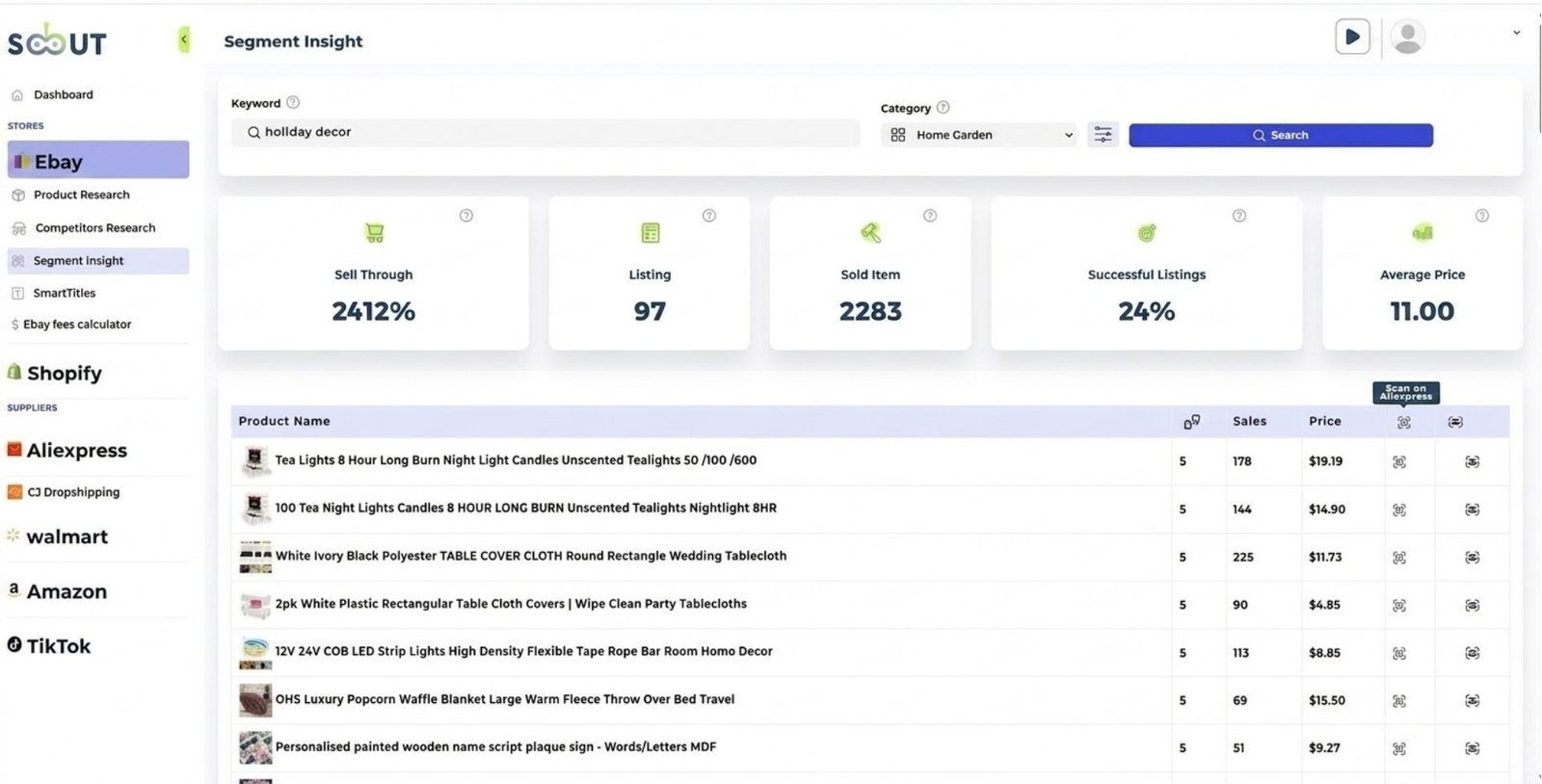
Running this check manually across dozens of candidate keywords is where most sellers give up. This is exactly the gap the eBay Segment Insight tool was built to close, it validates multiple keyword signals against live sell-through and seller-count data in one pass, instead of you running the same Product Research query over and over by hand.
Is the Niche a Real Trend or a Fad? (Seasonality and Durability Check)
A niche can pass every check above and still be worthless three months from now if it was a spike, not a trend. This is the step static niche lists never include, and it's the one that keeps your method reusable instead of a one-time win.
Look at the sales-trend chart inside eBay's Product Research tool for your candidate keyword. You're looking for one of three shapes:
-
A rising line across several consecutive months, durable, structural growth
-
A seasonal wave that repeats yearly, real, but only worth sourcing ahead of its window (holiday décor, back-to-school supplies)
-
A single sharp spike with no repeat pattern, a fad; don't build inventory commitments around it
If you're building a sourcing calendar around predictable seasonal peaks rather than chasing spikes, it's worth cross-checking your candidate niche against an eBay seasonal selling calendar so you're not caught sourcing a seasonal item outside its window.
Does the Niche Actually Surface in eBay Search?
A niche can have a strong sales history and still be a trap for a new seller if buyers can't actually find your listing once you list it. eBay's internal search engine, commonly referred to by sellers as the eBay Cassini algorithm, ranks listings on relevance to the search query, seller performance history, and listing quality, meaning a brand-new seller entering a niche where top listings are dominated by years of sales history and tightly optimized titles will struggle to rank, regardless of how good the underlying demand numbers look.
Before committing, pull the top-selling listings for your niche and check how closely their titles match the keyword phrases buyers are actually searching. If there's a mismatch, high sales, but titles that don't cleanly reflect buyer search terms, that's a keyword gap you can fill immediately once you list. It's also worth checking your draft listing against common eBay listing errors that suppress visibility for reasons that have nothing to do with keywords. The eBay Niche Finder Tool is useful here too, since it surfaces the actual keyword variants buyers are searching within a niche, letting you check title fit before committing sourcing budget.
How Do You Spot a Genuine Product Gap Inside a Niche?
Once a niche clears the demand and durability checks, look inside it for what's missing: sizes, colours, bundle configurations, or compatibility variants that buyers are clearly searching for but can't find listed. This is a smaller, faster win than trying to out-compete an entire niche head-on.
eBay's own results give a useful structural clue here. eBay Inc. Reports Second Quarter 2026 Results identifies collectibles, motors, fashion, and refurbished goods as the platform's fastest-growing focus categories, with focused-category GMV growing faster than the rest of the marketplace. That's eBay confirming, in its own reporting, exactly where buyer demand is structurally shifting in 2026. If your candidate niche sits inside or adjacent to one of those four categories, the platform-level tailwind is working in your favour before you even list.
Pulling variation-level data across a niche at scale, which sizes, bundles, or specs are selling versus which are listed but ignored, is where TS Scout's eBay Product Research Tool earns its keep, surfacing gap patterns across hundreds of listings faster than manually clicking through each one.
How Do You Audit the Competition Before Committing?
"Low competition" and "no competition" are not the same thing, and confusing the two is how sellers end up disappointed. A genuinely low-competition niche usually has a handful of sellers with inconsistent listing quality, thin item specifics, generic titles, not zero sellers.
Before sourcing, check:
-
Active seller count relative to sold volume (your demand-per-seller number from step 3)
-
Listing quality benchmarks among current top sellers, is there room to outclass them?
-
Promoted Listings saturation, a category where most competitors are paying for visibility signals thinner organic differentiation
This is a direct, listing-by-listing audit, and it's slow to do manually across every seller in a niche. The eBay Competitors Research tool was built specifically for this stage, surfacing competitor listing quality, pricing, and Promoted Listings patterns in one view.
What Should Automatically Disqualify a Niche, No Matter How Good the Data Looks?
Some niches will pass every check above and still not be worth pursuing. Rule these out before you spend research time on anything else:
-
Branded, restricted, or hazmat categories, compliance risk that isn't worth it for a non-stockholding seller without legal sourcing agreements
-
IP-risk products, anything relying on unlicensed use of a trademark or copyrighted design
-
Categories with fee or return-rate profiles that erode margin, high-return categories quietly eat into non-stockholding margins through return shipping and refund costs
-
UK/US-specific compliance flags, import duties and VAT thresholds on low-value goods entering the UK, plus category-specific prohibited-items differences between marketplaces. Cross-border sourcing also means watching eBay currency conversion fees, which quietly erode margin if left unchecked
Skipping this step is one of the most common ways new sellers get flagged. If you've ever had a listing pulled or an account restricted over a compliance issue you didn't see coming, it's worth reviewing what triggers an eBay account suspension so this stage of the method isn't just theoretical.
How Do You Test a Niche Without Committing to Inventory?
For a non-stockholding seller, this is the step that actually de-risks the whole method. Before scaling spend on any niche, run a small-batch listing test:
-
List a limited sample (5–10 SKUs or variants) inside your candidate niche
-
Set a fixed testing window, 2 to 4 weeks is usually enough against a niche with a healthy STR
-
Track sell-through against your original Product Research tool benchmark, not against hope
-
Run the actual margin math: eBay final value fees, supplier cost, and shipping, subtracted from your real average sold price
Once a niche validates, sourcing reliable supply becomes the next test, a good starting point is a vetted list of top eBay suppliers rather than the first result on a generic search. Only move from test to scale once the tested margin clears your threshold and the sell-through rate matches or beats what you validated in step 3.
How Do You Turn This Into a Repeatable Monthly System?
This is what separates a method from a one-time research sprint. Set a cadence:
-
Weekly: scan raw signals (Trends, community chatter, cross-platform crossover), five minutes, not a deep dive
-
Monthly: re-run full validation (STR, demand-per-seller, durability check) on your strongest 3–5 candidates
-
Quarterly: revisit niches you previously ruled out, a "no" in step 8 or 9 three months ago may have changed
Keep a running niche watchlist rather than starting from zero each time. Because you're not committing to warehouse inventory upfront, you can afford to test more candidates and drop the ones that don't validate one building block among several in how sellers grow an eBay store sustainably rather than chasing single wins.
What Niche Sells the Most on eBay Right Now?
Based on eBay Inc. Reports Second Quarter 2026 Results, focused categories, collectibles, eBay Motors, fashion, and refurbished goods, are growing faster than the rest of the marketplace and now represent the platform's largest source of GMV growth. That's not a prediction; it's the platform reporting its own current sales mix. Use it as a starting filter for step 6 above, not as a final answer, the specific sub-niche and product gap inside those categories is still yours to find.
What Actually Separates a Seller Who Finds Niches Repeatedly From One Who Gets Lucky Once?
Anyone can stumble onto one good niche. The sellers who keep finding new ones are running a process, not chasing a headline. That's the entire point of building this as a system: signal collection, validation against real sold data, a durability check that filters out fads, a search-fit check so what you list can actually be found, a gap and competition audit, hard disqualifiers, a low-risk test, and a repeatable monthly cadence.
Run it consistently and the question stops being "what should I sell this month" and becomes "which of my validated candidates is ready to scale." If you want to shortcut the manual research load in steps 3, 6, and 7, TS Scout's $1, 14-day full-access trial gives you the Niche Finder, Product Research, and RivalView tools together to run this exact method from day one.
FAQS
-
What niche sells the most on eBay?
Based on eBay's own Q2 2026 reporting, collectibles, eBay Motors, fashion, and refurbished goods are the platform's fastest-growing focus categories right now.
-
How do I find low competition eBay categories?
Compare sold volume against active seller count (demand-per-seller) rather than looking at total sales alone.
-
What's a good sell-through rate on eBay?
Roughly 60% or higher generally signals strong demand; 30–60% is a normal competitive market; below 30% usually means supply is outpacing demand.
-
How do I know if an eBay niche is a trend or a fad?
Check the sales-trend chart in eBay's Product Research tool, consistent growth across several months signals a durable niche, while a single unrepeated spike usually signals a fad.
-
Can non-stockholding sellers compete in trending eBay niches?
Yes, testing with small listing batches before committing to larger sourcing runs lets non-stockholding sellers validate demand with far less financial risk.
-
How often should I re-run niche research?
Scan raw signals weekly, fully validate top candidates monthly, and revisit previously rejected niches quarterly.
-
What eBay categories should I avoid as a beginner?
Branded, restricted, and hazmat categories, along with anything carrying IP risk or a return-rate profile likely to erode thin margins.
like?


Table of Contents
- What Does "Untapped" Actually Mean on eBay, and Why Do Most Niche Lists Fail?
- Where Do You Pull Raw Niche Signals From?
- How Do You Validate a Signal With Real eBay Sales Data, and What Is Demand-per-Seller?
- Is the Niche a Real Trend or a Fad? (Seasonality and Durability Check)
- Does the Niche Actually Surface in eBay Search?
- How Do You Spot a Genuine Product Gap Inside a Niche?
- How Do You Audit the Competition Before Committing?
- What Should Automatically Disqualify a Niche, No Matter How Good the Data Looks?
- How Do You Test a Niche Without Committing to Inventory?
- How Do You Turn This Into a Repeatable Monthly System?
- What Niche Sells the Most on eBay Right Now?
- What Actually Separates a Seller Who Finds Niches Repeatedly From One Who Gets Lucky Once?
- FAQS