
What Is Ecommerce in 2026? The Real Guide for Sellers Who Never Touch Stock
- 2026-06-13
-
 1
1

Most people ask "what is ecommerce" expecting a textbook answer, but if you're selling on eBay, AliExpress, or Shopify without ever holding a single unit in your own hands, the definition matters differently to you than it does to a warehouse-owning retailer. Ecommerce, at its core, is simply commerce that happens through a digital channel instead of a physical storefront, but the moment you remove inventory from that equation, the rules of the game shift. Non-stockholding sellers depend on suppliers, fulfillment partners, and marketplace policies they don't control, which makes understanding what ecommerce actually is, and which type fits a no-stock model, a genuine competitive advantage rather than a formality.
According to the U.S. Census Bureau, retail e-commerce sales reached $326.7 billion in the first quarter of 2026 alone, up 9.8% year over year, proving the channel is still expanding fast enough to reward new entrants. This guide breaks down what ecommerce means for a seller with no stock, the business models and marketplaces that actually work, and where the real profit, and the real risk, sits in 2026. By the end, you'll know exactly which model, platform, and next step fits your situation.
What Does Ecommerce Actually Mean for a Seller Who Never Touches Inventory?
Ecommerce is any transaction where the order, payment terms, or both are negotiated over the internet, a definition the U.S. Census Bureau uses in its own retail trade surveys, regardless of who fulfills the order or where the product physically sits. For a stockholding retailer, that means a warehouse and a website. For a non-stockholding seller, it means the product photo lives on your storefront, but the item itself never passes through your hands, it moves from a supplier's shelf in China, the UK, or the US straight to the buyer's door.
That distinction is exactly why "what is ecommerce" and "what is dropshipping" get confused so often: dropshipping is one fulfillment method inside the much larger ecommerce category, not a synonym for it. Print-on-demand, digital products, and affiliate storefronts are ecommerce too, and none of them require a shipping label with your name on it. Understanding this separation early prevents a seller from building a business model around one narrow tactic when three or four others might fit their budget better.
What Are the Main Types of Ecommerce, and Which One Fits a No-Stock Business?
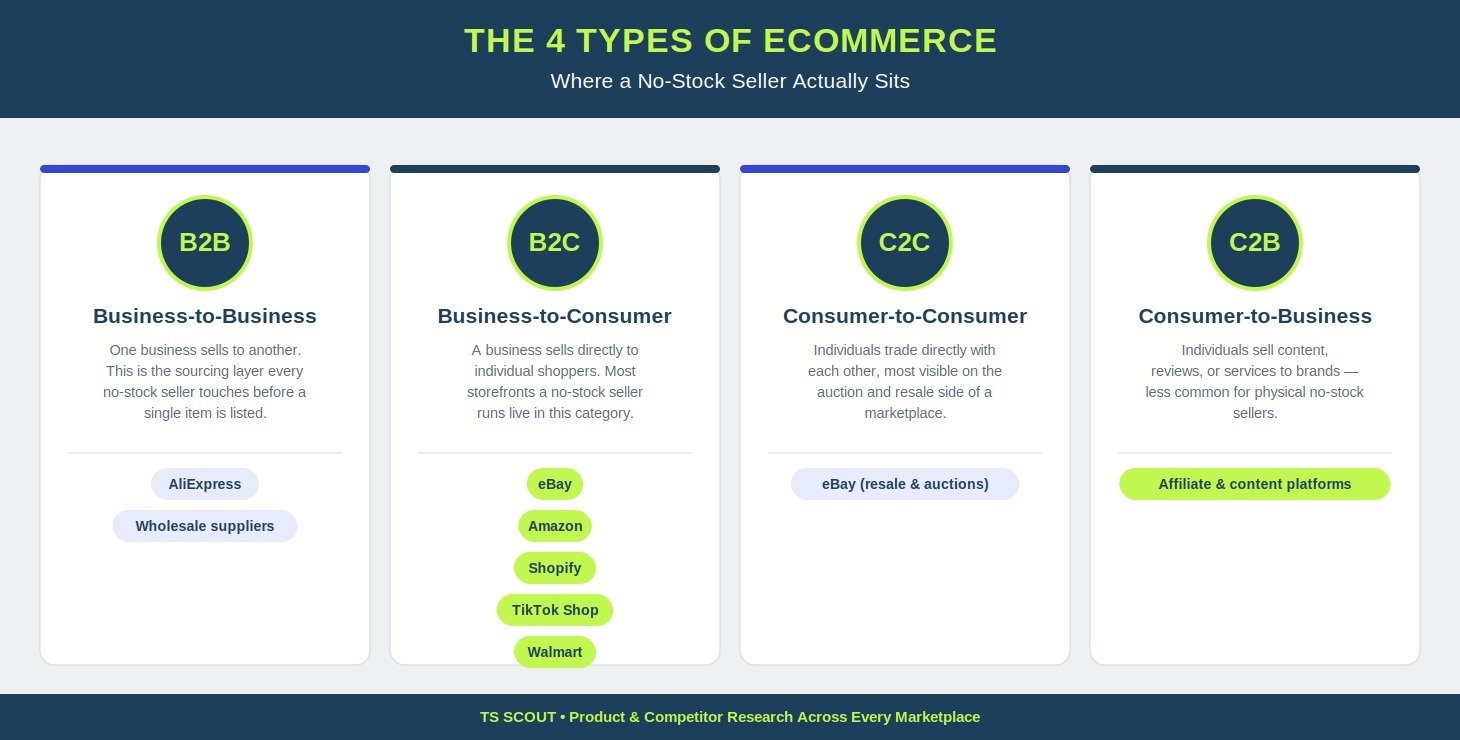
Ecommerce splits into a handful of core relationship types, and a no-stock seller usually operates inside more than one of them at the same time:
-
Business-to-consumer (B2C), a business sells directly to individual shoppers. This is where most eBay, Amazon, Shopify, and TikTok Shop storefronts live.
-
Business-to-business (B2B), one business sells to another, which is the layer a no-stock seller touches every time they source from an AliExpress or wholesale supplier.
-
Consumer-to-consumer (C2C), individuals trade directly with each other, most visible on eBay's auction and resale side.
-
Consumer-to-business (C2B), less common for physical sellers, but relevant to anyone monetizing content or reviews for brands.
A non-stockholding seller almost always sits between the B2B sourcing layer and the B2C selling layer at once, buying from a supplier as a business customer, then reselling as a consumer-facing brand. This dual position is exactly what makes The Complete Multi-Marketplace Ecommerce approach worth understanding before committing to a single channel, since the sourcing side and the selling side don't have to live on the same platform.
How Big Is the Ecommerce Market in 2026, and Is There Still Room for New Sellers?
The scale here isn't a marketing talking point, it's measurable and current. Global retail ecommerce revenue is projected to hit $6.88 trillion in 2026, according to Shopify's own global ecommerce data, now accounting for 21.1% of total retail sales worldwide. In the US, the U.S. Census Bureau put Q1 2026 e-commerce sales at $326.7 billion, or 16.9% of all retail spending. The UK tells a similar story: the Office for National Statistics reported that online sales climbed to 29.4% of total UK retail spending in June 2026, the highest share recorded since April 2021.
None of these numbers point to a saturated market closing its doors, they point to a channel still taking share from physical retail every quarter. For a seller reading up on Ecommerce in the UK, the real signal is that growth is coming from categories where non-stockholding models already compete well: clothing, electronics accessories, and seasonal goods.
Is Ecommerce Still Profitable in 2026 Without Holding Stock?
Profitability without inventory depends less on the market size and more on which cost lines you can avoid. A no-stock seller skips warehousing, unsold-stock write-offs, and upfront bulk-buying risk, but trades those savings for thinner per-unit margins and less control over shipping times. Realistic net margins for AliExpress-sourced resale typically land in the 10% to 30% range once marketplace fees, advertising, and returns are accounted for, while print-on-demand and digital products can run higher because there's no per-unit sourcing cost at all.
The seller who treats "profitable ecommerce business" as a guarantee rather than an outcome usually skips the step that actually protects margin: validating demand before listing. That's where 6 Profitable Niche Products in 2026 becomes more than a headline, niche selection is the single biggest lever a non-stockholding seller controls, since it decides both your competition level and your realistic price ceiling. If you haven't picked a lane yet, Start Your Own Online Business in 2026 walks through the foundational decisions before you list your first product.
Which Business Model Should a Non-Stockholding Seller Choose First?
Every no-stock model trades speed for margin differently. Here's how the main four compare:
|
Model |
Startup cost |
Typical margin |
Control over fulfillment |
|
AliExpress-sourced resale |
Low |
10–30% |
Low, supplier-dependent |
|
Print-on-demand |
Very low |
20–40% |
Medium, print partner controls speed |
|
Digital products |
Minimal |
60%+ |
High, no physical fulfillment |
|
Affiliate storefront |
Minimal |
Commission-based |
None, you never touch the sale |
Before locking in a model, it's worth checking real product-level demand rather than guessing. Express Product Research lets you search AliExpress by product name and filter by price, category, and sales performance, which turns "I think this will sell" into an actual number before you write a single product description. Sellers who skip this step tend to discover their margin problem after launch instead of before it, which is the difference between adjusting a plan and abandoning one. It's also worth browsing Best eCommerce Niches for 2026 if the product category itself is still an open question.
Which Marketplace Actually Fits Your Product and Budget?
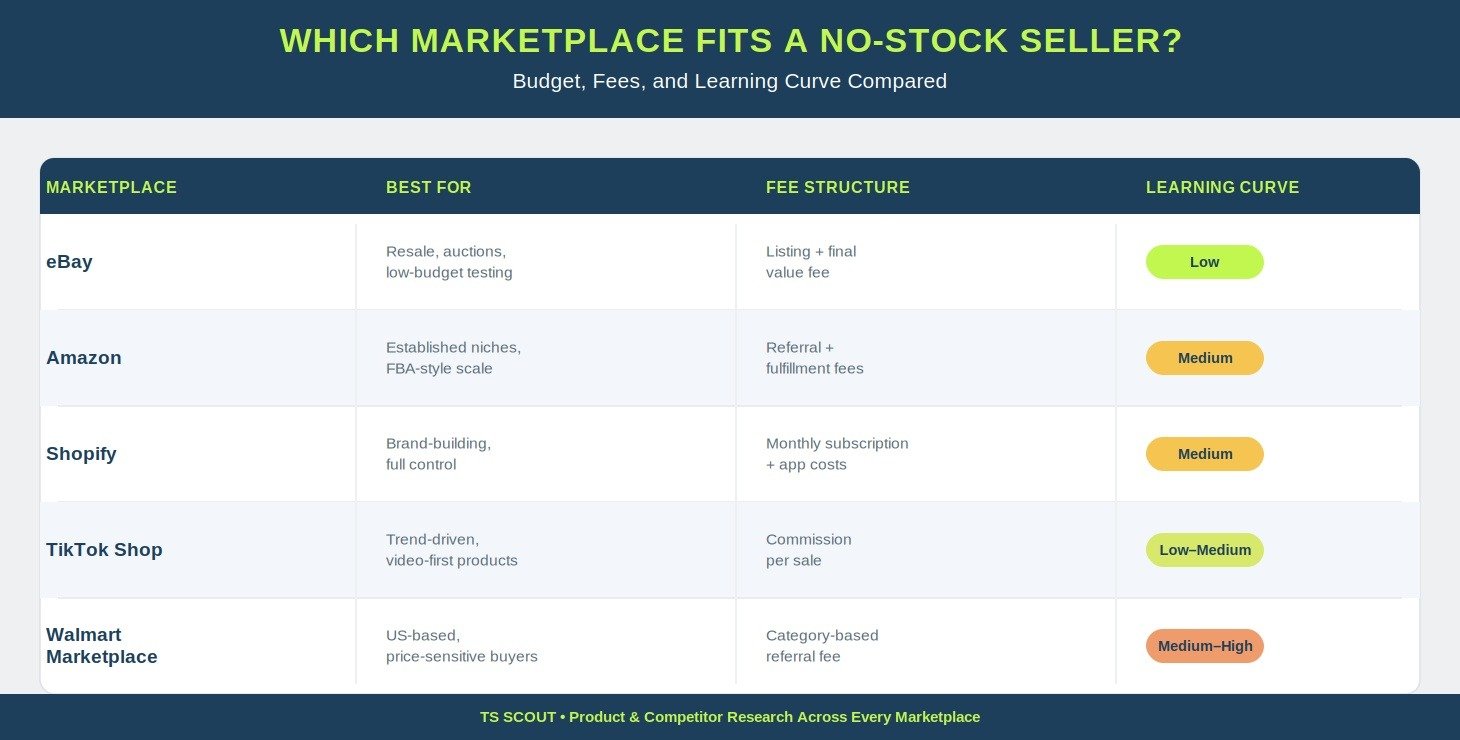
Marketplace choice is where most beginner sellers waste the most time, because each platform rewards a different kind of product and budget:
|
Marketplace |
Best for |
Fee structure |
Learning curve |
|
eBay |
Resale, auctions, low-budget testing |
Listing + final value fee |
Low |
|
Amazon |
Established niches, FBA-style scale |
Referral + fulfillment fees |
Medium |
|
Shopify |
Brand-building, full control |
Monthly subscription + app costs |
Medium |
|
TikTok Shop |
Trend-driven, video-first products |
Commission per sale |
Low–Medium |
|
Walmart Marketplace |
US-based, price-sensitive buyers |
Category-based referral fee |
Medium–High |
If eBay is on your shortlist, eBay Segment Insight shows demand, competition, and growth potential for a specific category before you list a single item, and eBay Product Research lets you filter existing listings by price, marketplace, and seller feedback to see what's already selling and at what volume, both far more precise than scrolling completed listings by hand. For anyone weighing Shopify against a marketplace, Shopify Competitor Research pulls product data, pricing, and sales performance straight from a specific competitor's store URL, and Shopify find stores surfaces real Shopify stores already selling in your target niche, so you're validating against actual market activity instead of assumptions. This is exactly the kind of decision covered in more depth in The Best Marketplaces for UK & US Ecommerce Sellers and Best eCommerce Sites for Small Business.
What Separates a Profitable Store From One That Quietly Fails?
Take a UK-based seller who launched a phone-accessories store on AliExpress sourcing in early 2025. The niche looked promising on paper, low competition, decent search volume, but the seller never checked what similar stores were actually charging or how many units they were moving. Six months in, margins had collapsed to almost nothing because three competitors were running the same product at a lower price point the seller hadn't priced against.
The lesson isn't "pick a better niche" in the abstract, it's that profitable stores validate pricing and volume against real competitor data before launch, not after. That validation step matters more in categories like Best Clothing Suppliers for Ecommerce in 2026 and Best Jewelry Suppliers, where visual products live or die on perceived brand quality. Once the numbers check out, the next differentiator is consistency, a store that looks the same today as it did on day one rarely earns repeat buyers, which is the whole premise behind How to Build eCommerce Brand Recognition That Lasts.
Why Do So Many No-Stock Sellers Rely on More Than One Platform?
A non-stockholding seller has zero control over a marketplace's policy changes, algorithm shifts, or account suspensions, because the entire business sits on infrastructure someone else owns. That's the exact exposure covered in The Hidden Risk of Single-Platform Selling, a single policy update or a wrongful suspension can zero out revenue overnight if there's no second channel to fall back on. Multi-marketplace selling isn't about spreading yourself thin; it's about making sure one platform's decision can't end your business in an afternoon. How to Scale Ecommerce Across Marketplaces covers the operational side of running the same catalog across two or three channels without doubling your workload.
Can AI Tools Make a No-Stock Store More Profitable?
AI has moved from a nice-to-have to a genuine margin lever in 2026, automated repricing, demand forecasting, and customer-service chat handling all reduce the manual hours a solo no-stock seller has to spend just keeping the lights on.
The sellers seeing the biggest gains aren't the ones adopting every new AI tool that launches, they're the ones applying automation specifically to the tasks that used to eat the most time without adding value, like manually checking competitor prices daily. AI Tools for Ecommerce Sellers breaks down which categories of automation actually move the needle for a seller running lean without a team behind them.
Is Selling Through Reddit or Niche Communities Worth It for a No-Stock Seller?
Reddit and niche forums can drive highly targeted traffic, but they punish anything that reads like an ad, a no-stock seller posting a product link with no context will get removed or ignored within minutes.
The channel works when it's treated as a research and community-building tool first, not a sales funnel. Is Reddit Actually Worth It for Non-Stockholding Sellers in 2026? goes into exactly where this channel earns its place in a seller's marketing mix and where it wastes time better spent elsewhere.
Ready to Turn "What Is Ecommerce" Into Your Own Profitable Answer?
Every section above answers a different piece of the same question, and the sellers who move fastest from "what is ecommerce" to an actual profitable store are the ones who validate before they launch instead of after.
TS Scout gives you $1 access for 14 days to research real product and competitor data across eBay, Shopify, and AliExpress before you commit a single dollar to inventory decisions that aren't yours to hold. Start your trial today and make your first listing a validated one, not a guess.
FAQs
-
What is the difference between ecommerce and dropshipping?
Ecommerce is the entire category of buying and selling through digital channels. Dropshipping is one fulfillment method inside that category, where a supplier ships directly to the buyer instead of the seller holding stock.
-
Do I need a business license to sell online without holding stock?
Requirements vary by country and platform, but most marketplaces require sellers to register as a business once sales pass a certain threshold, even if you never touch physical inventory.
-
How much money do I need to start a profitable ecommerce business in 2026?
Digital products and print-on-demand can start with minimal upfront cost, while AliExpress-sourced resale mainly requires budget for advertising and marketplace fees rather than bulk inventory.
-
Which marketplace is easiest for a beginner with no stock to start on?
eBay generally has the lowest barrier to entry for testing a niche before committing to a subscription-based platform like Shopify or Walmart Marketplace.
-
Is ecommerce still profitable with so many sellers already in the market?
Yes, global ecommerce revenue is still growing year over year according to both Shopify and the U.S. Census Bureau, and growth is concentrated in specific niches rather than being evenly spread, which is exactly why niche validation matters more than market size alone.
-
Can I run a no-stock ecommerce business from the UK while selling to US customers?
Yes, and it's common, most non-stockholding models route sourcing and fulfillment internationally regardless of where the seller is based, though shipping times and customs rules should be checked per marketplace.
-
How long does it take to become profitable in ecommerce without holding inventory?
It varies by model and niche validation quality, but sellers who test demand and competitor pricing before launch typically reach profitability faster than those who list first and adjust later.
like?


Table of Contents
- What Does Ecommerce Actually Mean for a Seller Who Never Touches Inventory?
- What Are the Main Types of Ecommerce, and Which One Fits a No-Stock Business?
- How Big Is the Ecommerce Market in 2026, and Is There Still Room for New Sellers?
- Is Ecommerce Still Profitable in 2026 Without Holding Stock?
- Which Business Model Should a Non-Stockholding Seller Choose First?
- Which Marketplace Actually Fits Your Product and Budget?
- What Separates a Profitable Store From One That Quietly Fails?
- Why Do So Many No-Stock Sellers Rely on More Than One Platform?
- Can AI Tools Make a No-Stock Store More Profitable?
- Is Selling Through Reddit or Niche Communities Worth It for a No-Stock Seller?
- Ready to Turn "What Is Ecommerce" Into Your Own Profitable Answer?
- FAQs