

AI Tools for Ecommerce Sellers Actually Trust in 2026
- 2025-07-04
-
 0
0

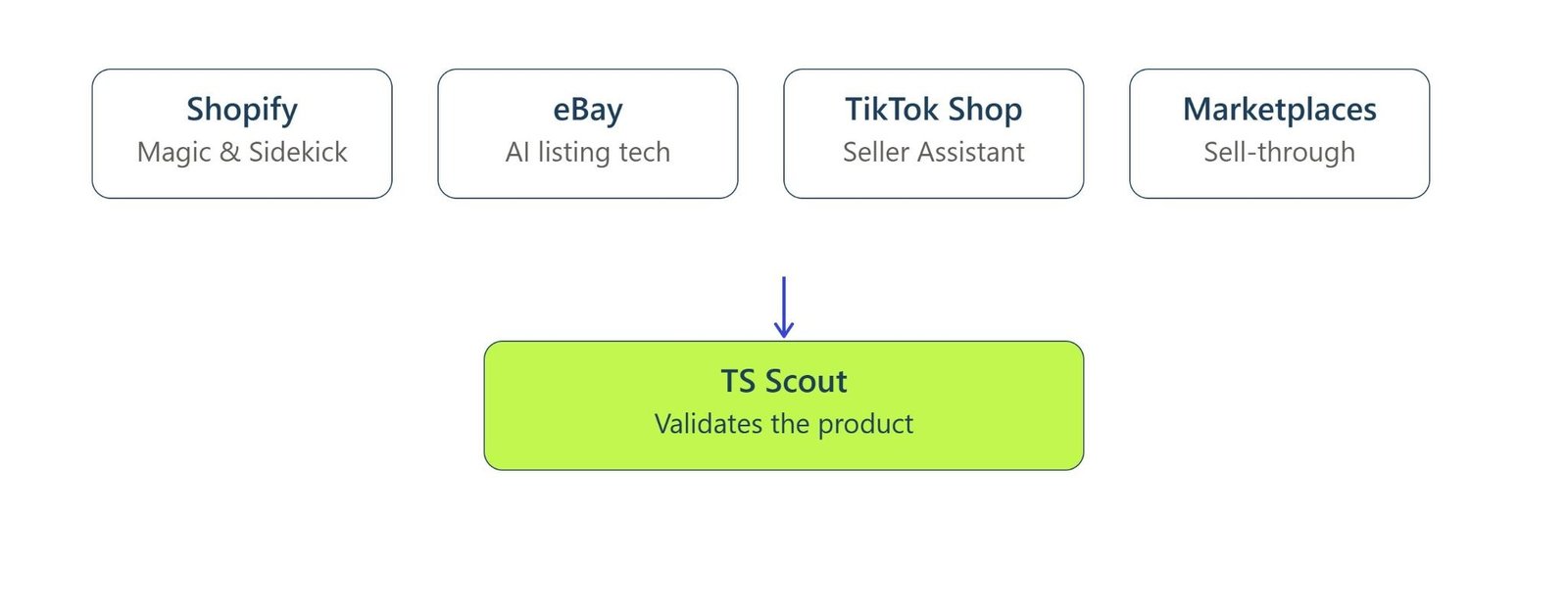
If you're running an online store without a warehouse, a spare room full of stock, or even a single unit sitting at home, every hour you spend guessing which product to list is an hour you're not making money. That's the real problem AI tools for ecommerce are supposed to solve, not automation for its own sake, but faster, better decisions for sellers who have no stock buffer to hide a bad call. Shopify's Help Center confirms that Shopify Magic, its free AI suite, is now built into every store regardless of plan, covering everything from product descriptions to email copy. eBay Inc. reports that more than 10 million sellers worldwide have already used its AI listing features to create over 100 million listings.
TikTok Shop has gone even further, embedding an AI business advisor called Seller Assistant directly into Seller Center, free for every seller who signs up. None of that tells you which product to sell in the first place, and for a seller with zero inventory buffer, that's the one decision that actually determines whether an AI-written listing ever makes a sale. This guide breaks down the AI tools for ecommerce that non-stockholding sellers are genuinely using in 2026, what each one is good at, where it falls short, and how to stack free platform AI with paid research tools without wasting a subscription. Start with the question that decides everything else: what actually counts as an AI tool worth your time.
What Are AI Tools for Ecommerce, and Why Do Non-Stock Sellers Need Them Most?
AI tools for ecommerce are software systems that use machine learning or large language models to handle a specific seller task, finding products, writing listings, tracking competitors, pricing, or answering customer messages, faster and with less guesswork than doing it manually. For a seller who holds physical inventory, a wrong call is expensive but recoverable: you can discount slow stock or bundle it out. For a seller with no inventory at all, the cost of a wrong call isn't stuck stock, it's wasted listing hours, wasted ad spend, and a damaged account history on a platform that already scrutinizes non-stockholding sellers closely. That's why the AI tools that matter most for this audience aren't the flashiest ones; they're the ones that remove guesswork from the decisions with no undo button. If you're building specifically for a UK audience, as we cover in our breakdown of running ecommerce in the UK, this matters even more, since shipping times and platform-specific seller protections change which tools are worth paying for.
Which AI Tools Actually Help You Find a Winning Product Without Holding Stock?
Product research is the one AI category that pays for itself before you've made a single sale, because it's the only category that changes what you sell, not just how it looks or how fast you can answer a question about it. For eBay sellers, the eBay Segment Insight tool analyzes sold listings and demand gaps to flag categories worth entering before they get saturated. Once a category looks promising, the eBay Product Research Tool goes deeper on the specific listings inside it, checking sell-through, price bands, and seller count before you write a single word of copy.
For sellers who split their catalog across marketplaces, the Amazon Scanner and Walmart Scanner do the same job on their respective platforms, tracking sell-through and price movement without you manually refreshing search results all day. Sellers sourcing from AliExpress get the same visibility through the Express Scan tool and Express Source Finder ool, which surface supplier reliability and shipping data before you commit a listing to a product you can't physically inspect.
|
Platform |
AI research tool |
What it actually flags |
|
eBay |
eBay Niche Finder Tool + eBay Product Research Tool |
Underserved categories, sell-through, price bands |
|
Amazon |
Amazon Scanner |
Sell-through rate, listing saturation |
|
Walmart |
Walmart Watch Tool |
Price shifts, competitor stock status |
|
AliExpress |
Express Scan Tool / Express Source Finder Tool |
Supplier reliability, shipping risk |
None of this replaces knowing which category of product survives past a single trend cycle. That's where a seller's own research needs to go beyond software: pairing a tool's live data with a proven niche list, like our 50+ Proven Niche Ideas That Sell All Year or our current Best eCommerce Niches for 2026 roundup, keeps you from optimizing a product that was never going to last. A genuine Evergreen Product, something with steady, non-seasonal demand, is still the safest starting point for a seller with no stock cushion to absorb a slow month.
Can AI Really Write and Optimize Your Listings for You?
Yes, and this is the part of the AI ecommerce stack that's matured the fastest. Shopify Magic generates product descriptions, email subject lines, and even theme content directly inside the admin, free on every plan. On eBay, sellers can upload a product photo and let eBay's AI listing technology fill in the title, category, and item specifics, a feature that eBay says has already produced billions of dollars in gross merchandise volume across its user base. Photos matter just as much as copy for a seller who never physically holds the product: the same eBay system can generate polished, AI-created backgrounds for product photos, and Shopify Magic can retouch and edit images from inside the same admin panel used for listing text. The catch is that all of this is only as good as the product decision behind it, none of it tells you whether the item is worth listing at all. For sellers sourcing visually rather than by exact product name, the Express Image Match tool closes that specific gap by letting you search AliExpress using nothing but an image URL, so you can go from "I saw this trending on TikTok" to a sourced, ready-to-list product without typing a single keyword.
How Do AI Pricing Tools for Ecommerce Keep You Competitive Without Manual Checking Every Day?
Manual price-checking doesn't scale past a handful of SKUs, which is exactly why pricing was one of the first ecommerce tasks AI took over. General-purpose tools like Prisync and Competera track competitor pricing across marketplaces and flag when you've drifted out of range. For eBay specifically, the eBay Competitor Research tool goes a step further for non-stockholding sellers: it tracks what competing sellers are actually moving, at what price, and how often, so you're pricing against real recent sales rather than a stale listing that's been sitting unsold for months. This matters even more when comparing sourcing costs across marketplaces; sellers weighing AliExpress against lower-cost alternatives should see our full AliExpress vs Temu comparison before assuming the cheaper listed price actually wins once shipping and return rates are factored in.
What AI Tools Handle Customer Questions So You're Not Glued to Your Inbox?
Customer service AI is the category where "free and built-in" already beats most paid alternatives for smaller sellers. TikTok Shop's Seller Assistant is embedded directly into Seller Center and answers policy, shipping, and performance questions in real time, at no extra cost, for every seller on the platform. For stores that need broader coverage across email, chat, and social, dedicated tools like Zendesk AI and Tidio add ticket routing and suggested replies on top of what platforms offer natively. The right call here is usually the cheapest one: exhaust what your platform gives you for free before paying for a third-party layer you may not need yet.
How Can AI Help You Catch the Next Trending Niche Before Everyone Else Does?
Spotting a trend early is the closest thing a non-stockholding seller has to a competitive moat, since you can react to demand without writing off unsold inventory if you're wrong. This is exactly the edge AI tools for ecommerce are meant to give a trend-driven seller: the TikTok Scanner tool tracks rising search and engagement patterns on TikTok Shop before they peak, giving sellers a lead-time window that's otherwise impossible to catch manually. For Shopify-based sellers, the Shopify Find Stores and Shopify Competitors Research tool reveal which stores are quietly scaling a niche right now, while Shopify Insight breaks down what's actually driving their traffic and sales. If the trend lands in fashion or accessories, two of the categories that move fastest on TikTok Shop, cross-check fulfillment options against our guides to the Best Clothing Suppliers for Ecommerce and Best Jewelry Suppliers before listing, since sourcing speed is what turns a trend window into an actual sale. Trends that don't hold up past a season are also worth weighing against steadier alternatives like an Evergreen High-Ticket Product or Evergreen Digital Product Ideas, both of which sidestep the restocking pressure a viral trend creates.
Which Platform Gives Non-Stock Sellers the Most AI Firepower in 2026?
No single platform's AI stack covers the full seller workflow,research, listing, pricing, and support, which is exactly why most non-stockholding sellers end up combining a free platform tool with one paid research tool rather than paying for five separate subscriptions.
|
Platform |
Strongest native AI |
Where it stops helping |
|
Shopify |
Magic (content) + Sidekick (store assistant) |
Doesn't validate product-market fit |
|
eBay |
AI listing technology + sold-comp pricing signals |
Free tier only writes title + description |
|
TikTok Shop |
Seller Assistant (support + performance) |
Doesn't source or vet suppliers |
|
Amazon / Walmart |
Marketplace-side sell-through data |
No cross-platform trend detection |
Shopify's own product page describes Sidekick as a conversational assistant that can adjust theme settings, draft marketing emails, and complete admin tasks from a simple chat box, a layer most sellers only discover once they've outgrown Magic's content tools alone.
Case study: what stacking free and paid AI actually looks like. Take a seller running one Shopify store and one eBay account, holding no physical stock. On eBay, they use the free AI listing technology to draft titles and item specifics from a product photo, drawing on the same system eBay says has already powered well over 100 million AI-assisted listings. Before that listing goes live, they run the product through the eBay Niche Finder Tool and eBay Product Research Tool to confirm the category isn't already saturated. On Shopify, Magic writes the product description and Sidekick flags a discount code worth testing, while Shopify Insight shows which competing stores are already scaling the same niche. The free tools handle the writing and the store admin; the paid research tools handle the one decision neither platform's AI is built to make, whether the product was worth listing at all.
Is It Worth Testing a Product Before You Commit to It as a Non-Stock Seller?
Almost always, and it costs less than most sellers assume. Before scaling ad spend or listing across every marketplace at once, run the product through a low-cost validation step, our guide to how to Test an Evergreen Product walks through exactly how to do this without overcommitting budget. Community platforms are also a legitimate, free signal check: our breakdown of Is Reddit Actually Worth It covers how sellers use niche subreddits to gauge real demand before a single ad dollar is spent. A quick pre-launch checklist:
-
Confirm sell-through data from your research tool, not just search volume
-
Validate supplier reliability before writing the listing
-
Test messaging on one channel before scaling to three
-
Set a hard stop, budget or days, before you call the test a failure
So Which AI Tool Should You Actually Start With?
Start with the tool that closes the gap none of the free platform AI covers: confirming the product itself is worth your time before a single listing goes live. Try the full TS Scout research toolset for $1, 14 days, full access and run your next product idea through it before you write a single listing.
FAQS
-
Do I need to hold inventory to use AI tools for ecommerce?
No. Most of the tools in this guide, product research, listing generation, pricing tracking, and customer support AI, work the same way whether you hold stock or fulfill through a supplier.
-
Which AI tool is best for finding a winning product with no upfront risk?
A dedicated research tool that tracks live sell-through and competitor data, such as the eBay Niche Finder Tool or Amazon Scanner, gives you evidence before you commit to a listing, unlike general keyword tools that only show search volume.
-
Are free platform AI tools like Shopify Magic or eBay's AI listing technology enough on their own?
They're strong for content and speed but don't validate whether a product is worth listing in the first place. Most sellers pair them with a paid research tool rather than relying on either alone.
-
Is dropshipping still a viable model with AI tools in 2026?
It's more competitive than a few years ago, but AI-driven research and listing tools have narrowed the gap for sellers who validate demand before listing, rather than listing first and hoping.
-
How much time can AI realistically save a seller who doesn't hold stock?
Platform data suggests meaningful time savings on listing creation alone, eBay's AI listing tools have already been used to generate more than 100 million listings, though the biggest time savings come from cutting failed product tests, not just faster copywriting.
like?


Table of Contents
- What Are AI Tools for Ecommerce, and Why Do Non-Stock Sellers Need Them Most?
- Which AI Tools Actually Help You Find a Winning Product Without Holding Stock?
- Can AI Really Write and Optimize Your Listings for You?
- How Do AI Pricing Tools for Ecommerce Keep You Competitive Without Manual Checking Every Day?
- What AI Tools Handle Customer Questions So You're Not Glued to Your Inbox?
- How Can AI Help You Catch the Next Trending Niche Before Everyone Else Does?
- Which Platform Gives Non-Stock Sellers the Most AI Firepower in 2026?
- Is It Worth Testing a Product Before You Commit to It as a Non-Stock Seller?
- So Which AI Tool Should You Actually Start With?
- FAQS


