
6 Profitable Niche Products in 2026: How to Find and Validate Them on Amazon, eBay, Shopify and TikTok Shop
- 2026-06-06
-
 1
1

Most online sellers don't fail from lack of effort. They fail because they bet on a product before checking whether anyone was already paying for it, and profitable niche products almost never reveal themselves through instinct. The demand is real: the U.S. Census Bureau estimates U.S. retail e-commerce sales at $340.2 billion in Q2 2026, up 12.2% from a year earlier and 17.1% of total retail sales. Growth is also concentrating in specific corners. In eBay's Q2 2026 results, GMV reached $22.4 billion, up 15%, and on the earnings call management said focus categories grew 26% and passed 40% of total GMV for the first time. Specialization is outrunning breadth.
This guide shows how to find profitable niche products with numbers instead of hunches, and how to confirm them on Amazon, eBay, Walmart, TikTok Shop, Shopify and AliExpress before you commit to a single unit. You'll get a four-filter scorecard, six niches with an honest stock-free verdict, a platform-by-platform validation workflow, and fee math that survives real costs. Every idea comes with what to verify first. Let's start with the question that saves most sellers months: what actually makes a niche profitable?
What Are Profitable Niche Products, and How Do They Differ From Merely Popular Ones?
Popular means many people want it. Profitable niche products mean a specific group wants it badly enough to pay a price that still leaves you money after every cost. That difference shows up in four measurable filters:
|
Filter |
What to measure |
Red flag |
|
Proven demand |
Units actually sold over 90 days and 12 months, not search interest |
Lots of searches, few completed sales |
|
Beatable competition |
Sell-through (sold ÷ active listings × 100) and how concentrated sales are among sellers |
One or two sellers take most of the sales |
|
Margin after costs |
Price − product cost − platform fees − shipping − ads |
Net margin disappears once test ad spend is added |
|
Staying power |
Demand spread across 12 months |
A single spike tied to a viral moment |
Sell-through is a ratio, so always note the time window you measured. The fourth filter is where sellers get burned. If you're unsure what is an evergreen product, the short version is one whose demand doesn't depend on a single moment, which is what lets you plan inventory and ad budgets. Run any idea through all four filters and the list of true profitable niche products gets short quickly, which is the point.
Is Ecommerce Still Growing Fast Enough to Build a Niche Business in 2026?
Yes, with a caveat about where the growth goes. Census data shows e-commerce grew 12.2% year over year in Q2 2026 while total retail grew 6.7%, though the figures are adjusted for seasonality and not for price changes, so part of the rise is price, not volume.
eBay's Q2 2026 results add a marketplace angle: active buyers reached 136 million, up 2%, while GMV rose 15%. Buyers grew slowly and spending grew fast. One reasonable reading is that each buyer is now worth competing for, and that sellers with precise listings beat generalists. Growth won't stay this fast, though, since management expects GMV growth to decelerate in Q3.
Costs matter as much as demand. Amazon's fee announcement says U.S. referral and FBA fees did not increase in 2025, and 2026 FBA fees rise by an average of $0.08 per unit. A stable cost base plus specialist demand is the setting where profitable niche products are won on purpose rather than by luck. If you haven't chosen where to sell yet, comparing the best ecommerce sites for small business first will save you a migration later.
Which Profitable Niche Products Are Worth Testing in 2026?
Not every category deserves your test budget. The six below pair marketplace momentum or repeat-purchase potential with a structure that breaks into sub-niches, so treat them as profitable niche products to test, not to assume.
|
Niche |
Why it's worth testing |
Stock-free fit |
Suggested test platform |
Check first |
|
Collectibles & trading cards |
eBay names collectibles among the areas driving its growth |
Low: you usually hold authentic stock |
eBay |
Authenticity, grading, price swings |
|
Auto parts & fitment accessories |
Motors is a named growth area; buyers search by exact vehicle |
Yes, via wholesale suppliers |
eBay, Amazon |
Fitment data accuracy, returns |
|
Refurbished electronics & tech accessories |
Refurbished is a named growth area; accessories are low-ticket |
Partly |
eBay, Amazon, Walmart |
Condition grading discipline |
|
Resale fashion & sneakers |
Fashion is a named growth area |
Low: stock is one-of-a-kind |
eBay |
Authenticity, sizing returns |
|
Pet sub-niches |
Repeat purchases from identity-driven buyers (a hypothesis to validate) |
Yes |
Amazon, TikTok Shop, Shopify |
Product safety claims |
|
Natural skincare sub-niches |
Repeat purchases, concern-specific buyers (a hypothesis to validate) |
Yes, with a compliant supplier |
TikTok Shop, Shopify, Amazon |
FDA duties in Section 8 |
The first four rows rest on eBay's own reporting. The last two rest on buying behavior, so let Section 4 confirm them before you spend anything.
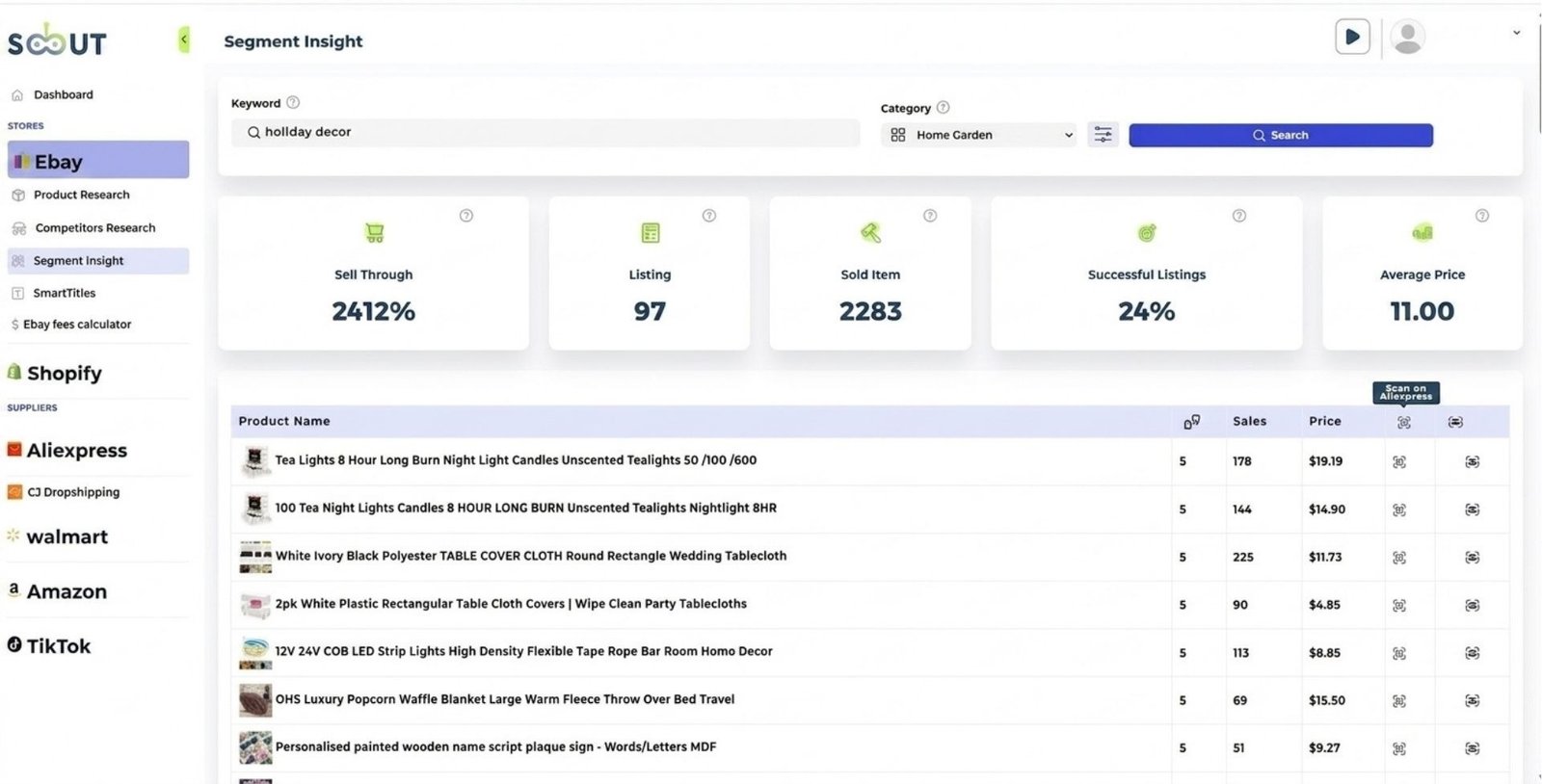
Broad categories rarely pay, so break them into segments first. eBay Segment Insight analyzes specific product categories and market segments and gives niche-level data on demand, competition and growth potential, which tells you which corner of a category deserves a test. For the momentum side, TikTok Shop Scanner analyzes trending products on TikTok Shop, and lets you search a product by name and see how many units are selling and at what price. It's built to catch viral, fast-moving opportunities in niches like pet and skincare. Consumable niches like these tend to behave like evergreen product categories, with demand that repeats instead of spiking. Then narrow each one:
-
Collectibles: one franchise or era, not "trading cards."
-
Auto parts: a specific make, model and year range where fitment is the buyer's main worry.
-
Refurbished tech: one device family with a written grading standard.
-
Resale fashion: one brand, decade or size range.
-
Pet: a life stage or dietary need, such as senior dogs or sensitive stomachs.
-
Skincare: one skin concern with a clear ingredient position.
The best profitable niche products are narrow enough that a buyer thinks "this was made for me."
How Do You Validate Profitable Niche Products on Any Platform Before Buying Inventory?
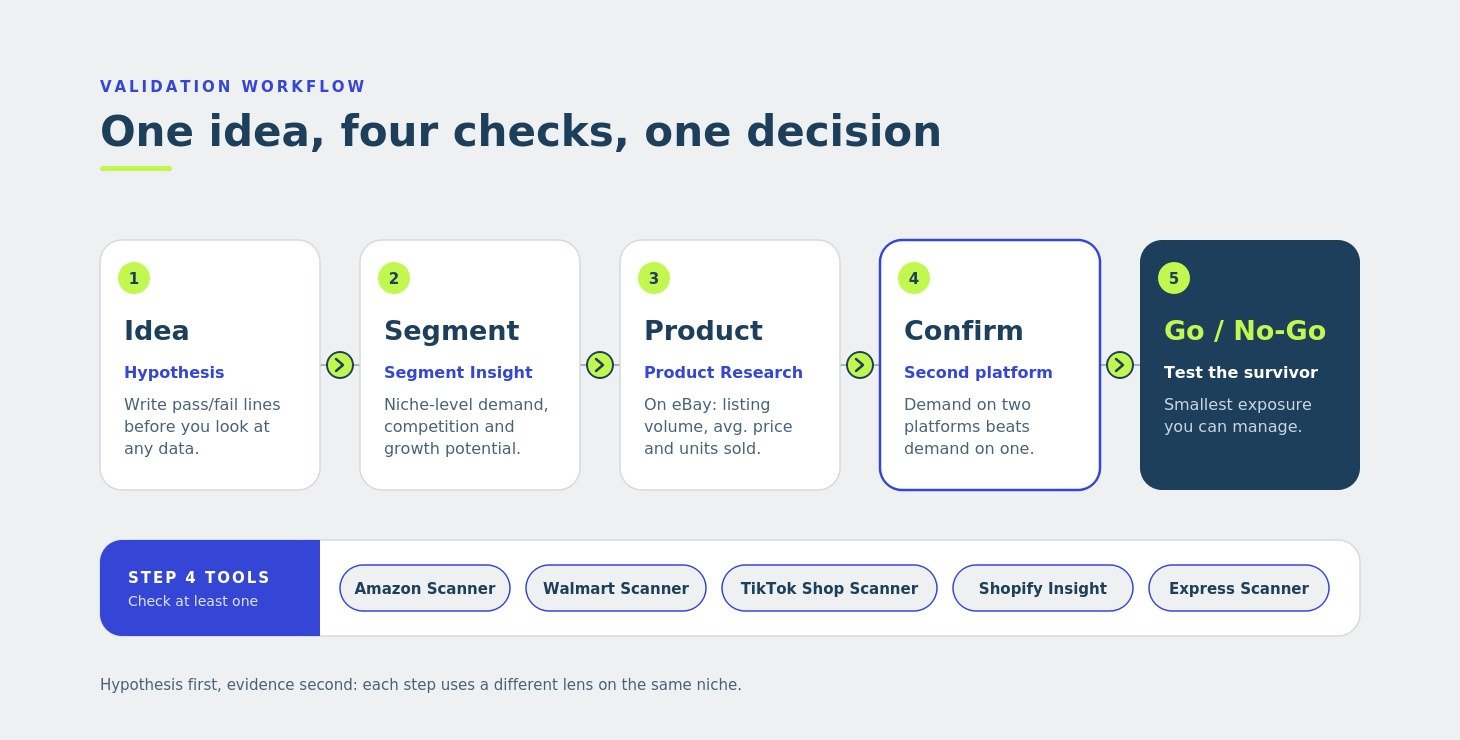
Where you validate depends on where you'll sell, and the strongest signal is a niche that shows demand on more than one platform. Each platform gives you a different lens:
|
Platform |
TS Scout tool |
What it shows |
|
eBay |
Segment Insight + eBay Product Research |
Niche-level demand, competition and growth; then listing volume, average price and total units sold, filtered by price, marketplace and seller feedback |
|
Amazon |
Trending and high-demand products, popular items and emerging opportunities |
|
|
Walmart |
Top-performing products on Walmart Marketplace, demand patterns and trends |
|
|
TikTok Shop |
TikTok Shop Scanner |
Trending products and viral, fast-moving opportunities |
|
Shopify |
Units sold, average prices, number of listings and sellers, filtered by price range, shipping location, time period and category |
|
|
AliExpress |
Trending and top-performing products; product-level data searched by name and filtered by price, category and sales performance |
Here's the order that keeps validation of profitable niche products cheap:
-
Start with the platform's own data. eBay's built-in Product Research (the tool many sellers still call Terapeak) offers preset research periods from 7 days to 3 years, but sell-through is available only for searches covering items sold within the last 90 days. It's free and first-party, so use it.
-
Find the segment, then the product. Segment Insight narrows the category, and eBay Product Research then lets you search a specific product and read its listing volume, average price and units sold. The platform's own tool tells you whether an item is sold on that platform. TS Scout's scanners tell you whether the niche is also moving elsewhere. That's the discipline behind the science of product research: form a hypothesis, then look for evidence in independent places.
-
Confirm across platforms. Check Amazon Scanner and Walmart Scanner for mainstream demand, TikTok Shop Scanner for momentum, Shopify Insight to see how many sellers and listings sit behind the sales (that's your competition), and Express Scanner for supply-side momentum on AliExpress. Demand on two platforms beats demand on one.
-
Set pass/fail lines before you look. Decide a minimum number of units sold, a ceiling on seller concentration, and a net-margin floor. Profitable niche products should survive rules you wrote first. Then test the survivor cheaply, following how to test an evergreen product.
Will the Numbers Still Work After Fees, Shipping and Ads?
Every platform takes a different cut, so model the platform you'll actually use:
|
Platform |
What the fee looks like |
|
eBay |
Per eBay's fee update, most categories carry a 13.6% final value fee for sellers without a Store or with a Starter Store. eBay Seller Center puts the overall range at 2.5% to 15.3% by category, plus a per-order fee: $0.30 for orders of $10 or less, $0.40 above. In most categories that's about $14.00 on a $100 sale: 13.6% plus $0.40 |
|
Amazon |
Per Amazon's pricing page, referral fees vary by category and are charged as a percentage of the total sales price or a minimum amount, whichever is greater. Some categories use price tiers, so check your category's exact rate. Amazon's fee announcement (Section 2) says referral and FBA fees did not increase in 2025 |
|
Walmart |
Per Walmart Marketplace pricing, referral fees vary by category and are deducted only when a sale completes, with no setup or monthly fees |
|
TikTok Shop |
TikTok Shop's referral-fee policy states a 6% referral fee on qualified orders. Confirm the current rate for your category in Seller Center, and remember that any affiliate commissions and ad spend you choose come on top |
|
Shopify (own store) |
No marketplace commission, but per Shopify's pricing page you pay a plan subscription ($39, $105 or $399 a month on Basic, Grow and Advanced when billed monthly, less on annual billing) plus card-processing rates that start at 2.9% + $0.30 online on Basic and fall to 2.5% + $0.30 on Advanced. An outside payment provider adds a transaction fee |
Rates differ by category and Store status. eBay's schedule lists trading cards at 13.25% and guitars at 6.7%, for example, and Store subscribers pay other rates, so look up your category before you model it.
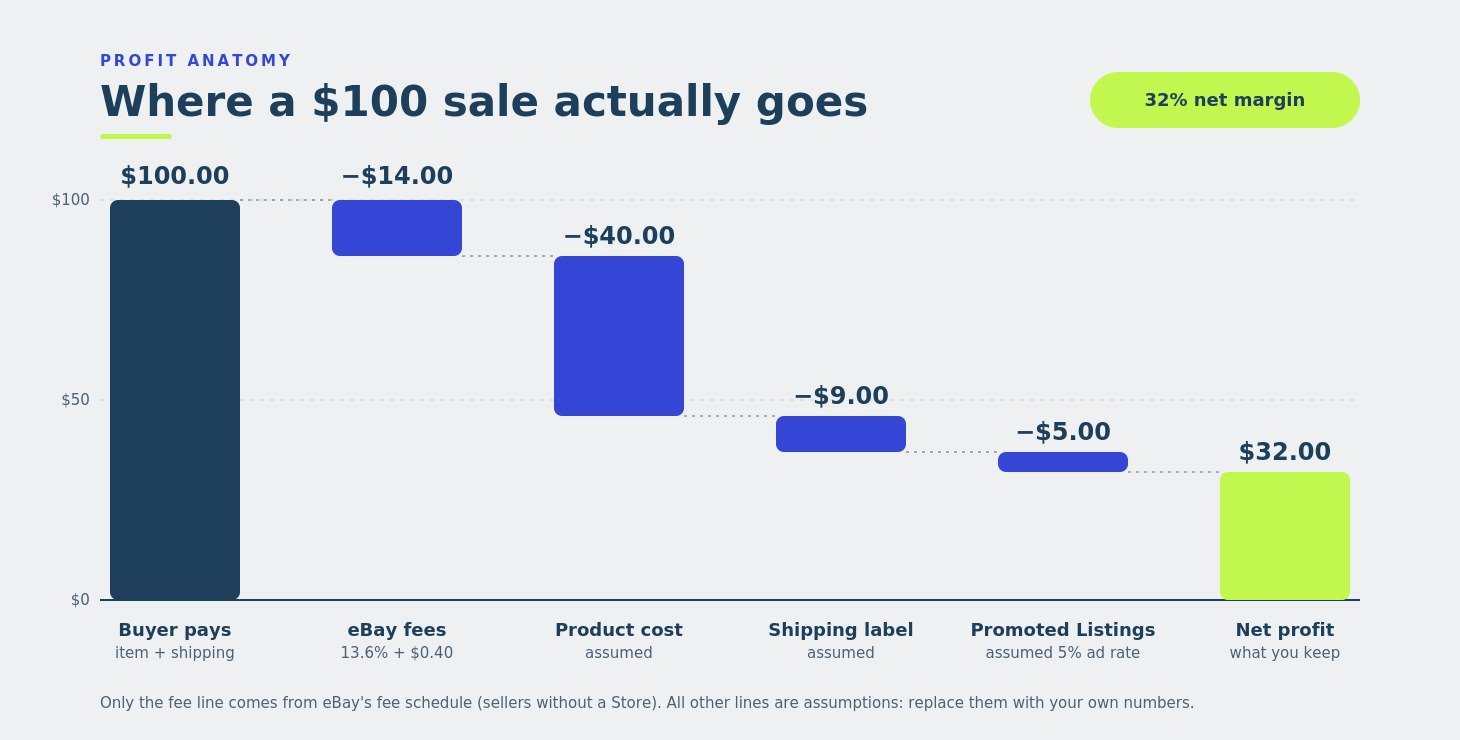
Here's the worked example on eBay. Only the fee line comes from eBay's schedule (for a seller without a Store). The rest are assumptions to replace with your own:
|
Line |
Amount |
|
Buyer pays (item + shipping) |
$100.00 |
|
eBay fees (13.6% + $0.40) |
−$14.00 |
|
Product cost (assumed) |
−$40.00 |
|
Shipping label (assumed) |
−$9.00 |
|
Promoted Listings at an assumed 5% ad rate |
−$5.00 |
|
Net profit |
$32.00 (32%) |
The ad line isn't optional in practice: roughly 1.3 billion of eBay's 2.6 billion listings are promoted, and the ad fee is charged only if the item sells, so it's a variable cost you can model. Reading a sale line by line is the profit anatomy of a product, and profitable niche products are simply the ones where every line is verified rather than guessed. Price is the input most sellers guess. Set it against live evidence: eBay Product Research shows average price and units sold, while Amazon Scanner and Walmart Scanner show what top-performing products cost on those marketplaces.
Price level also changes the math. Higher-priced items carry a lower effective fee rate because the per-order fee has less impact, which is why evergreen high-ticket product ideas deserve a look if your niche allows it. Either way, a niche only counts among profitable niche products if the net line survives.
Where Do You Source Niche Products Without Holding Stock?
Stock-free selling is legitimate, but the marketplace rules decide whether it's safe. Read the policy of the platform you sell on before you sign a supplier. On eBay, drop shipping is allowed if you own the items before listing or have an agreement with a wholesale supplier, and a user agreement from another retailer or marketplace doesn't count. The penalties range from ended or hidden listings to lowered seller rating and account suspension.
That rule shapes how you use research tools. Finding the same product on Amazon or Walmart is useful for comparing price and demand, but buying from a retailer after an eBay sale to fulfill it is what the policy prohibits. For the supply side, Express Scanner highlights AliExpress products with strong demand and consistent sales activity, and Product Research lets you search by name and filter by price, category and sales performance. That way you compare suppliers on the same product with real sales data instead of guessing.
A supplier is worth using only if it passes five checks:
-
A written wholesale agreement, not just a retail account.
-
Handling and shipping times that fit inside the delivery promise in your listing.
-
Tracking you can upload on time.
-
A sample order you've inspected yourself.
-
A clear return path, because the buyer deals with you, not your supplier.
The full vetting process is in find reliable ecommerce suppliers, and apparel sellers have their own shortlist in best clothing suppliers for ecommerce. If even a stock-free supplier feels like too much operational weight, evergreen digital product ideas remove physical fulfillment entirely. Sourcing is where many profitable niche products lose their profit, so treat it as part of validation, not a step after it.
How Do You Find the Gap Inside a Niche Competitors Already Serve?
Demand data tells you a niche is real. Competitor data tells you where you can enter. Shopify Find Stores lets you select a product or niche and discover the Shopify stores selling in that market. It shows how many orders each store received in your selected time frame, their total revenue, and shipping regions, which helps you map competitors and validate the niche against real activity. Shopify Insight then goes product-level, showing units sold, average prices and number of listings by shipping location and time period. A workable method:
-
Pick three stores already selling in your sub-niche.
-
Sort them by revenue and note their top performers.
-
Look for products with strong sales and few sellers.
-
Compare price ladders to find gaps between the cheap and premium tiers.
-
Note what none of them offer: bundles, sizes, variants, faster handling.
Once you know who the rivals are, competitor price tracking to protect margins turns their pricing moves into an early-warning system instead of a surprise. Spotting a gap is what turns a list of profitable niche products into a plan.
Try it yourself: a 20-minute gap check
Pick one sub-niche from Section 3, say senior-dog food. Run Segment Insight on it and note whether demand is rising and how crowded the segment looks. Then open Shopify Find Stores for the same product and pull the three stores with the highest revenue over the last 90 days. In Shopify Insight, list each store's top product, its average price and how many sellers offer something similar.
Now write down two things: the price tier nobody covers, and the one feature no store offers, such as a bundle, a smaller size or faster handling. If you can name both, you have a gap worth testing. If every tier and every variant is already taken, move to the next sub-niche instead of forcing this one.
Which Compliance Traps Can Sink a Profitable Niche?
A niche can have strong demand and still be a bad idea if the rules trip you first. Supplements are the classic example. eBay's prescription and over-the-counter policy requires that vitamins and supplements be new, unused and in original, unopened, undamaged packaging, and that herbal or drug-like remedies not make non-FDA-approved health claims. That's why supplements aren't on the list in Section 3.
Skincare has its own trap. Under the Modernization of Cosmetics Regulation Act, the responsible person is the manufacturer, packer or distributor whose name appears on the label. According to FDA, that person must list each marketed cosmetic product with the FDA, including its ingredients, and provide updates annually. If you private-label skincare, that person may be you. Certain small businesses are exempt, so check your status before your first sale. That makes compliance a step in choosing profitable niche products, not paperwork afterward.
How Do You Keep a Validated Niche Selling All Year?
Balance seasonal peaks with steady sellers, and re-check the niche every quarter. Segment Insight shows whether demand and competition in your segment have shifted, TikTok Shop Scanner shows whether momentum has moved to adjacent products, and Shopify Find Stores shows whether new stores have entered your niche. If saturation is rising and your net margin is falling, you'll see it in the numbers before you see it in your bank balance.
Durability comes from the brand, not just the product. Sellers who keep margins through competition usually own something the niche can't copy, and How to build your ecommerce brand covers how to turn a validated niche into a recognizable one. Routine monitoring is also where AI tools for ecommerce sellers earn their place, taking over repetitive checks so you spend time on decisions. Keeping profitable niche products profitable is a measurement habit, not a one-time pick.
Ready to Find Profitable Niche Products Before Your Competitors Do?
You don't need more ideas. You need a repeatable way to test them. Pick two or three sub-niches from Section 3, run them through the four filters, confirm demand on a second platform, and test only the survivor with the smallest exposure you can manage. The sellers who win with profitable niche products are usually the ones who measured first.
Validate your next niche for 14-day, full-access trial for $1 with TS Scout and run your first niche through Segment Insight, the platform scanners and Shopify Find Stores.
FAQs
-
How do I find profitable niche products?
Start with sold data, not search interest, then narrow a broad category into a segment. Check demand over 90 days and 12 months, how concentrated sales are among sellers, and net margin after fees. Then confirm the niche shows demand on at least one other platform.
-
What makes a niche product profitable?
Four things together: proven sales, competition you can beat, a margin that survives platform fees, shipping and ads, and demand that lasts across the year. If any one fails, the niche is popular but not profitable.
-
Are profitable niches the same as trending products?
No. Trending products spike and fade, so their margins get competed away quickly. Steady demand in a narrow segment gives you time to build listings, reviews and supplier relationships.
-
Can I sell niche products without holding inventory?
Yes, if the platform allows it. On eBay, drop shipping is permitted when you own the item beforehand or have an agreement with a wholesale supplier. Buying from a retailer after the sale isn't allowed.
-
How many products should I test before choosing a niche?
Test a small number of products within one sub-niche, so results reflect the niche and not a single listing. Set pass/fail thresholds first, then let the data decide whether to expand.
-
Which niche is best for beginners in 2026?
Beginners usually do better with stock-free, lower-ticket sub-niches where specification is the main buying factor, such as fitment-specific auto accessories. Categories that need authentication, like collectibles or resale fashion, demand more experience.
-
How do I check competition inside a niche?
Study the sellers already winning: find their stores, compare revenue and orders over a set time frame, count how many sellers offer the same item, and compare price tiers. A store-level tool such as Shopify Find Stores makes this faster than checking listings one by one.
like?


Table of Contents
- What Are Profitable Niche Products, and How Do They Differ From Merely Popular Ones?
- Is Ecommerce Still Growing Fast Enough to Build a Niche Business in 2026?
- How Do You Validate Profitable Niche Products on Any Platform Before Buying Inventory?
- Will the Numbers Still Work After Fees, Shipping and Ads?
- Where Do You Source Niche Products Without Holding Stock?
- How Do You Find the Gap Inside a Niche Competitors Already Serve?
- Which Compliance Traps Can Sink a Profitable Niche?
- How Do You Keep a Validated Niche Selling All Year?
- Ready to Find Profitable Niche Products Before Your Competitors Do?
- FAQs