
Start Your Own Online Business in 2026: The Blueprint Sellers Wish They Had on Day One
- 2026-06-13
-
 18
18

Most people who try to start your own online business don't fail because the idea was bad. They fail because they picked a business model that didn't match their time, budget, or risk tolerance — and nobody told them the difference before they spent months building the wrong thing. In the United States alone, retail e-commerce sales hit $326.7 billion in the first quarter of 2026, up 9.8% year-over-year, according to the U.S. Census Bureau.
Globally, that number climbs past $6.88 trillion, based on eMarketer's 2026 forecast. That growth is real, but it also means more competition, more noise, and less room for guesswork. This guide breaks down exactly how to start your own online business in 2026, from choosing the right model, to picking a platform, to vetting suppliers, to handling the legal and marketing pieces most beginner guides skip entirely. No filler, no recycled tips, just the sequence that actually works, backed by current data. If you're serious about how to start your own online business this year, here's where to start.
What Does "Starting an Online Business" Actually Mean in 2026?
A lot of beginner guides treat "eCommerce" and "dropshipping" as the same thing. They're not. eCommerce is the umbrella term for any business that sells goods or services online, that includes stores that hold their own inventory, private-label sellers, digital product creators, and dropshippers alike. Dropshipping is just one fulfillment method inside that umbrella, where you never touch or store the product yourself.
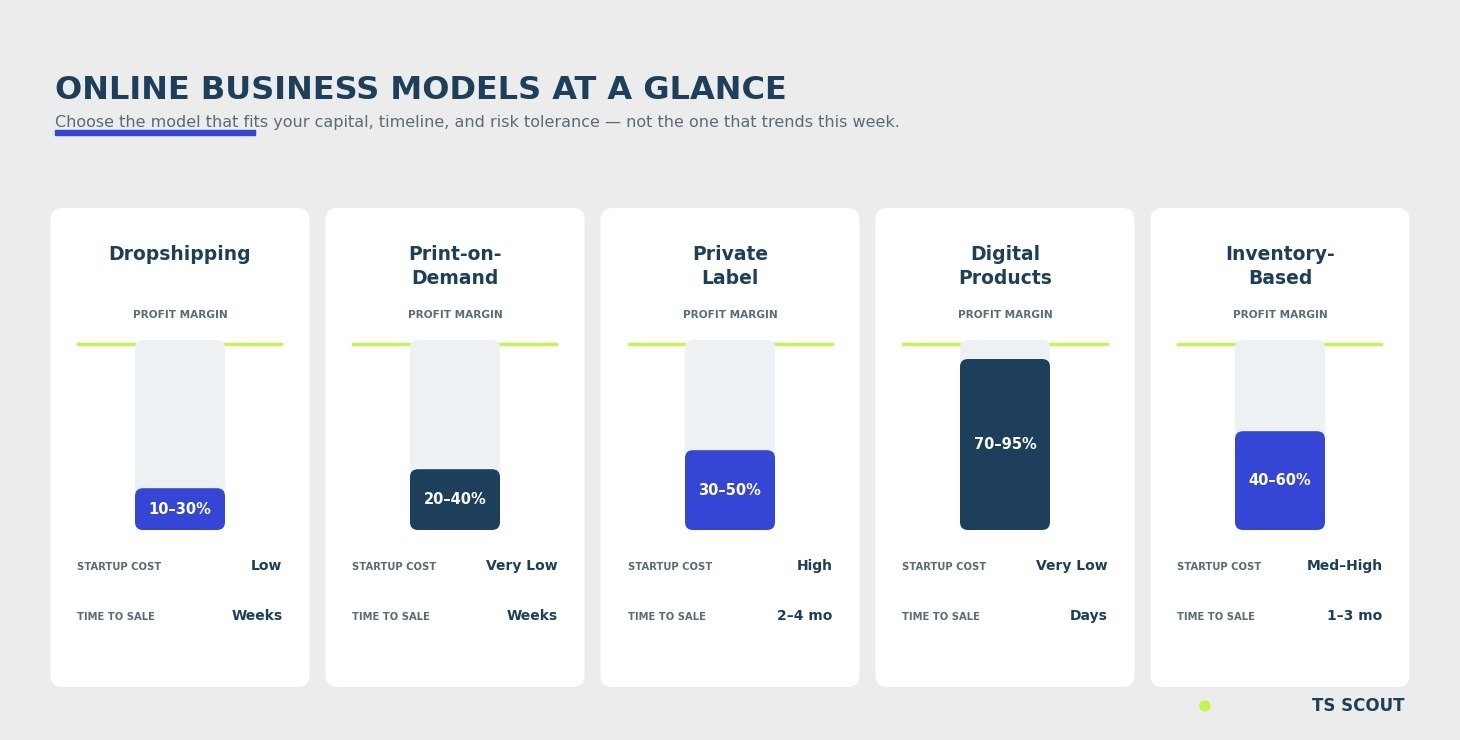
Understanding this distinction matters before you start your own online business, because each model comes with a completely different cost structure, risk level, and timeline to profit.
|
Model |
Upfront Cost |
Profit Margin |
Time to First Sale |
Who It Fits |
|
Dropshipping |
Low ($200–$1,000) |
10–30% |
Weeks |
Beginners testing demand |
|
Print-on-Demand |
Very low ($0–$300) |
20–40% |
Weeks |
Designers, niche creators |
|
Private Label (Amazon/Walmart) |
High ($2,000–$10,000+) |
30–50% |
2–4 months |
Sellers ready to invest |
|
Digital Products |
Very low (<$200) |
70–95% |
Days to weeks |
Content creators, specialists |
|
Traditional Inventory-Based eCommerce |
Medium–High |
40–60% |
1–3 months |
Sellers who want full control |
Figures above are directional ranges compiled from multiple current industry sources and are meant as planning benchmarks, not guarantees, actual costs and margins vary by niche, supplier, and execution.
This is the fork in the road most beginners never see clearly, and it's the first decision to make before touching a platform or a supplier.
Which Online Business Model Actually Fits You?
Before you start your own online business, choosing a model isn't about which one sounds most profitable, it's about matching the model to your actual constraints. Three questions decide it:
-
How much capital can you risk without it affecting your life?
-
How much control do you need over product quality and branding?
-
How fast do you need your first dollar of revenue?
If your answer is "low capital, fast validation," dropshipping or print-on-demand makes more sense than sinking money into private-label inventory. If you're chasing long-term brand equity, inventory-based eCommerce or private label pays off more over time, even though it costs more upfront. For readers who want to start your own online business around products with steady year-round demand instead of trend-chasing, it's worth exploring Evergreen Digital Product Ideas and comparing them against Best eCommerce Niches for 2026 before locking in a direction, the niche you pick will shape every decision after this one.
How Do You Find a Niche and Winning Products Without Guessing?
This is where most beginners waste the most time when they try to start your own online business. They browse marketplaces manually, guess based on what "looks trendy," and end up chasing saturated products with razor-thin margins.
A faster, data-backed approach looks like this:
-
Narrow your category based on personal interest or market gap, not just what's viral this week.
-
Validate real demand before spending a dollar on inventory or ads.
-
Check competition density, a product with high search volume and low seller saturation beats a "hot" product everyone already sells.
-
Confirm the product has staying power, not just a 6-week spike.
Tools built specifically for this step save weeks of manual digging. eBay Segment Insight analyzes specific product categories and niches to show demand, competition density, and growth potential before you commit a single dollar, which is exactly the kind of validation covered in How to Test an Evergreen Product Before Committing.
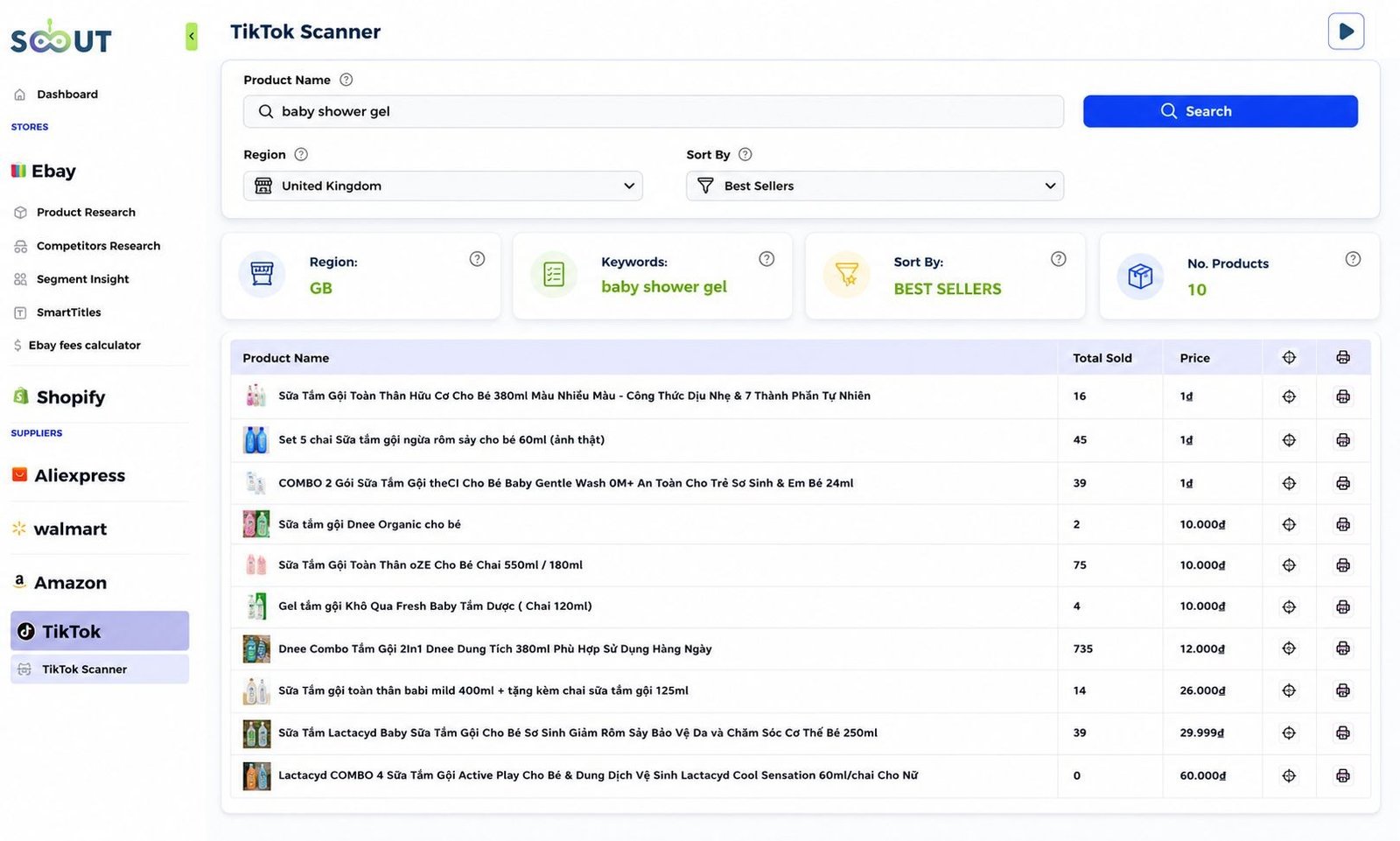
And because social commerce is no longer optional, the TikTok Shop Scanner tracks which products are actually converting on TikTok Shop right now, rather than what merely looks viral in a video with no purchase data behind it. Social commerce isn't a side channel anymore, the global market is projected to reach $2.11 trillion in 2026, growing at a 29% CAGR, according to Mordor Intelligence. Skipping that channel while trying to start your own online business in 2026 means leaving one of the fastest-growing sales channels untouched.
Where Should You Actually Sell, One Platform or Several?
Once you know your product, the platform decision comes next, and this is exactly where most guides get shallow, listing three platform names with no real comparison. Whichever way you start your own online business, this decision shapes your fee structure for years.
|
Platform |
Starting Price |
Card Processing Rate |
Best For |
|
$29/mo (billed annually) |
2.9% + $0.30 |
Fast launch, no developer needed |
|
|
WooCommerce |
Free plugin (hosting extra) |
Varies by processor |
SEO-driven, content-first stores |
|
BigCommerce |
~$29/mo (billed annually) |
0% platform fee via embedded providers |
Larger catalogs, B2B, no transaction fees |
Pricing and transaction rates above reflect Shopify's official published plans as of 2026. And this is exactly where the WooCommerce vs Shopify decision becomes the first real fork in the road for most new sellers, before they even think about multi-marketplace expansion. Shopify wins on speed and ease of setup; WooCommerce wins if your growth strategy leans on content and organic search rather than paid ads.
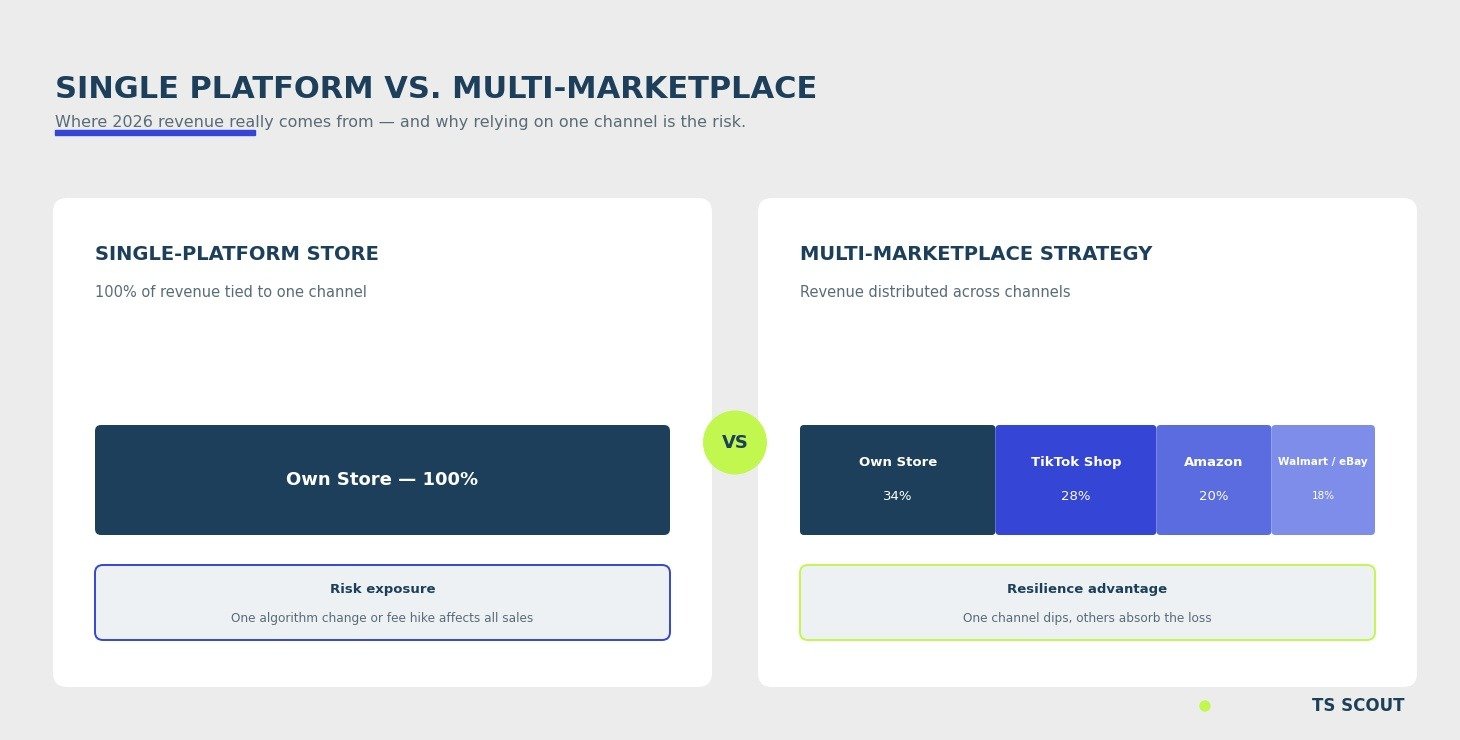
But the bigger mistake isn't picking the wrong platform, it's picking only one. The Hidden Risk of Single-Platform Selling is that your entire revenue depends on one algorithm, one fee structure, and one policy change. Sellers who diversify across channels build more resilient revenue, which is the core idea behind The Complete Multi-Marketplace Ecommerce approach and The Best Marketplaces for UK & US Ecommerce Sellers.
This is where product-performance visibility across channels becomes non-negotiable. Shopify Insight analyzes product performance on Shopify stores using filters like price range, shipping origin, and time period, showing units sold, average prices, and total listings so you can benchmark before you launch. On the marketplace side, the Amazon Scanner tracks trending and high-demand products directly on Amazon, the Walmart Scanner monitors what's performing on Walmart Marketplace, and eBay Product Research lets you search listings by price, seller feedback, and total units sold, giving you comparable data across every channel instead of guessing which one to prioritize. This kind of cross-platform visibility is exactly what makes it possible to build toward Best eCommerce Sites for Small Business without overcommitting to a single channel too early.
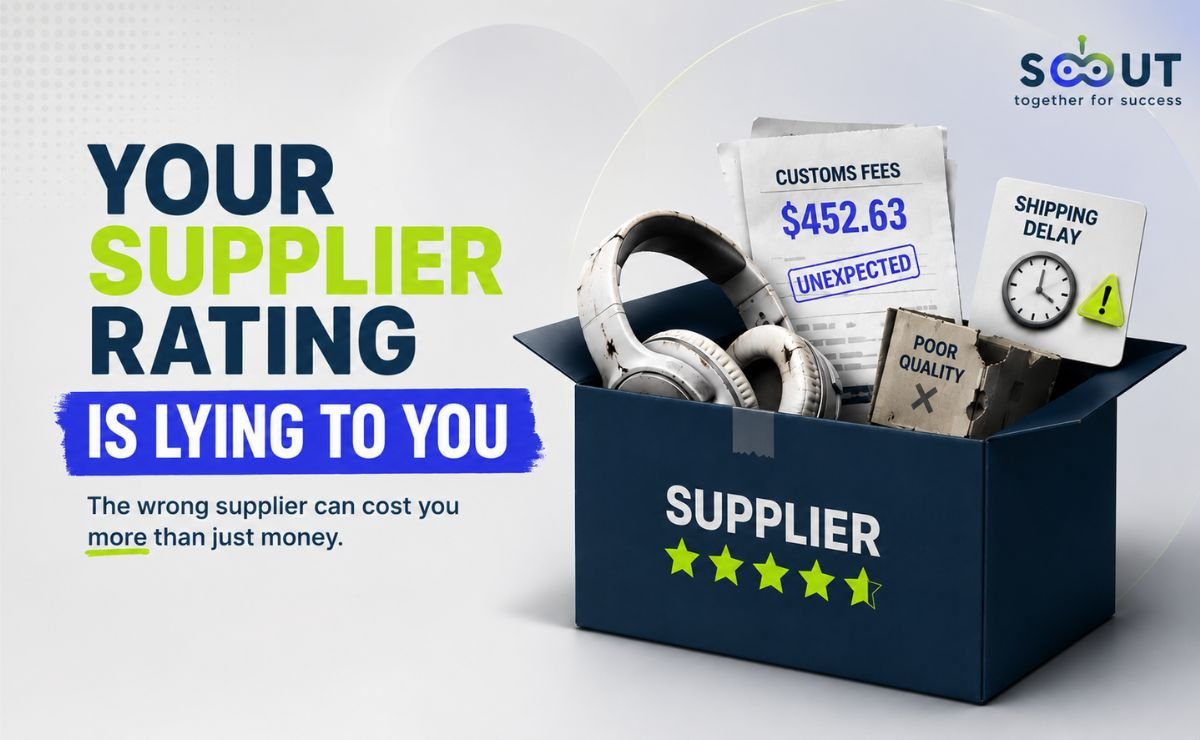
How Do You Vet Suppliers Before They Cost You Customers?
A slow or unreliable supplier can undo months of good marketing in a single bad review cycle — and it's one of the fastest ways to derail a plan to start your own online business. Before committing to any supplier, confirm:
-
Average processing time and shipping window (3–7 days has become the standard benchmark for competitive stores in 2026)
-
Minimum order quantities, if any
-
Return and refund policy
-
Whether they can provide references from other active sellers
Manually vetting suppliers one by one on marketplaces like AliExpress is slow and easy to get wrong. The Express Scanner scans AliExpress to surface products with consistent sales activity and strong demand signals, rather than one-off spikes. Once you've shortlisted a category, Express Product Research lets you search by product name and filter by price, category, and sales performance to compare suppliers side by side, the exact workflow behind How to Find Reliable eCommerce Suppliers.
What Legal and Financial Steps Can You Not Afford to Skip?
This is the part most beginner guides leave out entirely when they explain how to start your own online business, and it's the part that causes the most stress later.
-
Register your business entity (an LLC in the U.S. is the most common choice for new online sellers, since it separates personal and business liability).
-
Open a dedicated business bank account the same week you register, mixing personal and business finances is the single biggest cause of accounting headaches down the line.
-
Set up accounting software from day one, not after your first tax season.
-
Budget for payment processing fees. Standard card rates from Stripe run 2.9% + $0.30 per successful domestic transaction, a cost every seller needs to factor into pricing, not discover after the fact.
-
Track quarterly tax obligations if you're self-employed in the U.S.; a portion of every payment received should be set aside before it gets spent.
Skipping this section doesn't just risk fines, it quietly erodes margins that looked healthy on paper.
How Do You Build a Brand Customers Actually Trust?
A generic store with no identity competes purely on price, a losing game against larger sellers with more capital. If you start your own online business without a clear identity, you're fighting on price alone. A strong brand identity fixes this by giving customers a reason to choose you specifically. That means:
-
A consistent visual identity (logo, color palette, typography) applied across every page and channel.
-
A clear unique selling proposition, one sentence that explains why your store exists.
-
A tone of voice that matches your actual audience, not a generic "corporate" default.
This process is covered in more depth in Build eCommerce Brand, but the short version is: consistency beats cleverness. A recognizable, coherent brand converts better than a flashy one-off design.
What Marketing Channels Are Actually Driving Sales Right Now?
Search engine optimization, email marketing, and influencer partnerships still work, but in 2026, ignoring social commerce means ignoring where a growing share of first-time purchases actually happen. Anyone who plans to start your own online business this year needs a channel strategy, not just a store. TikTok Shop's U.S. GMV grew roughly 650% year-over-year in 2024 to $9 billion, part of $33.2 billion in global GMV, according to Momentum Works and Tabcut. That kind of growth doesn't happen on a channel you can afford to skip.
A realistic 2026 marketing stack looks like:
-
Short-form video for discovery (TikTok, Instagram Reels, YouTube Shorts)
-
SEO for long-term, compounding organic traffic
-
Email marketing for repeat purchases and retention
-
Influencer or creator partnerships for social proof at low upfront cost
How Can AI Tools Save You Time Without Replacing Your Judgment?
AI has become a genuine time-saver for repetitive research and content tasks, product description drafts, ad copy variations, and store design mockups can all be generated in minutes instead of days. But AI is only as useful as the data feeding it. A tool that generates ten product ideas based on generic training data isn't the same as a tool that shows you actual sales volume, actual price points, and actual seller counts pulled from live marketplace data. That distinction, reviewed in more detail in AI Tools for Ecommerce Sellers, is why product research tools built on real transaction data consistently outperform generic AI product generators for the one decision that matters most when you start your own online business: what to actually sell.
How Do You Keep Inventory and Customer Service From Breaking as You Grow?
Growth exposes weak operations fast. The two most common failure points are stockouts caused by poor supplier communication, and slow customer response times that tank reviews. Fixing both comes down to:
-
Weekly (not monthly) review of sales data against current stock levels
-
Clear, written fulfillment timelines agreed with suppliers in advance
-
A single system, even a simple shared spreadsheet at first, for tracking every open customer inquiry until it's resolved
These aren't glamorous tasks, but they're the difference between a store that scales smoothly and one that collapses under its own growth.
What Does a Real Launch-to-Scale Journey Look Like?
Consider a seller who decided to start your own online business with $600 and one product category: pet accessories. In the first month, she used niche-level research instead of guessing, narrowing down to a sub-category with steady demand and low seller saturation. She launched on Shopify with a $39/month plan, sourced through a vetted AliExpress supplier with a confirmed 5-day shipping window, and ran her first ads through short-form video rather than static image ads.
By month three, TikTok Shop was outperforming her Shopify store two-to-one in order volume, so instead of abandoning her own site, she kept both running, using the marketplace for discovery and her store for repeat customers and higher margins. By month six, she'd added a second product line based on what her own sales data showed was already working, not a new guess. Nothing about that path was luck, it was sequencing the right decisions in the right order, which is exactly the structure this guide has walked through.
How Do You Scale Once the Model Is Proven?
Scaling isn't about adding more products randomly, it's about expanding deliberately once you have proof a model works.
-
Expand your catalog within your validated niche before jumping to an unrelated one.
-
Add a second sales channel only after your first one is stable and predictable.
-
Consider adding a higher-margin product line, the kind of approach detailed in Evergreen High-Ticket Product Ideas, once your lower-ticket products have built trust and repeat customers.
-
Automate what can be automated (reordering, tracking updates, review requests) so growth doesn't multiply your manual workload.
The strategy for How to Scale Ecommerce Across Marketplaces is the same principle applied at a larger scale: diversify deliberately, not reactively. Whether you're a month in or a year in, the goal when you start your own online business should always be sustainable growth over quick wins.
What's Stopping You From Starting This Week?
Every section in this guide answers a question that usually takes new sellers months of trial and error to figure out on their own before they successfully start your own online business. The one variable you still control completely is when you start. Sellers who validate their niche with real data before spending on inventory consistently outperform those who guess, and that validation takes minutes, not weeks, when you're working from live marketplace data instead of hunches.
Try TS Scout for $1 and get full access to every research tool for 14 days, enough time to find and validate your first product before you spend a dollar on inventory.
FAQS
-
Is it still profitable to start your own online business in 2026?
Yes, U.S. retail e-commerce sales grew 9.8% year-over-year in Q1 2026 according to the U.S. Census Bureau, and global sales are projected to exceed $6.88 trillion this year. Profitability now depends more on niche selection and channel diversification than on timing.
-
Do I need money to start your own online business?
Not much. Print-on-demand and digital products can start under $300, while dropshipping typically requires $200–$1,000 for a basic store and initial testing budget.
-
Is dropshipping the same as eCommerce?
No. eCommerce is the broad category of selling online; dropshipping is one fulfillment method within it where you never hold inventory yourself.
-
Which platform should a complete beginner choose, Shopify or WooCommerce?
Shopify is faster to launch and easier for non-technical founders. WooCommerce suits sellers who plan to grow primarily through content and SEO and are comfortable with more setup work.
-
How long does it take to see the first sale after you start your own online business?
With a validated product and an active marketing channel like TikTok Shop, sellers typically see their first sale within 2–4 weeks of launch.
-
Do I need a business license to start your own online business?
In most cases, yes, registering as an LLC or equivalent entity and opening a separate business bank account is standard practice before scaling beyond a hobby level.
like?


Table of Contents
- What Does "Starting an Online Business" Actually Mean in 2026?
- Which Online Business Model Actually Fits You?
- How Do You Find a Niche and Winning Products Without Guessing?
- Where Should You Actually Sell, One Platform or Several?
- How Do You Vet Suppliers Before They Cost You Customers?
- What Legal and Financial Steps Can You Not Afford to Skip?
- How Do You Build a Brand Customers Actually Trust?
- What Marketing Channels Are Actually Driving Sales Right Now?
- How Can AI Tools Save You Time Without Replacing Your Judgment?
- How Do You Keep Inventory and Customer Service From Breaking as You Grow?
- What Does a Real Launch-to-Scale Journey Look Like?
- How Do You Scale Once the Model Is Proven?
- What's Stopping You From Starting This Week?
- FAQS