

Evergreen High-Ticket Product Ideas That Actually Protect Your Margins
- 2026-08-20
-
 0
0
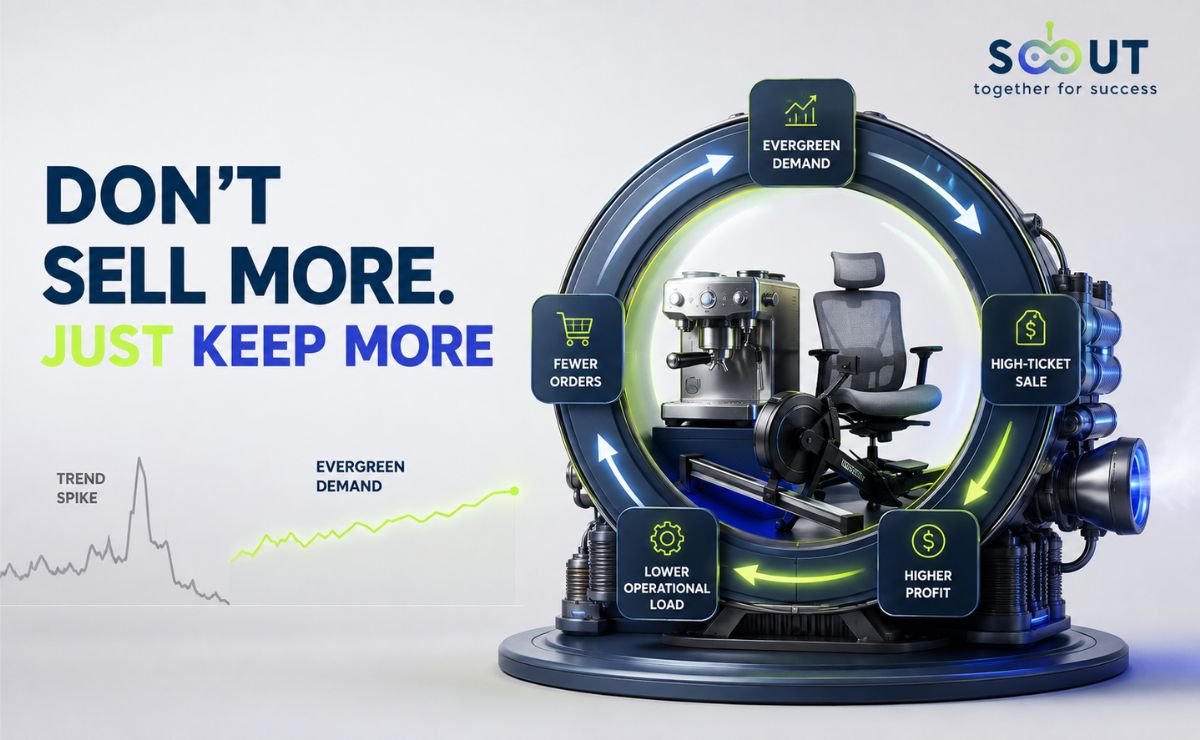
Most sellers chase low-cost products because the risk feels smaller, but the math rarely works in their favor. Fifty small sales take fifty times the customer service, fifty times the listing management, and fifty times the ad spend to generate the same profit a handful of well-chosen evergreen high-ticket product ideas can produce.
This guide breaks down why pairing a high price point with genuine evergreen demand is one of the strongest combinations available to a non-stockholding seller, walks through the margin math most guides skip, and hands you real category ideas to build around. If you haven't locked in the fundamentals yet, start with What Is an Evergreen Product?, this piece builds directly on that foundation, then narrows the lens to a specific price tier that changes the entire economics of your store. Let's get into what actually makes a high-ticket item evergreen, and what it takes to sell one profitably.
What Makes a High-Ticket Product Truly Evergreen?
A high price tag on its own means nothing, plenty of expensive items are just as trend-dependent as a $15 novelty toy, they just cost more to get stuck with.
Does a High Price Tag Guarantee Long-Term Demand?
No. A high-end version of last year's viral gadget is still tied to that gadget's shelf life, when the trend fades, the premium price doesn't protect it. A genuinely evergreen high-ticket product solves a permanent problem regardless of what it costs: a rowing machine addresses the same "exercise at home" need whether it's priced at $300 or $1,500, and that need doesn't expire with a product cycle. The category itself has to pass the same evergreen test covered in Evergreen Product Categories, price point is a separate variable layered on top of that foundation, not a replacement for it.
Why Is High-Ticket + Evergreen Such a Strong Combination?
Here's what changes when you combine a stable, non-seasonal category with a higher price point, the operational math shifts in your favor on every level.
Do You Really Need Fewer Sales to Hit the Same Revenue Target?
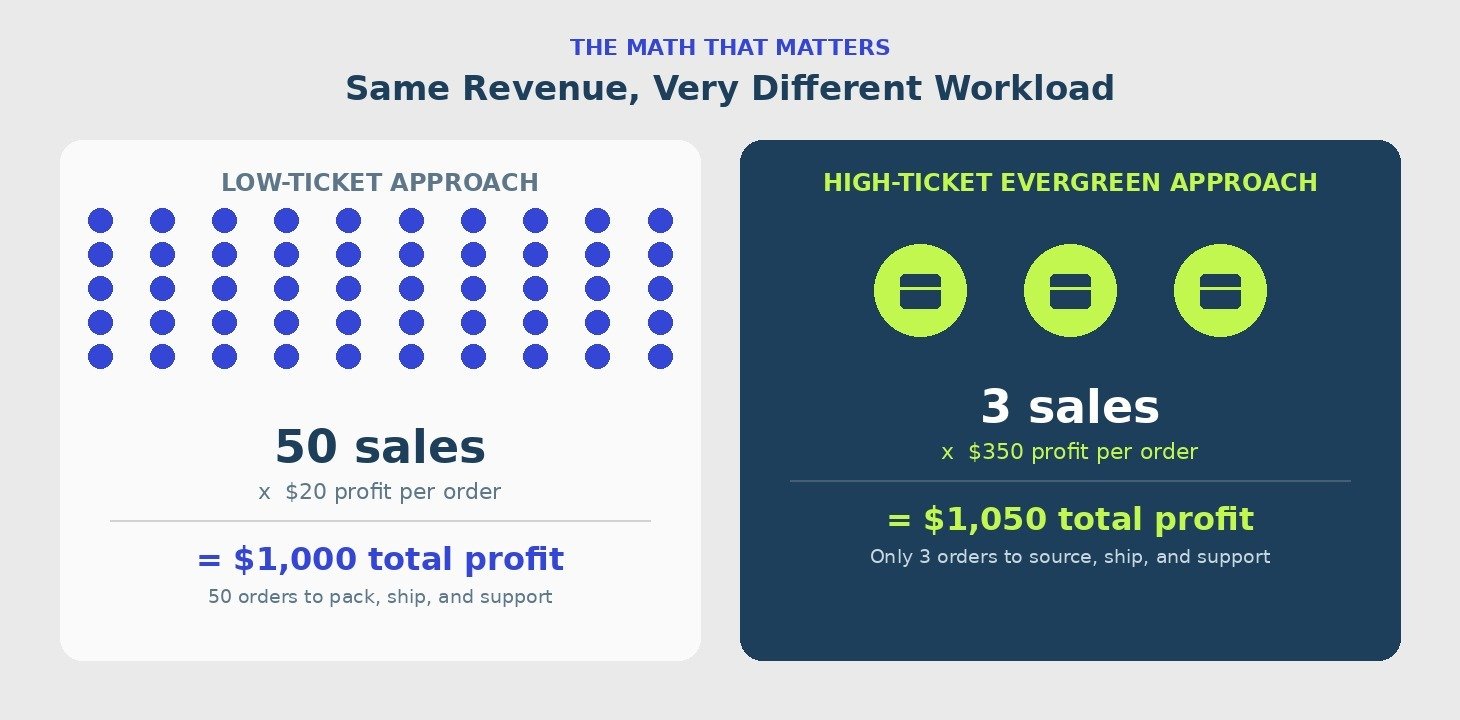
As a simplified example: a store built on $20-profit items needs 50 sales to clear $1,000 in profit. A store built around a $350-profit evergreen item needs three. It's a rough illustration, not a promise, but the direction of the math holds regardless of the exact numbers involved, and it's the reason fewer, better-chosen listings can outperform a large catalog of cheap ones.
Does Selling Fewer, Bigger Orders Reduce Your Day-to-Day Workload?
It does, directly. Every order, regardless of price, generates roughly the same amount of customer service overhead: a shipping question, a tracking request, an occasional return. Spreading that overhead across three orders instead of fifty is a meaningfully lighter operational lift for a seller running the business solo or with a small team.
Can the Same Ad Creative Justify a Higher Price Over Time?
It can, and this is where the evergreen half of the equation pays off. Because the underlying need doesn't shift with trends, the same product photography, ad copy, and positioning stay relevant for years, so the cost of producing that creative gets spread across a much smaller number of higher-value sales instead of needing constant refreshes to chase a moving trend.
Here's what that looks like side by side:
What Are the Real Margin Considerations Before Choosing a High-Ticket Product?
This is where most high-ticket guides stop at "sell expensive things" and skip the part that actually determines whether you keep any of that revenue.
How Much of the Retail Price Should Sourcing Cost Actually Take?
As a starting benchmark, the lower the percentage of your retail price that goes to product cost, the more room you have to absorb shipping, fees, and ad spend without the sale becoming unprofitable. This is the core logic behind the Profit Anatomy of any listing, sourcing cost is only one line in a much longer list of deductions, and treating it as the whole picture is how sellers end up surprised by a thin payout.
Why Do Shipping and Return Logistics Make or Break High-Ticket Margins?
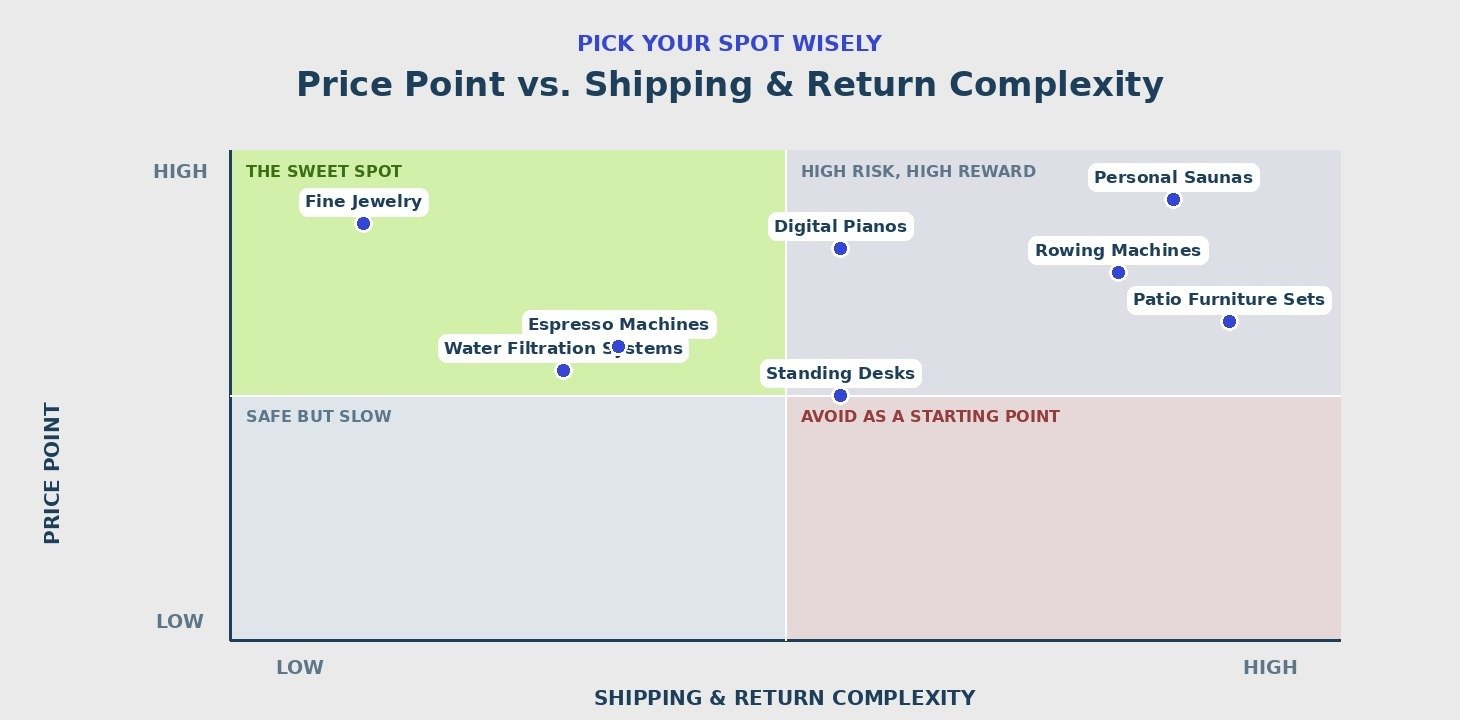
A $2,000 item that's small, light, and rarely returned protects its margin far better than a $2,000 item that's bulky, fragile, or frequently sent back. Freight costs, damage-in-transit risk, and return shipping all scale with size and weight, not with price, which is exactly why two products at the same price point can have completely different real-world profitability.
How Much Do Platform Fees Really Eat Into a High-Ticket Sale?
More than sellers expect, and the rate isn't flat. eBay's official selling fees page confirms that most categories carry a 13.6% final value fee plus a small per-order charge, but Jewelry & Watches carries a 15% rate on sales up to $5,000, and eBay's own worked example on that same page shows a seller keeping roughly 85% of a $400 sale after fees. On a high-ticket item, that missing percentage is a real dollar figure worth building into your price from day one, not discovering after the sale clears.
Does a Higher Price Always Mean a Higher Percentage Margin?
Not necessarily, and this is the mistake that catches sellers off guard. Here's a simple illustration: a $1,000 product with a 20% margin nets $200, while a $200 product with a 40% margin nets only $80. The higher-ticket item still wins on dollars in this example, but the percentage alone can be misleading if you're comparing categories without running the full math on each one.
What Extra Challenges Do High-Ticket Products Bring for Sellers Without Stock?
Selling higher-priced items without holding inventory yourself introduces a few risks that simply don't exist or exist at a much smaller scale, in the low-ticket world.
Can Cash Flow Become a Problem When You're Not Holding Inventory?
Yes, and it catches new high-ticket sellers off guard more than any other issue on this list. Picture this: a seller lists patio heaters, a payment processor holds a portion of early revenue in reserve for weeks as a new-seller precaution, while the supplier expects payment up front to fulfill the order. That gap between money going out and money becoming available has to be bridged somehow, usually with a credit line or a cash buffer set aside before the first high-ticket sale, not after.
Do Import Duties and Customs Fees Affect High-Ticket Margins More?
Significantly, and this changed in a way every US-based non-stockholding seller needs to know about. U.S. Customs and Border Protection confirms that the $800 de minimis exemption, which previously let low-value shipments enter the US duty-free, has been suspended, meaning imported goods are now subject to applicable duties regardless of value. Because duties are calculated as a percentage of the item's value, that cost scales directly with price: a $50 accessory absorbs a small duty hit, but a $1,500 item can see a duty bill large enough to reshape your entire margin calculation if it isn't priced in from the start.
Are High-Ticket Orders More Vulnerable to Chargebacks and Fraud?
They carry more exposure simply because there's more money on the table per transaction. A single disputed high-ticket order does more damage to your margin than a handful of disputed low-ticket ones, which makes basic verification steps, confirming shipping and billing addresses match, watching for first-time buyers placing unusually large orders, worth the extra few minutes before you ship.
How Do You Build Buyer Trust for an Item You Don't Physically Stock?
A $30 purchase is close to an impulse buy. A $1,000 purchase from a store the customer has never used before is not, and that gap in hesitation has to be closed with something concrete.
Why Do Expensive Purchases Need More Proof Before the Click?
Customers spending real money want evidence, not just product photos: genuine reviews, detailed specifications, clear sizing or compatibility information, and a visible, plainly worded return policy all reduce the hesitation that naturally comes with a bigger purchase decision.
Does a Longer Return Window Actually Increase High-Ticket Conversions?
It tends to, because it shifts risk away from the buyer at the exact moment they're most hesitant to commit. A generous, clearly stated return policy costs little if your return rate is genuinely low, and for a well-chosen evergreen item, it typically is, while giving anxious first-time buyers the reassurance they need to actually complete checkout.
What Are the Best Evergreen High-Ticket Categories to Sell?
These categories share the two traits that matter most: demand that doesn't fade with a season or a trend cycle, and a price point that makes the fewer-sales math work in your favor. The price ranges below are directional starting points based on typical retail positioning, not verified market data, always confirm current pricing and demand on your target platform before sourcing.
Which Premium Kitchen Appliances Sell Consistently at a High Price Point?
High-ticket kitchen appliances stay in demand because they're tied to daily habits, not passing trends. Here are three picks that consistently justify their price tag.
|
Product |
Typical Price Range |
Why It's Evergreen |
|
Espresso machines |
$400–$2,000 |
Coffee habits are daily and permanent, not seasonal |
|
High-performance blenders |
$300–$700 |
Tied to an ongoing health and wellness routine |
|
Built-in wine coolers |
$500–$1,500 |
A steady home-upgrade purchase independent of trends |
What Outdoor & Patio Furniture Ideas Hold Value Year-Round?
Outdoor living has become a permanent part of how people use their homes, keeping these pieces relevant across every season. These three options combine durability with steady year-round demand.
|
Product |
Typical Price Range |
Why It's Evergreen |
|
Modular outdoor sofa sets |
$800–$3,000 |
Outdoor living is a permanent homeowner priority |
|
Fire pit tables |
$400–$1,200 |
Functional and decorative, with no single-season dependency |
|
Teak dining sets |
$600–$2,500 |
A durable, classic style that doesn't chase trends |
Which Home Fitness Equipment Pieces Justify a Higher Price Tag?
The shift to home workouts is now a lasting behavior rather than a passing phase, which keeps this equipment selling at premium prices. These three picks stand out for their durability and consistent demand.
|
Product |
Typical Price Range |
Why It's Evergreen |
|
Rowing machines |
$500–$1,800 |
Home-fitness habits are now a permanent behavior shift |
|
Adjustable dumbbell sets |
$300–$700 |
A space-saving solution to an ongoing strength-training need |
|
Power racks |
$600–$2,000 |
Long product lifespan with minimal seasonal fluctuation |
What Ergonomic Office Furniture Sells Well All Year
With remote and hybrid work here to stay, ergonomic office furniture continues to see steady, non-seasonal demand. These three pieces are worth featuring for their consistent appeal.
|
Product |
Typical Price Range |
Why It's Evergreen |
|
Standing desks |
$400–$1,200 |
Tied to a permanent shift toward remote and hybrid work |
|
Ergonomic office chairs |
$300–$1,500 |
A recurring health-driven purchase, not a trend |
|
Monitor arm workstations |
$200–$600 |
Functional home-office upgrade with steady demand |
Why Is Fine Jewelry Considered a "Quiet Winner" in This Category?
Jewelry earns its place at the top of the logistics-complexity matrix above for a reason, it combines a high price point with low shipping weight, low damage risk, and comparatively low return complexity, which protects margin better than almost any other high-ticket category.
|
Product |
Typical Price Range |
Why It's Evergreen |
|
Statement gemstone necklaces |
$300–$1,500 |
Gifting occasions repeat every year, regardless of trends |
|
Fine gold bracelets |
$400–$2,000 |
Classic styles with decades-long, stable demand |
|
Designer-style watches |
$500–$3,000 |
A durable accessory purchased for lasting use, not a season |
What Wellness & Recovery Equipment Sells at a Premium?
Wellness and recovery routines have moved from niche to mainstream, driving reliable demand for higher-priced equipment. These three items reflect that shift toward long-term self-care investment.
|
Product |
Typical Price Range |
Why It's Evergreen |
|
Personal infrared saunas |
$1,500–$4,000 |
Tied to an established, ongoing wellness routine |
|
Percussion massage guns |
$200–$500 |
A recovery habit with consistent, non-seasonal demand |
|
Cold plunge tubs |
$600–$2,500 |
Part of a growing but stable wellness routine, not a fad |
Which Musical Instruments Perform Well as Evergreen High-Ticket Items?
Musical instruments hold their value because new learners enter the market every year, keeping demand steady regardless of trends. These three picks combine durability with consistent buyer interest.
|
Product |
Typical Price Range |
Why It's Evergreen |
|
Digital pianos |
$500–$2,500 |
Music education demand renews every year with new learners |
|
Acoustic guitars |
$300–$1,200 |
A durable purchase with decades-long relevance |
|
Studio audio interfaces |
$200–$800 |
Steady demand tied to ongoing home-recording interest |
Why Are Water Filtration Systems a Reliable Evergreen Pick?
Clean water is a non-negotiable household need, which makes filtration systems a dependable evergreen category. These three options cover different budgets while maintaining steady, year-round relevance.
|
Product |
Typical Price Range |
Why It's Evergreen |
|
Whole-home filtration systems |
$500–$2,000 |
Clean water is a permanent, non-negotiable household need |
|
Reverse osmosis under-sink systems |
$200–$600 |
Recurring relevance with minimal seasonal variation |
|
Countertop filtration units |
$150–$450 |
A practical, ongoing household upgrade |
Before committing a budget to any single category above, it's worth cross-checking which platform actually has proven demand for it. The eBay Segment Insight tool lets you filter by category and price band to see real listing and sell-through activity instead of guessing based on price alone.
If a physical, higher-ticket item isn't the right fit for your store right now, the same evergreen logic applies to the digital side of the market too, covered separately in Evergreen Digital Product Ideas for 2026.
How Do You Vet a Supplier for a High-Ticket Product You'll Never Physically Hold?
The stakes of a bad supplier scale with the price of the product, a $15 item that arrives damaged is a minor annoyance, a $1,500 item that arrives damaged is a real financial hit.
Ordering a sample, reviewing the supplier's sales history, and confirming their return and damage policy in writing are non-negotiable steps before committing to a high-ticket item. When the sourcing route involves AliExpress, the Express Source Finder Tool narrows listings down to suppliers with a consistent, provable sales history instead of leaving you to sort through unverified options on a product where a bad supplier choice is far more costly than it would be at a lower price point. The full vetting process, including how to apply the Science of Product Research to a specific supplier decision, is covered in How to Test an Evergreen Product Before Committing. For a broader framework on supplier vetting itself, Find Reliable eCommerce Suppliers in 2026 is worth reading before you place your first high-ticket order.
Ready to Build a Catalog That Works Smarter, Not Harder?
The sellers making real money in 2026 aren't necessarily listing more products, they're listing fewer, better ones, at a price point where the math actually rewards the effort. Every category above passes the same test: durable demand, a price point that makes the operational load worth it, and margin that survives contact with real-world fees and logistics. Before you commit a budget to your first high-ticket listing, get $1 for 14 days of full TS Scout access and verify real demand and pricing data across platforms first.
FAQ
-
What are the best evergreen high-ticket product ideas for 2026?
Premium kitchen appliances, outdoor furniture, home fitness equipment, ergonomic office furniture, fine jewelry, wellness equipment, musical instruments, and water filtration systems all combine stable, non-seasonal demand with strong per-sale margins.
-
What price range counts as "high-ticket" in eCommerce?
There's no fixed rule, but most sellers treat items from roughly $200 up to a few thousand dollars as high-ticket, high enough to change the profit-per-sale math, low enough that customers don't need weeks of deliberation before buying.
-
Is high-ticket selling more profitable than low-ticket selling?
It can be, dollar-for-dollar, but only if margin, shipping complexity, and fees are accounted for upfront, a higher price alone doesn't guarantee a healthier profit margin.
-
What's the biggest risk of selling high-ticket products without holding stock?
Cash flow timing is the most common issue, supplier payment is often due before a payment processor releases your funds, so having a financial buffer in place before your first high-ticket sale matters more than it does at lower price points.
-
Do high-ticket products have higher return rates?
Not necessarily, well-chosen evergreen high-ticket items (like jewelry or fitness equipment bought for an established habit) often see lower return rates than impulse-driven low-ticket purchases, since the buying decision itself involves more research upfront.
like?


Table of Contents
- What Makes a High-Ticket Product Truly Evergreen?
- Why Is High-Ticket + Evergreen Such a Strong Combination?
- What Are the Real Margin Considerations Before Choosing a High-Ticket Product?
- What Extra Challenges Do High-Ticket Products Bring for Sellers Without Stock?
- How Do You Build Buyer Trust for an Item You Don't Physically Stock?
- What Are the Best Evergreen High-Ticket Categories to Sell?
- How Do You Vet a Supplier for a High-Ticket Product You'll Never Physically Hold?
- Ready to Build a Catalog That Works Smarter, Not Harder?
- FAQ


