

Stop Losing Margin: The Best Marketplaces for UK & US Ecommerce Sellers
- 2026-03-10
-
 0
0
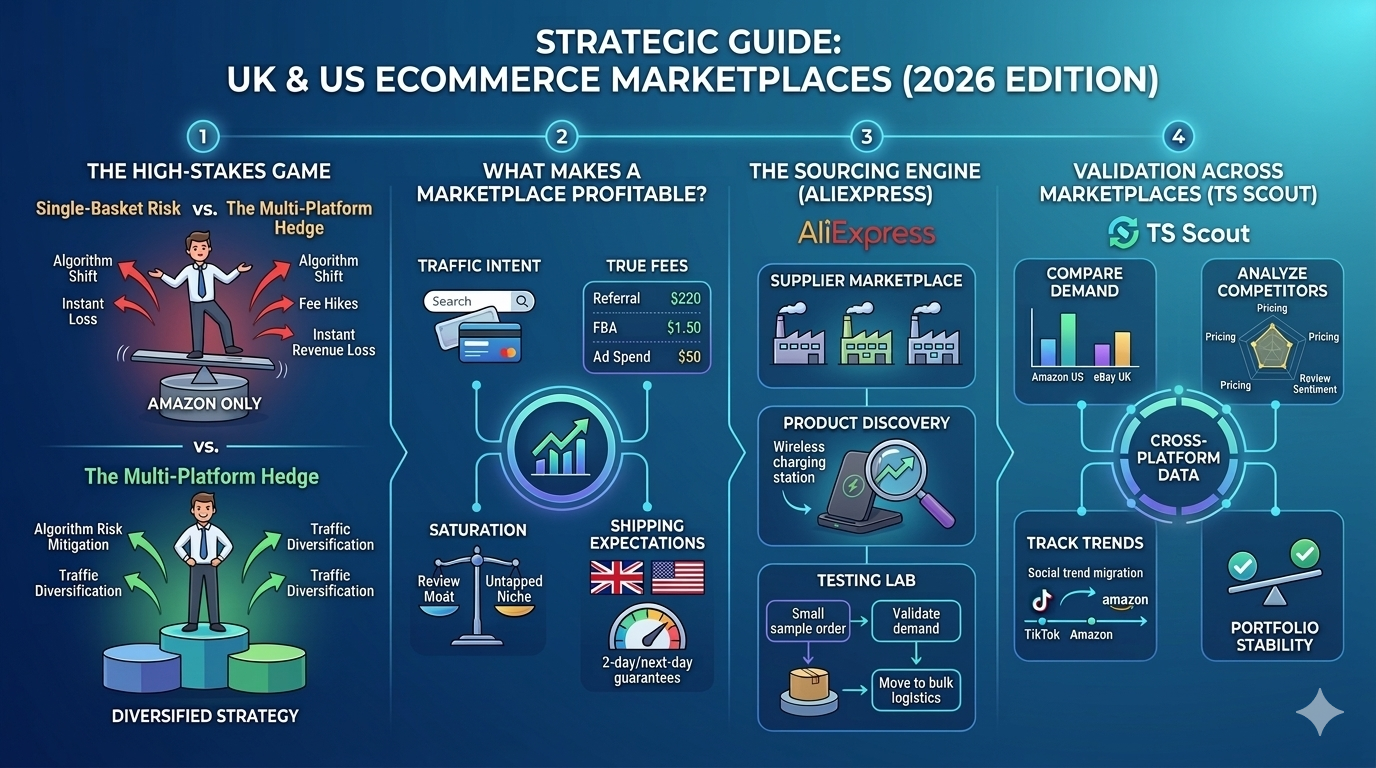
In the 2026 ecommerce landscape, choosing where to list your products is no longer just a "top-of-funnel" decision, it is the single most significant factor in determining your net profitability. With global online sales continuing to hit record highs, the competition has shifted from simply "being online" to mastering the specific algorithms and fee structures of diverse platforms.
For UK and US online sellers, the "right" marketplace acts as a silent partner that provides built-in trust and a ready-made audience; the "wrong" one can quietly erode your margins through hidden referral fees, storage surcharges, and aggressive PPC requirements. If you aren't diversifying, you aren't just missing sales you are bleeding margin.
The Danger of the "Single-Basket" Strategy
Relying on a single platform is a high-risk gamble that many veteran digital merchants and multi-platform sellers are moving away from. In an era where AI personal shoppers and shifting algorithms can make a once-dominant listing invisible overnight, diversification is your only true hedge against platform volatility. Whether it’s a sudden policy change on Amazon or a shift in buyer behavior on eBay, online sellers who haven't integrated a multichannel ecommerce strategy find themselves vulnerable to instant revenue loss.
What This Guide Covers
To help you navigate this complex environment, we’ve analyzed the top-performing platforms for 2026, focusing on where the highest volume of buyers is currently migrating. In this article, we will break down:
- The "Big Three" Titans: A deep dive into Amazon, eBay, and Walmart Marketplace, and how their latest updates impact international third-party sellers.
- The Social Commerce Surge: Why TikTok Shop and Instagram Shopping are essential for impulse-buy categories in the UK and US.
- Niche & Regional Powerhouses: Exploring platforms like OnBuy (UK), Wayfair (Home Goods), and Etsy (Handmade/Vintage) for targeted growth.
- Logistics & Profitability: How to leverage tools like FBA (Fulfillment by Amazon) or WFS (Walmart Fulfillment Services) to maintain a competitive edge without sacrificing your bottom line.
Whether you are an established online seller or a brand owner looking to scale across the Atlantic, understanding the nuances of these marketplaces is the first step toward building a resilient, profitable business.
Why Smart Sellers Use Multiple Marketplaces
In the competitive world of digital commerce, relying on a single storefront is no longer a viable long-term plan. Top-tier online sellers treat their business like an investment portfolio: they diversify to protect their gains and accelerate their growth. Transitioning from a single platform to a multifaceted presence is the definitive way to mitigate the hidden risk of single-platform selling.
1. Eliminating "Algorithm Risk"
Every marketplace is governed by a proprietary algorithm that can change without warning. A small tweak in how Amazon or eBay weights "fast shipping" or "keyword density" can plummet a best-selling listing to page five overnight. By diversifying, you ensure that a sudden dip in organic traffic on one platform doesn't result in a total revenue blackout. Diversification acts as your business’s insurance policy against the unpredictable nature of marketplace AI.
2. Capturing Diverse Traffic Streams
Different marketplaces attract different buyer mindsets:
· Amazon is the go-to for high-intent, mission-driven shoppers prioritizing speed.
· Walmart attracts value-seekers and loyalists of the US retail giant.
· TikTok Shop captures impulse buyers through creator-led discovery. By being present on all three, you aren't just selling the same product multiple times; you are accessing three entirely different "neighborhoods" of the internet.
3. Faster Product Validation
For multi-platform sellers, testing a new product across different audiences simultaneously provides a much clearer picture of its market fit. A product that struggles on eBay’s auction-style environment might become a viral sensation on TikTok Shop. This cross-platform data allows you to "fail fast" on poor products and double down on winners with high statistical confidence.
4. Seamless Cross-Platform Scaling
Scaling isn't just about selling more; it's about selling everywhere. Once you have a winning product and a reliable supply chain, the most logical next step is to port that success into new ecosystems. Learning how to scale ecommerce across marketplaces allows you to leverage the infrastructure of one (like Amazon’s fulfillment) to satisfy the demand of others, creating a compounded growth effect that a single site could never achieve alone.
What Makes a Marketplace Profitable for Sellers?
Choosing a platform isn't just about where the most people are; it’s about where the math actually works for your specific business model. In 2026, with rising acquisition costs and "agentic commerce" (AI-driven shopping) becoming the norm, profitability is found at the intersection of high visibility and controlled overhead.
To determine if a marketplace is a "gold mine" or a "margin killer," use this five-factor evaluation framework:
1. Traffic vs. Intent-Match
High traffic is a vanity metric if the audience isn't ready to buy.
· Amazon & Walmart: These are high-intent platforms where users search with a credit card already in hand.
· TikTok Shop: While traffic is massive, it is discovery-based. Your profitability here depends on your ability to convert "passive scrollers" into "active buyers" through viral content.
2. The True Cost of Selling (Fees)
Marketplace fees are more than just a percentage of the sale. You must account for:
· Referral Fees: Typically 8% to 15% depending on the category.
· Fulfillment Surcharges: If using FBA (Amazon) or WFS (Walmart), factor in 2026 storage rate hikes and "low-inventory" fees.
· Ad-Spend "Tax": In many competitive US/UK niches, you effectively must pay for sponsored placements to be seen, which can eat another 10%–20% of your margin.
3. Competitive Saturation
Profitability often hides in the gaps. Before entering a marketplace, check the "Review Moat" of your competitors. If the top 10 sellers all have 5,000+ reviews, your cost to break into that niche will be significantly higher than a platform like OnBuy or Target+, where the competition may be thinner.
4. Shipping & Buyer Expectations
Your logistics strategy must match the platform's "culture."
· US Market: Buyers expect 2-day shipping as a baseline. If you cannot meet this profitably, your "Buy Box" prominence will suffer.
· UK Market: Next-day delivery is the gold standard. Sellers who can't leverage local UK-based 3PLs (Third-Party Logistics) often see their conversion rates plummet due to long lead times.
5. Data-Driven Validation
Never "guess" a product’s success. Learning how to validate a product before selling is the final gate. This involves using AI-powered research tools to cross-reference search volume on Google Trends with active "Sponsored" listings on the target marketplace. If there are 3+ competitors running ads for 30+ days, it’s a sign of a validated, profitable niche.
eBay: The Ultimate Launchpad for Fast Product Testing
While giants like Amazon and Walmart dominate in pure volume, eBay remains the premier "proving ground" for the modern online seller. Because of its unique search-based ecosystem and lower entry barriers, it is often where successful multi-platform strategies begin. If you are looking for a platform that rewards speed and agility, eBay is your primary destination.
Why It’s the Starting Point for Top Sellers
eBay’s "low-friction" environment makes it the ideal laboratory for digital merchants to test new inventory without the heavy upfront investment required by other platforms.
- Minimal Barrier to Entry: You can have a listing live in minutes. Unlike Amazon, there is no rigorous brand registry process required just to start selling, making it perfect for rapid market entry.
- Instant Market Feedback: Because eBay’s algorithm (Cassini) prioritizes recent activity and engagement, you can get a "read" on a product’s demand within 48 to 72 hours.
- Dual-Market Power: eBay holds a massive footprint in both the US and UK, allowing you to test a product's international appeal simultaneously.
Best Product Categories for 2026
Success on eBay often comes from "utility" and "niche" rather than just broad trends. Based on current data, these categories are high-performers:
- Tech & Retro Electronics: Smartphone accessories, "lo-fi" digital cameras, and refurbished gaming consoles.
- Automotive Parts: Specific replacement components like wing mirrors, center caps, and lighting.
- Home & Garden: Replacement parts for high-end appliances (e.g., Dyson attachments) and smart home sensors.
- Collectibles: Trading cards, vintage fashion, and limited-edition toys.
The Pros and Cons
|
Pros |
Cons |
|
Lower Fees: Generally around 13.25% + $0.30 per order, often cheaper than Amazon’s total cut. |
Manual Management: Keeping inventory synced across multiple platforms can be labor-intensive without automation. |
|
Built-in Global Shipping: The eBay International Shipping program handles the customs and logistics for you. |
High Ad-Dependency: Recent 2026 updates to "Promoted Listings" mean you often need to pay for visibility. |
|
Seller Protections: Robust systems to handle "Item Not Received" or "Remorse Returns" compared to social shops. |
Strict Performance Metrics: Maintaining "Top Rated Seller" status requires 95%+ tracking validation. |
Master the Research
Winning on eBay is a science, not a gamble. Before you list, you must master the ebay product research. The secret lies in the "Sell-Through Rate" (STR). By comparing the number of Sold listings to Active listings, you can statistically verify demand before spending a single dollar.
Learning how to find winning products on ebay involves using internal tools like Terapeak to look back at three years of historical pricing data. If a product shows consistent sales at a 50% STR or higher, it’s a green light for scaling.
Shopify: Best for Building an Independent Brand
While marketplaces like Amazon and Walmart offer immediate access to millions of shoppers, they essentially "rent" you their audience. Shopify, conversely, is the foundation for a business you own entirely. In the 2026 landscape, top-tier online sellers use Shopify as their "home base" to escape the fee-heavy cycle of third-party platforms and build long-term equity.
Why Shopify is the Ultimate "Brand Builder"
The primary difference lies in data ownership and customer experience. On a marketplace, the customer belongs to the platform; on Shopify, the customer belongs to you.
- Full Creative Control: Unlike the rigid templates of eBay or Amazon, Shopify allows you to dictate every pixel of the user journey. From custom landing pages to branded checkout flows, you can ensure your store reflects a "modern and minimalist" professional aesthetic that builds trust.
- Direct Customer Relationships: You get full access to customer emails and purchase history. This allows for high-ROI email marketing and SMS campaigns, tools that are restricted on most marketplaces but are essential for increasing Lifetime Value (LTV).
- Higher Profit Margins: While Shopify has a monthly subscription fee, you aren't paying the 15% "referral tax" common on marketplaces. For an established online seller, this shift can instantly boost net margins by 5% to 10%, even after accounting for your own marketing spend.
Pros and Cons of the Shopify Model
|
Pros |
Cons |
|
No "Referral Fees": Keep more of every dollar earned. |
No Built-in Traffic: You are responsible for your own SEO and ads. |
|
Customization: Use a Shopify product research guide to build unique, high-converting pages. |
App Costs: Advanced features often require paid monthly plugins. |
|
Brand Immunity: You aren't at the mercy of a single marketplace algorithm change. |
Management Overhead: You handle customer service and site maintenance. |
When to Move from Marketplaces to Shopify
Scaling isn't about choosing one or the other; it’s about timing. You should consider launching or migrating to a Shopify store when:
- Your "Winner" is Validated: Once you have a product performing well on marketplaces, move it to Shopify to capture higher margins.
- Ad Costs are Rising: If your marketplace PPC costs are eating your profits, it’s time to build an organic audience via your own site.
- You’re Ready to Scale: Using a tool to analyze Shopify competitors can show you exactly where gaps in the market exist that marketplaces are too broad to fill.
Amazon: The Titan of Massive Demand
As of 2026, Amazon remains the undisputed heavyweight of ecommerce in both the US and UK. With a market share hovering around 40% in its strongest regions, it is the first place most consumers go to "problem-solve" via a search bar. For online sellers, Amazon isn't just a marketplace; it is a high-velocity discovery engine.
The 2026 FBA Advantage
The "Prime" badge continues to be the most powerful conversion tool in a seller's arsenal. In the UK, Amazon has significantly optimized its network, recently announcing one of its largest-ever fee reductions for European sellers to stay competitive. In the US, while fulfillment costs for standard items have seen minor inflationary adjustments, the introduction of the SHV1 next-gen fulfillment centers has made delivery speeds faster than ever.
By using Fulfillment by Amazon (FBA), multi-platform sellers outsource the two biggest headaches of scaling: storage and last-mile delivery. This allows you to meet the strict 2-day (US) and next-day (UK) delivery expectations that buyers now consider a baseline.
Pros vs. Cons of the Amazon Ecosystem
|
Feature |
Pros |
Cons |
|
Traffic |
Unmatched global volume; "credit-card-in-hand" intent. |
Extreme competition; high cost of entry for popular niches. |
|
Logistics |
Hands-off scaling via FBA and Global Shipping programs. |
Increasing "Aged Inventory" and low-stock surcharges. |
|
Trust |
Instant credibility for new brands via the Prime badge. |
High return rates, especially in Apparel and Home goods. |
|
Ads |
Powerful PPC tools and the new "Rufus" AI search integration. |
"Ad-tax": You often must pay for placement to stay on page one. |
The Critical Need for Trend Analysis
Because the environment is so competitive, you cannot afford to guess what will sell. Success on Amazon in 2026 is built on amazon product trend analysis. Instead of chasing "saturated" items, smart sellers look for "High Demand, Low Review" gaps—niche sub-categories where the search volume is high, but the top-ranking competitors have poor-quality listings or outdated features.
Learning how to find profitable niches involves looking beyond the Best Sellers list. Focus on the "New Releases" and "Movers & Shakers" tabs to identify emerging consumer habits (like AI-integrated home gadgets or sustainable pet care) before the market becomes flooded.
Walmart Marketplace – The Underrated Opportunity
While most sellers fixate on the sheer volume of Amazon, the savviest online merchants are quietly moving their inventory to Walmart Marketplace. In 2026, Walmart has emerged as the most credible challenger to the status quo, offering a unique "land grab" opportunity for those who value higher margins over crowded bidding wars.
1. The Low-Competition Advantage
The most compelling reason to join Walmart is the seller-to-buyer ratio. While Amazon hosts over 2 million active third-party sellers, Walmart Marketplace is currently home to approximately 150,000 to 200,000 sellers. This represents a massive gap in saturation; on Walmart, your products have a significantly higher chance of appearing in the top row of organic search results without the extreme "Review Moat" that makes new entries on Amazon so difficult. Exploring low competition ecommerce marketplaces like this allows you to establish market share before the platform becomes truly crowded.
2. A Fast-Growing Ecosystem
Walmart isn't just a physical retail giant; its digital wing is seeing explosive growth. In the 2026 fiscal year, Walmart's global ecommerce sales surpassed $150 billion, driven by double-digit growth in its online marketplace. For multi-platform sellers, this means access to a loyal, value-conscious US customer base that is increasingly choosing Walmart+ for their daily needs.
3. Fewer "Price Wars" and Better Fees
One of the biggest hurdles for sellers is the race to the bottom on price. Walmart’s stricter onboarding process—which requires a manual application and business verification—acts as a natural filter against the "noise" of amateur accounts. Furthermore, Walmart does not charge a monthly subscription fee, unlike Amazon’s $39.99/month Pro plan. This lower overhead makes it a highly attractive environment for established online sellers looking to diversify their risk.
4. Strong US Demand and Logistics
With Walmart Fulfillment Services (WFS) maturing in 2026, sellers can now achieve the "2-day shipping" badge that buyers demand. WFS-enabled items often see a 50% average growth in GMV (Gross Merchandise Volume) due to improved search visibility. To win here, you must be precise; using a dedicated walmart product research guide to identify high-demand, low-supply items in categories like Home, Wellness, and Automotive is the key to a successful launch.
TikTok Shop – Best for Viral Products
In 2026, TikTok Shop has officially transitioned from a social media experiment to a commerce powerhouse, with US sales alone expected to exceed $23 billion. Unlike the "search-based" commerce of Amazon, TikTok thrives on discovery-based commerce. Here, buyers don’t necessarily log in with a shopping list; they are served products by an AI-driven "Interest Graph" that matches their current moods and behaviors. For online sellers, this creates an environment where a single video can generate a month’s worth of revenue in 48 hours.
The Rise of "Impulse with Intention"
While TikTok remains the undisputed king of impulse buys, 2026 data shows a shift toward what experts call "Emotional ROI." Shoppers are no longer just buying "cheap gadgets"; they are investing in products that promise a specific lifestyle upgrade or emotional payoff. This makes the platform ideal for:
· Visual Transformations: Beauty, home organization, and DIY tools that show a clear "before and after."
· Niche Communities: Products tailored to specific subcultures (e.g., #FitTok, #BookTok, or #CleanTok).
· Creator-Led Trust: 2026 shoppers rely heavily on "tastemakers"—creators who act as filters for quality, making affiliate marketing a core scaling pillar.
The Reality of the Short Product Lifecycle
The "viral spike" on TikTok is intense but often brief. Research indicates that the average peak window for a trending product has compressed to approximately 11 days. For multi-platform sellers, this means your logistics and inventory must be incredibly agile. The goal isn't just to catch a trend; it's to use TikTok as a high-speed testing ground before moving successful items into more stable, long-term channels like Amazon or Walmart.
Researching Your Next Winner
Success on this platform is never a "guess." To maintain a competitive edge, you must master trending product research by analyzing real-time engagement data. This involves:
· The TikTok Creative Center: Monitoring the "Top Searched Keywords" and "Product Insights" to see what users are actively hunting for.
· Competitor Ad Spying: Using tools like Minea or Helium 10 to see which "Problem/Solution" videos are scaling in terms of ad spend.
· Strategic Observation: Learning how to find viral products on TikTok by following "Key Opinion Consumers" (KOCs) who often showcase early-stage trends before they hit the mainstream.
AliExpress: The Engine for Product Sourcing & Innovation
While marketplaces like Amazon and Walmart are where you capture demand, AliExpress remains the undisputed world headquarters for discovering it. In 2026, the platform has evolved from a simple directory into a sophisticated supplier marketplace designed for high-speed retail. For the modern online seller, it serves as the ultimate laboratory for testing new concepts before committing to bulk inventory.
1. The 2026 Sourcing Ecosystem
AliExpress is no longer just about "cheap goods"; it is a gateway to a massive product discovery network. The introduction of the AliExpress Choice service has been a game-changer for UK and US merchants, offering standardized shipping, better quality control, and "shippable" guarantees that were previously hard to find. By utilizing the platform's internal data, you can see real-time transaction volumes that act as a pulse for global consumer trends.
2. A Powerful Product Discovery Engine
The true value of AliExpress lies in its role as a "first-look" platform for viral trends. Before a product hits the shelves of major US retailers, it usually surfaces here.
· Trend Spotting: Smart sellers monitor the "New Arrivals" and "Hot Selling" sections to find items that solve emerging pain points.
· Low-Risk Testing: Because you can purchase single units, you can order samples to your UK or US address to verify quality firsthand, an essential step in any aliexpress product research guide.
3. Advanced Sourcing Strategies
To build a sustainable business, you must move beyond just "picking a product." You need to master how to source products by vetting the entities behind them.
· Supplier Vetting: In 2026, top sellers look for the "Choice" badge or "Gold Supplier" status with at least two years of history and a 95%+ positive feedback rate.
· The "Hybrid" Model: Many successful merchants use AliExpress for the initial validation phase, then move to private agents or local 3PLs once a product is proven. This allows for faster shipping while maintaining the high margins found at the source.
Pro Tip: Use the AliExpress Dropshipping Center (a free internal tool) to analyze the "Growth Rate" of a product rather than just total orders. A product with 500 orders and a 200% weekly growth rate is often a better opportunity than one with 50,000 stagnant orders.
How Smart Sellers Validate Products Across Marketplaces
In the 2026 landscape, launching a product based on a "hunch" is a recipe for trapped capital. Data-driven validation is the bridge between a speculative idea and a profitable SKU. For multi-platform sellers, this process requires looking beyond a single site’s data to understand how a product performs across different consumer ecosystems. This is where a specialized tool like TS Scout becomes the central nervous system of your operation.
1. Comparing Demand Across Platforms
A product that is "oversaturated" on Amazon might be an untapped opportunity on Walmart Marketplace or TikTok Shop. Smart online sellers use product research for multichannel sellers to identify these gaps.
· The Volume Gap: Use TS Scout to compare search volume on Amazon (US) versus eBay (UK). If the search-to-listing ratio is higher on one, that is your primary entry point.
· Regional Nuances: A product trending in London might not yet have reached the US Midwest. Cross-platform tools allow you to spot these geographical "lag times" and profit from them.
2. High-Velocity Competitor Analysis
To succeed, you don't just need to know who your competitors are; you need to know their weaknesses. Comprehensive competitor analysis for ecommerce involves:
· Review Sentiment Analysis: Use TS Scout to scan competitor reviews across multiple marketplaces. Are buyers complaining about shipping speed on eBay? Or packaging quality on Amazon?
· Pricing Strategy: Track how top sellers adjust their prices during "Flash Deals" or seasonal peaks. This allows you to set a "floor price" that protects your margins while remaining competitive.
3. Tracking Trends Before They Peak
Marketplace success is often a matter of timing. By the time a product is on every "Top 10" list, the profit margins have usually been compressed.
· Trend Forecasting: Use TS Scout to monitor rising search terms and "Movers & Shakers" lists.
· Social Proof Integration: In 2026, trends often start on social commerce (like TikTok Shop) and migrate to legacy platforms (like Amazon) 14–21 days later. Tracking this "migration" gives you the lead time needed to secure stock and optimize your listings before the peak.
4. The "TS Scout" Advantage
TS Scout simplifies the complex math of multichannel ecommerce strategy. Instead of manually toggling between tabs and spreadsheets, it aggregates real-time data into a single view. This allows you to:
· Validate at Scale: Research 50+ product ideas in the time it used to take for one.
· Identify "Winner" Traits: Automatically flag products with high search volume, low return rates, and manageable shipping dimensions.
Validation Rule of Thumb: A product is truly validated when it shows consistent search growth across at least two distinct marketplaces with a "Review Gap" (top sellers having fewer than 500 reviews) on at least one of them.
The Best Marketplace Strategy for Beginners: A Proven Path to Scale
For a new online seller, the sheer number of available platforms can lead to "analysis paralysis." Success in 2026 isn't about being everywhere at once; it's about mastering one ecosystem, validating your unit economics, and then executing a methodical ecommerce scaling strategy.
Below is the industry-standard "Ladder Approach" to building a resilient, multi-platform business from scratch.
Step 1: Start on eBay (The Low-Barrier Laboratory)
eBay remains the best "testing ground" for the UK and US markets.
· Why it works: The listing process is straightforward, and the auction-style or "Buy It Now" formats provide immediate feedback on price elasticity.
· Low Risk: Unlike Amazon, eBay is generally more forgiving with newer accounts, making it the ideal place to learn the ropes of customer service and logistics without high overhead.
Step 2: Validate Demand with Data
Once you have 20–30 consistent sales on eBay, it’s time to look at the data.
· Validation: Are customers asking for more variations? Is your return rate low?
· The "Winner" Signal: If a product maintains a steady sell-through rate for 30 days, you have officially validated your niche. This is the green light to move from "testing" to "brand building."
Step 3: Scale to Shopify (Owning the Audience)
After proving your product, the next stage of an ecommerce scaling strategy is launching your own Shopify store.
· Diversification: Moving to your own domain protects you from being 100% dependent on a third-party marketplace's rules.
· Customer Data: This is where you begin collecting emails and building a brand identity. You can now use "retargeting ads" to bring back customers who previously bought from you on marketplaces.
Step 4: Expand to Amazon or TikTok Shop (The High-Volume Growth)
With a proven product and a branded storefront, you are ready for high-velocity traffic.
· Amazon (US/UK): Leverage FBA to offer Prime shipping. This is where you see the most significant jump in volume, provided your margins can handle the referral and fulfillment fees.
· TikTok Shop: If your product has a "visual" or "problem-solving" element, TikTok is the fastest way to achieve viral growth in 2026.
The Power of a Multichannel Ecosystem
Following this path transforms you from a casual seller into a professional merchant with a robust multichannel ecommerce guide for your team. By the time you reach Step 4, you aren't just "selling a product", you are managing a diversified retail operation where one platform's dip is offset by another's peak.
Final Thoughts: Building a Resilient Digital Empire
The ecommerce landscape of 2026 has made one thing clear: the era of the "single-platform specialist" is over. As algorithms become more volatile and buyer attention more fragmented across the UK and US, the most successful online sellers are those who treat their business as a fluid, data-driven network rather than a static storefront.
Diversification is Your Greatest Asset
Relying on one marketplace -no matter how dominant- is no longer a growth strategy; it is a structural vulnerability. By implementing a multichannel ecommerce strategy, you insulate your brand against sudden policy shifts, fee hikes, and aggressive competition. Smart merchants don't just "hope" for sales; they position their products where the demand already exists, whether that is the high-intent search bar of Amazon or the discovery-driven feed of TikTok Shop.
Let Data Dictate Your Next Move
Success in modern retail isn't about chasing every trend, it's about knowing which ones to ignore. By mastering how to validate a product before selling and using high-velocity tools like TS Scout, you replace guesswork with statistical certainty.
The blueprint for 2026 is simple:
1. Source with quality and speed in mind (via a reliable supplier marketplace).
2. Validate demand across multiple ecosystems simultaneously.
3. Scale by meeting the customer exactly where they prefer to shop.
The marketplaces of the UK and US are ready for your products. The only question is: are you ready to meet your customers everywhere they are?
like?


Table of Contents
- The Danger of the "Single-Basket" Strategy
- Why Smart Sellers Use Multiple Marketplaces
- What Makes a Marketplace Profitable for Sellers?
- eBay: The Ultimate Launchpad for Fast Product Testing
- Shopify: Best for Building an Independent Brand
- Amazon: The Titan of Massive Demand
- Walmart Marketplace – The Underrated Opportunity
- TikTok Shop – Best for Viral Products
- AliExpress: The Engine for Product Sourcing & Innovation
- How Smart Sellers Validate Products Across Marketplaces
- The Best Marketplace Strategy for Beginners: A Proven Path to Scale
- Final Thoughts: Building a Resilient Digital Empire


