

Ecommerce in the UK: How Non-Stockholding Sellers Can Actually Win in 2026
- 2025-05-07
-
 0
0
The UK is Europe's biggest online shopping market, and it's still growing fast enough to make a serious dent in traditional retail. But if you're planning to launch a store without holding any physical stock, growth numbers alone won't tell you whether you'll succeed. You need to know which platform actually converts, how much VAT is going to eat into your margin, and which legal steps you can't afford to skip.
This guide breaks all of that down for UK-based, non-stockholding online sellers, the people managing the storefront and the marketing while a supplier handles fulfillment. We'll walk through the current state of ecommerce in the UK, the platforms worth your time in 2026, how to source products that won't leave you chasing a ghosted supplier, and the registration and compliance steps that keep HMRC off your back. Every figure here is sourced from government data or verified platform reporting, current as of July 2026. By the end, you'll know exactly where to start, and where most new sellers waste their first six months.
How Big Is the UK Ecommerce Market Right Now?
Online spending in Great Britain rose by 9.8% in the three months to May 2026 compared with the same period a year earlier, and by 12.2% year-on-year within the monthly series, according to the Office for National Statistics. The proportion of total retail sales made online climbed from 28.1% in April 2026 to 28.8% in May 2026, the highest level since early 2022 (ONS). Looking at the wider trajectory, the UK ecommerce market is valued at $317.33 billion in 2026 and is projected to grow at a 9.72% CAGR to reach $504.61 billion by 2031, with B2B ecommerce growing even faster at 12.47% CAGR as procurement digitizes (Mordor Intelligence).
The takeaway: this isn't a market you're trying to break into early. It's mature and still accelerating, and it rewards sellers who move fast on platform selection and product research over sellers who just "wait and see."
What Does Running a Non-Stockholding Store in the UK Actually Involve?
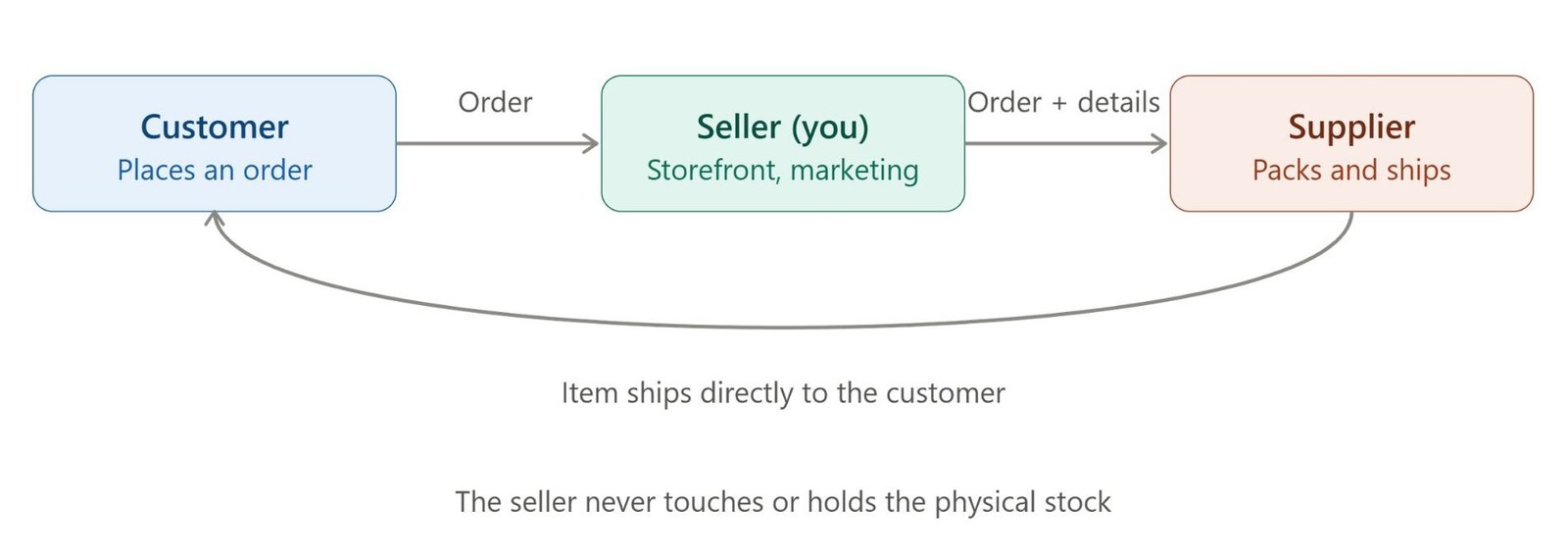
A non-stockholding ecommerce business is a fulfillment model where you sell products through your own storefront or a marketplace listing, but you never physically hold the inventory. When a customer orders, you pass the details to a supplier, who ships the item directly to the buye, often branded as if it came straight from your store.
Your job is everything the customer sees: the storefront, the product research, the pricing, and the customer service. The supplier's job is everything they don't see: packing, shipping, and stock management. For UK sellers specifically, this model keeps startup costs low and lets you test multiple product categories before committing to a warehouse lease or bulk stock order.
Which UK Platform Actually Fits Your Non-Stockholding Business?
Not every platform rewards non-stockholding sellers the same way. Amazon rewards search-intent buyers, TikTok Shop rewards impulse buyers who trust a creator, and eBay still dominates specific categories like pre-owned electronics and collectibles. Here's how the main options compare for a UK-based seller in 2026.
|
Platform |
Best For |
Buyer Behaviour |
Entry Difficulty |
|
Amazon UK |
High-intent, search-first buyers |
Compares listings, buys on trust signals |
Moderate, strict account health rules |
|
eBay UK |
Niche, pre-owned, and collectible categories |
Price-driven, feedback-conscious |
Low, fast to set up |
|
TikTok Shop |
Impulse buys, beauty, apparel, viral products |
Discovers via content, buys without comparing |
Low, but algorithm-dependent |
|
Shopify |
Full brand control, no marketplace fees |
Needs to be driven to the site via marketing |
Moderate, you own all traffic |
Is Amazon UK Worth It for a Non-Stockholding Store?
Amazon UK remains the revenue anchor for most serious sellers because of its built-in trust and search volume, customers already go there expecting to buy, not just browse. The trade-off is stricter account health enforcement and thinner margins once Amazon's referral fees are factored in.
How Does eBay UK Fit Into a Non-Stockholding Strategy?
eBay UK is still the fastest and cheapest platform to get listings live on, and it rewards sellers with strong feedback scores and competitive pricing. It works especially well as a supplementary channel alongside Amazon or TikTok Shop rather than a sole platform. If you're setting up an eBay store for the first time, our eBay Account Setup Guide covers the process step by step, and the eBay Product Research Tool shows demand and competition data eBay's own seller hub doesn't surface as clearly.
Is TikTok Shop Worth the Hype in 2026?
Yes, and TikTok's own numbers back it up. TikTok Shop now counts more than 300,000 small UK business sellers, with new seller sign-ups up 200% year-on-year and sales through TikTok Shop LIVE growing 55% year-on-year, according to TikTok's UK Newsroom. More than 6,000 LIVE shopping broadcasts now run on the platform in the UK every single day (TikTok). TikTok Shop UK head Jan Wilk called the 300,000-seller milestone proof of "the scale of opportunity, whether you're an established retailer or a founder making your very first sale." Real sellers are seeing it too, Glow For It founder Daisy Kelly generated £100,000 in sales during a single LIVE shopping event, describing it as something that "categorically changed the trajectory" of her business (TikTok).
The catch: TikTok Shop is content-first, not search-first. A product only sells if it gets discovered, which means creator seeding and trend-timing matter more here than on Amazon or eBay. The TikTrend Scan Tool flags which product categories are actually trending on TikTok Shop before you commit ad spend or creator outreach to them.
What About Building on Shopify Instead of a Marketplace?
Shopify gives you full control over branding, customer data, and pricingو no marketplace fees eating into every sale. The trade-off is that you own 100% of the traffic problem; nobody's browsing a Shopify store the way they browse eBay or Amazon. It works best once you already have a marketing channel driving people there. For a deeper breakdown of setting one up specifically for the UK market, see our Shopify eCommerce in the UK guide. Before launching, the Shopify Spy Tool lets you see what's actually working for competitor stores in your nicheو pricing, product mix, traffic sourcesو rather than guessing from their storefront alone.
Where Should You Actually Source Products From?
Supplier reliability makes or breaks a non-stockholding business, a supplier who ghosts you mid-season or raises prices without warning can wipe out a month of marketing spend overnight. UK sellers typically source from a mix of these platforms:
-
AliExpress: vast catalogue, competitive pricing, buyer protection policies, though shipping times vary by route
-
CJ dropshipping: faster delivery and branding options for stores that want a more polished unboxing experience
-
Banggood: strong for tech gadgets and home goods, with UK warehousing that shortens delivery times
-
Printful: the go-to for print-on-demand apparel and home decor, with built-in quality control
-
Spocket and SaleHoo: curated supplier directories that vet sellers before listing them
For a full walkthrough of vetting suppliers before you commit, our How to Find Reliable eCommerce Suppliers in 2026 guide and AliExpress Product Sourcing Guide go deeper on the process. If you're weighing AliExpress against newer entrants, our AliExpress vs Temu comparison breaks down where each one actually wins.
Manually vetting suppliers one by one is where most new sellers lose weeks. The Express Source Finder Tool pulls verified supplier data, pricing, shipping windows, and reliability signals, in a single search, cutting that vetting process down from days to minutes.
How Do You Register a Non-Stockholding Business in the UK?
Getting this step wrong is one of the fastest ways to get an unexpected letter from HMRC. Here's the two-part decision every UK seller has to make.
Should You Register as a Sole Trader or a Limited Company?
As a sole trader, you and the business are legally the same entity, simple to set up, but your personal assets carry all the risk if something goes wrong. A limited company is a separate legal entity registered with Companies House, which protects your personal assets and pays Corporation Tax instead of Income Tax, but comes with more filing requirements.
As a general rule, sellers earning under roughly £30,000-£40,000 in annual profit often stay sole traders for simplicity, while higher earners typically save more tax and gain liability protection by incorporating.
When Do You Need to Register for VAT?
This is the number that changed most since older guides were written. The UK VAT registration threshold is £90,000 of taxable turnover in any rolling 12-month period, up from the previous £85,000 limit, a change that took effect on 1 April 2024 and remains in place through 2026 (gov.uk). Once you cross it, you have 30 days to register. If you're an overseas seller storing stock in a UK warehouse, that threshold drops to zero, registration is required from your very first UK sale (gov.uk).
One detail that trips up multi-channel sellers: HMRC counts turnover across all your sales channels combined, Amazon, eBay, TikTok Shop, and your own site all count toward the same £90,000 limit, not separately per platform.
What Consumer Protection Rules Do You Need to Follow?
UK consumers have stronger statutory rights than many new sellers realise, and ignoring them risks disputes, refunds, and regulatory scrutiny. Under the Consumer Rights Act 2015, buyers are entitled to goods of satisfactory quality, and if an item is faulty or not as described, you cannot charge them for the return (gov.uk). Separately, UK distance-selling rules give online shoppers a 14-day cooling-off period to cancel an order for any reason, plus a further 14 days to actually send the item back once they've notified you.
On top of that, the Digital Markets, Competition and Consumers Act 2024 is rolling out in phases through 2025 and 2026, giving the Competition and Markets Authority direct fining powers over unfair trading practices and introducing new pricing-transparency and dispute-resolution requirements (legislation.gov.uk). If you're building a returns policy from scratch, write it in plain English, state your legal minimums clearly, and don't bury it in a footer link, it directly affects your marketplace feedback score and buyer trust.
What Are the Real Risks of Running a Non-Stockholding Store in the UK?
Three risks catch new sellers off guard more than any others:
-
Thinner margins than expected: supplier costs, platform fees, and VAT (once you cross £90,000) compound faster than most spreadsheets account for.
-
Stock disappearing without warning: you don't control supplier inventory, so a bestseller can go out of stock mid-campaign.
-
Being the face of someone else's delivery problem: customers hold you responsible for shipping delays even when the supplier caused them.
None of these are reasons to avoid the model, they're reasons to build in buffer time, diversify suppliers per product, and set customer expectations on shipping windows upfront rather than after a complaint.
How Do You Get Your First Sales Without a Big Ad Budget?
Organic-first works better in the UK market than most new sellers expect, especially with TikTok Shop's content-driven discovery. A realistic first-90-days mix looks like:
-
Content on TikTok and Instagram to build discovery before spending on ads
-
SEO on your storefront or Shopify site so Google traffic compounds over time instead of resetting every month
-
Email capture from day one, even a small list converts far better than cold traffic
-
Paid ads on Meta or Google, once you know which products actually convert, not before
If you're deciding between marketplaces as your primary channel, our Best Marketplaces for UK & US Ecommerce Sellers guide compares them side by side, and if the US market is also on your radar, our Walmart Marketplace for UK Sellers guide covers a very different rule set worth knowing before you expand.
Ready to Stop Guessing Which Products Will Actually Sell?
Ecommerce in the UK isn't short on opportunity, it's short on sellers who validate a product before they commit a budget to it. The difference between a store that survives its first year and one that doesn't usually comes down to how much guesswork you removed before launch. Try TS Scout free for $1 over 14 days with full access to every research tool covered above, no long-term commitment, just enough time to see whether your next product idea actually holds up.
FAQ
-
Is a non-stockholding business legal in the UK?
Yes. It's a fully legal fulfilment model as long as you register your business correctly, meet VAT obligations once you cross the £90,000 threshold, and comply with UK consumer protection law.
-
Do I need a VAT number to start selling in the UK?
Not immediately. You only need to register once your taxable turnover exceeds £90,000 in a rolling 12-month period, unless you're an overseas seller storing stock in a UK warehouse, in which case the threshold is zero.
-
Can I start an ecommerce business in the UK with no money?
Yes, using free trial accounts on platforms like Shopify and suppliers who don't require upfront payment, though investing in even basic marketing or SEO significantly improves your odds of standing out.
-
Which platform is best for a beginner, Amazon, eBay, or TikTok Shop?
It depends on your product. Amazon UK suits search-intent products with steady demand, eBay UK suits niche or pre-owned categories, and TikTok Shop suits visually engaging products that perform well in short-form video.
-
How much can a non-stockholding seller realistically earn in year one?
It varies widely by niche and effort, but sellers who validate demand before sourcing typically see healthier margins than those who source first and hope for sales second, profitability depends far more on product research than on the platform chosen.
like?


Table of Contents
- How Big Is the UK Ecommerce Market Right Now?
- What Does Running a Non-Stockholding Store in the UK Actually Involve?
- Which UK Platform Actually Fits Your Non-Stockholding Business?
- Where Should You Actually Source Products From?
- How Do You Register a Non-Stockholding Business in the UK?
- What Consumer Protection Rules Do You Need to Follow?
- What Are the Real Risks of Running a Non-Stockholding Store in the UK?
- How Do You Get Your First Sales Without a Big Ad Budget?
- Ready to Stop Guessing Which Products Will Actually Sell?
- FAQ


