

What Is an Evergreen Product? The Real Difference Between Steady Sellers and Fading Trends
- 2026-08-13
-
 0
0
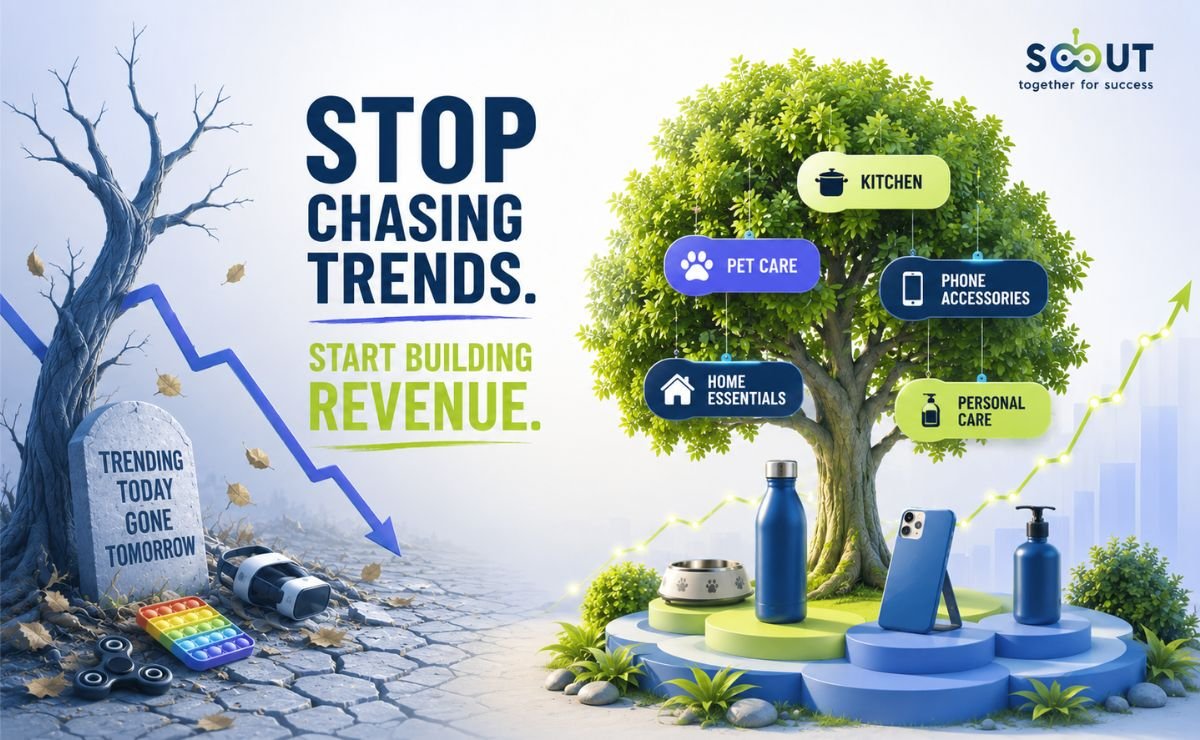
Every online seller has watched a hot product die overnight. One month it's flooding every feed and every store; the next, nobody's clicking, and the ad account that used to print money is bleeding spend. That whiplash is exactly why "evergreen" has become one of the most searched terms among sellers building a business without holding physical stock, because the opposite of that boom-and-bust cycle is a product that just keeps selling, quietly, month after month.
This guide breaks down exactly what an evergreen product is, the characteristics that separate it from a trending item, and why building a catalog around evergreen demand is one of the most reliable ways to protect revenue in 2026. You'll get a clear definition, a side-by-side comparison with trending products, real examples across categories, and the platform tools that let you verify demand before committing a single dollar. If you've ever wondered whether the product you're about to list will still be selling in a year or in six weeks, this is the framework that answers that question.
What Is an Evergreen Product?
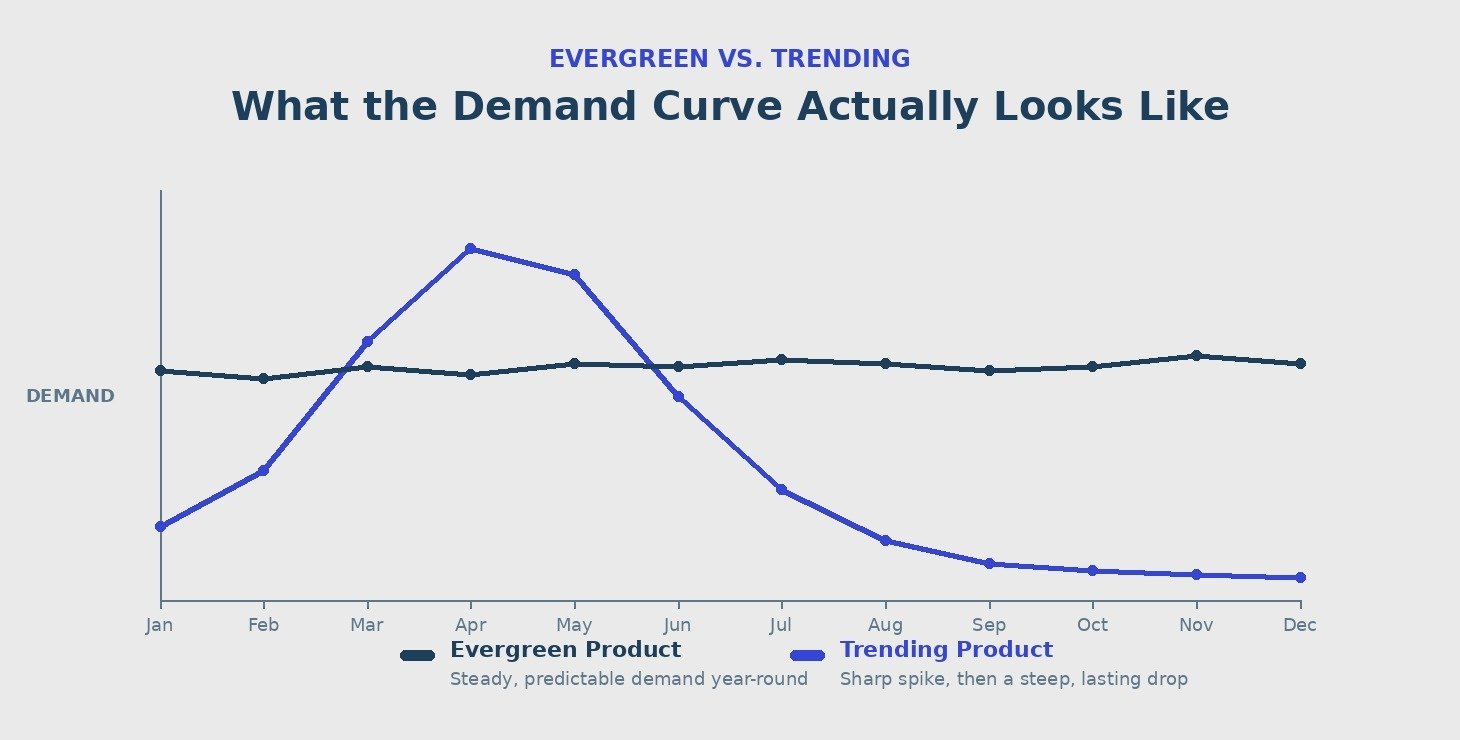
An evergreen product is an item that keeps a steady, predictable level of demand all year, regardless of season, cultural moment, or algorithm-driven virality. The name borrows from evergreen trees, which stay green through every season instead of losing their leaves. Applied to commerce, it means a product whose demand doesn't rise or fall with the calendar or a viral video cycle. Ecommerce items in this category don't move up or down significantly because of cultural moments, algorithm-driven discovery, or calendar events, think personal care staples, kitchen essentials, basic apparel, and pet care products, where the underlying need is ongoing rather than tied to a specific situation.
That's the opposite of a trending product, which spikes fast, generates a short burst of high revenue, and then fades, often permanently. Both categories have a place in a healthy catalog, but they play very different roles, which is exactly what the next section breaks down. (If what you're after right now is what's hot this week rather than what lasts all year, High-Demand Products covers that side of the equation.)
What Are the Key Characteristics of an Evergreen Product?
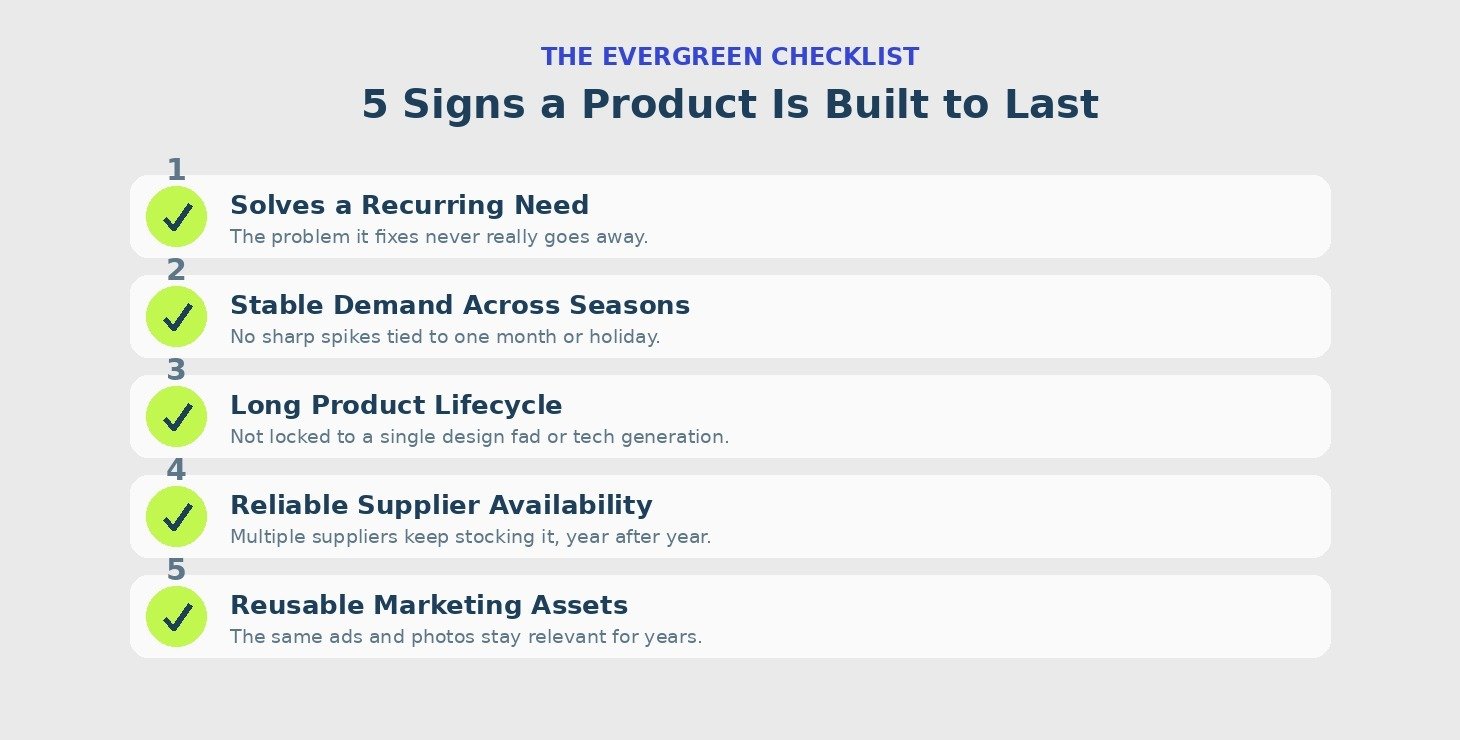
Not every item that "sells well right now" qualifies as evergreen. A genuinely evergreen product checks several boxes at once, not just one.
Does It Solve a Recurring or Permanent Need?
The strongest evergreen products solve a problem that never goes away, storage, hygiene, comfort, organization. A phone charging cable solves the same problem today it solved three years ago and will solve three years from now.
Is Demand Stable Across Seasons and Regions?
An evergreen product shouldn't show sharp, predictable spikes tied to a single season or holiday. Kitchen tools, for example, sell at a fairly consistent rate in January and in July, unlike a product like Halloween decor, which is functionally dead for eleven months of the year.
Does It Have a Long Product Lifecycle?
Evergreen items aren't tied to a specific design fad, tech generation, or aesthetic moment. A basic cotton t-shirt has a lifecycle measured in decades; a fidget-spinner-style novelty item has a lifecycle measured in months.
Is There Reliable, Ongoing Supplier Availability?
If dozens of suppliers across multiple regions consistently stock a product, that's a strong signal the underlying demand is real and durable, manufacturers don't keep producing items nobody wants.
Can the Same Marketing Assets Be Reused Long-Term?
Because the audience and the value proposition don't change, ads, product photography, and listing copy built for an evergreen product stay relevant for years instead of expiring with the trend.
Is Your Product Idea Evergreen? A 5-Point Checklist
|
Signal |
Evergreen product |
Trending product |
|
|
1 |
Underlying need |
Permanent |
Temporary or situational |
|
2 |
Seasonal pattern |
Minimal, consistent |
Sharp spike, then drop |
|
3 |
Supplier depth |
Wide, ongoing |
Often narrow, opportunistic |
|
4 |
Ad creative lifespan |
Reusable for years |
Expires with the trend |
|
5 |
Design/tech relevance |
Rarely outdated |
Tied to a specific moment |
Evergreen vs. Trending Products: What Really Separates Them?
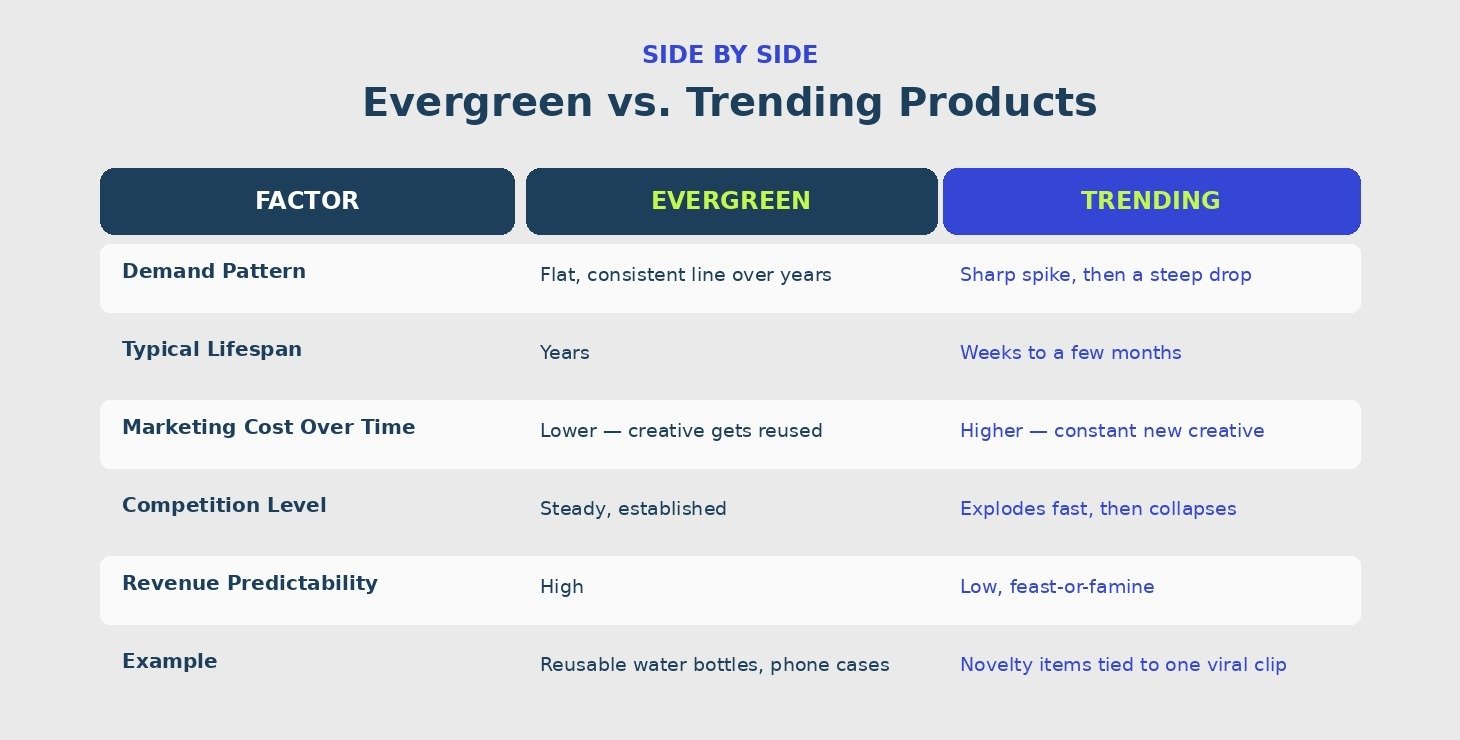
This is the comparison most sellers actually need before choosing what to list.
|
Factor |
Evergreen Products |
Trending Products |
|
Demand pattern |
Flat, consistent line over months/years |
Sharp spike, short plateau, steep drop |
|
Typical lifespan |
Years |
Weeks to a few months |
|
Marketing cost over time |
Lower, creative gets reused |
Higher, constant new creative needed |
|
Competition level |
Steady, established |
Explodes fast, then collapses |
|
Revenue predictability |
High |
Low, feast-or-famine |
|
Example |
Reusable water bottles, phone cases |
Novelty toys tied to a single viral clip |
The two categories aren't mutually exclusive, and the smartest sellers don't pick a side, they build a core catalog of evergreen items for stability and layer in trending products for short-term revenue spikes. Shopify's own guidance frames the real test simply: the deciding factor is whether the product solves a specific need, and whether that need is everlasting.
A product's category isn't always permanent, either. During the COVID-19 pandemic, items solving a very specific, time-bound problem, like touchless door openers and UV phone sterilizers, largely disappeared once that moment passed, while others, like hand sanitizer and disinfectant spray, moved from being trend-driven to becoming a permanent part of people's everyday routines. That's the clearest real-world proof that "evergreen" isn't a fixed label, it's a pattern you can track and confirm with data, not just a guess.
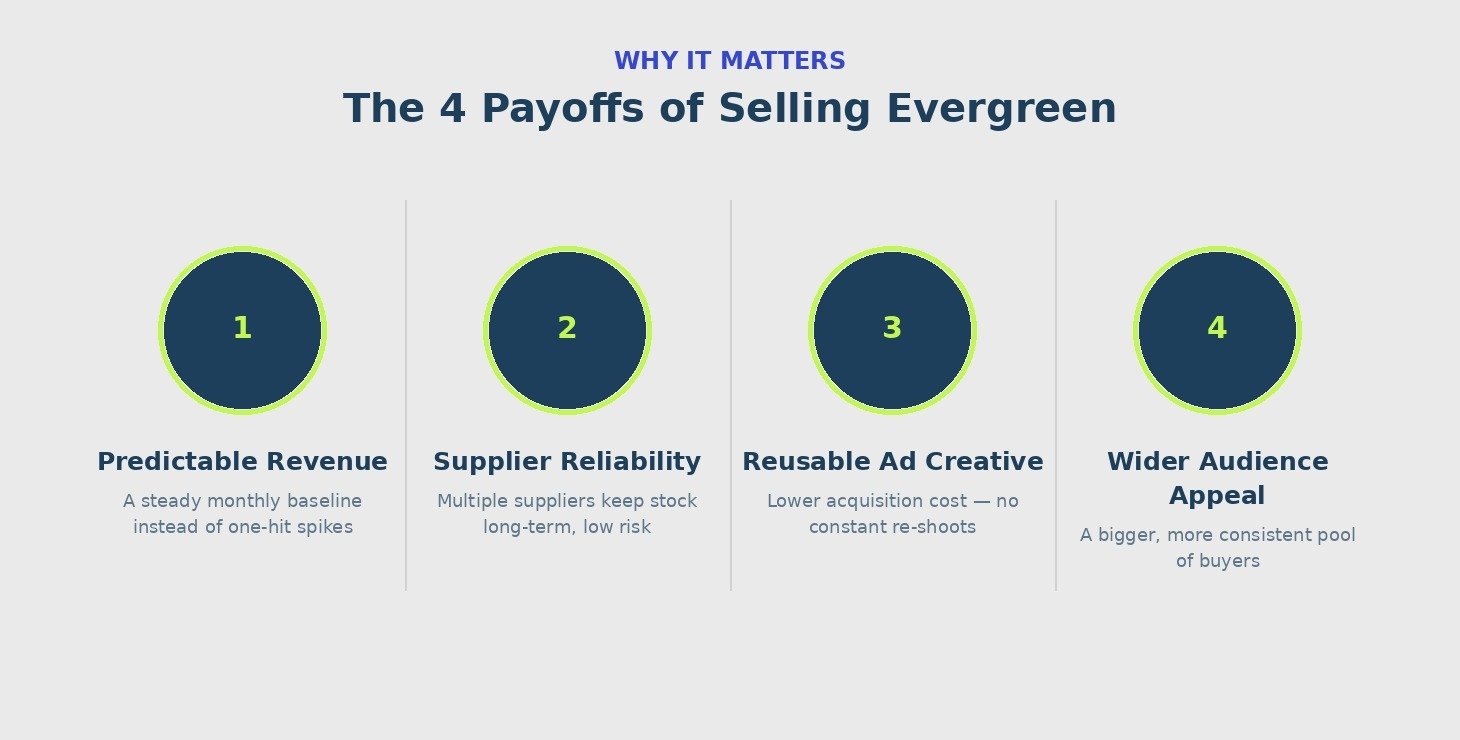
Why Do Evergreen Products Matter for Sellers Who Don't Hold Stock?
For sellers sourcing products without holding their own inventory, evergreen items reduce risk in ways that go beyond just "steady sales."
Do They Provide Predictable, Stable Revenue?
Instead of a business that lives or dies by the next viral hit, an evergreen catalog produces a baseline of orders every month, the kind of consistency that makes it possible to plan ad budgets and cash flow with confidence.
Do They Reduce Supplier and Sourcing Risk?
Because demand is steady, multiple suppliers keep the product in stock long-term, which means fewer sudden stockouts, less scrambling for alternate sources, and more room to negotiate better terms over time.
Can You Reuse the Same Ads and Creatives?
An ad built around a kitchen organizer or a pet feeding mat doesn't need to be rebuilt every few weeks the way a trend-driven ad does, that alone can meaningfully lower customer acquisition costs across a full year.
Do They Attract a Wider, More Consistent Audience?
A trending toy might only appeal to one narrow group for one narrow window. A well-chosen evergreen product, a phone case, a set of storage containers, appeals to a much broader, ongoing pool of buyers, which smooths out demand instead of concentrating it into a single spike.
What Are Some Real Examples of Evergreen Products?
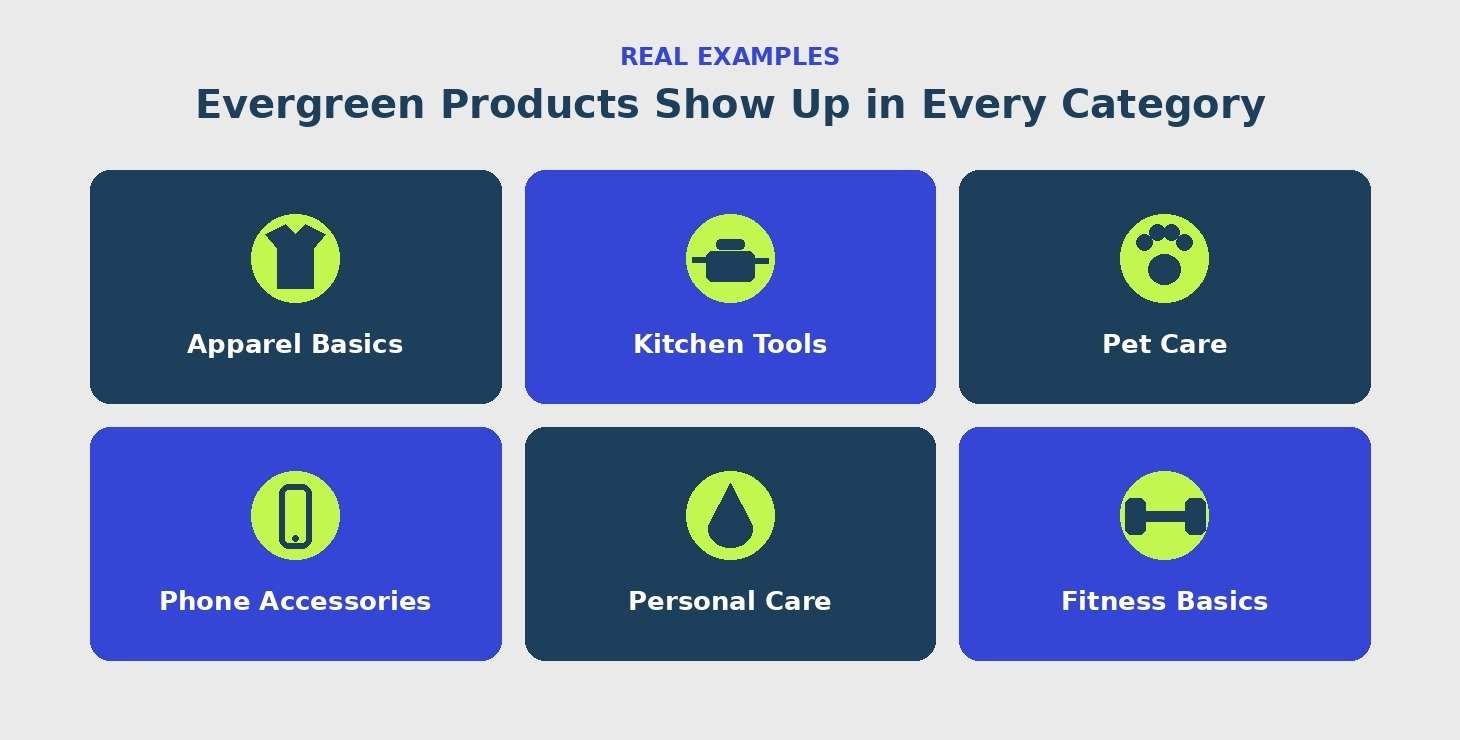
Evergreen demand shows up across nearly every category, not just one niche:
-
Apparel basics: plain t-shirts, socks, underwear
-
Kitchen tools: cutting boards, storage containers, utensil sets
-
Pet care: feeding bowls, leashes, grooming supplies
-
Phone and electronics accessories: cases, cables, chargers
-
Personal care staples: skincare basics, oral care, grooming tools
-
Fitness basics: resistance bands, yoga mats, water bottles
These are just starting points, a full breakdown across dozens of niches, complete with sourcing angles, lives in Evergreen Product Categories, Niches, and 50+ Product Ideas.
Evergreen doesn't mean low-cost, either. A separate class of higher-priced items, think furniture pieces or premium electronics, sells consistently year-round despite the bigger price tag, which is exactly what High-Ticket Evergreen Product Ideas That Sell Year-Round covers in detail. And evergreen demand isn't limited to physical goods at all: templates, guides, and other downloadable products can show the same stable, non-seasonal pattern, which is the focus of Evergreen Digital Product Ideas for 2026.
What Tools Can You Use to Find Evergreen Products Across Platforms?
Every major platform gives sellers a free, official way to check whether a product's demand is genuinely steady or just having a moment, but the depth of that data varies a lot by platform.
How Do You Research Evergreen Products on eBay?
eBay's built-in Product Research tool, the tool formerly branded Terapeak, lets sellers see how products and categories are performing across all of eBay's marketplaces, with easy-to-read reports on which products and strategies are attracting buyers. That's a solid starting point for a single-listing check. For a sharper read on total market activity, order volume, average price, and true sell-through across categories, eBay Product Research inside TS Scout adds the filtering depth (price, marketplace, seller feedback) that the native tool doesn't offer on its own, alongside eBay Best Items for spotting which products are already proving themselves at scale. Since eBay demand also shifts with recurring seasonal patterns, it's worth cross-checking any product against the eBay Seasonal Selling Calendar before assuming a spike is permanent.
How Do You Research Evergreen Products on Amazon?
Amazon's official Movers & Shakers page tracks the biggest gainers in sales rank compared to twenty-four hours earlier, updated frequently across categories. It's useful for catching momentum in real time, but it's built for 24-hour spikes, not long-term stability. Amazon Scanner is built specifically to separate genuine, sustained demand from a short-lived rank jump, tracking trending and high-demand items over a much longer window.
How Do You Research Evergreen Products on AliExpress?
AliExpress runs its own free research suite at ds.aliexpress.com, where sellers can browse hot-selling items and pull sales history on a specific listing. It's a useful first filter, but the data is limited to what's happening on AliExpress alone. Express Scanner goes further by isolating products with genuinely consistent sales activity over time rather than a short-term surge, which is the exact distinction that matters when the goal is evergreen, not viral.
How Do You Research Evergreen Products on TikTok Shop?
TikTok's own Creative Center — Top Products dashboard is the official source here, ranking ecommerce items by performance across organic and paid content. It's designed to surface what's moving right now, which is exactly why it's a trend tool first. TikTok Shop Scanner is built to catch those same fast-moving opportunities early and, just as importantly, help identify which ones show staying power instead of fading after the initial wave.
How Do You Research Evergreen Products on Walmart Marketplace?
Walmart's Assortment Growth dashboard inside Seller Center recommends the most-searched, best-selling items and brands to sellers based on customer demand signals and category data. Walmart Watch builds on that by continuously monitoring top-performing products across the marketplace to help flag stable, repeatable demand patterns rather than a single seasonal push.
How Do You Research Evergreen Products on Shopify?
Shopify itself doesn't run a built-in product-discovery tool the way marketplaces do, so most sellers lean on Google Trends alongside their own store analytics. Shopify Insight fills that gap directly, analyzing product performance across Shopify stores with filters for price range, shipping location, time period, and category, showing units sold, average price, and listing count in one place.
No single platform tells the whole story on its own. The most reliable read on whether a product is truly evergreen comes from comparing demand signals across more than one marketplace at once, rather than trusting one dashboard in isolation, which is the core idea behind the Science of Product Research.
How Can You Confirm a Product Is Evergreen Before You Commit?
Spotting a promising product is only step one, validating it properly, with real historical data instead of a gut feeling, is what actually protects your ad budget and your margins. That process, checking demand consistency, supplier depth, and long-term search interest before you commit, is covered step by step in How to Test an Evergreen Product Before Committing. Getting this step right is also what protects the numbers behind the Profit Anatomy of a listing, and it's often the difference between a product worth a Profit Pivot and one worth dropping altogether.
So, Is Your Next Product Built to Last, or Built to Fade?
Chasing whatever's trending this week will always feel exciting, but it's a strategy with an expiration date built in. Evergreen products won't give you a single explosive week of sales, what they give you instead is a catalog that keeps generating revenue in January, in July, and in every month between, without needing a new ad campaign every time interest cools off. The sellers who build lasting, resilient stores aren't the ones guessing best, they're the ones checking the data across platforms before they commit a budget to a product. Start applying that lens to your own catalog today, and get $1 for 14 days of full TS Scout access to check real demand data across every platform before you list your next product.
FAQ
-
What is an evergreen product?
An evergreen product is an item that keeps steady, predictable demand all year, without relying on a season, holiday, or viral moment to sell.
-
What is the difference between an evergreen product and a trending product?
Evergreen products maintain a flat, consistent demand pattern over years; trending products spike quickly and fade within weeks or months, usually driven by virality rather than an ongoing need.
-
Can a trending product become evergreen over time?
Yes. Some items launch on a wave of trend-driven demand and, once the underlying need proves lasting, settle into steady, long-term sales, hand sanitizer is a well-documented example of that shift.
-
What industries have the most evergreen products?
Apparel basics, kitchen tools, pet care, personal care, and phone accessories consistently show the most stable, year-round demand across major marketplaces.
-
How do you know if a product will stay evergreen long-term?
Check its demand pattern across multiple platforms and multiple years, not just a single spike, consistent search interest, stable supplier availability, and steady sell-through across seasons are the strongest indicators.
like?


Table of Contents
- What Is an Evergreen Product?
- What Are the Key Characteristics of an Evergreen Product?
- Evergreen vs. Trending Products: What Really Separates Them?
- Why Do Evergreen Products Matter for Sellers Who Don't Hold Stock?
- What Are Some Real Examples of Evergreen Products?
- What Tools Can You Use to Find Evergreen Products Across Platforms?
- How Can You Confirm a Product Is Evergreen Before You Commit?
- So, Is Your Next Product Built to Last, or Built to Fade?
- FAQ


