

eBay Account Suspension: The 72-Hour Plan That Actually Gets Sellers Reinstated
- 2026-07-26
-
 0
0
You check your phone before coffee, and the number in your Seller Hub is gone. Not down, gone. A message with a code like MC011 sits in your inbox, your listings have vanished from search, and whatever cash was sitting in your payouts is now frozen behind a wall you didn't know existed.
It happens to sellers with five-star feedback just as often as it happens to beginners, and it rarely comes with a warning. What separates the sellers who get reinstated from the ones who lose the account for good isn't luck, it's what they do in the next 72 hours.
This guide walks through that window step by step, using eBay's own account restrictions and suspensions policy as the baseline rather than guesswork, alongside real seller-reported outcomes so you know what to actually expect. You'll get a clear read on why suspensions happen, how to build an appeal eBay actually approves, what happens to your held funds, and whether a second account is a real option or a fast track to losing both. Let's start with what the notice in your inbox is actually telling you.
What Exactly Happens When eBay Suspends Your Account?
A suspension isn't a single event, it's one point on a scale eBay uses to manage platform risk. On the milder end sits a restriction: your account stays open, but selling, listing, or payout access is limited until you resolve a specific issue. On the severe end sits a suspension, where eBay restricts or suspends accounts to protect the platform, and sellers' payouts may be placed on hold until the restriction or suspension is lifted.
eBay's official policy also confirms that restricted or suspended sellers are notified by email and through eBay Messages, with an explanation of the reason and what's needed to get reinstated, which is why the very first move after any notice is checking Messages inside your account, not just your inbox, since spoofed emails commonly imitate eBay suspension notices.
Sellers often describe this moment as their account being "banned" or "blocked," and while eBay's own documentation sticks to the terms restriction and suspension, the practical effect, no selling, no listing, no payout access, is exactly what those informal terms are pointing to. Whichever word you use to search for help, the fix starts in the same place: identifying which of the two categories you're actually in.
Restriction and suspension aren't interchangeable, and confusing them wastes your first, most valuable hours.
How Many Types of eBay Account Suspensions Should You Actually Recognize?
Not every suspension carries the same weight, and your response should match the category you're actually in.
|
Type |
Typical Duration |
Reinstatement Outlook |
Common Trigger |
|
Warning / Policy Notice |
Immediate to a few days |
High, if fixed quickly |
Single listing violation |
|
Temporary Restriction |
Days to a few weeks |
Moderate to high |
Performance metrics, unpaid fees |
|
Indefinite Suspension |
No fixed end date |
Depends entirely on appeal quality |
Repeated violations, unresolved risk flags |
|
Permanent Suspension |
No scheduled reinstatement |
Low, but not always zero |
Fraud, counterfeit sales, severe repeat breaches |
The category you're in determines whether you're solving a documentation problem (fast) or building a full evidence-backed case (slower, and worth doing properly the first time, a rejected appeal is harder to reverse than a delayed one).
What Should You Do in the First 72 Hours?
Hours 0–6: What's the First Move After You Get the Notice?
Open the notice fully. Note the exact policy name, dates, item IDs, and reference numbers, you'll need every one of them later. Screenshot your Seller Hub metrics and recent transactions before access narrows further. Then stop: no new listings, no relisting, no new account. Creating a second account during an active suspension is one of the fastest ways to turn a recoverable case into two unrecoverable ones.
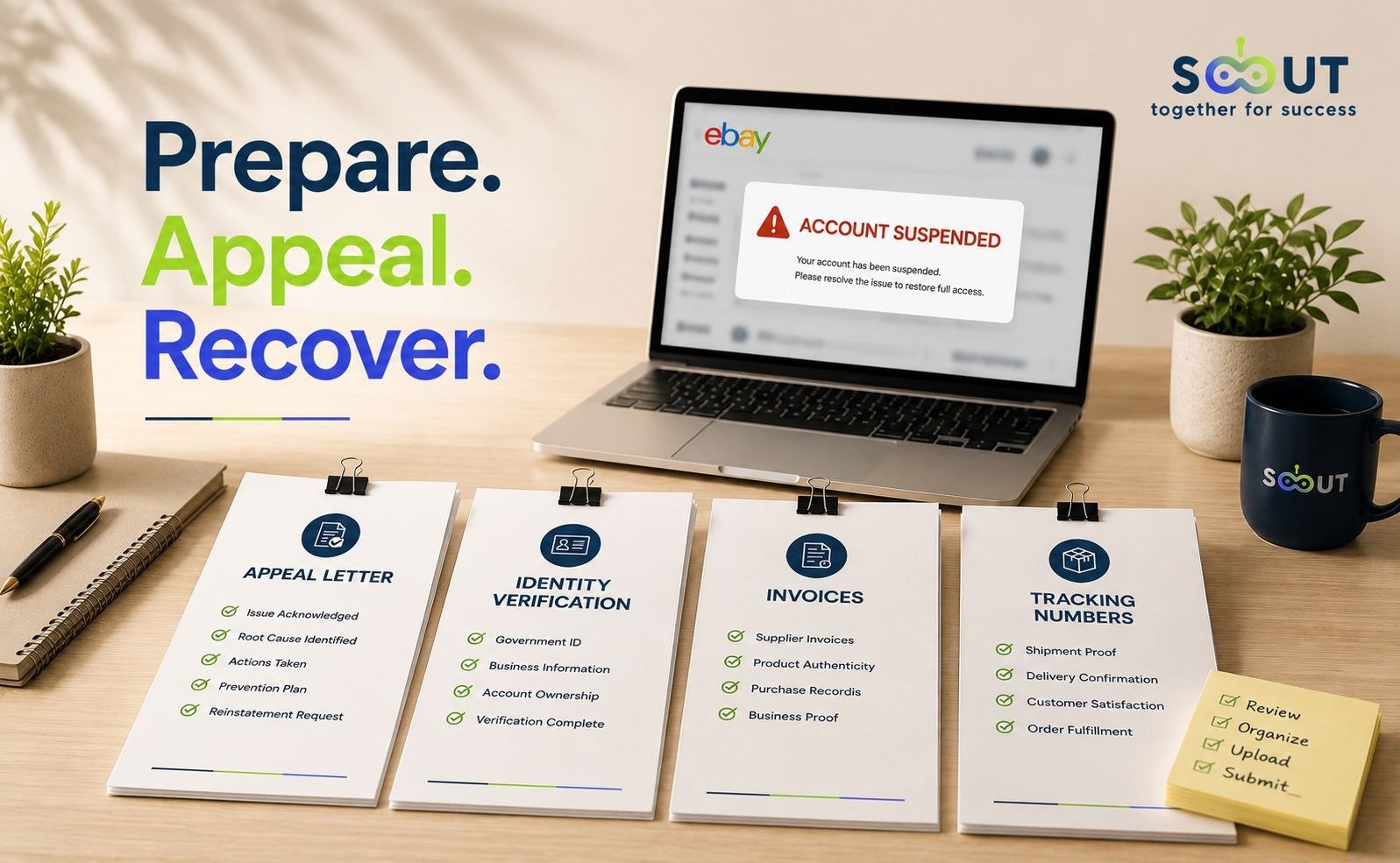
Hours 6–24: What Evidence Do You Need to Gather?
eBay hasn't published an official public glossary defining every restriction code, so treat any code lookup as a general pattern, not a confirmed diagnosis, the specific instructions inside your actual notice always outrank a generic definition. That said, sellers consistently report a few recurring categories: identity or performance-related holds, unpaid seller fees, listing-level policy flags, and account security reviews. Gather supplier invoices, product photos proving authenticity, tracking and delivery confirmations, and any customer communication tied to the flagged listings. If the cause is a straightforward one, unpaid selling costs or an unreimbursed buyer refund, eBay's own policy confirms you can often resolve it directly with a one-time payment through Payments in My eBay or Seller Hub, which reinstates the account once received.
Hours 24–48: How Do You Write an Appeal eBay Will Actually Approve?
The appeals that succeed read like a short business case, not an emotional plea. Structure it in five parts:
-
State the issue plainly: Appeal for Account Reinstatement, referencing the exact policy cited.
-
Own the root cause: no excuses, no blame toward buyers or the algorithm.
-
List what's already fixed: specific, verifiable actions, not intentions.
-
Show your prevention plan: the controls you're putting in place going forward.
-
Make a direct, professional reinstatement request.
Keep it to one page. eBay's review process is looking for evidence of changed behavior, not sympathy.
Hours 48–72: How Do You Submit the Appeal Without Slowing It Down?
Submit through the link in your suspension email or the Help Center appeal flow. Response times vary by complexity, straightforward cases are commonly resolved within a few days, while cases requiring manual review can take considerably longer. Sending repeated follow-ups before that window closes doesn't speed anything up; it just adds noise to your file. Log every reference number and date instead.
Which eBay Policies Actually Trigger Most Suspensions?
Four categories account for the large majority of cases:
-
Performance metrics: late-shipment rate, high Item Not As Described claims, or unresolved buyer cases dragging your account status down over time. If your listings themselves are the recurring problem, it's worth auditing them against a breakdown of common eBay listing errors before they escalate into a metrics issue.
-
Policy violations: VERO intellectual property complaints, prohibited or restricted items, moving payment off-platform, or feedback manipulation.
-
Security and identity mismatches: inconsistent banking details, logins from unfamiliar devices or networks, or incomplete verification.
-
Sourcing-risk signals: unverified or non-transparent supplier relationships, and sudden spikes in listing volume or price that don't match your account's history. This is where product selection matters more than sellers expect: listing high-risk, low-history items is one of the fastest ways to trigger an automated review. TS Scout's eBay Product Research tool exists specifically to flag which products already carry proven demand and stable seller history: reducing the odds you're the account that gets flagged for testing something eBay's systems haven't seen you sell before.
If it feels like you were banned from eBay for no reason, it's worth revisiting this list closely. In practice, an unexplained-feeling suspension almost always traces back to one of these four categories once you match dates against your account activity, even when eBay's notice doesn't spell out the specific trigger.
Where Does Your Money Actually Go During a Suspension?
This is the question that causes the most anxiety, and it's also where a lot of guides get vague or inconsistent. Here's what's actually documented. eBay's payments-hold policy states that holds can apply for several distinct reasons, registration discrepancies, compliance requirements, unusual account activity, or an invalid payment method, and specifically that previously restricted or suspended sellers typically experience transaction holds for 30 days after the restriction or suspension itself is lifted, while eBay confirms successful delivery of the affected orders.
That 30-day figure applies once a restriction ends. It's a different situation entirely if the suspension is never lifted. In that scenario, sellers on eBay's own community forums report waiting considerably longer, commonly citing timeframes stretching toward six months before funds are released or, in unresolved cases, routed to state unclaimed-property programs if no active payout method remains linked to the account. That's real seller experience, not official published policy, so treat it as a realistic expectation rather than a guaranteed number. Either way, your Money Back Guarantee obligations to buyers continue regardless of your account status, fulfilling open orders and keeping delivery proof protects both your case and your funds.
Is Running a Second eBay Account Actually Legal?
Yes, with real limits. eBay permits multiple accounts when each serves a genuinely distinct purpose, separating a buying account from a selling one, for example, or operating in a clearly different product category. What's explicitly against policy is opening a new account specifically to bypass a restriction on an existing one. eBay's systems cross-reference registration details, device data, IP addresses, and payment methods, and linked accounts found circumventing a suspension can be banned together, including ones that individually followed every rule.
If you're building a legitimately separate account, the smartest first move is choosing a niche and product category that's actually distinct from what got your original account flagged, not just a different-sounding store name. TS Scout's eBay Segment Insight is built for exactly this, it evaluates demand, competition, and growth potential at the category level, so a second account starts on solid, differentiated ground instead of accidentally mirroring the first one closely enough to look linked in eBay's eyes. And before you list your first item, it's worth reviewing how to properly set up your eBay account from scratch, since registration inconsistencies are themselves a common trigger for the identity-verification holds covered above.
The account that gets flagged twice for the same behavior almost never gets a third chance. The account that appeals cleanly and rebuilds differently usually does.
How Do Experienced Sellers Avoid a Repeat Suspension?
Prevention isn't a mindset, it's a maintenance habit. Three areas do the heaviest lifting:
-
Metrics discipline. Check your dashboard before the monthly performance snapshot locks in, late shipments, open cases, and defect rates from the final days of the month are the ones sellers most often miss until it's too late to fix them.
-
Listing hygiene. Audit active listings on a set schedule, not reactively. Titles matter more than most sellers assume: overstuffed or trademark-adjacent keywords are a recurring VERO trigger, while under-optimized titles cost visibility even on a clean account. TS Scout's eBay Smart Titles pulls real search-volume data to generate titles that are both compliant and actually findable, solving both problems in the same step, which is more than a manual keyword list can do.
-
Account hygiene. Never share logins or devices across accounts, complete verification requests the day they arrive, and if you're weighing whether to convert to a store format, understanding eBay store benefits first can prevent a mismatched setup from adding friction to your account's standing later.
What Did a Real 72-Hour Recovery Actually Look Like?
Strip away the theory and the pattern in successful cases is consistent. One eBay Community seller, restricted after a VERO flag on a single listing, described the standard playbook working exactly as documented: the flagged item was pulled within hours, supplier documentation was submitted the same day, and the appeal referenced the specific policy by name rather than disputing the flag itself. Reinstatement followed within the window eBay's own notice had outlined. Contrast that with sellers on the same forum who waited past the response window, sent multiple follow-up messages, or disputed the violation instead of addressing it, cases that consistently stretched into weeks or ended in a second, harder-to-appeal suspension. The difference wasn't the severity of the original flag. It was the speed and specificity of the response.
Ready to Make Sure This Never Happens Again?
A suspension freezes your business for a window of time, it doesn't have to end it. The sellers who come back strongest treat the appeal as the first fix and the prevention system as the permanent one: cleaner sourcing, compliant listings, and product choices backed by actual demand data instead of guesswork. That last piece is where most repeat suspensions start, and it's exactly the gap a proper research tool closes. Try TS Scout for $1, with full access for 14 days, and start rebuilding your listings on data your next suspension notice won't be able to touch.
Frequently Asked Questions
-
What's the actual difference between a restriction and a suspension?
A restriction limits specific account functions, selling, listing, or payouts, while the account itself stays open and is typically resolved by fixing the cited issue. A suspension removes broader account access and, on eBay's more severe tiers, can be indefinite or permanent.
-
Can you appeal a permanent eBay suspension?
Yes, a "permanent" label doesn't always close the door. Submitting a clear appeal with updated evidence and a specific plan of action can still result in reinstatement, though the odds are lower than with a temporary or indefinite suspension.
-
How long does eBay typically take to respond to an appeal?
Straightforward cases are often resolved within a few business days; cases requiring manual review or additional documentation can take considerably longer. eBay doesn't publish a fixed guarantee either way.
-
How long is an eBay account suspended?
It depends entirely on the category. A warning or single-listing flag can clear in days, a temporary restriction usually resolves within a few weeks, and an indefinite or permanent suspension has no scheduled end date at all, its length is set by how convincing your appeal is rather than a fixed calendar.
-
How do I unsuspend my eBay account?
Submit a policy-specific appeal within the first 72 hours: name the exact violation, show what's already fixed, and outline your prevention plan going forward. There's no separate "unsuspend" button, reinstatement runs entirely through this appeal process.
-
What happens if your appeal gets denied?
You can request clarification through eBay's official Help Center or, for significant financial cases, consider legal guidance. Filing several appeals back-to-back rarely improves the outcome and can slow the review further.
-
Can you create a new account while your original one is under appeal?
No. This is treated as an attempt to bypass an active restriction and commonly results in both accounts being suspended together.
-
Will you eventually get your held funds back?
In most cases, yes, though the timeline depends heavily on whether the restriction was lifted or the account remains suspended, see the funds section above for the documented difference between the two.
-
Does eBay always explain exactly why an account was suspended?
Not always in plain language, some notices reference a policy category without full detail. Your Seller Hub performance dashboard and Account Status page often fill in the specifics the notice leaves out.
10. What's the fastest way to reach a real person at eBay about a suspension?
Start from the Help article matching your issue, then scroll to the bottom and select the contact option, this routes you to an agent handling that specific issue type rather than a general queue. For suspension-related policy notices specifically, the Resolution Hub is the direct path eBay points sellers to.
11. Can you still buy on eBay while your selling privileges are suspended?
Usually yes, most restrictions target selling activity specifically. Full account suspensions tied to fraud or serious violations are the exception, where buying access is also affected.
12. Can you get back on eBay after being banned?
Sometimes. A ban tied to a permanent suspension is the hardest tier to reverse, but it isn't automatically final, the path back is the same appeal process covered above, built around evidence and a specific corrective plan rather than a dispute of the original decision. Opening a fresh account instead of appealing is the move most likely to close that door for good.
like?


Table of Contents
- What Exactly Happens When eBay Suspends Your Account?
- How Many Types of eBay Account Suspensions Should You Actually Recognize?
- What Should You Do in the First 72 Hours?
- Which eBay Policies Actually Trigger Most Suspensions?
- Where Does Your Money Actually Go During a Suspension?
- Is Running a Second eBay Account Actually Legal?
- How Do Experienced Sellers Avoid a Repeat Suspension?
- What Did a Real 72-Hour Recovery Actually Look Like?
- Ready to Make Sure This Never Happens Again?
- Frequently Asked Questions