
Why Your eBay Listings Are Invisible: The eBay Cassini Algorithm 2026 Fix Nobody Talks About
- 2026-09-01
-
 0
0
You published a clean listing. Sharp photos, complete title, fair price. Then you searched for it yourself and it wasn't there. This is the moment most eBay sellers panic and start rewriting titles that were never the actual problem. The truth is that eBay listing not showing in search is rarely a single mistake, it's the outcome of how the eBay Cassini algorithm 2026 scores relevance, seller performance, and listing quality together, and most guides only explain one of those three.
This article breaks down the real mechanics: what Cassini actually measures, which hidden metrics quietly bury otherwise strong listings, and the exact eBay listing visibility fix for each scenario. You'll also see why a growing number of sellers are losing organic reach without ever touching their listings, because the problem often sits at the account level, not the page level. By the end, you'll have a clear diagnostic for whether your issue is indexing, ranking, or something buyers are doing without realizing it. Let's start with a distinction almost every seller gets wrong.
What's the Difference Between Cassini and Best Match?
Cassini is eBay's underlying search engine, introduced in 2013 to replace the older Voyager system. Best Match is the default sort order that Cassini powers, it's the label buyers actually see in the sort dropdown, which is why so much seller advice about "beating the algorithm" never quite lands: sellers are optimizing for a name they never see reflected back at them.
According to eBay's Best Match guidance, ranking considers how closely a listing matches the buyer's search terms, item popularity, price, listing completeness and quality, terms of service like return policy and handling time, and the seller's track record. Cassini isn't scanning for keyword density, it's predicting which listing is most likely to end in a completed, satisfying transaction, which means a "perfectly written" listing with no engagement history can still lose to a plainer one that converts.
If you're still shaping your core research process around this, the eBay Segment Insight tool is worth building into your workflow this early, it flags which categories and search terms already have strong buyer demand and manageable competition, so the listings you build from the start are working with Cassini's relevance pillar instead of against it.
Why Does Organic Ranking Matter More in 2026 Than It Did Two Years Ago?
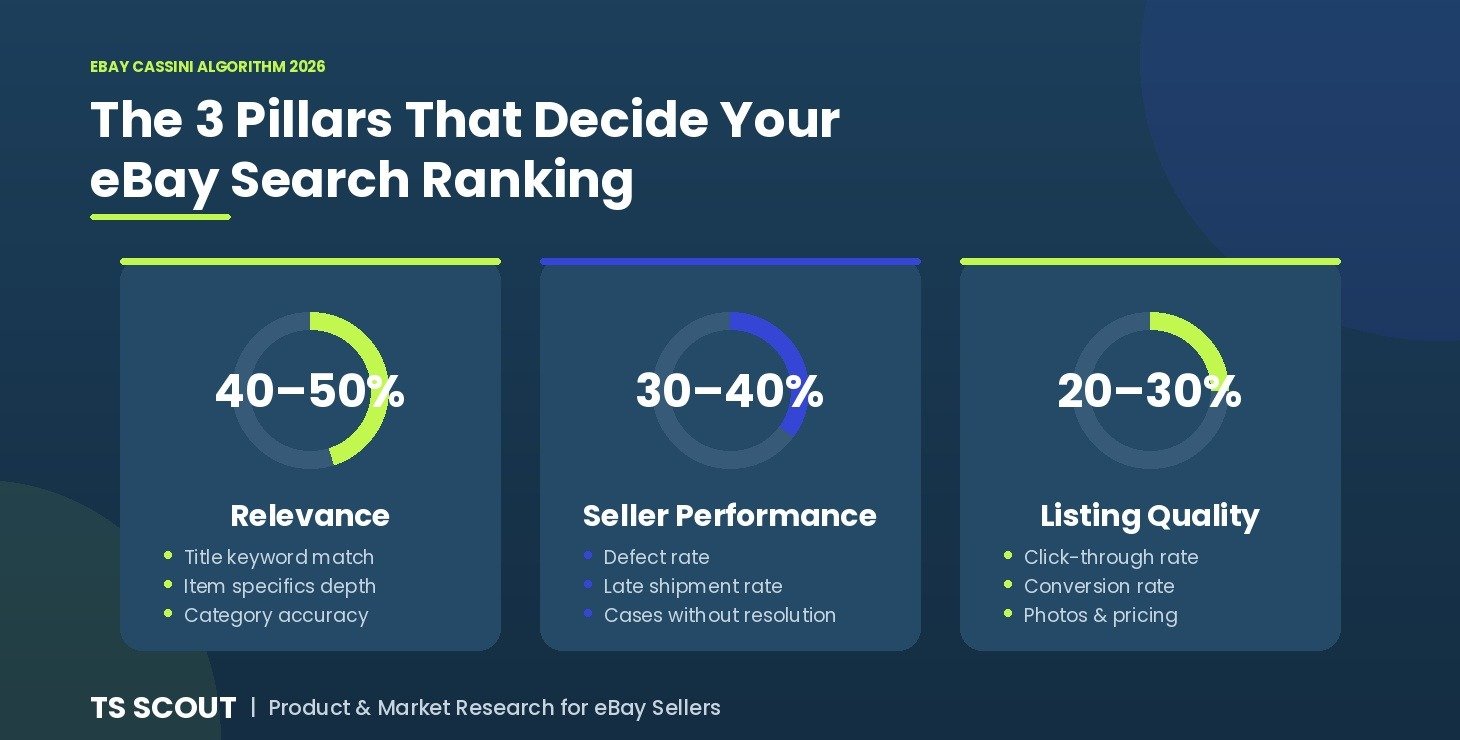
Two forces are pushing organic visibility higher up every seller's priority list this year. First, Promoted Listings ad rates have climbed, which makes free, algorithm-earned placement worth meaningfully more than it was a couple of years ago. Second, Cassini's three ranking pillars interact more tightly than ever. eBay hasn't published official weightings for these pillars, so treat the breakdown below as estimated weights based on seller community analysis, not confirmed figures:
|
Pillar |
Estimated weight (seller analysis, not eBay-confirmed) |
What it covers |
|
Relevance |
40–50% |
Title match, item specifics, category accuracy |
|
Seller performance |
30–40% |
Defect rate, late shipment, unresolved cases |
|
Listing quality & engagement |
20–30% |
CTR, conversion rate, photos, pricing |
Most sellers pour all their effort into the first column and treat the other two as background noise. That imbalance is exactly why a well-written listing can still sit on page three; the title did its job, but performance and engagement signals dragged the overall score down.
New Listing or Lost Ranking, Which Problem Are You Actually Facing?
Before diagnosing anything, separate these two situations, because they need different fixes:
-
A brand-new listing that hasn't appeared yet. This is almost always an indexing issue, not a quality issue.
-
An established listing that used to rank and doesn't anymore. This is a performance decay issue, something changed in your metrics, not your copy.
Treating the second problem with a first-problem fix, like rewriting the title, is one of the most common wastes of seller time on eBay.
Why Does Cassini Need Time Before It Trusts a New Listing?
Per eBay's own guidance on finding a listing, a new item should appear in eBay search within 24 hours of publishing, and revising the listing before that window closes restarts the clock. If it's been under a day, the fix is simple: stop editing and wait. If it's been longer and the listing still isn't appearing, check three things in order: the listing's active status in Seller Hub, any suppression or policy notices in your account messages, and whether the item specifics and category actually match how buyers are searching for it.
What Is eBay Sell-Through Rate, and Why Does It Predict Its Own Decline?
eBay sell-through rate (STR) is units sold divided by units listed over a given period. Cassini treats a healthy sell-through rate as a trust signal, proof that your price point and positioning are working for that category. The problem is that STR doesn't just report your performance; it actively shapes what happens next.
A listing that converts consistently earns better placement, which drives more impressions, which drives more sales. A listing whose STR drops loses placement, loses impressions, and the decline compounds, each stage makes the next one worse, and the lost visibility translates directly into lost revenue, not just lost rank. If this compounding effect sounds familiar, it's worth reading alongside
Stop Bleeding Profits to see how the same decline shows up on your margins, not just your search position.
For non-stockholder sellers specifically, this is where an underappreciated risk shows up: a listing can look fine on the surface while a supplier's real stock or pricing has quietly shifted underneath it, creating cancellations or fulfillment delays that tank STR without an obvious cause. Catching that drift before it hits sales data, using something like the eBay Product Research tool to verify current supplier pricing and stock reliability before it becomes a cancellation, protects the exact number Cassini is watching. If your STR is already sliding, revise the existing listing's price or positioning. Don't relist it, that resets the exact history Cassini uses to trust you.
What Is eBay Listing Quality Score, and Why Do Complete Listings Still Underperform?
Your eBay listing quality score is read by Cassini before a buyer ever sees your listing, and the most damaging gaps are invisible to you unless you know to check for them:
-
Incomplete item specifics. A missing attribute doesn't lower your rank, it removes you entirely from any filtered search using that field. This is the single most common silent visibility killer.
-
Wrong category. Buyers who browse by category instead of typing a search term never encounter a miscategorized listing at all.
-
Weak primary photos. On mobile, where most eBay traffic happens, a clean, well-lit photo against a plain background consistently drives higher click-through than a cluttered thumbnail, and CTR feeds directly back into ranking.
-
Descriptions that don't echo buyer language. If your description structure doesn't align with how people actually phrase their search, it does nothing for relevance scoring even if it reads well.
If you're still building out your foundational listings, reviewing Common eBay Listing Errors alongside this checklist will catch overlaps before they compound.
What Are the Hidden Metrics Almost No One Explains?
This is where the real "fix nobody talks about" lives.
-
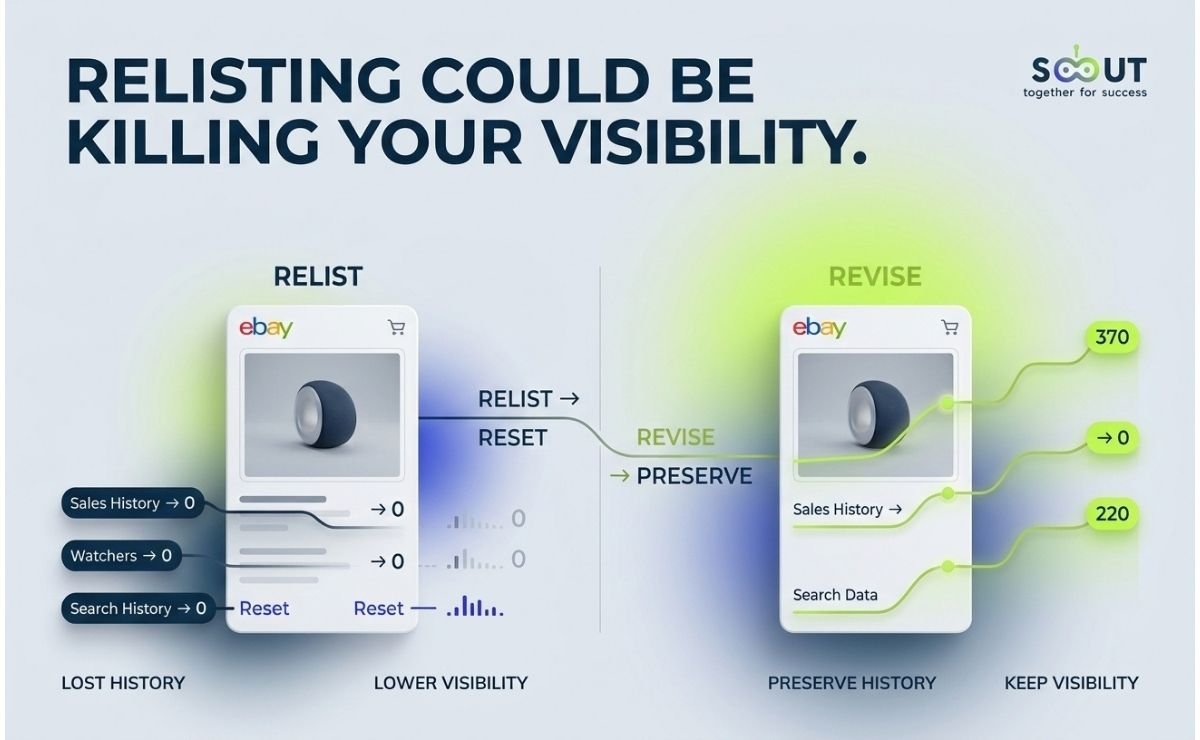
The relisting trap. Ending a listing and creating a new one resets sales history, watcher data, click data, and search indexing. Cassini treats the replacement as having zero track record, the exact opposite of what a seller trying to "refresh" a slow listing wants.
-
Stale listing contagion. eBay hasn't published an official timeframe for this, but sellers commonly report that listings with no sales, views, or watchers for 60–90+ days start dragging down visibility signals for the rest of the store, not just the underperforming listing itself. If you're carrying several of these, an audit against your broader Grow eBay Store strategy is worth doing before you list anything new.
-
Buyers' own filters work against you. Sort options like "Price + Shipping: lowest first," or any filter tied to an item specific you left blank, can hide a genuinely strong listing from a meaningful share of buyers by default, no ranking penalty involved, just a filter doing exactly what it's designed to do. This is precisely why item specific completeness (Section 6) matters more than most sellers assume.
-
Failed offer cycles. Sending Best Offer promotions that consistently go unanswered is itself a weak engagement signal Cassini can read.
What Are eBay's Seller Performance Standards, and Why Can They Tank Rankings Even When "Nothing Changed"?
Per eBay's Seller Standards Policy, a transaction defect rate above 2% is enough to move an account to Below Standard — and that status suppresses visibility across your entire catalog, not just the transactions that caused it. This is why sellers so often report "I changed nothing and my sales stopped": the change wasn't on the listing, it was on the account-level dashboard.
Top Rated Seller status, by contrast, requires a defect rate at or below 0.5% and a late shipment rate at or below 3%, along with valid tracking uploaded on 95%+ of transactions, per eBay's seller performance overview and eBay's seller protections policy, and it functions as a visible ranking multiplier on top of everything else. eBay's own breakdown of how these metrics are calculated is detailed further in its ABCs of metrics and defects guide. If your account has ever slipped, reviewing what led to an eBay Account Suspension risk in the past is a useful gut-check before assuming the listing itself is at fault, and if you're building account health with a Store subscription, eBay Store Benefits breaks down which tier actually supports Top Rated status versus which one just adds cost.
Which of the Two Visibility Problems Do You Actually Have?
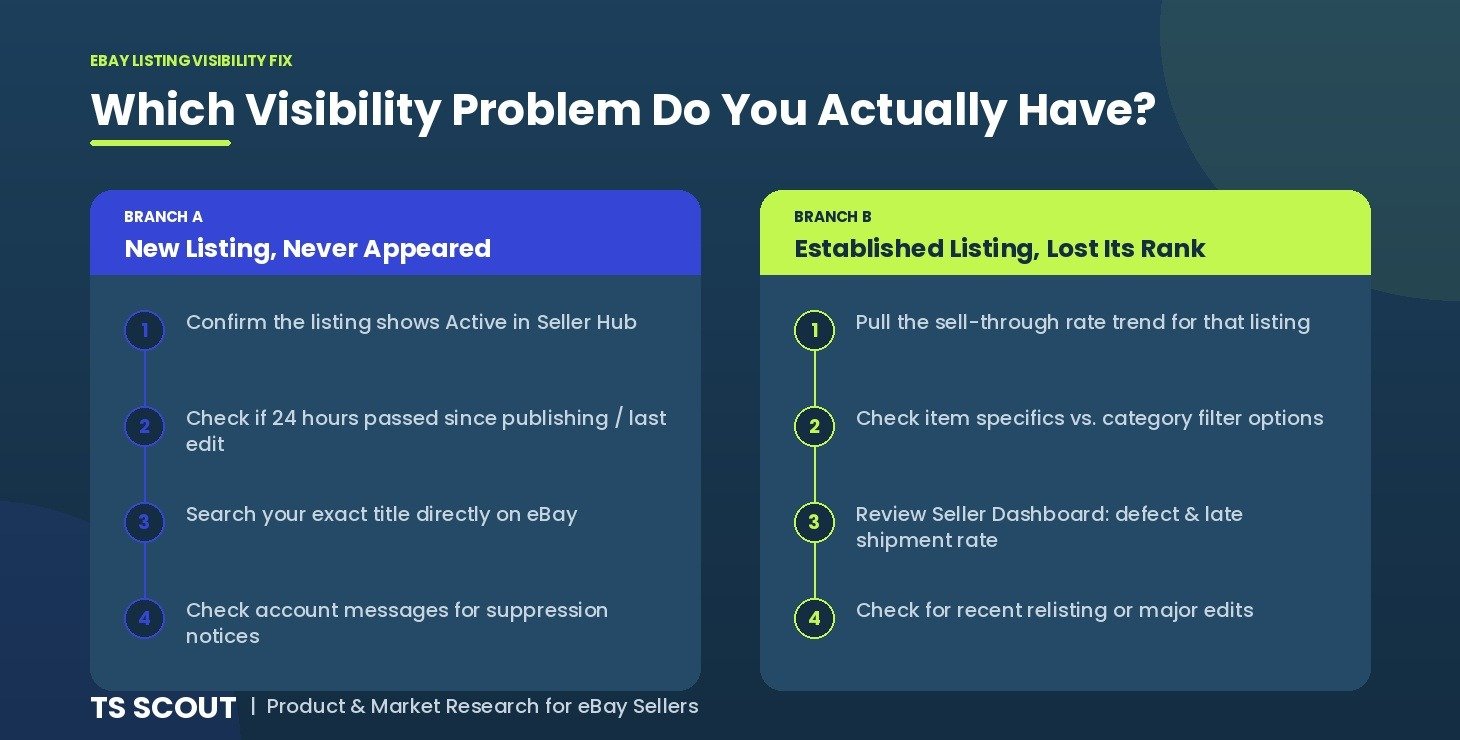
Use whichever branch matches your situation:
Branch A, New listing, never appeared:
-
Confirm the listing shows Active in Seller Hub.
-
Check whether 24 hours have passed since publishing or the last edit.
-
Search your exact title directly on eBay.
-
Check account messages for suppression or policy notices.
Branch B, Established listing, lost its rank:
-
Pull the sell-through rate trend for that listing.
-
Check item specifics completeness against the category's filter options.
-
Review your Seller Dashboard for defect rate and late shipment rate.
-
Check whether the listing was relisted or majorly edited recently.
How to Improve eBay Listing Visibility? The Fix, Not Just a Quick Patch
The real fix isn't a one-time title edit, it's a maintenance rhythm applied consistently:
-
Audit item specifics across your active catalog, not just new listings
-
Track sell-through rate per listing and revise (never relist) anything sliding
-
Check your seller performance dashboard on a fixed schedule, not only when sales drop
-
Reprice against actual sold comps rather than competitor asking prices
Running this rhythm consistently is faster with the right research layer underneath it. The eBay Competitors Research tool shows how your listings' pricing and positioning compare against real competing sellers in your category, and the eBay Smart Titles helps rebuild titles around actual buyer search data instead of guesswork, both feed directly into the relevance and quality pillars covered in Section 2. For sellers auditing supplier reliability alongside listing health, this pairs naturally with the sourcing checks in your eBay Suppliers research.
Ready to Stop Guessing Why Your Listings Disappear?
Visibility on eBay isn't won with a single keyword fix, it's the compounding result of relevance, seller performance, and listing quality moving together, plus a few buyer-side mechanics most sellers never learn about. Fix the account-level signals first, then the listing-level ones, and stop relisting your way into losing history you can't get back.
Get full access to TS Scout's eBay research tools, including Niche Finder, RivalView, Product Research, and Title Master, for $1 with a 14-day full-access trial.
FAQ
-
Why did my eBay listing suddenly stop showing up in search?
It's almost always one of four causes: the listing is still indexing, there's a policy or suppression notice on the account, the title and item specifics are too weak to match buyer queries, or an account-wide performance issue is suppressing the entire catalog.
-
What's the difference between Cassini and Best Match?
Cassini is eBay's underlying search engine; Best Match is the default sort order it powers and the only part of it buyers actually see.
-
Does sell-through rate really affect ranking, or is it a myth?
It's real and compounding, a dropping STR reduces placement, which reduces impressions, which drops STR further.
-
Should I relist or revise an underperforming listing?
Revise. Relisting resets sales history, watcher data, and search indexing, putting you back at zero.
-
How long does a new eBay listing take to appear in search?
Up to 24 hours per eBay's own guidance, and editing the listing before that window closes restarts the clock.
-
Can one bad listing hurt my whole store's visibility?
Stale, non-converting listings can drag down store-wide visibility signals, so auditing and revising them matters beyond that single listing.
-
What's the fastest fix for a low listing quality score?
Complete every item specific field first, it's the single most common reason a technically fine listing disappears from filtered searches entirely.
like?


Table of Contents
- What's the Difference Between Cassini and Best Match?
- Why Does Organic Ranking Matter More in 2026 Than It Did Two Years Ago?
- New Listing or Lost Ranking, Which Problem Are You Actually Facing?
- Why Does Cassini Need Time Before It Trusts a New Listing?
- What Is eBay Sell-Through Rate, and Why Does It Predict Its Own Decline?
- What Is eBay Listing Quality Score, and Why Do Complete Listings Still Underperform?
- What Are the Hidden Metrics Almost No One Explains?
- What Are eBay's Seller Performance Standards, and Why Can They Tank Rankings Even When "Nothing Changed"?
- Which of the Two Visibility Problems Do You Actually Have?
- How to Improve eBay Listing Visibility? The Fix, Not Just a Quick Patch
- Ready to Stop Guessing Why Your Listings Disappear?
- FAQ