
When Your AliExpress Price Increases at Checkout: A Margin Protection Playbook for 2026
- 2026-07-21
-
 0
0
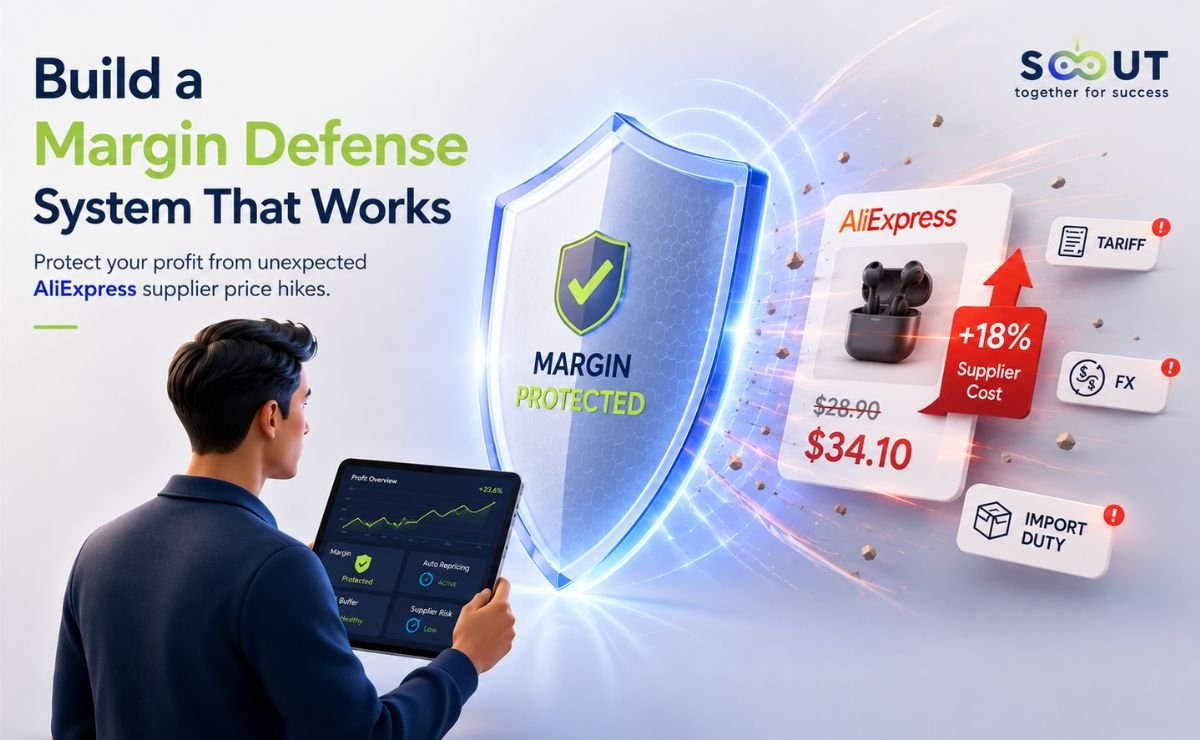
It's a familiar gut-drop: you open your supplier dashboard and a SKU that's been your best seller for six months now costs 18% more to source. Nothing about your store changed overnight. Your supplier's costs did, and your margin absorbed the hit before you even logged in.
This is the reality of sourcing from AliExpress in 2026: tariff stacking, currency swings, and the end of duty-free low-value shipments have made an AliExpress price increase at checkout a recurring operational risk, not a rare event. Price increase protection isn't a one-time fix, it's a system: spot the manipulation early, build a buffer that absorbs the shock, and automate the response so a single overlooked SKU doesn't quietly erase a month of profit.
This article walks through all three, with the actual numbers, tools, and decision points you need to protect your margins on active listings, not generic advice you've read everywhere else. Let's start with why this is hitting harder right now than it did a year ago.
What's Actually Driving AliExpress Supplier Cost Increases in 2026?
The single biggest driver right now isn't seasonal demand, it's trade policy, and the numbers have moved a lot in the last twelve months. The $800 duty-free de minimis exemption that let low-value China shipments enter the US tax-free was eliminated for China and Hong Kong on May 2, 2025, then suspended for every other country on August 29, 2025 under Executive Order 14324, according to U.S. Customs and Border Protection. As of mid-2026, Chinese-sourced goods carry a combined effective rate of roughly 35%, a 10% Section 122 surcharge plus a 25% Section 301 duty on most consumer categories, per tariff-action data published by the Office of the United States Trade Representative. That's down from the 145% peak in 2025 after the Supreme Court struck down the broader IEEPA tariffs in February 2026, a ruling CBP has confirmed and is implementing, but it's far from the duty-free environment sellers built their pricing models around two years ago.
There's a near-term wildcard worth watching right now: the Section 122 surcharge is scheduled to expire on July 24, 2026 unless Congress extends it, just days from when this update was written. The Court of International Trade ruled the surcharge unlawful in May 2026, but that relief currently applies only to the named plaintiffs in the case, so CBP continues collecting it from everyone else while the government's appeal proceeds. Translation: the rates behind that price increase at checkout could shift again within days, which is exactly why "set it and forget it" pricing doesn't work in this category anymore.
Three forces are converging on your supplier costs simultaneously:
Tariff pass-through: Suppliers either build the new duty into the listed price or leave it to surface at checkout, more on that distinction below.
Currency conversion drift: If you're not paying in your supplier's preferred currency, exchange-rate swings can quietly inflate what you're charged. AliExpress's own currency guidance notes that displayed prices may not always reflect the actual checkout cost due to conversion-rate fluctuations.
Seasonal and raw material cycles: Independent of trade policy, demand spikes around major sales events and material cost shifts still move supplier pricing the way they always have.
The first two are new pressure points most sellers haven't built defenses for yet. That's where this gets practical.
How Can You Spot Supplier Price Manipulation Before It Hits Your Listings?
Not every cost increase is announced. Some are buried in places sellers don't habitually check, and by the time you notice, the damage is already live on your storefront.
Why Does AliExpress Price Change at Checkout?
This is the pattern that catches the most sellers off guard, and it's worth understanding directly from the source. AliExpress's own seller guidance confirms that the tariff line shown at checkout is an estimated customs duty and import tax, collected upfront through the platform's logistics partners so packages clear customs without delay, rather than a duplicate or hidden charge. How it's presented depends on the shipping method: standard economy options (like basic postal or economy parcel services) typically bundle this into an integrated customs process automatically, while some premium express carriers offer a manual self-clearance option instead. In practice, this means some sellers fold the tariff directly into the listed product price, so your synced cost updates correctly, while others leave the listed price unchanged and add it as a separate line at checkout, which many sourcing tools won't automatically reflect back into your cost data. If your supplier cost sync looks stable but your actual landed cost has crept up, this is usually why an AliExpress price increase at checkout shows up before it ever shows up on the product page. Check the order breakdown, not just the listed price.
What does the "overnight hike" pattern look like?
A supplier raises the price on a single high-demand SKU with no warning, often right after it starts trending. There's no announcement, you only catch it if you're actively tracking the listing or get an alert when the synced cost changes.
Are "discount" cycles quietly resetting the base price?
Many listings show a temporary "sale" price that expires without notice, after which the price reverts to a higher undiscounted rate, sometimes higher than before. Pricing your margin off a temporary discounted rate is a common trap: if your markup calculation is based on today's sale price rather than the standard price, your entire safety margin can disappear the moment the discount ends. Always calculate your margin off the undiscounted price, not whatever number happens to be alive today.
A weekly red-flag checklist:
-
Compare today's supplier cost against last week's for your top 20 SKUs by volume.
-
Check whether the checkout total (not just the listed price) has shifted.
-
Confirm the "discount" price hasn't quietly become the new base price.
-
Flag any SKU where cost has moved more than 5% week-over-week for manual review.
Checking 20+ listings manually every week doesn't scale once your catalog grows, this is where a dedicated research tool earns its keep. Express Producr Research lets you pull detailed, current product-level data by name with filters for price and sales performance, so instead of clicking through individual AliExpress listings hoping nothing changed, you get the current numbers in one search. It's a faster, more reliable check than relying on the platform's own listing page, which doesn't surface price history.
How Do You Build a Margin Buffer That Survives a Cost Spike?
Detection tells you a hike happened, whether it's on the product page or a price increase at checkout. A buffer determines whether it actually hurts you.
Fixed vs. percentage-based buffers, which holds up better?
|
Buffer type |
Response to a cost spike |
Underpricing risk |
Admin effort |
Best for |
|
Fixed dollar buffer |
Doesn't scale with cost, a $2 buffer on a $50 item absorbs less, proportionally, than on a $10 item |
Higher on expensive SKUs during large spikes |
Low, set once |
Stable, low-cost catalogs with rare cost swings |
|
Percentage-based buffer |
Scales automatically with item cost, so a 15% buffer stays proportional whether the item is $10 or $100 |
Lower, keeps pace with cost changes |
Slightly higher, needs periodic review of the percentage itself |
Catalogs with mixed price points or frequent tariff exposure |
For most AliExpress-sourced catalogs in the current tariff environment, a percentage-based buffer is the more resilient choice, since it scales with the very cost swings tariffs are causing.
Are you pricing off landed cost or just the sticker price?
Landed cost means product price plus shipping plus any import duty, not the number on the AliExpress product page. Skipping this step is one of the most common margin leaks sellers report, because the "Estimated Charges" breakdown at checkout (sales tax, import tax) often isn't reflected back into your sourcing app's synced cost in real time.
Does paying suppliers in their preferred currency protect your margin?
It can. As noted above, AliExpress itself acknowledges that the price you see displayed isn't always what you're charged once currency conversion is applied at checkout. Holding and paying in your supplier's preferred currency, typically USD or CNH, through a multi-currency account removes that variable from your cost stack, rather than leaving the conversion to happen automatically on each order.
What's a realistic margin floor?
Don't set this number arbitrarily. Build in room for the costs that erode margin even without a supplier hike, refunds, returns, and payment disputes all chip away at your realized margin on cross-border sourced goods. A 10-15% buffer on top of your target margin is a reasonable, defensible floor rather than a number pulled from nowhere. If a cost increase would push you below that floor on a given SKU, that's your trigger to act, which brings us to the moment most articles skip.
A Supplier Just Raised Prices, What Do You Do Right Now?
This is the actual decision tree, in order:
-
Absorb it, if the increase fits inside your buffer: No price change needed. Log it and move on; this is what the buffer exists for.
-
Reprice, if the increase exceeds your buffer but the new retail price is still competitive: Raise the retail price by the amount needed to restore your margin floor, then check it against comparable listings before publishing.
-
Switch supplier, if repricing would push you above competitive market price: At that point, the SKU isn't sustainable with this supplier anymore, and you need a backup sourced and ready before the listing goes stale.
The mistake most sellers make is treating this as one decision instead of three sequential checks. Skipping straight to "switch supplier" wastes time on SKUs your buffer already covers; skipping straight to "absorb it" on every hike erodes margin slowly until it's gone.
How Do You Set Up Automated Pricing Rules to Protect Active Listings?
Manually running that decision tree across a growing catalog isn't sustainable, this is where automation earns its place.
-
Set up supplier cost sync alerts: Real-time notifications the moment a synced supplier cost changes on a tracked SKU, including a price increase at checkout that hasn't yet synced back into your product cost.
-
Define your margin floor rule: If a cost increase would drop margin below your floor, auto-flag the listing for review or pause it rather than letting it sell at a loss.
-
Auto-adjust retail price based on cost percentage change: A rule-based repricer applies the increase proportionally, so your margin target holds without manual recalculation per SKU.
-
Set a backup-supplier trigger: When a SKU's cost increase would require repricing above competitive market range, the rule flags it for an automatic sourcing review rather than letting it quietly underperform.
No automation set up yet? You don't need software running in the background to protect yourself, you need a fixed weekly cadence. Block 30 minutes every Monday to run your top 20 SKUs through the red-flag checklist above and apply the three-step decision tree manually. It's slower than automated rules, but it closes the same gap, and it's a reasonable starting point before you invest in tooling.
What Does Margin Protection Look Like in Practice?
A functioning defense stack needs four capabilities working together: cost-change alerting, margin-floor logic, rule-based repricing, and a fast path to backup sourcing. Most general-purpose sourcing apps cover the first one reasonably well and leave the other three to spreadsheets.
Where research tools genuinely change the outcome is upstream of all of this, in vetting suppliers before a SKU ever goes live, so cost volatility and reliability issues are visible before you've built a listing around them. Express Source Finder lets you pull a full performance report on any AliExpress store directly from the seller's shop URL, product listings, pricing, ratings, and total units sold, which gives you a much clearer read on a supplier's stability than checking a single product page. A store with erratic pricing across its catalog or a thin sales history is a higher-risk source for the kind of overnight hikes covered above; this is the check that catches that before it becomes your problem. If you're also still narrowing down which suppliers are worth that level of scrutiny in the first place, our guide on how to find reliable suppliers in 2026 walks through the vetting criteria in more depth.
A short walkthrough: A no-inventory seller running 40 active AliExpress-sourced SKUs gets a cost-sync alert showing an 18% increase on a top-five product, driven by the current Section 301/122 tariff stack. The increase exceeds their 12% buffer. Their repricing rule automatically raises retail price by the difference needed to restore margin, keeping it inside the range of comparable listings. Two lower-margin SKUs from the same supplier cross their margin floor entirely under the new cost; those get flagged and resourced within the week rather than left to bleed margin silently. Net result: one pricing adjustment, two supplier swaps, zero SKUs sold at a loss.
If you're weighing AliExpress against other low-cost sourcing platforms as part of this kind of supplier diversification, our breakdown of AliExpress vs. Temu covers where each platform's cost structure and reliability actually differ.
Ready to Stop Losing Margin to Supplier Hikes You Didn't See Coming?
The sellers who protect their margins in 2026 aren't the ones reacting fastest to each individual price hike, they're the ones who built the system before the hike happened: spot it early, absorb what the buffer allows, reprice or resource the rest. Start with your top 20 SKUs this week. If you want product-level data, supplier performance reports, and trending-product tracking in one place instead of stitching it together manually, grab full access to TS Scout for $1 for 14 days, start tracking your first SKU in the next five minutes.
Frequently Asked Questions
-
What does an AliExpress price increase at checkout usually mean?
It usually means the tariff, sales tax, or import duty is being applied as a separate charge rather than folded into the listed product price. Check the order breakdown before assuming your supplier cost changed.
-
How often should I check AliExpress supplier prices?
Weekly, at minimum, for your top-selling SKUs. Tariff and currency conditions have been shifting fast enough in 2026 that monthly checks leave too large a gap.
-
What's the difference between margin and markup?
Margin is profit as a percentage of your selling price; markup is profit as a percentage of your cost. A 50% markup on a $10 item ($15 retail) is only a 33% margin, conflating the two is a common source of underpriced listings.
-
What exactly does "landed cost" include?
Product price, shipping, and any import duty or tariff, not just the number shown on the AliExpress product page.
-
Is a price-tracking tool worth it for a small catalog?
If you're under 20 SKUs, manual weekly checks are manageable. Past that, the time cost of manual tracking usually exceeds the cost of automating it.
-
Will tariff rates on Chinese imports change again in 2026?
Likely. The current Section 122 surcharge is set to expire July 24, 2026 absent Congressional action, and related court proceedings are still ongoing, so treat current rates as the baseline, not the ceiling.
like?


Table of Contents
- What's Actually Driving AliExpress Supplier Cost Increases in 2026?
- How Can You Spot Supplier Price Manipulation Before It Hits Your Listings?
- How Do You Build a Margin Buffer That Survives a Cost Spike?
- A Supplier Just Raised Prices, What Do You Do Right Now?
- How Do You Set Up Automated Pricing Rules to Protect Active Listings?
- What Does Margin Protection Look Like in Practice?
- Frequently Asked Questions