
Find Profitable Shopify Stores in Your Niche: A 2026 Research Framework
- 2026-09-15
-
 0
0
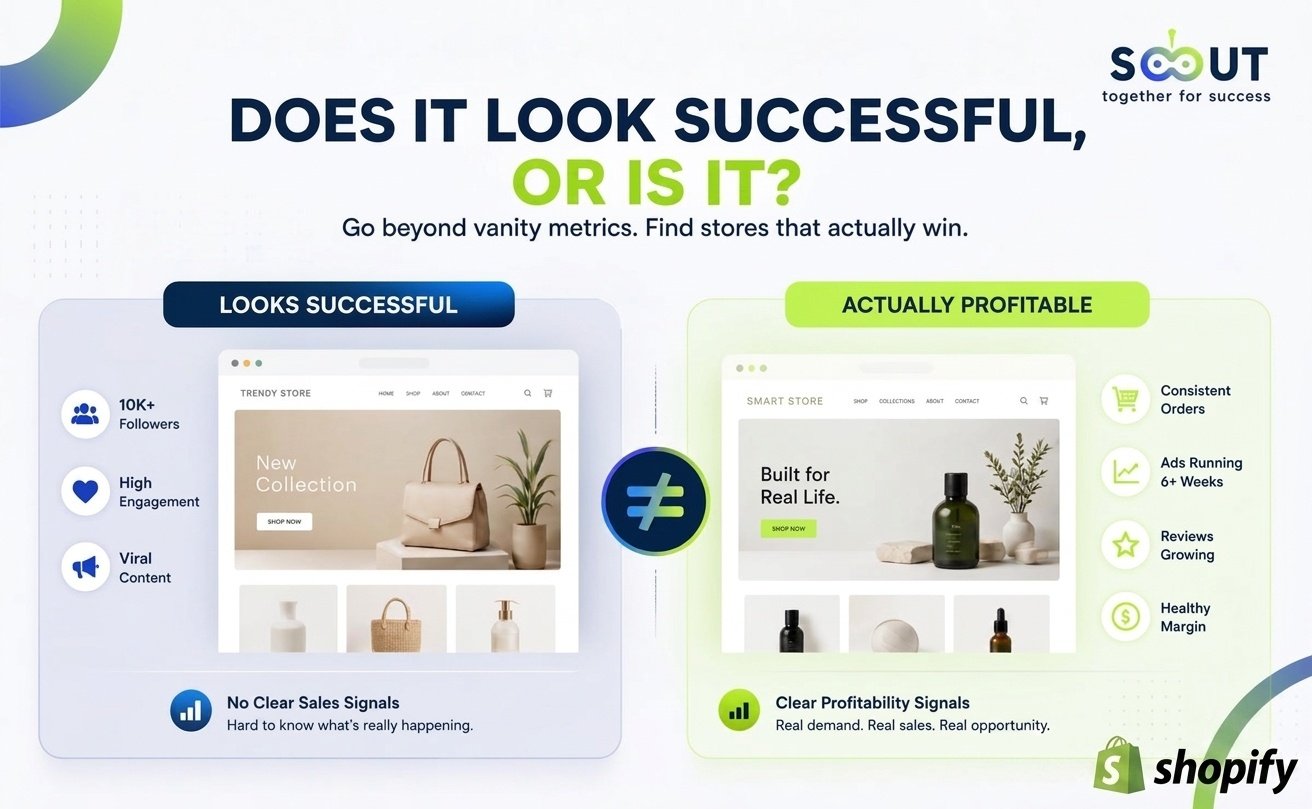
Anyone can find a Shopify store that looks successful, clean design, a busy Instagram, thousands of followers. Almost none of that tells you whether the store is actually making money. And if you're building without holding stock, copying the wrong signals doesn't just waste a weekend; it wastes your ad budget testing a product nobody's really buying.
According to Shopify's Q2 2026 quarterly filing with the SEC, the platform facilitated $115.6 billion in gross merchandise volume in a single quarter, up 32% year over year, proof that real money is moving through this platform at scale, but that scale also means thousands of stores that look identical on the surface, with wildly different real performance underneath. This guide gives you a repeatable framework: where to actually find stores in your niche, which signals prove a store is profitable rather than just busy, and how to turn that research into a store you can realistically build, without ever touching inventory. By the end, you'll have a shortlist process you can run in an afternoon, not a week.
Why Model Existing Shopify Stores Instead of Guessing at a Niche?
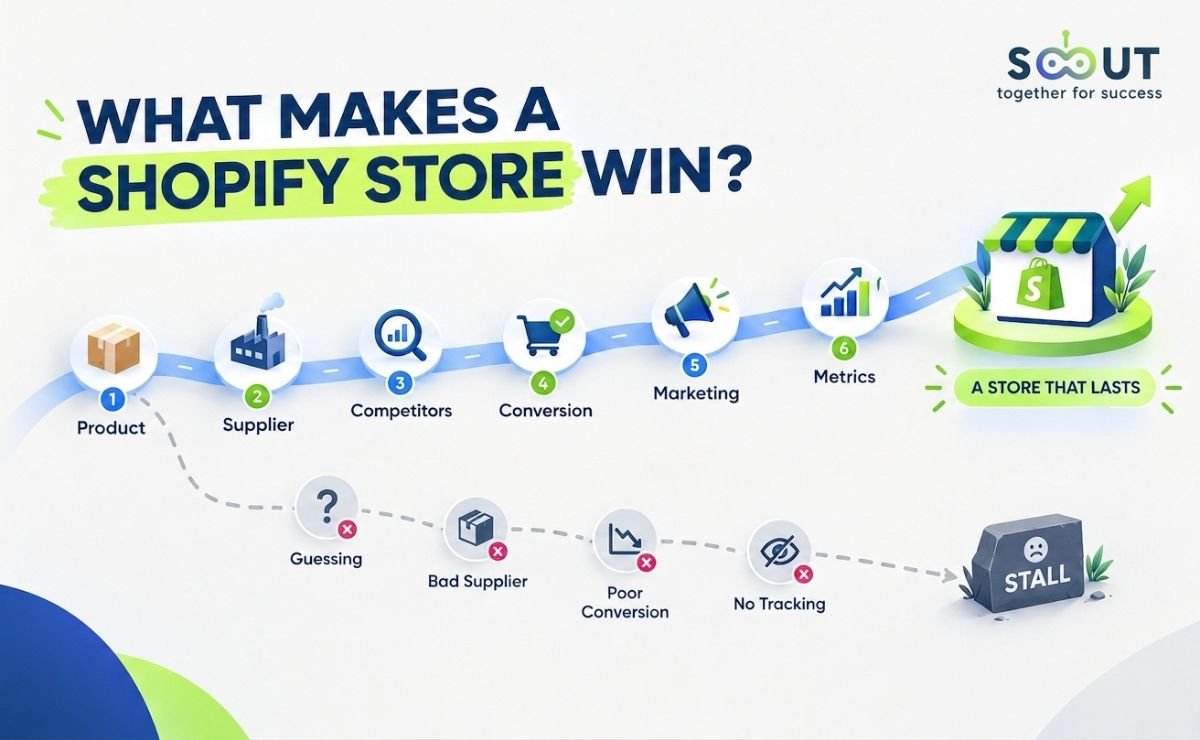
Starting from a blank page and guessing at a niche is the most expensive way to learn what sells. Studying stores that are already converting real traffic into real orders compresses months of trial and error into a single research session, you inherit their market validation instead of paying for your own.
This works because Shopify's scale means almost every viable niche already has active, visible proof of demand. Shopify's own Q1 2026 filing put quarterly GMV at $100.7 billion, spread across millions of merchants. That's not a reason to copy blindly; it's a reason to treat existing stores as a live, constantly-updating dataset of what customers are actually paying for right now.
The catch is picking the right stores to learn from in the first place, which starts with picking a niche where real demand exists, not just where competitors are loud. If you haven't locked that down yet, our breakdown of the Best eCommerce Niches for 2026 is worth reading alongside this guide before you go store-hunting.
What Actually Makes a Shopify Store "Profitable" (Not Just Popular)?
A profitable store and a popular-looking store are not the same thing, and confusing the two is the single most common research mistake. Follower count, a slick homepage, or a viral TikTok clip tell you a store got attention, they say nothing about whether that attention converted into repeat, sustained orders.
Real profitability leaves a different kind of trail: consistent order volume over weeks (not a single spike), ads that keep running past the first few days, reviews that accumulate steadily rather than arriving in one suspicious burst, and pricing that leaves room for margin after product cost and shipping. Every section below builds toward helping you read these signals instead of the surface-level ones.
Is It Legal and Ethical to Study a Competitor's Shopify Sales Data?
Yes, with a clear line. Browsing a public storefront, reading its product pages, checking its public reviews, and estimating its performance from publicly available signals is standard competitive research, done by agencies and brands every day. What crosses the line is scraping private account data, misrepresenting yourself to extract non-public information, or copying a store's copyrighted photos, written descriptions, or branding wholesale.
The safest approach is to research patterns, pricing structure, catalog depth, positioning, not to duplicate a specific store's assets. We cover this distinction in detail in Ethical Shopify Competitor Research, including exactly what's fair game and what isn't before you start building your own listings.
Where Do You Start Looking for Shopify Stores in Your Niche?
There are three practical entry points, each with different trade-offs:
|
Method |
Speed |
Cost |
Precision |
|
Search engine operators (e.g., niche keyword + Shopify's domain pattern) |
Fast |
Free |
Low, surfaces stores regardless of performance |
|
Niche hashtags on Instagram/TikTok |
Medium |
Free |
Medium, biased toward stores investing in social, not necessarily the most profitable |
|
Purpose-built store-search tools with sales filters |
Fast |
Paid |
High, filters directly on real performance data |
Manual search methods are a fine starting point for volume, but they hand you a list of stores that exist in your niche, not stores that are winning in your niche, you still have to click through dozens of them one by one to find out which are real. That gap is exactly what the next section solves.
One quick sanity check before you go further: confirm the store is actually built on Shopify and not a similar-looking platform, since checkout flow, app ecosystem, and even how you'd analyze it differ by platform.
How Do You Search Shopify Stores by Product Category or Keyword Efficiently?
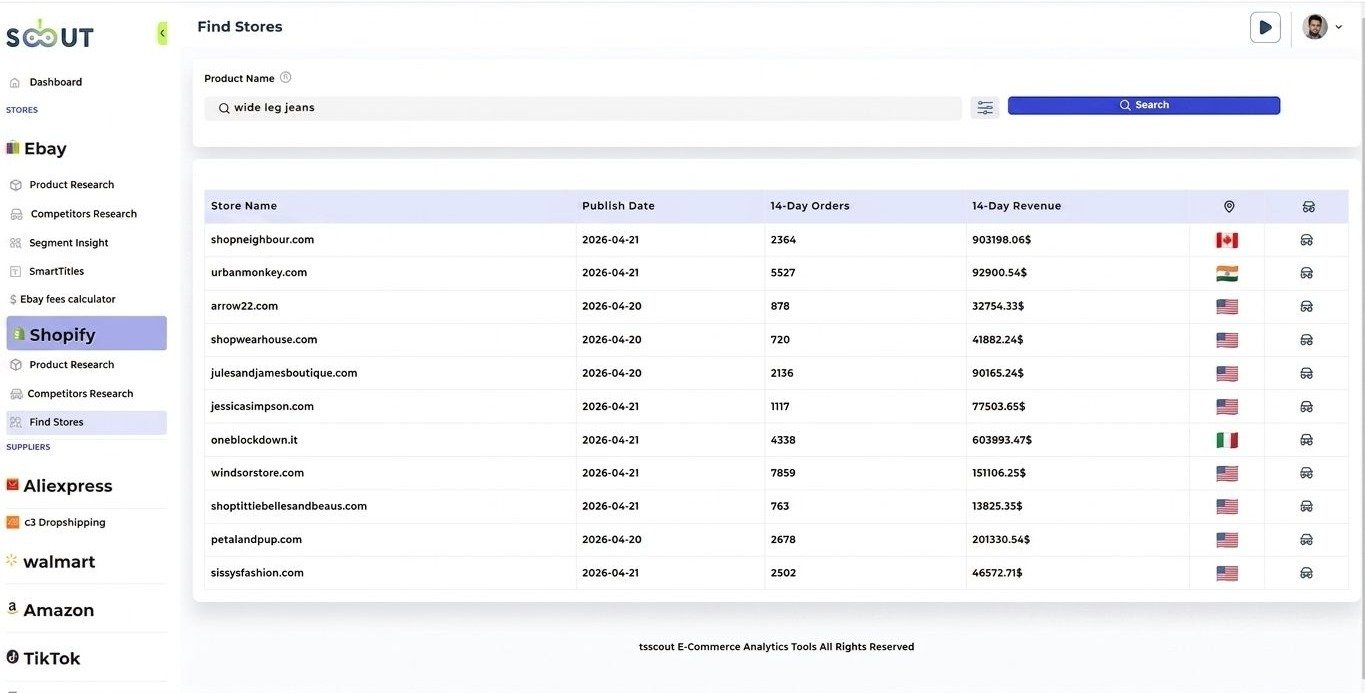
Instead of testing dozens of manual search strings and opening each result to check if it's even active, a store-search tool that lets you filter directly by product, category, price range, and shipping region turns hours of clicking into a single search. TS Scout's Shopify Finder Stores works this way: you search by product name, narrow by sale date range, price, category, and shipping location, and get back a table of active stores that actually match, sorted by real order and revenue data rather than how polished their homepage looks.
That last part matters more than it sounds. A manual search can't tell you which of the 50 stores it surfaced sold five orders last month versus five thousand. A filtered, data-backed search can, which takes you straight into the next question.
What Real Sales Signals Prove a Store Is Actually Making Money?
Look past the homepage for these signals, roughly in order of reliability:
-
Sustained order volume over a multi-week window, not a single day's spike
-
Ad longevity the same product or creative still running weeks or months later (short-lived ads usually mean the campaign got pulled because it wasn't working)
-
Review accumulation pattern reviews arriving steadily over time, not 200 reviews appearing in one week
-
Site age and consistency a store that's been live and active for 6+ months has survived past the initial hype cycle
-
Pricing with realistic margin a price point that plausibly covers product cost, shipping, and ad spend, not a race-to-the-bottom price
What Does This Look Like in Practice? A Hypothetical Example
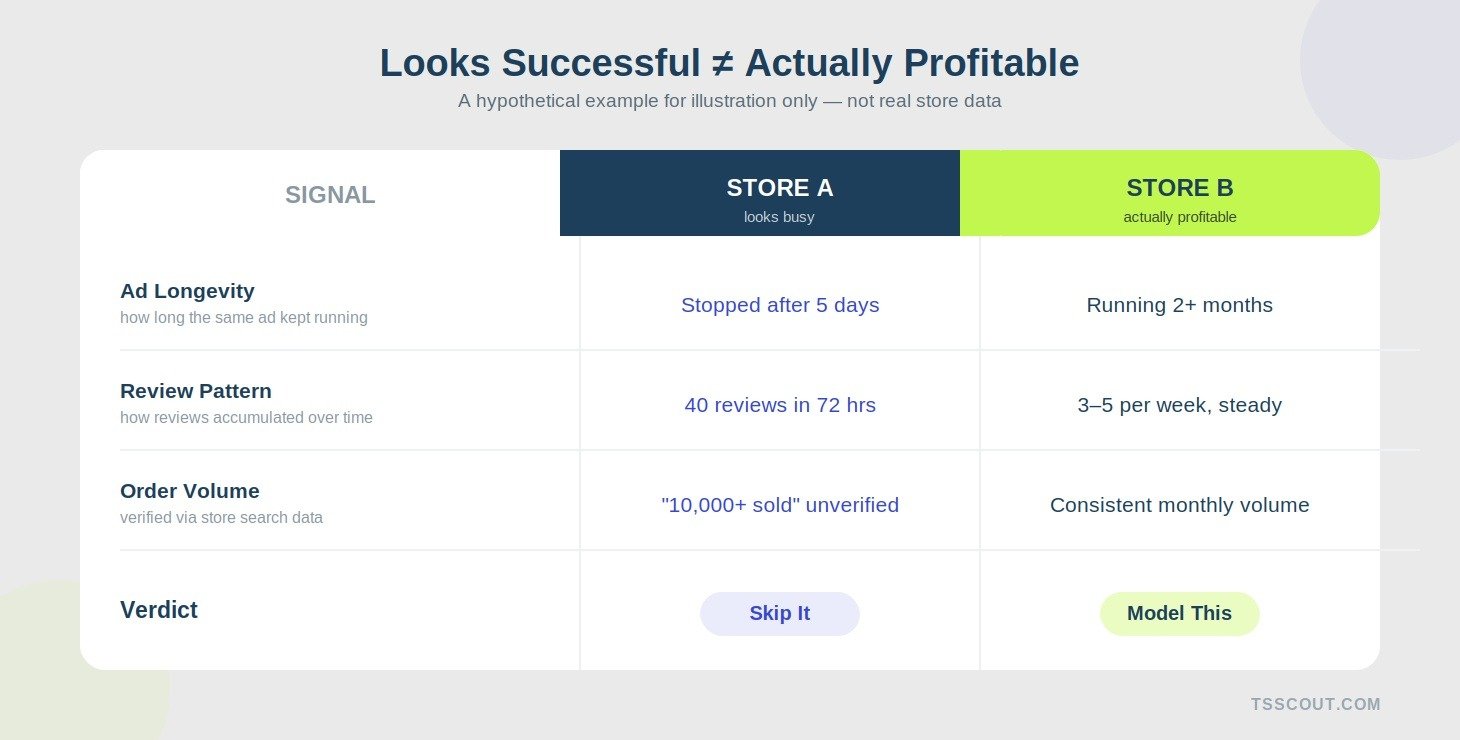
Imagine two stores selling the same trending kitchen gadget, both with attractive Instagram feeds and similar follower counts. Store A's ads launched two weeks ago and stopped running after five days; its 40 reviews all posted within the same 72-hour window; its "sold 10,000+" badge isn't reflected in any order or revenue data. Store B has run the same core ad creative for over two months with new variations added regularly; its reviews trickle in at a steady 3–5 per week; and a filtered store search shows consistent monthly order volume across the last quarter.
Store A looks louder. Store B is the one actually worth modeling the kind of consistent order and revenue pattern you can see directly using Shopify Store Finder rather than guessing from the outside.
How Do You Verify a Store's Performance Without Guessing?
Beyond order and revenue filters, cross-check with two free, publicly available sources before you commit research time to a store:
-
Meta's Ad Library a free, official transparency tool that shows how long a store's Facebook/Instagram ads have actually been running. A store with ads active for months is signaling real, sustained ad profitability; a store with ads that vanish after a few days usually pulled a losing campaign.
-
The Wayback Machine lets you check how long a store's site has existed and whether its catalog and branding have stayed consistent, versus a store that's rebranded three times in a year chasing whatever's trending.
Running a store through both checks alongside the order and revenue data from Shopify Store Finder gives you a fuller picture than any single metric on its own. If you want a broader checklist for confirming a store is legitimate, not just profitable but structurally sound, our guide A Healthy Checkup for Shopify Stores walks through the full audit.
Can You Actually Source and Fulfill What a Profitable Store Sells, Without Holding Stock?
This is the question that separates a useful research session from a wasted one if you're not holding inventory. Not every profitable-looking store is one you can realistically model, because not every product is sourceable.
There are two broad types of stores you'll run into:
-
Private-label or manufactured-exclusive stores, the product is custom-made or exclusively licensed to that seller. It looks great in your research, but there's no supplier you can access to sell the same item.
-
Sourceable, dropshipping-friendly stores, the product is available through multiple suppliers, meaning several sellers can legitimately compete on the same item with different branding, pricing, or bundling.
Before you invest time modeling a store, confirm three things: the product is available from more than one supplier (so you're not dependent on a single point of failure), the shipping timeline is realistic for your target market, and the margin that's actually left after product cost, shipping, and ad spend is enough to sustain the business, not just cover the first sale.
How Can You Reverse-Engineer a Competitor Store's Strategy Once You've Found It?
Once you've shortlisted a store worth studying, go deeper than the product itself: how is the catalog structured (a handful of hero products or dozens of variations?), where does the pricing ladder sit (entry-level item to pull people in, higher-margin item to upsell?), what bundles or "frequently bought together" offers are they running, and which apps power their checkout, reviews, and upsell flow.
For this level of detail on one specific store, TS Scout's Shopify Spy tool is built for exactly this: search a competitor by name and get a full report on their product listings, pricing structure, and sales trend in one place, instead of manually clicking through every product page and guessing at what's actually selling.
Which Signals Separate a Store Worth Modeling From One to Avoid?
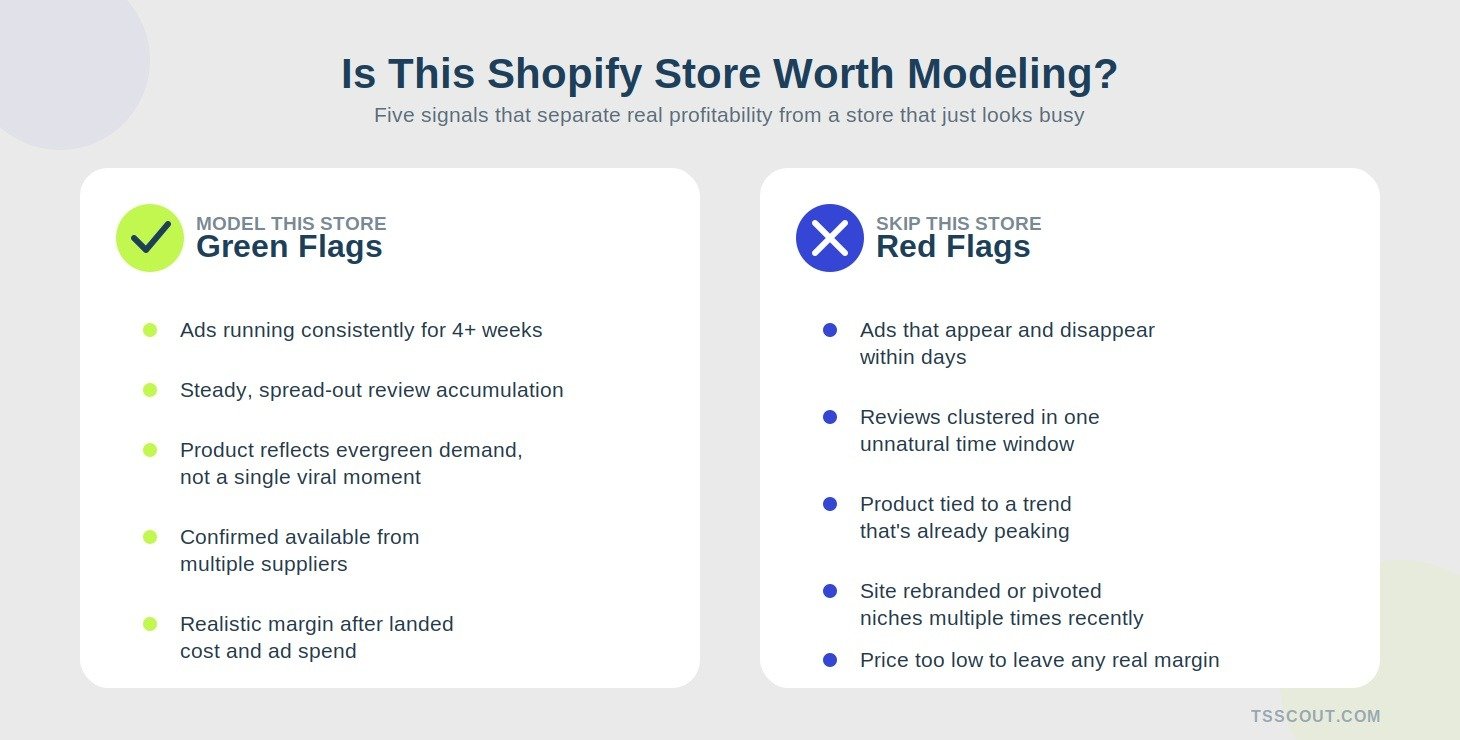
Use this as a fast filter before you commit real research time to a store:
Green flags:
-
Ads running consistently for 4+ weeks
-
Steady, spread-out review accumulation
-
Product is evergreen demand, not a single viral moment
-
Confirmed available from multiple suppliers
-
Realistic margin after landed cost and ad spend
Red flags:
-
Ads that appear and disappear within days
-
Reviews clustered in an unnatural time window
-
Product tied to a trend that's already peaking
-
Site rebranded or pivoted niches multiple times recently
-
Price point too low to leave any real margin
If a product keeps showing up as a "trend" rather than a category with staying power, it's worth checking against genuinely durable demand. Our list of Evergreen Product Categories is a useful cross-reference before you commit to modeling a store built on something seasonal.
How Do You Turn Store Research Into a Playbook, and How Often Should You Repeat It?
Turn your findings into something usable with a simple log:
|
Store name |
Niche |
Price range |
Est. monthly orders |
Ad activity |
Standout UX feature |
|
Example A |
Pet wellness |
$25–$45 |
300–500 |
Running 6+ weeks |
Subscription upsell at checkout |
|
Example B |
Home office |
$40–$90 |
100–200 |
Running 3+ weeks |
Bundle discount on category page |
Figures above are illustrative, log the actual numbers from your own research.
Shortlist 5–10 stores that pass the green-flag checklist, log them this way, then look for the patterns that repeat across your best-performing entries, that's your actual playbook, not any single store's exact copy. As a starting point, 5–10 well-vetted stores is enough to spot real patterns without drowning in noise; fewer than that and you're extrapolating from too small a sample.
This isn't a one-time exercise. Niches shift, ad creative fatigues, and new entrants appear constantly, so re-running this research every 4–6 weeks, or whenever your current best-seller's order volume starts slipping, keeps your store aligned with what's actually working now. Both Shopify Spy Tool and Shopify Store Finder are built for that kind of recurring check, not just a one-off search.
Ready to Stop Guessing Which Shopify Stores Are Actually Winning?
Finding a store that looks successful takes minutes. Confirming it's actually profitable and sourceable without holding stock, is what separates a wasted week from a store that actually converts. Run your next niche search on real order and revenue data instead of surface impressions: start your $1 trial, 14 days, full access to TS Scout and see which stores in your niche are genuinely worth modeling.
FAQs
-
How many Shopify stores are there in 2026?
Shopify processes tens of billions of dollars in GMV every quarter across millions of active merchants worldwide, per the company's own financial filings, meaning virtually every product category already has multiple active stores you can research before building your own.
-
Is it legal to research a competitor's Shopify store data?
Yes, as long as you're working from publicly visible information storefronts, public reviews, public ad libraries rather than scraping private data or copying protected content like photos and written descriptions.
-
What's the difference between a Shopify Store Finder and a Shopify Spy Tool?
A store finder helps you discover multiple stores across a niche or product category using filters like price and sale date; a spy tool goes deep on one specific store you've already identified, breaking down its full catalog, pricing, and sales trend.
-
Can I dropship the same products a profitable Shopify store sells?
Only if the product is available through multiple suppliers rather than manufactured exclusively for that store always confirm sourcing availability before modeling a store's product lineup.
-
How do I know if a store's sales numbers are real and not inflated by ads alone?
Cross-check ad longevity, review accumulation pace, and site age against actual order and revenue data, a store with all four aligned is far more reliable than one relying on a single loud signal.
-
How many stores should I analyze before picking a niche to model?
Five to ten stores that clearly pass the green-flag checklist is usually enough to spot real, repeatable patterns without wasting time on outliers.
like?


Table of Contents
- Why Model Existing Shopify Stores Instead of Guessing at a Niche?
- What Actually Makes a Shopify Store "Profitable" (Not Just Popular)?
- Is It Legal and Ethical to Study a Competitor's Shopify Sales Data?
- Where Do You Start Looking for Shopify Stores in Your Niche?
- How Do You Search Shopify Stores by Product Category or Keyword Efficiently?
- What Real Sales Signals Prove a Store Is Actually Making Money?
- How Do You Verify a Store's Performance Without Guessing?
- Can You Actually Source and Fulfill What a Profitable Store Sells, Without Holding Stock?
- How Can You Reverse-Engineer a Competitor Store's Strategy Once You've Found It?
- Which Signals Separate a Store Worth Modeling From One to Avoid?
- How Do You Turn Store Research Into a Playbook, and How Often Should You Repeat It?
- Ready to Stop Guessing Which Shopify Stores Are Actually Winning?
- FAQs