
Shopify eCommerce Store: The Real Playbook Behind Stores That Actually Sell in 2026
- 2026-06-10
-
 2
2
Thousands of new stores launch on the platform every quarter, yet most quietly disappear within a year. The difference rarely comes down to the platform itself, it comes down to decisions made before the first sale ever happens. In Q1 2026 alone, merchants on the platform generated $101 billion in Gross Merchandise Volume, a 35% year-over-year jump, according to Shopify's official Q1 2026 investor press release.
That number proves the opportunity is real, it does not explain why one Shopify eCommerce store scales past six figures while another, selling nearly identical products, stalls at zero. This guide walks through the decisions that actually separate the two: what to sell, who to trust as a supplier, how to study competitors without copying them, what makes a visitor convert, and where the real mistakes happen after launch. By the end, you'll have a sequence you can actually follow, not a checklist of generic advice.
Why Do Some Shopify eCommerce Stores Outperform Others in 2026?
The platform itself is no longer the differentiator. Two merchants can use the same theme, the same apps, even the same supplier, and still land in completely different places a year later.
The Q1 2026 numbers make the point clear: Shopify reported Merchant Solutions revenue rising 39%, driven largely by deeper Shopify Payments penetration and GMV strength (per the same Shopify investor release above). That growth isn't evenly spread across every store, it's concentrated in stores that treat the platform as infrastructure for a real brand, not a shortcut to a quick storefront. If you're deciding between platforms at all, it's worth reading our breakdown on WooCommerce vs Shopify before committing, since the platform choice shapes how much of this playbook applies to you later. Everything from here assumes you've already chosen, or are about to choose, Shopify, and the real work is what you build on top of it, which is the core idea behind Build eCommerce Brand.
What Should You Actually Sell in a Shopify eCommerce Store?
Picking a product based on what's trending this week is how most stores end up with dead inventory decisions and no repeatable process. A better approach starts with demand data, not intuition, the methodology covered in The Science of Product Research.
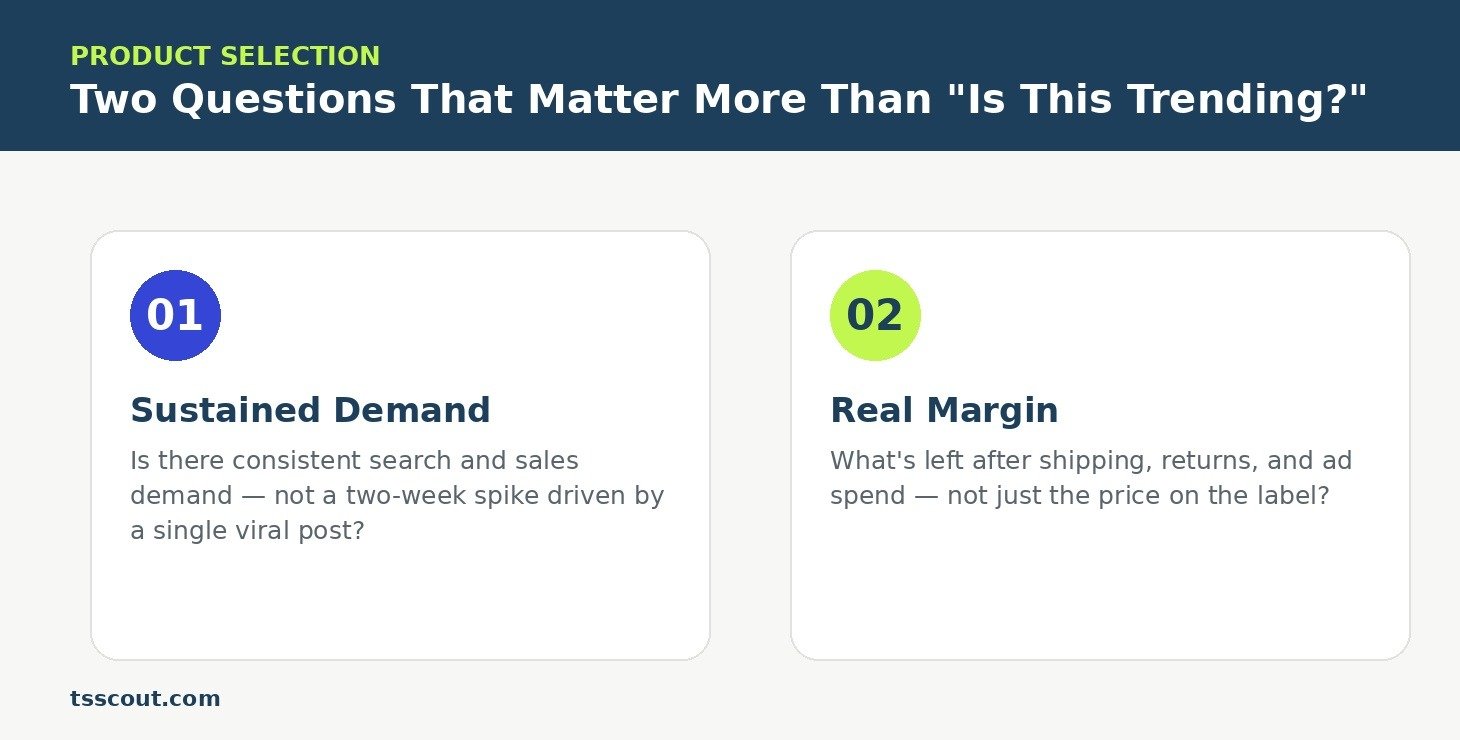
What Two Questions Matter More Than 'Is This Trending? :
-
Is there sustained search and sales demand, not a short spike? A product with a two-week TikTok moment and no underlying demand curve is a liability, not an opportunity.
-
What's the margin after real costs, shipping, returns, ad spend, not just the sticker price? This is where The Profit Anatomy becomes relevant: the product that looks most profitable on paper is often the one that breaks even once return and acquisition costs are factored in.
Instead of guessing from Amazon Best Seller lists, tools built specifically for Shopify data give a much clearer picture of what's actually converting across live stores. Shopify Insight pulls real performance signals, order volume trends, pricing patterns, seasonality, directly from active Shopify stores, which is a meaningfully different data source than scraping trending hashtags.
Who Can You Actually Trust to Supply Your Products?
A great product idea paired with an unreliable supplier is still a failing store. Supplier vetting deserves the same rigor as product research, and it's covered in depth in Find Reliable eCommerce Suppliers.
What Should You Verify Before Committing to a Supplier?
|
What to check |
Why it matters |
|
Verifiable delivery windows |
Late shipping is the single biggest driver of refund requests and chargebacks |
|
Sample product quality |
Photos on a supplier page rarely match what arrives at a customer's door |
|
Communication responsiveness |
A supplier who's slow to respond pre-sale will be worse post-sale |
|
Stock consistency |
Frequent stockouts damage ad performance and customer trust simultaneously |
If AliExpress is part of your sourcing strategy, our AliExpress Product Sourcing Guide covers platform-specific vetting steps. For merchants selling primarily to UK customers, Top UK Suppliers for Shopify narrows this down to suppliers with realistic UK delivery timelines rather than generic global lists.
How Do You Study Competitors Without Copying Them?
Competitor research is where a lot of stores cross an ethical line without realizing it, copying product photos, descriptions, or entire store layouts instead of learning from what's working. Ethical Shopify Competitor Research covers where that line actually sits.
The goal isn't imitation. It's pattern recognition: which product categories a niche's top stores keep returning to, how they structure pricing tiers, what their review volume signals about demand.
Shopify Find Stores is built for exactly this, surfacing live, comparable stores in a given niche so you're analyzing real competitors instead of guessing who they are. Once you've identified them, Shopify Competitors Research tool lets you track how their traffic, ad creative, and product catalog shift over time, which is far more useful than a single snapshot.
What Actually Makes a Visitor Buy From Your Store?
Traffic without conversion is just an expensive way to generate page views. Checkout friction is the biggest, most measurable leak in that process.
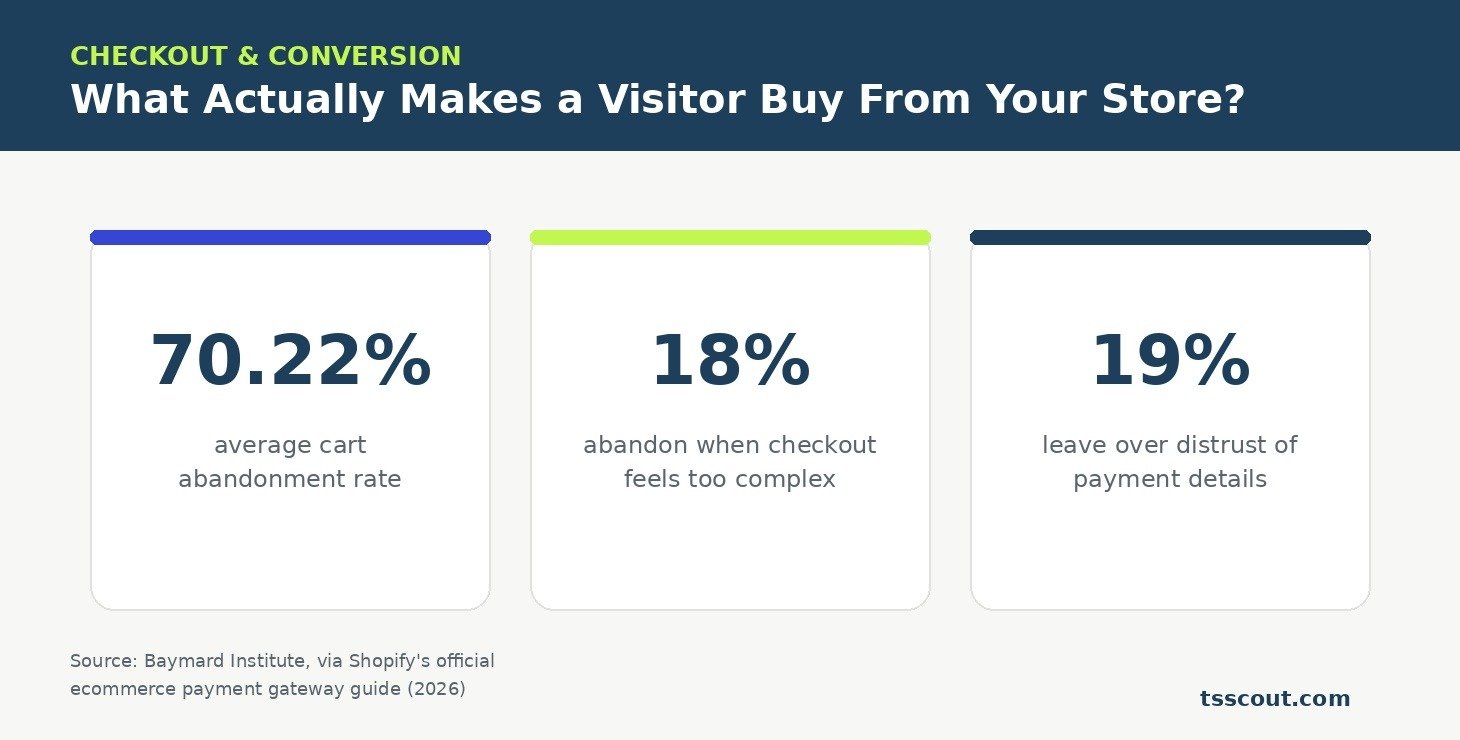
The research backs this up directly: Baymard Institute, cited in Shopify's official payment gateway guide, found the average cart abandonment rate sits at 70.22%, with payment-related friction as a leading cause, 18% of shoppers abandon when checkout feels too complex, and 19% leave because they don't trust the site with payment details. Separately, Shopify's own research on checkout optimization found that improving the checkout workflow can lift conversion rates by more than 35%, according to Baymard's data referenced in Shopify's payment gateway comparison guide.
One detail worth correcting from older advice still circulating: many guides describe PayPal and Stripe as two freely interchangeable options you simply "plug in." That's no longer accurate everywhere. Per Shopify's own Help Center, in countries where Shopify Payments is supported, Stripe often isn't available as a separate standalone gateway at all, because Stripe is Shopify Payments' banking partner behind the scenes. Shopify Payments itself is now available in 40 countries as of 2026 (per the Shopify guide above), which means for most merchants, the real decision isn't "PayPal or Stripe", it's whether Shopify Payments is available in their market at all.
Product pages matter just as much as checkout. Vague, templated descriptions copied from a supplier feed convert worse than pages written for both the reader and search intent, which is exactly what Write Shopify Product Descriptions That Rank and Convert walks through.
Does Your Return Policy Help You Sell, or Quietly Cost You Customers?
Return policies are usually treated as a legal formality, buried in a footer link. In practice, they're a visible trust signal that shoppers check before buying, especially on higher-priced items.
Case in point: a mid-sized Shopify eCommerce store selling home goods moved its return policy from a footer link to a visible badge near the "Add to Cart" button, and simplified the language from legal phrasing to plain terms ("30 days, free returns, no questions asked"). The change itself didn't alter the actual policy, only its visibility and clarity, yet it directly addressed the exact trust gap Baymard's research flags above. This is the pattern examined in Shopify Return Policy Gap: the policy usually isn't the problem. Its visibility is.
Which Marketing Channels Are Actually Worth Your Budget in 2026?
Spreading a small budget across every channel equally is a common early mistake. A more useful question is which channels match your product's price point and purchase decision speed.
-
Paid social (Meta, TikTok): Still effective, but acquisition costs have risen, which makes creative testing and audience precision more important than raw spend.
-
TikTok Shop: Increasingly a direct sales channel, not just a discovery tool, relevant for stores that were built around older "social media = awareness only" thinking.
-
Email: Highest-margin channel for repeat buyers and building customer loyalty, but only if the list is segmented by purchase behavior rather than blasted as one group.
-
Influencer partnerships: Most effective when the influencer's audience overlaps tightly with your niche, broad reach without relevance rarely converts.
The mistake isn't using any one of these channels. It's treating them as separate strategies instead of a sequence: paid or influencer traffic for discovery, email for retention, and organic content for the customers who aren't ready to buy yet.
How Do You Know What's Actually Working?
Without tracking the right metrics, every channel decision above is a guess dressed up as a strategy.
|
Metric |
What it tells you |
|
Conversion rate |
Whether your site and offer are doing their job |
|
Customer Acquisition Cost (CAC) |
Whether a channel is actually profitable, not just active |
|
Average Order Value (AOV) |
Whether upsells and bundling are working |
|
Customer Lifetime Value (LTV) |
Whether you're building repeat customers or one-time buyers |
|
Return/refund rate |
An early warning sign for product or supplier issues |
Tracking these consistently, not just glancing at revenue, is what connects directly back to the margin math in The Profit Anatomy.
Where Should You Sell If You're a UK-Based Shopify Seller?
Store mechanics shift depending on where your customers are. UK sellers face different supplier logistics, delivery expectations, and marketplace dynamics than US-based stores, which is why Shopify eCommerce in the UK treats this as its own topic rather than an afterthought.
If you're migrating from another marketplace rather than starting fresh, eBay being the most common one, the process has enough differences (listings, reviews, customer data) that it deserves its own roadmap, covered in Migrate Your eBay Store to Shopify.
What Mistakes Quietly Kill Shopify eCommerce Stores After Launch?
Most "what went wrong" lists repeat the same three points, no market research, wrong audience, no conversion optimization, which are really just launch-stage mistakes already covered above. The mistakes below are different: they happen after a store is already live and selling.
-
Treating launch as the finish line. Stores that stop updating product pages, testing new angles, or refreshing creative after the first few sales plateau fast, the store that looked "done" at launch rarely still matches what's converting six months later.
-
Single-supplier dependency. One supplier issue, a stockout, a shipping delay, can stall an entire catalog when there's no backup source lined up in advance.
-
Ignoring post-sale data. Return reasons, support tickets, and repeat-purchase patterns are usually richer signals than any ad dashboard, yet they're the least-reviewed data in most stores.
So What Actually Separates a Shopify Store That Lasts From One That Fades?
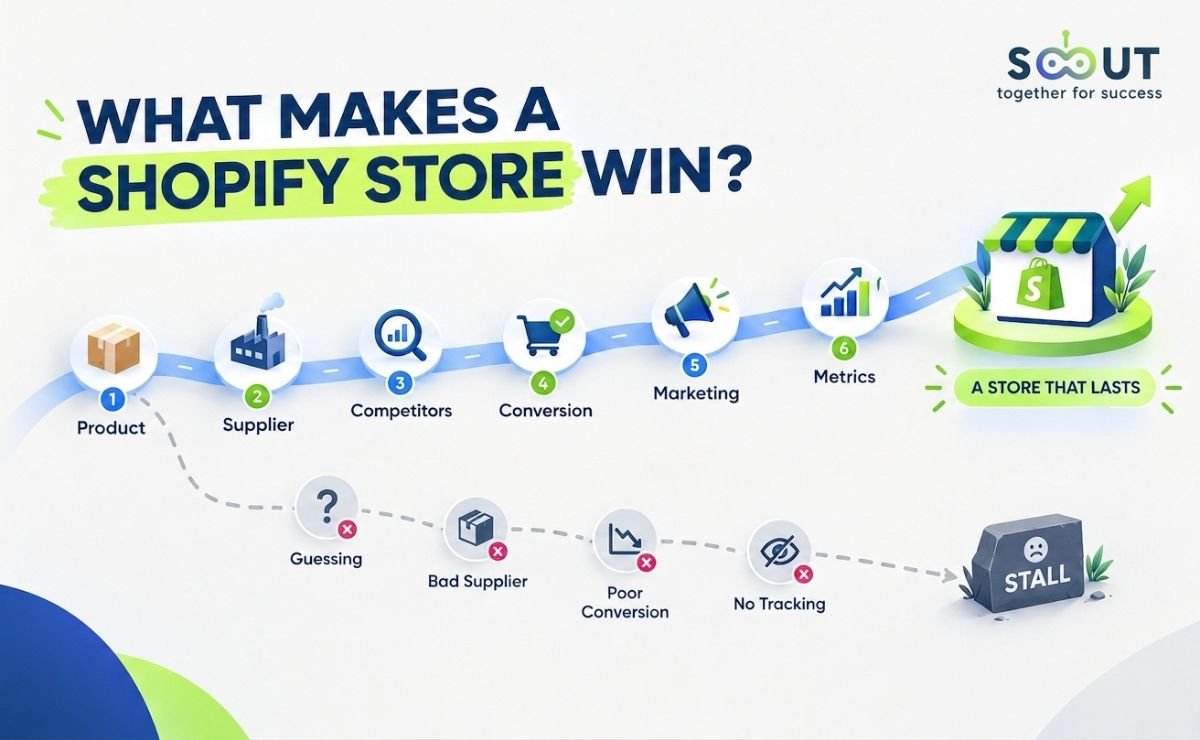
Every section above points to the same underlying pattern: stores that last are the ones making decisions based on real data, product demand, supplier reliability, checkout friction, post-sale signals — instead of assumptions carried over from what used to work. None of that requires a bigger budget. It requires better information at each step, from the first product decision to what happens months after the sale.
That's the gap TS Scout is built to close, real store and product data instead of guesswork, across every stage covered in this guide. Start your $1, 14-day full-access trial and see the data behind your next product decision before you commit to it.
FAQS
-
Is it still profitable to open a Shopify eCommerce store in 2026?
Yes, platform-wide GMV is growing (35% year-over-year per Shopify's Q1 2026 results), but profitability depends on product margin and acquisition cost management, not the platform choice alone.
-
Do I need Shopify Payments, or can I just use PayPal and Stripe?
In many countries, if Shopify Payments is supported, standalone Stripe won't appear as a separate option, it operates as Shopify Payments' banking partner. PayPal typically remains available as an additional method regardless.
-
How long does it take for a new Shopify store to become profitable?
There's no fixed timeline, it depends on product margin, ad efficiency, and how quickly checkout and trust signals (like return policy visibility) are optimized after launch.
-
Is dropshipping still a viable model for a Shopify eCommerce store?
It remains viable but requires stronger supplier vetting and faster fulfillment than in previous years, as customer tolerance for long shipping times has dropped.
-
What's the biggest post-launch mistake new Shopify sellers make?
Treating the initial launch as finished, stores that stop iterating on product pages, creative, and supplier reliability after the first sales plateau the fastest.
like?


Table of Contents
- Why Do Some Shopify eCommerce Stores Outperform Others in 2026?
- What Should You Actually Sell in a Shopify eCommerce Store?
- Who Can You Actually Trust to Supply Your Products?
- How Do You Study Competitors Without Copying Them?
- What Actually Makes a Visitor Buy From Your Store?
- Does Your Return Policy Help You Sell, or Quietly Cost You Customers?
- Which Marketing Channels Are Actually Worth Your Budget in 2026?
- How Do You Know What's Actually Working?
- Where Should You Sell If You're a UK-Based Shopify Seller?
- What Mistakes Quietly Kill Shopify eCommerce Stores After Launch?
- So What Actually Separates a Shopify Store That Lasts From One That Fades?
- FAQS