
Ethical Shopify Competitor Research: A Beginner’s Guide to Learning from Other Stores
- 2026-05-21
-
 0
0
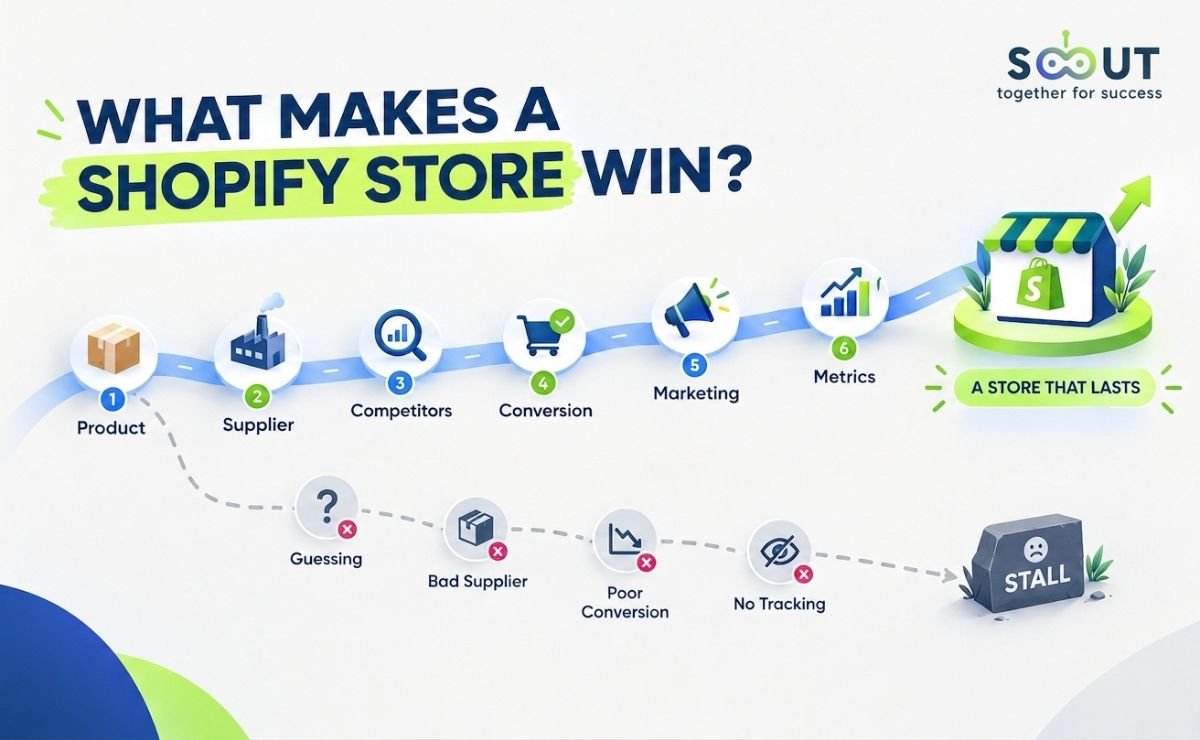
You have clicked Publish, tested the checkout, then… silence. You refresh for that little sale notification more than you’d like to admit. Meanwhile, a competitor’s store hums along like it’s effortless, and a quiet question creeps in: How do they do that? Before you start reading their signals, it’s worth weighing The Pros and Cons of Shopify for Your Ecommerce Business because the platform itself shapes every move you’ll make. This guide takes it from there: teaching you how to conduct ethical Shopify competitor research, reading pricing, best sellers, and store structure so you can turn observation into confident action and bring the cha‑ching back to your own pocket.
The Foundation
Before we look outward, let’s settle the quiet worry that freezes so many new store owners: “I’m not technical enough.” You’re not alone. And you don’t need to be. Shopify ecommerce in the UK and US handles the heavy infrastructure of secure checkout, product databases, page loading so you can focus on what matters: your products and your customers. The shops you admire? Their owners rarely wrote a single line of code. They just learned to read the dashboard. When you look at another store to learn from it, you’re not hacking anything. You’re walking the digital high street, noticing which window displays invite you in. That instinct, the one you already have, is the beating heart of competitive analysis. Forget suits and spreadsheets. Competitive analysis is simply paying attention. It’s noticing why one stall has a queue and another sits ignored, then using that awareness to make your own shop feel like the obvious choice.
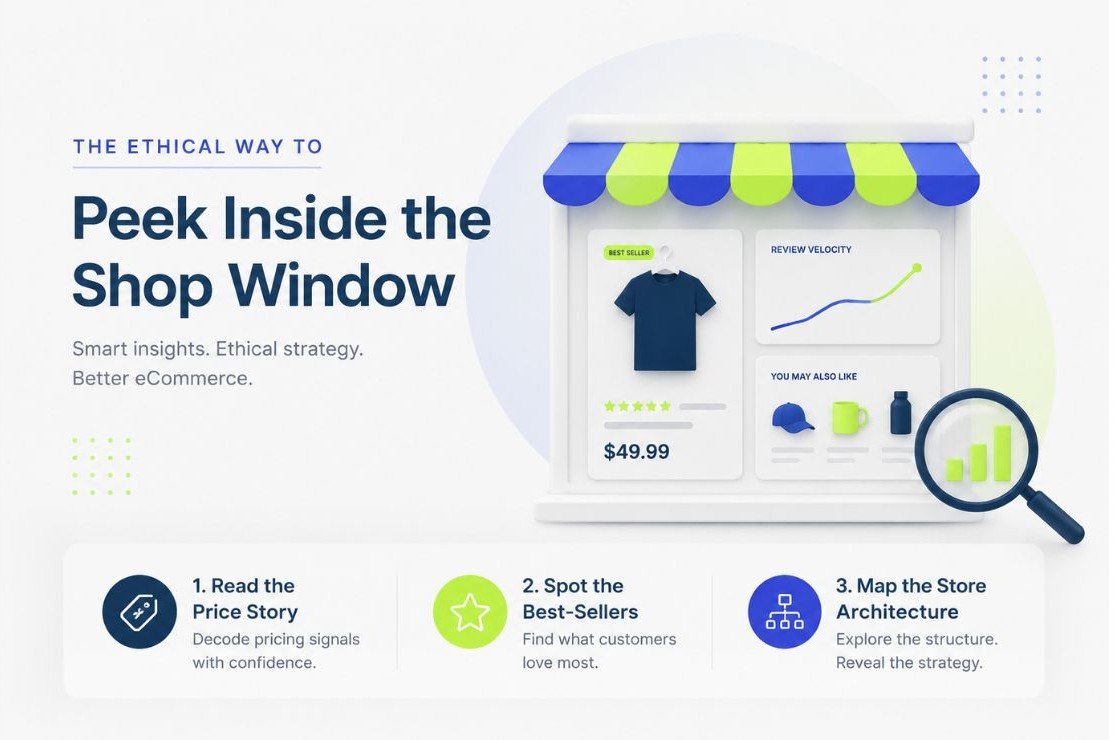
The Ethical Ways to Peek Inside the Shop Window
Now that we've established that looking around is simply good business sense, let's talk about where to direct your gaze. The beauty of Shopify as a platform is its consistency. While every store dresses itself up in different colors and fonts, the underlying skeleton is remarkably similar. This means that once you learn to recognize a few simple patterns, you can understand the strategy behind almost any store you visit. We're going to start with the manual, do-it-yourself approach because understanding the "why" behind the data is what separates a clever merchant from someone just copying numbers.
Here are three quiet observation techniques you can use right now, armed with nothing more than your web browser and a curious mind.
1. Reading the Price Tag Story
Look beyond the final number. Notice how sale prices are displayed: is the "Compare at" price prominent or barely mentioned? A perpetual 5% discount signals steady quality; deep, rotating discounts signal urgency.
-
-
The Slash-Through Sale:
Is the "Compare at" price displayed prominently? In the UK, shoppers are trained to look for "RRP" (Recommended Retail Price). In the US, a bold red slash-through signals immediate value. Notice how the store you're observing uses this. Is the sale price just 5% off, or a dramatic 40%? A store running perpetual 5% discounts is signaling premium quality and steady value. A store with deep, rotating discounts is signaling volume and urgency.
-
The .99 vs .00 Debate:
Some online sellers lean heavily on prices ending in .99 or .97—a classic bargain signal. The data backs this up: approximately 60.7% of all retail prices end in the digit 9, while only 7.5% end in 0, regarding to Capital One Shopping Research . Research shows that charm pricing (prices ending in 9, 99, or 95) increases sales by at least 24%, and a 2003 experiment from MIT and the University of Chicago found it increased consumer demand by 35%. Others favour rounded numbers (.00, .50) to convey premium simplicity. Neither is wrong. By observing which convention your most successful competitors consistently use, you learn the trust signal their audience responds to best.
-
2. Spotting the Quiet Best-Sellers
Every store has a "hero" product they push on the homepage with a big, beautiful banner. And sometimes, that product is their slowest mover the one they're trying to clear out. The real winners are often hiding in plain sight. Here's how to find them:
| Manual method | What it reveals | The limitation |
| The best sellers collection | Many Shopify stores use a default collection URL ending in /collections/best-sellers. Type this after their domain and you'll often see a list curated by actual sales data. | Some stores disable or rename this collection. |
| Revie velocity | Scroll to the reviews section. A product with 4 reviews added this week is selling far more actively than one with 42 reviews accumulated over three years | Counting and dating reviews across multiple products is time-consuming. |
| The ' you may also like ' section | This is algorithmic gold. These product pairings are generated based on what other customers actually put in their carts together. It reveals natural bundles and cross-sell opportunities | You can only see a few suggestions at a time. |
3. Mapping the Store's Hidden Architecture
Before a customer even sees a product, they navigate a structure. A confusing menu is the online equivalent of a shop with boxes blocking the aisles.
- The Sitemap Shortcut:
Add /sitemap.xml to the end of any Shopify store's URL. This file is a public roadmap generated for search engines. It lists every product page, every collection, and every blog post the store owner considers important. It's a completely ethical, publicly accessible directory of their entire catalog structure.
-
Collection Sorting:
Add sort_by=price-ascending or sort_by=best-selling to a collection URL. This instantly reorders the page and shows you their product range hierarchy from their cheapest entry-level item to their premium flagship offer.
-
From Manual Scrolling to Meaningful Insight (Letting the Data Come to You)
The manual techniques are valuable; they sharpen your eye. But let's be honest: tab‑hopping between stores, squinting at timestamps, and piecing together fragments of a sitemap isn't how you planned to spend your Tuesday. You came to build something, not to become a full‑time data archivist. That's where tools shift you from chasing data to actually understanding it. Say you have a hunch about sustainable kitchen accessories. Without the right tool, you'd hunt down stores, dig through collections, and guess what's moving based on scattered reviews. Slow, and mostly a guessing game.
Shopify Insight – Product Research changes that equation entirely. Rather than starting with a specific store, you start with a question: "What's actually happening in the sustainable kitchen market right now?" The tool allows you to filter the vast landscape of live Shopify stores using parameters that matter to your business:
-
-
Price Range: Are you looking to compete in the affordable, mid-tier, or premium segment? Filtering by price instantly shows you the volume of activity and average pricing at each level.
-
Shipping Location: Are you sourcing from a specific region or targeting customers with specific delivery expectations? This filter narrows the view to relevant competitors.
-
Time Period: Trends fade. Filtering by recent activity ensures you're looking at what's selling now, not what was popular eighteen months ago.
-
Category: Drilling down into your exact niche eliminates the noise of unrelated stores.
-
The result is a clean, digestible overview. You're not guessing anymore. You can see actual data on units sold, compare average prices across dozens of active listings, and even identify which sellers are moving the most volume. It transforms product research from a slow, manual dig into a focused, strategic conversation with the market itself.
Zooming In: What One Store Can Teach You About Your Own
Shopify Insight gives you the aerial view of valleys where prices cluster, peaks where products move fast. But soon, your curiosity settles on a single storefront. Perhaps it's the one with a loyal following and steady social buzz, or a newcomer that shot up the rankings out of nowhere. You can't help wondering: What makes this particular store tick? That's when a sharper lens becomes essential. Without it, you're stuck bookmarking pages, refreshing daily, and building clumsy spreadsheets and meticulous work that steals time from improving your own store.
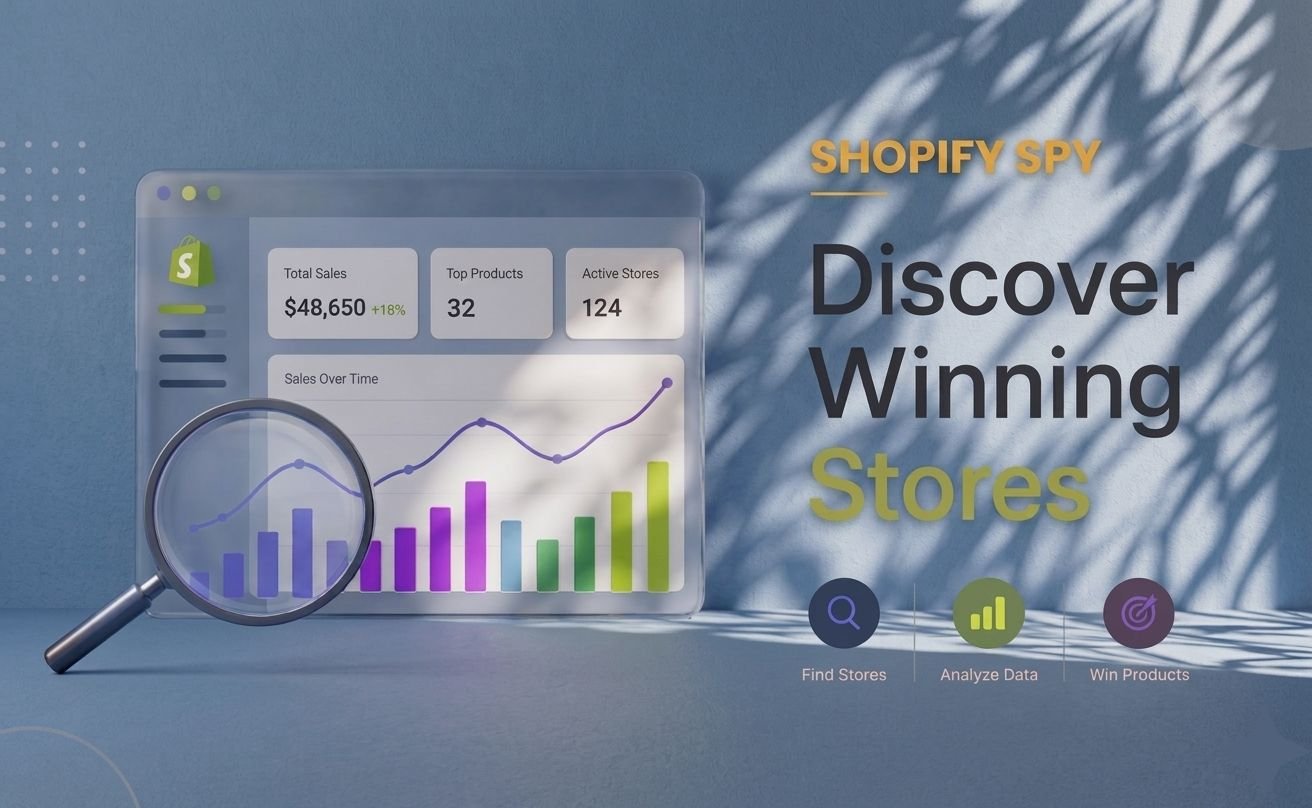
Shopify Spy is designed precisely for this kind of deep, single-store understanding. Instead of scattered notes and guesswork, you simply enter the store's URL and let the tool present you with an organized, readable snapshot of their operation. It answers the questions that keep a new merchant up at night with clarity rather than speculation.
Here is what you can learn when you point this lens at a specific Shopify store:
-
Complete Product Visibility:
You're not limited to what they feature on the homepage. You gain access to their full catalog listing, including items that might be buried deep within niche collections or seasonal archives. This reveals the true breadth of their offering.
-
Pricing Strategy Decoded:
Beyond seeing the current price, you can observe patterns. Do they frequently adjust their pricing? Do they run specific products as consistent loss-leaders to attract traffic? Understanding this rhythm helps you position your own offerings with confidence rather than anxiety.
-
Sales Performance Indicators:
While no tool can see inside a private bank account, the data on listing frequency, product additions, and sustained activity provides a reliable proxy for understanding which items contribute to the store's healthiest margins and steadiest movement.
This isn't about copying a store note for note. That would be a hollow and ultimately doomed strategy. It's about learning the cadence of a successful operation. It's about seeing which products they trust enough to keep in stock and which they quietly phase out. Armed with this kind of intelligence, you stop reacting to the market and start making decisions based on a clear, informed picture.
Discovering the Map: Finding Stores You Didn't Know Existed
We've covered two powerful approaches: the broad market scan with Shopify Insight and the deep dive into a known store with Shopify Spy. But a third question tends to linger: Who else is out there? You know the obvious names. Yet you can feel the quieter operations, the ones that don't rank on page one or run flashy ads humming somewhere just beneath the surface. Finding them manually means guessing keywords, scrolling past endless marketplaces, and hoping to stumble across independent Shopify storefronts. It's like hunting for every indie bookshop in a city by wandering random streets with no directory.
Shopify Store Finder acts as that directory. It flips the research process on its head. Instead of starting with a store name, you start with a product or a niche. The tool then surfaces a curated list of active Shopify stores operating within that exact market space. Here is how it reshapes your understanding of the competitive landscape:
| Research Goal | How Shopify Store Finder Helps |
| Mapping the Field | You select a product category "handmade ceramic mugs," for example. The tool returns a list of stores whose catalogs contain that product type. You immediately see who you're sharing the shelf with. |
| Validating a Niche | Before you commit to a new direction, you can see how many existing stores are already serving that audience. A healthy number indicates demand. An overwhelming number suggests you'll need a sharper angle. Silence suggests a potential blue ocean or a lack of market interest. |
| Discovering Real Market Activity |
These are not dead domains or abandoned projects. The stores surfaced are active, operating, and part of the current Shopify ecosystem. You're looking at real-time competitors and potential collaborators. |
With the competitive landscape now clearly mapped, the real work shifts from looking outward to looking inward. Everything you've observed leads to one quiet, powerful realisation that separates stores that merely exist from those that keep customers coming back.
The Key Takeaway: Product Insight Is Your Foundation, Everything Else Builds on It
The real takeaway is deceptively simple: clarity on what's selling and how it's priced gives you your foundation. But turning that clarity into a process of building ecommerce brand is where quiet, deliberate choices make the difference, wrapping that winning product in a store that loads fast, communicates honestly, and treats every visitor like someone worth keeping.
You Have the Vision. The Right Tools Handle the Legwork.
We started with a simple question: How do they make it look so easy? We've walked through manual techniques and the eight pillars of a trustworthy store. But the truth remains: you didn't start this to become a full-time researcher.
The tools we've covered serve one purpose—giving you back your time.
-
Shopify Insight filters the noise so you spot real market movement.
-
Shopify Spy reveals the rhythm behind any specific store.
-
Shopify Store Finder uncovers the full landscape of players in your niche.
With the intelligence gathered and the pillars as your foundation, you're no longer building in the dark. You're building with quiet confidence, knowing exactly where your shop belongs.
Ready to see the landscape clearly? Explore the full suite Shopify Insight, Shopify Spy, and Shopify Store Finder and watch the data come to you. Start your 14 day trial for just $1 and uncover what the market’s been hiding before you commit another penny.
like?


Table of Contents
- The Foundation
- The Ethical Ways to Peek Inside the Shop Window
- From Manual Scrolling to Meaningful Insight (Letting the Data Come to You)
- Zooming In: What One Store Can Teach You About Your Own
- Discovering the Map: Finding Stores You Didn't Know Existed
- The Key Takeaway: Product Insight Is Your Foundation, Everything Else Builds on It
- You Have the Vision. The Right Tools Handle the Legwork.