
Shopify eCommerce Pros and Cons in 2026: The Numbers Nobody Shows You Before You Launch
- 2026-06-14
-
 0
0
A Shopify store can be live in under an hour. The maths that decides whether it survives takes a lot longer to understand, and most of it changed in the last eighteen months. This guide breaks down the real Shopify eCommerce pros and cons using current platform pricing, the customs rules now in force in the US and UK, and a full cost stack on a single $40 order.
You will see exactly what a Basic plan buys you, which fees compound quietly on every sale, and why two sellers on identical plans can end the month with completely different margins. According to Shopify Pricing, the Basic plan now runs at $39 monthly or $29 when billed yearly, with online card rates starting at 2.9% plus 30¢. That subscription is the smallest number you will deal with. The rest of this article is about the numbers underneath it.
What Is Shopify eCommerce and How Does It Work Without Holding Stock?
Shopify is a hosted commerce platform: it supplies the storefront, checkout, payment processing, and hosting, while you supply the products, pricing, and traffic. Sellers who do not hold inventory connect their catalogue to third-party suppliers, and the supplier ships each order directly to the buyer.
One distinction decides most of your workload, and plenty of guides get it wrong: the supplier handles fulfilment only. You remain the merchant of record. That means customer service, refunds, chargeback responses, consumer-law obligations, and the tax registration behind the store all sit with you, not with whoever packs the box. A supplier can lose you a sale; only you can lose the customer.
That single fact shapes every advantage and every risk that follows, and it is why building a Shopify eCommerce store properly at the start costs far less than repairing one later.
What Does a Shopify Store Actually Cost Before Your First Sale?
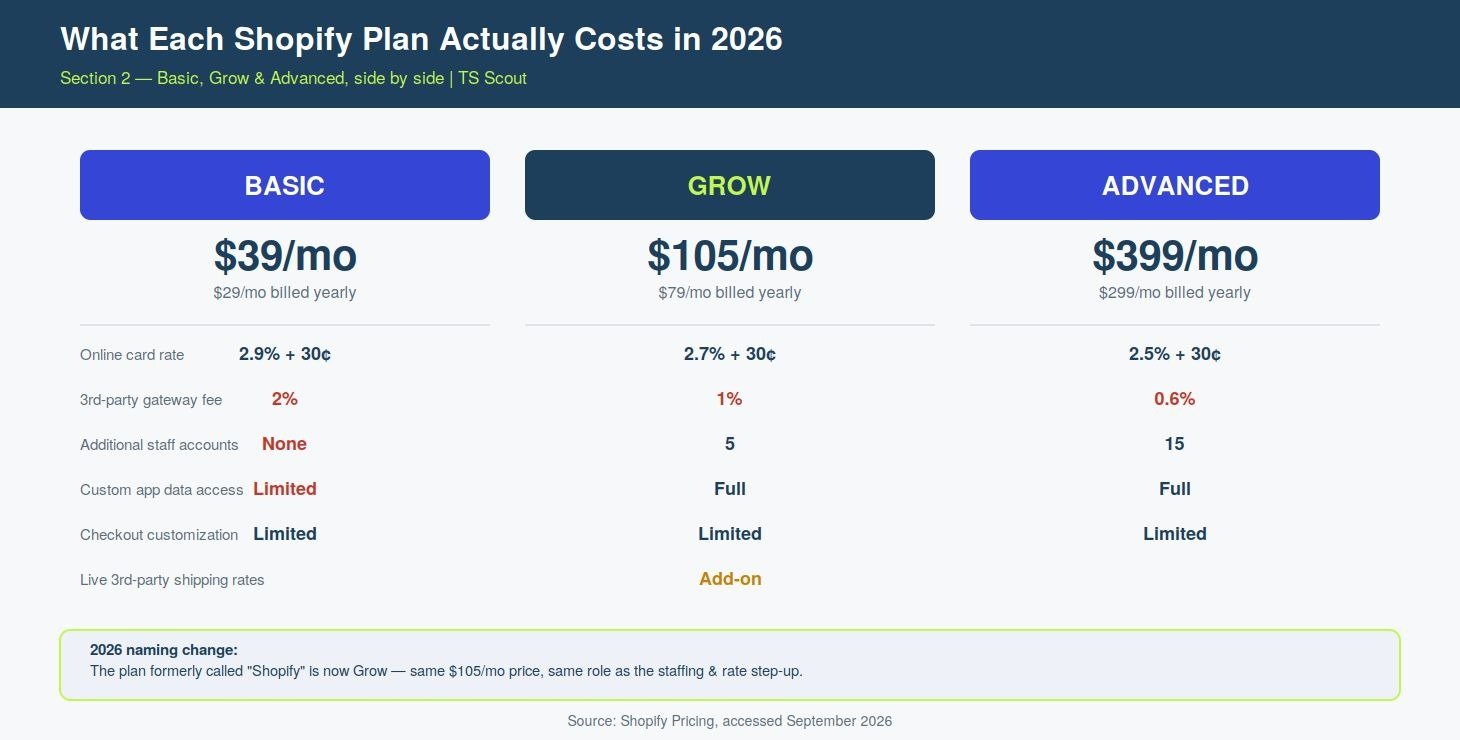
"All you need is a laptop" is the most expensive sentence in this industry. Here is what the platform itself charges, per Shopify Pricing:
|
Basic |
Grow |
Advanced |
|
|
Monthly billing |
$39/mo |
$105/mo |
$399/mo |
|
Yearly billing |
$29/mo |
$79/mo |
$299/mo |
|
Online standard card rate |
2.9% + 30¢ |
2.7% + 30¢ |
2.5% + 30¢ |
|
Third-party gateway fee |
2% |
1% |
0.6% |
|
Additional staff accounts |
None |
5 |
15 |
|
Inventory locations |
10 |
10 |
10 |
Two details in that table catch out sellers working from older guides. The middle tier previously called "Shopify" is now named Grow, so any comparison still using the old label is out of date. And Basic no longer includes additional staff accounts at all, a solo operation is fine, a two-person team is not.
Shopify currently offers a 3-day free trial followed by $1 per month for three months, which genuinely does lower the entry barrier. The trap is treating that promotion as the cost of launching. It is not. Your real pre-revenue spend is advertising: you are buying traffic before you have a single proven product, and that budget dwarfs any subscription. Budget for testing, not for the platform.
Why Do Sellers Still Choose Shopify in 2026?
The advantages are real. They are also specific, so here they are with the receipts attached.
1. The infrastructure is genuinely included. Unlimited web hosting, a free SSL certificate, and Level 1 PCI DSS compliance come with every plan. Replicating that on a self-managed stack costs either money or developer hours, usually both.
2. Zero inventory capital at risk. You are not buying stock that might not sell. That freedom matters most at the testing stage, when your job is to kill nine ideas quickly and scale the tenth.
3. Checkout that is already optimised. Shopify Pricing reports its checkout converts 15% better on average than other platforms. For a store where every visitor was paid for, conversion rate is margin.
4. Multichannel selling, including AI channels. All plans now support selling on social and marketplaces as well as inside AI chats, a distribution surface that did not exist when most "pros and cons" articles were written.
5. Built-in international handling. Storefront translation, local currency display, local payment methods, and the ability to estimate and collect duties and taxes are available across plans. Section 5 explains why that last feature stopped being optional.
Where Shopify does not help is the writing itself. Product pages still convert on clarity and specificity, and learning to write Shopify product descriptions that answer buyer objections is one of the few free margin gains available to a new store.
Where Does Shopify Quietly Eat Your Margin?
Every platform trade-off shows up as a line item eventually. These are the ones that matter.
-
Card fees compound. 2.9% + 30¢ is modest on a $200 order and brutal on a $15 one. Low-ticket catalogues pay a disproportionate share of revenue to processing.
-
The third-party gateway penalty. Using a payment provider other than Shopify Payments adds 2% on Basic, 1% on Grow, and 0.6% on Advanced, on top of whatever that provider charges you.
-
The app stack is a second subscription. Reviews, upsells, email, bundling, and sourcing apps each bill separately. A lean stack is a strategy, not an accident.
-
Checkout customisation is limited below Plus. It is marked "Limited" on Basic, Grow, and Advanced, and "Full" only on Plus.
-
API access is tiered. Basic offers limited data access for custom apps; full data access starts at Grow, which constrains reporting and automation on the cheapest plan.
-
Leaving is expensive. Migration means redirect mapping, content rebuilding, and app data you may not get back.
That last point is worth settling before launch rather than after. Sellers weighing control and content flexibility against convenience usually work through WooCommerce vs Shopify first, because the cost of switching platforms at month eighteen is far higher than the cost of choosing carefully at month zero.
How Did the 2026 Customs Rules Change the Maths for UK and US Sellers?
This is the section most competing articles still omit, and it is the one that moves your P&L.
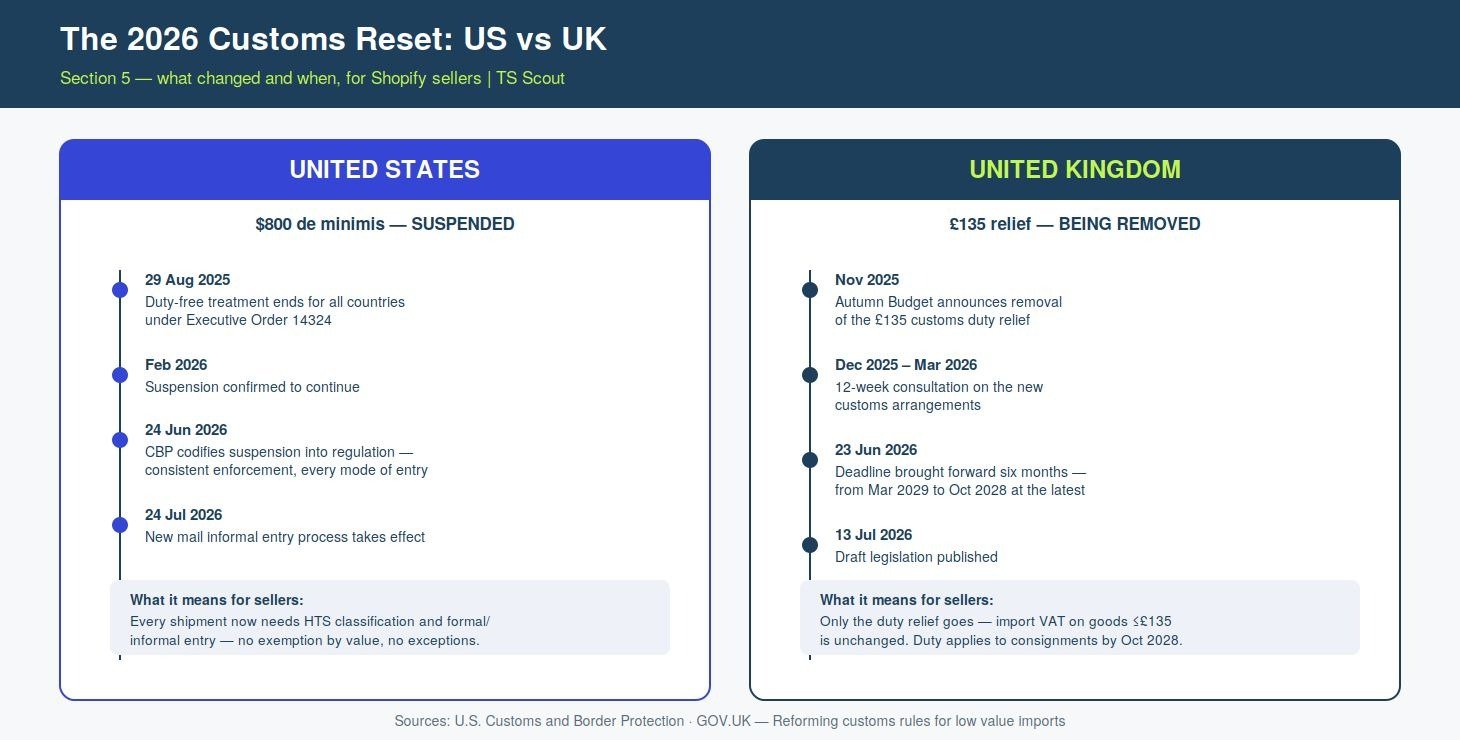
In the United States, the $800 duty-free threshold is gone. Under Executive Order 14324, de minimis duty-free treatment ceased to be available from 29 August 2025 for shipments from all countries, meaning goods valued at or below $800 are now subject to all applicable duties, taxes, and fees. On 24 June 2026, U.S. Customs and Border Protection issued rules indefinitely suspending duty-free treatment and applying consistent enforcement across every mode of entry. The new mail informal entry process took effect on 24 July 2026. This is no longer a temporary policy position — it is written into the regulations.
In the United Kingdom, the equivalent relief is being withdrawn. GOV.UK confirms the measure removes the £135 low value import relief, making such consignments subject to customs duty, and will come into force by October 2028 at the latest. That date was brought forward by six months on 23 June 2026 from the original March 2029 deadline, and the reform changes only the duty position, import VAT on goods of £135 or less is unchanged.
Three operational consequences follow, and none of them are optional:
-
Classification is now your job. Every product needs a correct HTS or commodity code. The rate depends on the code and the country of origin, so there is no single percentage to plug into a spreadsheet.
-
Ship DDP, not DDU. If the duty bill arrives at the customer's door, you get a refused parcel and a chargeback instead of a sale. Prepay it and show an all-in price at checkout.
-
Duty paid is not recovered on a return. When a customer returns an item, the duty stays spent. Your refund policy is now a customs cost as well as a service cost.
The structural answer is to shorten the supply chain. Sellers building for the UK market increasingly pair a domestic fulfilment partner with their overseas testing, and the practical starting point is a shortlist of top UK suppliers for Shopify rather than a single overseas vendor. The wider regulatory picture for Shopify eCommerce in the UK — VAT registration, marketplace rules, consumer cancellation rights, sits alongside this and should be settled before you scale spend.
What Does a Realistic Shopify Margin Look Like After Every Fee?
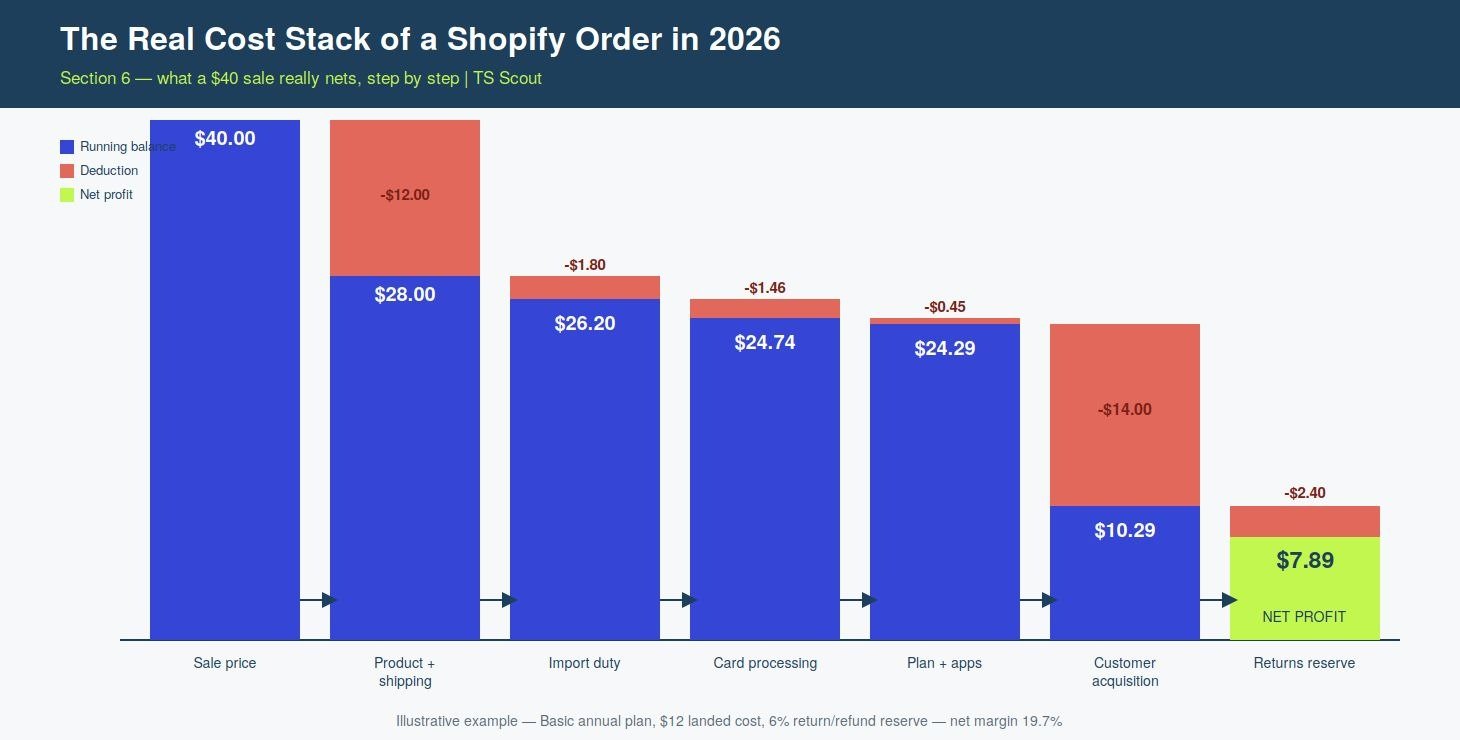
Gross margin flatters. Net margin decides. Here is a single $40 order on a Basic annual plan, with a $12 landed product cost.
|
Line item |
Amount |
Notes |
|
Sale price |
$40.00 |
— |
|
Product + supplier shipping |
−$12.00 |
70% gross margin on paper |
|
Import duty (illustrative 15% of the $12 landed cost) |
−$1.80 |
Varies entirely by code and origin |
|
Card processing (2.9% + 30¢) |
−$1.46 |
Basic plan rate |
|
Plan + apps allocated over 200 orders |
−$0.45 |
$89/mo stack ÷ 200 |
|
Customer acquisition cost |
−$14.00 |
The real variable |
|
Returns and refund reserve (6%) |
−$2.40 |
Duty inside it is unrecoverable |
|
Net profit |
$7.89 |
19.7% net margin |
Switch to a third-party gateway and the 2% penalty removes another $0.80, taking net margin under 19%. Let acquisition cost drift from $14 to $18 and the order clears roughly $4, about 10%.
The lesson is not "dropshipping doesn't work." It is that a 70% gross margin and a 20% net margin sit on the same product, and only one of them pays your bills. Before committing to a price point, validate what comparable stores actually charge and how deep the demand really runs, Shopify Insight exists for exactly that check, turning a guessed retail price into one backed by what the market is already paying.
Why Do Payment Holds and Chargebacks End More Stores Than Competition?
Saturation gets discussed constantly. Payment risk gets discussed almost never, and it closes more stores.
Processors assess risk continuously. A store with long delivery windows, a sudden volume spike, or a rising dispute ratio can face a rolling reserveو a percentage of revenue held for a fixed periodو or an outright hold on payouts. The business does not fail because it stopped selling. It fails because it cannot pay suppliers and ad platforms while its own money is frozen.
The chain runs in one direction, and every link is preventable:
-
Delivery estimate is vague or optimistic
-
Customer waits past the expected window
-
Customer opens a dispute instead of a support ticket
-
Dispute ratio rises
-
Processor imposes a reserve or hold
Your defences are unglamorous and effective: honest delivery windows on the product page, proactive tracking notifications, sub-24-hour first responses, and a refund policy written in plain language before you need it. Most stores discover the gap between the policy they published and the policy they can actually honour at the worst possible momentو the mechanics of the Shopify return policy gap are worth understanding while it is still theoretical for you.
How Do You Pick Products That Survive These Costs?
Once the cost stack is visible, product selection stops being about what looks trendy and becomes an arithmetic filter. Four criteria do most of the work:
-
Perceived value gap. The distance between what a buyer will pay and what the item costs to land. Narrow gaps cannot absorb duty and acquisition cost.
-
Light and compact. Weight drives both shipping and duty exposure.
-
Low return risk. Sizing-dependent apparel and fragile goods bleed margin through refunds where duty is already sunk.
-
Repeat purchase potential. A single-sale product must earn its entire profit from one transaction. A consumable does not.
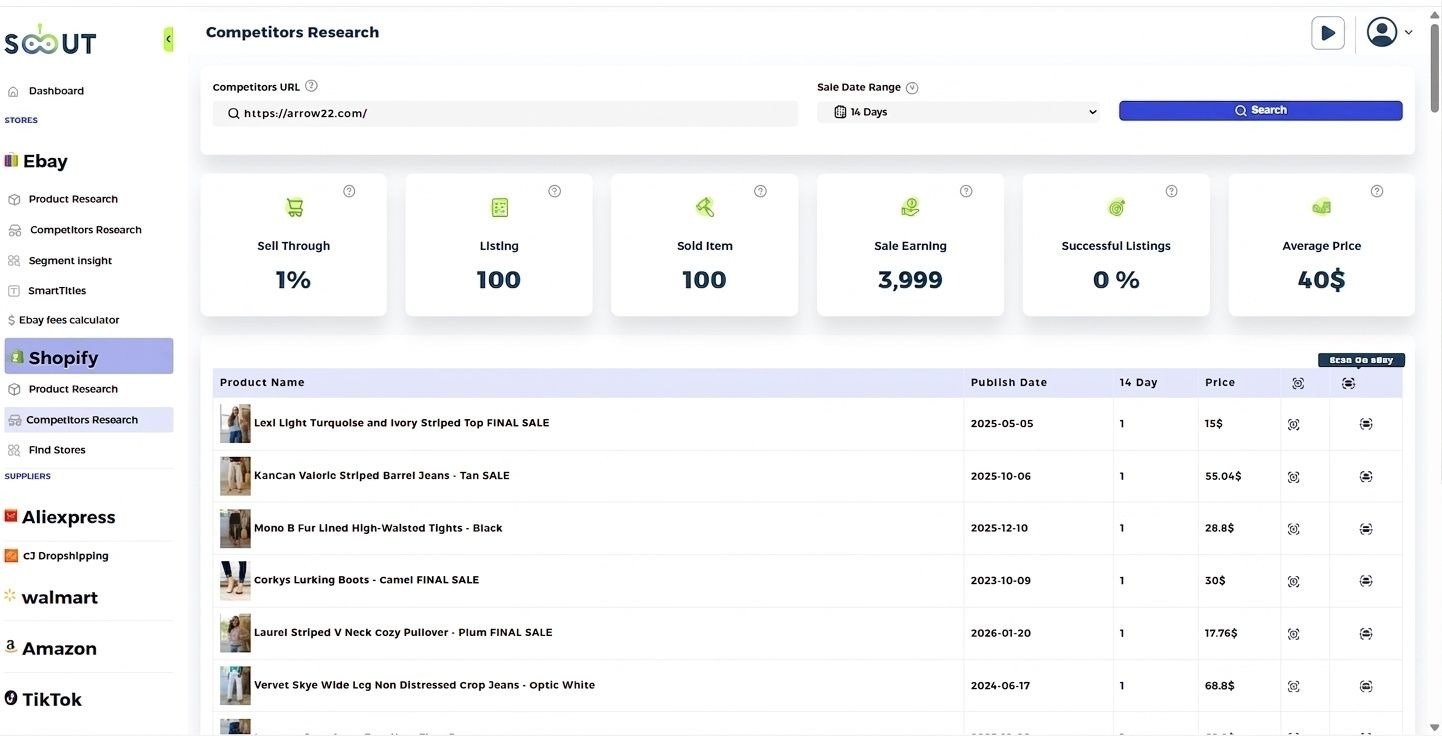
The harder question is evidence. A product passing all four criteria still needs proof that real stores are selling it now, not that a trends page mentioned it. That means looking at active stores in the niche and at what they are actually listing, Shopify Find Stores tool surfaces the stores operating in a category, and Shopify Competitor Research tool shows what sits inside their catalogues, which turns "this looks promising" into a decision you can defend with data.
Two disciplines matter alongside the tooling. Finding profitable Shopify stores in your niche is about pattern recognition, pricing bands, catalogue depth, product mix, not copying a single competitor. And ethical Shopify competitor research keeps that analysis on the right side of the line: study structure and positioning, never lift assets or descriptions.
Which 2026 Shopify Features Actually Change the Pros and Cons?
Platform features are only interesting if they cancel a cost. Here is the honest mapping, based on what Shopify Pricing currently lists.
|
Feature |
Which problem it addresses |
Where it stops |
|
Sidekick AI assistant (all plans) |
Admin and analysis time |
Does not validate demand or supplier quality |
|
Selling in AI chats |
Dependence on paid social traffic |
Still requires accurate product data |
|
Shopify Collective |
Slow overseas delivery windows |
Limited to participating merchants and regions |
|
Duties and taxes estimation |
DDU refusals at the door |
You still supply the classification |
|
Shop Campaigns |
Acquisition cost volatility |
A channel, not a margin fix |
|
Up to 87% off shipping labels |
Outbound postage on self-shipped orders |
Irrelevant if the supplier ships direct |
Every plan also earns 1% back on sales, up to $5,000 on Basic and $7,500 on Grow, useful, but a rebate on spend, not a substitute for a working unit economic model.
The pattern is consistent: Shopify keeps removing operational friction and keeps leaving the two decisions that actually determine profit, which product, and at what price, entirely with you.
Case Study: What Happened to a UK Seller's Margin After the Rules Changed?
A composite scenario built from the cost structures above, showing the sequence most UK sellers are working through now.
Starting position. A homeware store selling a £32 item with a £9 landed cost from an overseas supplier. Gross margin 72%. Delivery window 14–21 days. Net margin around 22% after ads, fees, and returns.
The change. With the £135 duty relief scheduled for removal and delivery windows already generating disputes, two costs move at once: duty enters the landed cost, and refunds rise because slow shipping converts impatience into chargebacks.
The response, in order:
-
Reclassified the catalogue and calculated landed cost per product instead of using a flat percentage
-
Switched to DDP pricing so the checkout total was the final total
-
Moved the three best-selling SKUs to a UK-based supplier, accepting a higher unit cost for a 3–5 day window
-
Repriced from £32 to £37 after confirming comparable stores were already selling in that band
-
Retired two SKUs whose perceived value gap could not absorb the new cost base
The outcome. Unit cost rose. Delivery complaints fell, the dispute ratio dropped below the level that triggers processor scrutiny, and net margin recovered to roughly its previous level on a smaller, cleaner catalogue. Step four was the one that made the rest viable — repricing without market evidence is guessing, and Shopify Insight turned a nervous £5 increase into a decision grounded in what buyers were already paying elsewhere.
So, Is Shopify Still Worth It for Your Kind of Store?
Shopify in 2026 rewards a specific seller: one who prices from landed cost rather than product cost, treats delivery speed as a financial metric, and picks products from evidence instead of enthusiasm. It punishes the opposite just as reliably. The platform has removed almost every technical excuse for failing — which means product selection is now the whole game.
Start your TS Scout trial for $1, 14 days, full access to every product research tool.
FAQs
-
Is Shopify eCommerce still profitable in 2026?
Yes, but on tighter terms. A product showing 70% gross margin realistically nets closer to 20% once duty, card fees, acquisition cost, and returns are deducted. Profitability now depends on product selection and delivery speed far more than on platform choice.
-
How much does it really cost to start a Shopify store?
The Basic plan is $39 monthly or $29 billed yearly, following a 3-day trial and $1 per month for three months. The larger figure is your product testing budget, since you are buying traffic before you have a proven winner.
-
Do I have to pay customs duties on every order now?
For shipments into the US, yes. Goods valued at or below $800 lost duty-free de minimis treatment from 29 August 2025 and are subject to all applicable duties, taxes, and fees. In the UK, the £135 duty relief is being removed by October 2028 at the latest, with import VAT unchanged.
-
Why did Shopify rename its middle plan?
The tier formerly called "Shopify" is now listed as Grow. The positioning changed, not the plan's role, it remains the step up for stores adding staff and needing lower card rates.
-
Can I run a Shopify store from outside the UK or US?
Operationally yes, but Shopify Payments availability varies by country, and your tax registration, VAT obligations, and consumer-law duties follow where your business is established and where you sell, not where you are sitting.
-
What is the biggest hidden cost in Shopify eCommerce?
Customer acquisition, followed by unrecoverable duty on returned goods. Both sit outside the subscription price, and both scale with volume rather than staying fixed.
like?


Table of Contents
- What Is Shopify eCommerce and How Does It Work Without Holding Stock?
- What Does a Shopify Store Actually Cost Before Your First Sale?
- Why Do Sellers Still Choose Shopify in 2026?
- Where Does Shopify Quietly Eat Your Margin?
- How Did the 2026 Customs Rules Change the Maths for UK and US Sellers?
- What Does a Realistic Shopify Margin Look Like After Every Fee?
- Why Do Payment Holds and Chargebacks End More Stores Than Competition?
- How Do You Pick Products That Survive These Costs?
- Which 2026 Shopify Features Actually Change the Pros and Cons?
- Case Study: What Happened to a UK Seller's Margin After the Rules Changed?
- So, Is Shopify Still Worth It for Your Kind of Store?
- FAQs