
The Shopify Return Policy Gap Nobody Warns You About
- 2026-09-06
-
 0
0
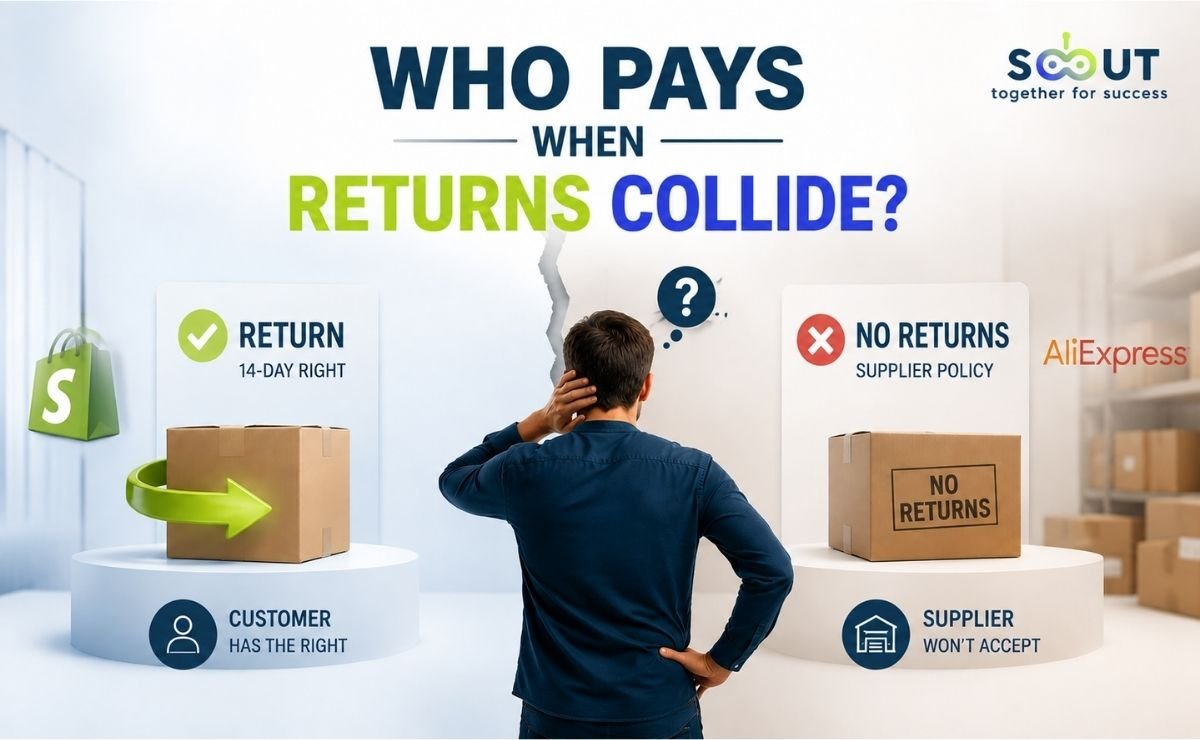
Every Shopify return policy promises customers a resolution window, and every AliExpress supplier's product page can say, in plain text, no returns accepted. Both statements are true at once, and neither side is going to change to accommodate the other. This is the actual shape of the returns problem for online sellers who never hold stock: the store is the only party contractually exposed on both ends legally to the customer, financially to a supplier who owes nothing back.
Most guides respond with "just offer refunds instead of returns" and stop there, as if one sentence solves the sourcing, the margin, and the legal exposure at the same time. It doesn't. What actually closes the gap is a system: a decision framework for each type of complaint, a documented way to decide when a refund alone costs less than a return, and a policy page that states exactly what happens next instead of vague reassurance. That's what the rest of this article builds, section by section.
Does a Shopify Store Legally Need a Return Policy If the Supplier Won't Accept One?
Yes, but not because of the supplier. Across most of Europe, the obligation exists independently of what any individual policy page says. Under the EU Consumer Rights Directive, distance-selling customers have a 14-day right of withdrawal that applies to the contract between the store and the customer, regardless of what any third-party supplier's own terms allow.
That distinction matters more than it sounds. A store's Shopify return policy doesn't create the customer's right, it only describes the procedure for exercising a right that already exists in law. Writing "we don't accept returns" on a policy page doesn't cancel that right; it just leaves the store unprepared for the request when it arrives.
There's a commercial reason to get this right too. Payment processors read return-policy compliance as an account-health signal. Shopify's own guidance on refunding orders confirms that resolving a customer's request directly, before it escalates, is the intended path for keeping disputes off a store's record.
Action step: Treat the return policy page as an operations document, not a negotiation. The question isn't "should we accept this," it's "what's our process for resolving it."
What's Actually the Difference Between a Shopify Refund and a Return?
A return means the physical product goes back to someone before the case is closed. A refund means the money moves back to the customer, the product may or may not come with it. Shopify treats these as separate actions: Shopify's Help Center documentation on refunding orders confirms a store can issue a full refund without ever creating a return record. That's the entire core of the shopify refund vs return question that trips up so many new sellers.
This distinction is the actual fix to the AliExpress problem, not a workaround for it. The EU's 14-day right entitles the customer to their money back, it says nothing about forcing the product through a supplier who has already said no to returns. Most "no returns accepted" situations are solvable the moment a store stops assuming a refund requires a physical return.
Action step: In Shopify Admin, set "Refund" (Orders → Refund) as the default resolution path for low-value claims, and reserve "Create a return" for the cases in Section 4 where a physical item genuinely needs to come back.
Why Won't an AliExpress Supplier Accept Returns in the First Place?
Because the math doesn't work for them. Shipping an item back from a customer in Europe to a warehouse in China routinely costs more than the item itself, this is exactly why an AliExpress supplier won't accept returns as a default policy; it's a cost calculation, not necessarily a red flag on the listing.
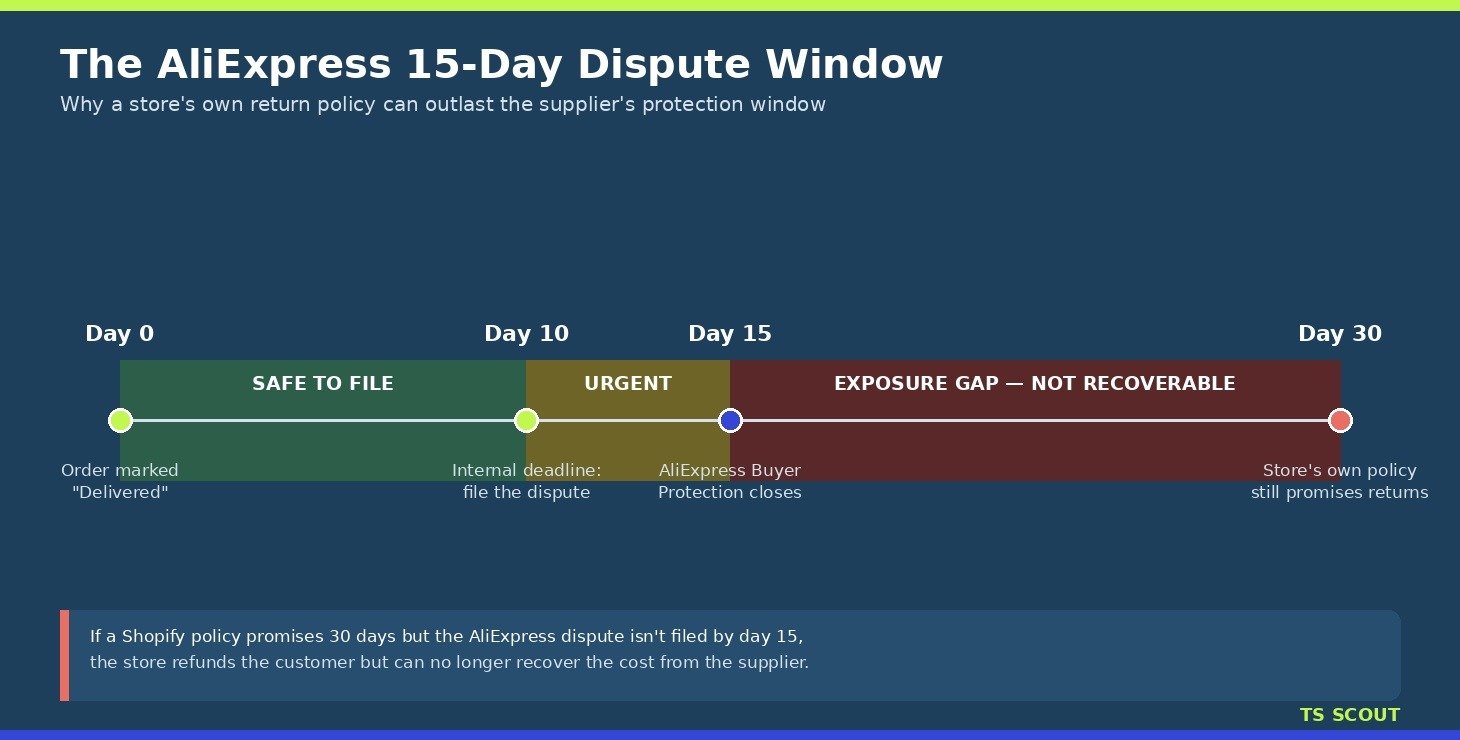
What does exist is AliExpress Buyer Protection, run by the platform itself rather than the individual seller. Per AliExpress's official Buyer Protection terms, a refund request can be submitted up to 15 days after the order is marked complete, with one dispute allowed per order, resolved on submitted evidence.
That 15-day figure creates a timing trap most sellers don't notice until they've already lost money on it: a store's own policy might promise a 30-day window, but AliExpress Buyer Protection closes at 15. File late, and the store absorbs the refund with no way to recover the cost from the supplier.
|
Trigger event |
AliExpress dispute deadline |
What the store must do |
|
Order marked "delivered" |
15 days from that date |
Open the dispute before the window closes, not after the customer complains |
|
Seller doesn't respond to a request |
Short reply window, then escalation opens |
Escalate immediately rather than waiting |
Before a product is even listed, it's worth knowing whether the specific supplier has a track record of stalling on disputes, a pattern that shows up in store-level performance, not on the individual listing.
TS Scout's Source Finder pulls a full AliExpress store's ratings, sales history, and pricing in one view, so a supplier's reliability can be checked before it becomes the store's problem. If a supplier goes quiet mid-dispute, the next move is covered in AliExpress Supplier Unresponsive? and for sellers weighing AliExpress against a platform with different buyer-protection terms, AliExpress vs Temu breaks the comparison down.
Action step: Start the 15-day countdown the moment tracking shows "delivered," not when the customer first complains, and set an internal deadline of day 10 to file, a five-day buffer.
What Should Actually Happen When a Customer Requests a Return?
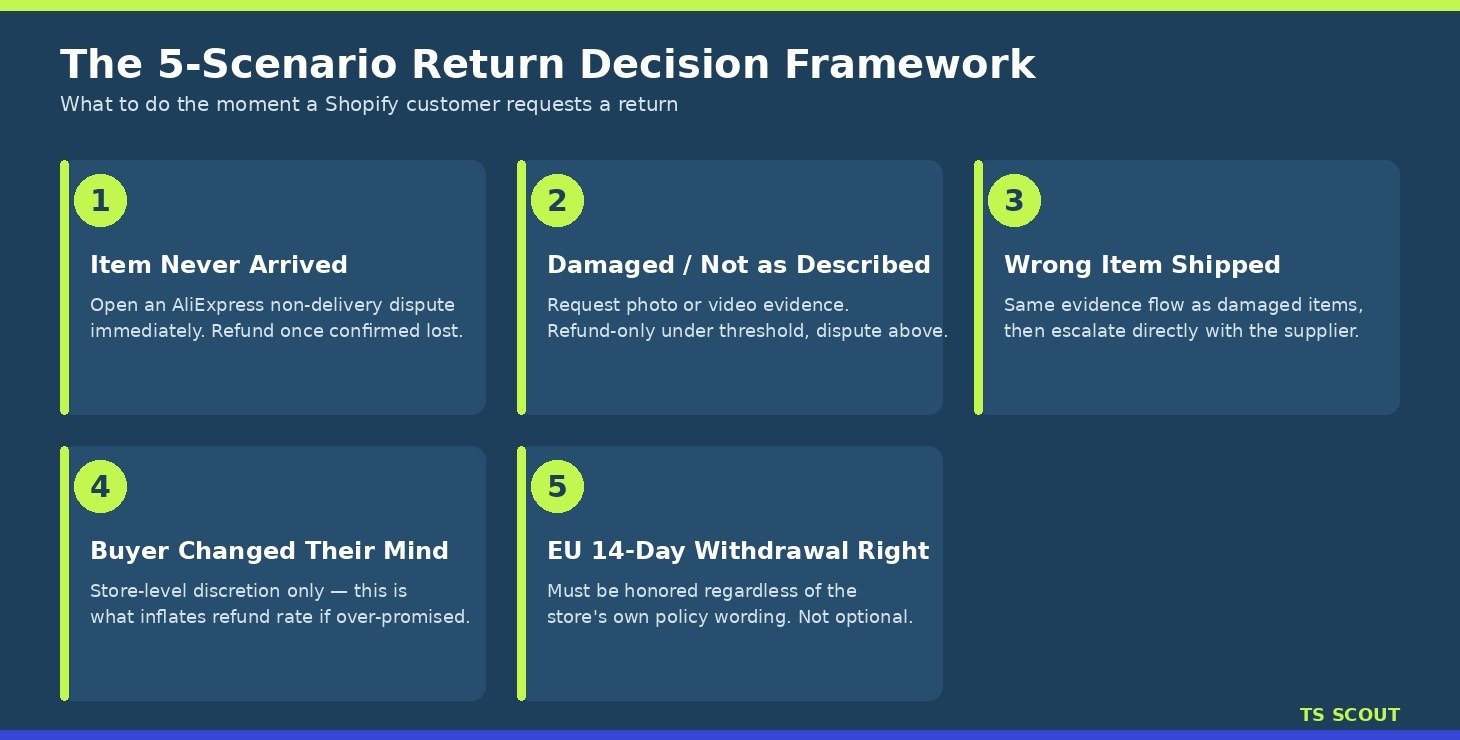
There isn't one answer, there are five, depending on what actually went wrong. Treating every request the same way is exactly what drives up cost and support time, and it's really what how to handle returns dropshipping comes down to in practice, more than any single policy line.
|
Scenario |
What to do |
|
Item never arrived |
Open an AliExpress non-delivery dispute immediately; refund once non-delivery is confirmed |
|
Item arrived damaged or not as described |
Request photo/video evidence from the customer; refund-only below a set price threshold, supplier dispute above it |
|
Wrong item shipped |
Same evidence flow, escalated with the supplier |
|
Customer changed their mind, no defect |
Store-level discretion, this is the category that inflates refund rate when over-promised |
|
Customer invokes the EU 14-day withdrawal right |
Must be honored regardless of the store's own policy wording, not discretionary |
For "not as described" claims, evidence quality decides the outcome. A photo comparing what arrived against what was listed is the strongest proof in an AliExpress dispute, the technique is covered step by step in AliExpress Reverse Image Search.
TS Scout's Image Match does this from the store owner's side: search by the product image itself to confirm what a listing actually matches, and surface the verified supplier behind it, useful both for gathering dispute evidence and for re-sourcing if the current supplier turns out unreliable.
Action step: Turn the table above into a short internal script or help-desk macro so support staff aren't deciding case-by-case under pressure.
How Do You Decide Between a Return and a Returnless Refund?
Run the numbers, not a gut feeling. The logic: net recovery = (resale value − refurbishment cost) − (reverse shipping + handling). If that number is negative, a returnless refund costs less than processing the return.
Worked example:
-
A €14 phone case: reverse shipping alone would run €8–€12. Net recovery is negative before handling is even counted → refund-only, no return requested.
-
A €120 skincare device: resale value after inspection is still meaningful, and the item can be relisted. Net recovery is likely positive → request the item back before refunding.
Action step: Set one fixed price threshold in the store's internal process (for example, "under €30 → refund-only, no return requested") so the decision isn't re-litigated on every single ticket.
How Do You Write a Shopify Return Policy That Actually Holds Up?
A solid dropshipping return policy isn't about promising more than the supply chain can deliver, it holds up when it separates two things most stores blur together: what counts as a "return" and what counts as a "refund." A page that says "30-day returns" without clarifying that most cases resolve as a refund-only, no-shipment-needed process sets an expectation the store didn't intend to make.
A workable Shopify return policy needs to state, in plain language:
-
The timeframe for requests
-
Condition requirements, if any
-
Refund method, original payment or store credit
-
Who pays return shipping, and when
-
Any exclusions (custom items, digital goods, etc.)
Disclosure has to repeat, not appear once in a footer link: product page, checkout, order confirmation email, and a dedicated policy page all need to carry the same core terms.
It's worth checking what already works before drafting from scratch. TS Scout's Shopify Store Finder surfaces real, high-performing Shopify stores by niche, including revenue and order volume, making it possible to see how stores that are actually converting structure their policy pages, instead of guessing. For sourcing suppliers whose stated terms are realistic enough to build a policy around in the first place, AliExpress Product Sourcing Guide covers the vetting process in full.
Action step: Draft the five-point checklist above once, then paste the same three core terms, timeframe, refund method, who pays shipping, into the checkout page and the confirmation email template so they never contradict each other.
How Do You Protect Your Dropshipping Refund Rate Margin?
Build the expected cost of refunds into pricing before it becomes a surprise. A self-funded return reserve works simply: if a product category runs a 3–5% refund rate, a matching per-unit buffer added to price covers it without the loss showing up as an unplanned deduction at month's end.
The buffer only works if it's based on real numbers, not a guess. TS Scout's Shopify Insight shows the actual average selling price and sales volume for a given product across live Shopify stores, which makes it possible to check whether current pricing already has room for a refund reserve, or whether it's priced too tight to absorb one.
Pricing volatility compounds this risk further when a supplier changes prices after checkout, covered in Your AliExpress Price Increases at Checkout , a margin hit on the sourcing side makes an already-thin refund buffer disappear even faster. And the cost of letting a request go unresolved is higher than the refund itself: escalation to a formal dispute adds a processor fee on top, as outlined in Shopify's chargebacks and inquiries documentation.
Action step: Add a return-reserve line item to the pricing sheet, recalculated per category based on that category's actual refund history, not a flat guess applied across the whole catalog.
How Do You Reduce Refund Requests Before They Start?
Most refund volume traces back to a handful of preventable causes: sizing or spec mismatches, unrealistic delivery-time promises, listing photos that don't match the real product, and no proactive notice when a shipment runs late. That's the short version of how to reduce refund requests without overhauling the whole catalog.
A short, repeatable checklist:
-
Cross-check listing specs against the actual supplier page before publishing, not after a complaint.
-
Set delivery estimates from real shipping data, not an optimistic default.
-
Send a proactive delay notice before the customer has to ask.
-
Review the products generating the most refund requests monthly, and fix or delist them.
Product selection itself is a lever here. Items with stable, well-documented specs, the kind covered in What Is an Evergreen Product? and Evergreen High-Ticket Product Ideas, tend to generate fewer "not as described" disputes than trend-driven items with inconsistent supplier batches, simply because there's less that can surprise the customer. Testing a product at small volume before scaling it, as outlined in Test an Evergreen Product, catches a quality or sizing problem while it's still cheap to fix.
Before committing catalog space to a new item, checking its actual demand and rating history helps avoid the ones most prone to complaints. TS Scout's Express Scanner filters AliExpress listings by price, rating, and sales volume, surfacing items with a track record, not just a trending photo, before they're added to the store.
Action step: Run the four-point checklist above against the current top five refund-generating products this month, and fix or remove whichever one has the clearest root cause.
What Happens If a Customer Files a Chargeback Instead of Requesting a Refund?
A refund is merchant-controlled, the store decides the outcome. A chargeback is bank-controlled: the customer's card issuer reverses the charge, the store loses control of the timeline, and a fee applies regardless of outcome, per Shopify's chargebacks and inquiries documentation.
The biggest predictor of a chargeback instead of a direct refund request is response speed, customers escalate to their bank specifically when a merchant is slow or unresponsive. Reviewing which products or store patterns tend to trigger disputes is easier with visibility into how comparable stores handle it:
TS Scout's Shopify Competitors Research analyzes a specific competitor's product listings and sales patterns, helping identify categories worth avoiding before they generate the same complaint volume elsewhere.
Action step: Set an internal SLA, 48 hours is a reasonable target, for responding to any refund request, since most chargebacks happen only after that window is missed.
How Does This Differ for Sellers Targeting the UK or US?
The core system above holds across Europe, but two markets diverge from the EU baseline in ways worth knowing before selling into them.
UK: The Consumer Contracts (Information, Cancellation and Additional Charges) Regulations 2013 mirror the EU's 14-day withdrawal right almost exactly and remain in force as UK law independent of EU membership.
US: There's no federal requirement to accept returns on non-defective goods at all. The relevant federal floor is the FTC's Mail, Internet, or Telephone Order Merchandise Rule, and it governs refunds for shipping delays specifically, not general returns.
Action step: A store built around the EU's 14-day standard shouldn't assume it automatically covers US customers, write a separate, explicit policy line for US orders rather than relying on the same page copy.
So What Happens the Next Time a Customer Asks for a Return?
With the framework above, a Shopify return policy stops being a case-by-case scramble: a clear decision table for what triggered the request, a refund-vs-return threshold based on actual math, a policy page that says exactly what happens next, and a pricing model that already has the refund rate built in. That's the difference between a store that loses money on every claim and one that resolves it in minutes.
Building that system starts with knowing which suppliers and products are worth the risk before they're in the catalog, which is what TS Scout is built for. Start your $1, 14-day full-access trial and see the store, supplier, and pricing data behind every decision in this article.
FAQS
-
Do I have to accept returns on my Shopify store?
There's no requirement to accept a physical return specifically, but under the EU's 14-day withdrawal right, customers are entitled to cancel and get their money back, a right that exists separately from what a store's own policy page says.
-
Can I offer a refund without asking the customer to send the item back?
Yes. Shopify supports issuing a refund without creating a return record, and for low-value items this is usually the cheaper, faster resolution for both sides.
-
How long do I have to file a dispute with an AliExpress supplier?
Fifteen days from the date the order is marked "delivered," per AliExpress Buyer Protection. Filing after that window closes forfeits the ability to recover the cost from the supplier.
-
Does the EU 14-day withdrawal right apply even if my supplier won't take the item back?
Yes. The right applies to the contract between the store and the customer, it doesn't depend on what any third-party supplier's own return terms allow.
-
What's the difference between a Shopify refund and a Shopify return?
A refund moves the money back to the customer. A return means the physical product comes back first. Shopify allows either to happen independently of the other.
-
How much should I budget for refunds as a percentage of revenue?
It depends on the product category's actual refund history, a 3–5% rate is a reasonable starting benchmark to build a pricing buffer around, adjusted per category once real data is available.
-
What happens if my customer opens a chargeback instead of contacting me first?
The store loses control of the resolution and absorbs a processor fee regardless of outcome, which is why responding to direct refund requests quickly matters more than the policy wording itself.
like?


Table of Contents
- Does a Shopify Store Legally Need a Return Policy If the Supplier Won't Accept One?
- What's Actually the Difference Between a Shopify Refund and a Return?
- Why Won't an AliExpress Supplier Accept Returns in the First Place?
- What Should Actually Happen When a Customer Requests a Return?
- How Do You Decide Between a Return and a Returnless Refund?
- How Do You Write a Shopify Return Policy That Actually Holds Up?
- How Do You Protect Your Dropshipping Refund Rate Margin?
- How Do You Reduce Refund Requests Before They Start?
- What Happens If a Customer Files a Chargeback Instead of Requesting a Refund?
- How Does This Differ for Sellers Targeting the UK or US?
- So What Happens the Next Time a Customer Asks for a Return?
- FAQS