
How to Migrate Your eBay Store to Shopify Without Losing Momentum (2026 Playbook)
- 2026-09-10
-
 0
0

You built a real business on eBay. Then you hit a wall: every sale hands a slice of your margin to eBay, every buyer belongs to eBay's database instead of yours, and one policy strike can freeze an account you spent years building. This is exactly why so many established sellers start searching for how to migrate their eBay store to Shopify, not to abandon eBay, but to stop renting their entire business from someone else.
This playbook is not another "why you should switch" piece. It's a decision framework first, then a step-by-step execution plan for anyone ready to move. You'll see the actual fee math from both platforms, what eBay data legally transfers and what doesn't, and the order of operations that keeps revenue flowing while you build. By the end, you'll know whether an eBay to Shopify migration is even the right call for your store right now, and if it is, exactly how to do it without a dead week of zero sales.
Why Are eBay Sellers Hitting a Ceiling in 2026?
Three structural limits show up at a predictable point in every eBay seller's growth curve:
-
Rented traffic, rented relationship. eBay owns the buyer. You can't email a past customer, retarget them, or build a loyalty program around them, every repeat sale has to be won again through eBay search.
-
A fee structure with no ceiling. According to eBay's official Seller Center, most categories carry a 13.6% final value fee on the total sale amount up to $7,500 (2.35% above that), plus a per-order fee of $0.30 on orders under $10 and $0.40 above it. That's a percentage of every single sale, forever, there's no point where the fee stops scaling with your revenue.
-
Account health is out of your hands. Your visibility, selling limits, and even your ability to sell at all depend on metrics eBay sets and can change. A brand you don't legally own can be throttled or suspended without much warning.
None of this means eBay stops being useful, for many sellers it stays the best top-of-funnel channel they have. It means the businesses that outgrow it eventually need a channel where the traffic, the data, and the brand belong to them.
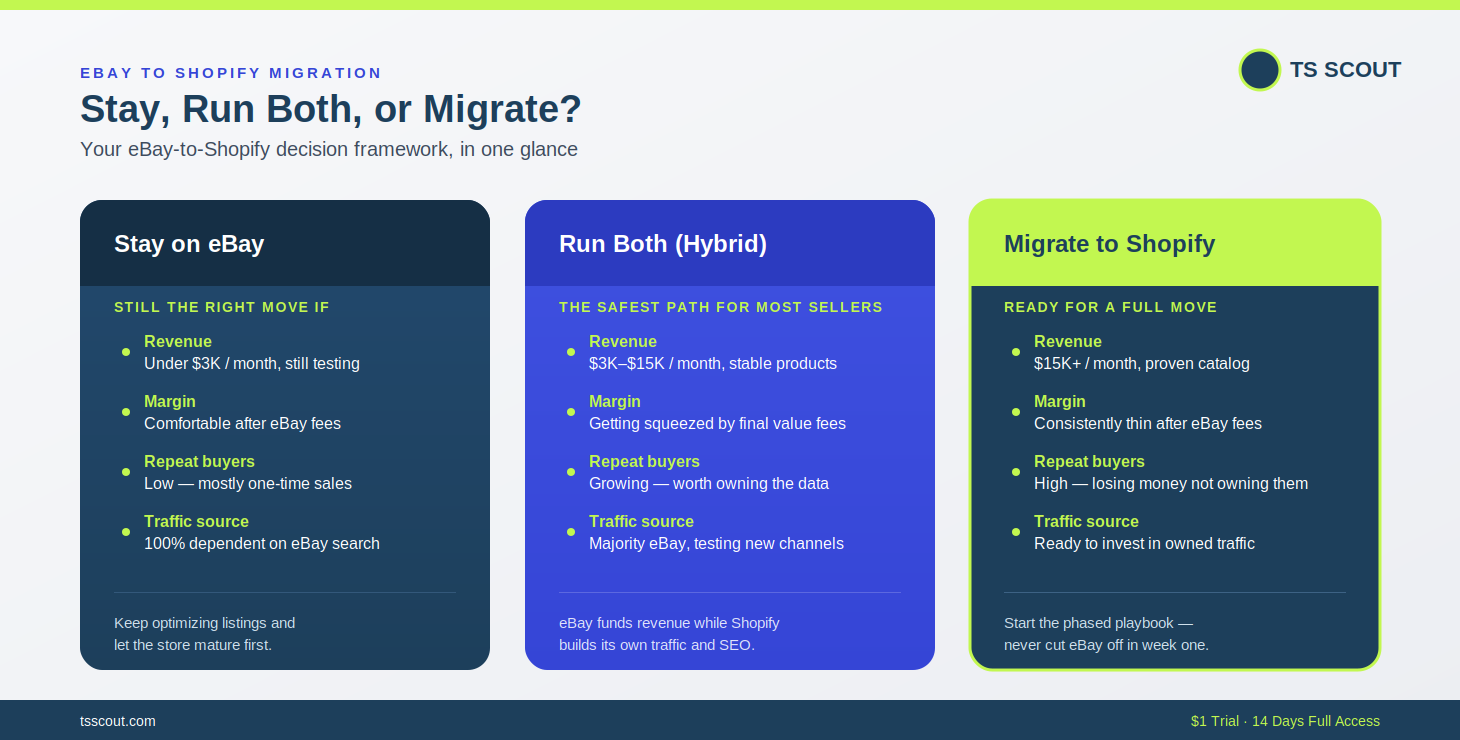
Should You Migrate, Diversify, or Stay on eBay? (Decision Framework)
This is the question most guides skip. Use these four inputs before deciding anything:
|
Signal |
Stay on eBay |
Hybrid (Both) |
Migrate to Shopify |
|
Monthly revenue |
Under $3K, still testing products |
$3K–$15K, stable repeat products |
$15K+, proven catalog |
|
Net margin after eBay fees |
Comfortable |
Getting squeezed by FVF |
Consistently thin |
|
Repeat buyer rate |
Low, mostly one-time |
Growing |
High, you're losing money not owning them |
|
Dependence on eBay traffic |
100% |
Majority, testing other channels |
Ready to invest in your own traffic |
If you land mostly in the first column, keep selling and optimizing on eBay, this isn't the right move yet. If you're spread across the middle, run both in parallel rather than migrating fully; eBay stays your proven revenue floor while Shopify grows underneath it. Only the last column justifies a full move right now, and even then, the smart path is almost always parallel operation before a clean cutover, never migrate and delist from eBay in the same week.
What's the Real Cost Difference Between eBay and Shopify?
The comparison isn't "percentage vs. no percentage", it's percentage-of-revenue-forever vs. fixed-subscription-plus-processing.
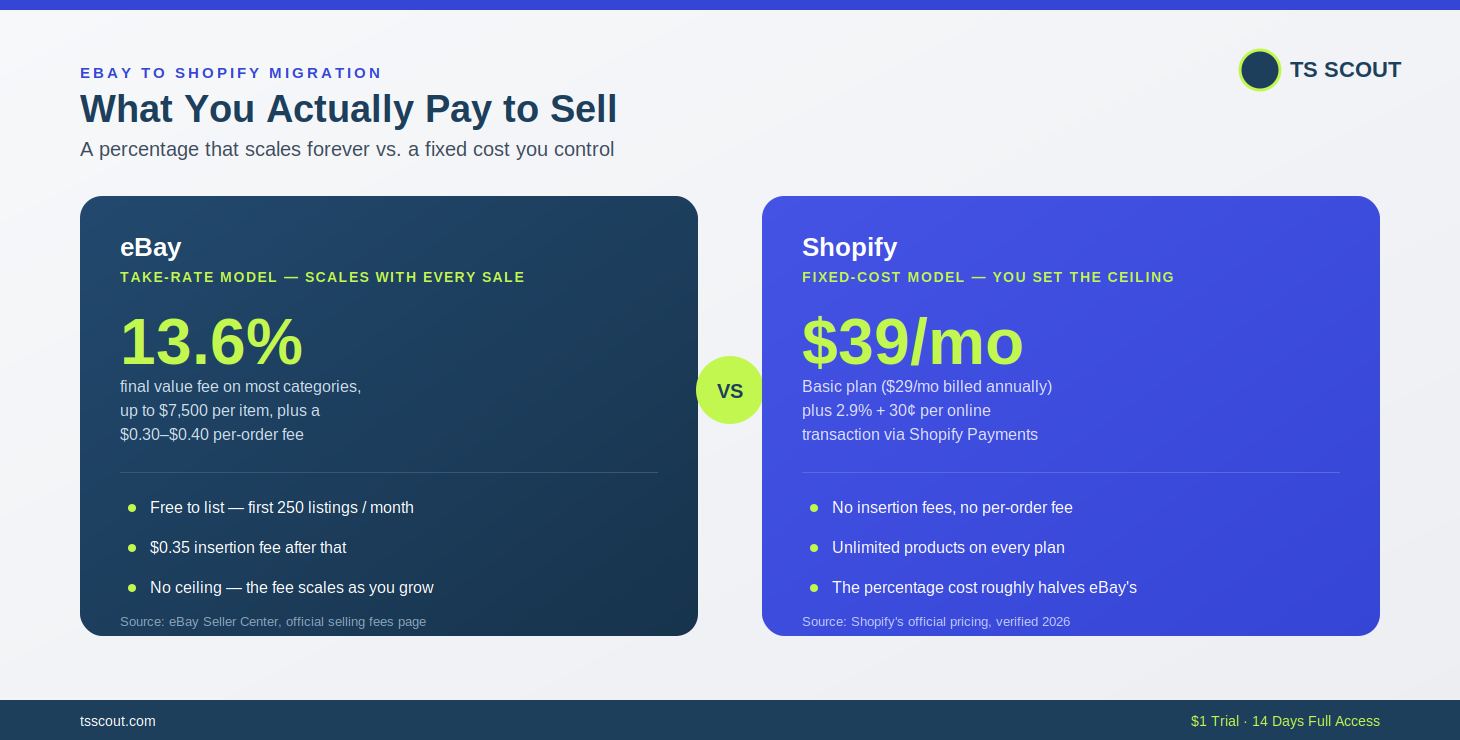
Per eBay's official fee page (linked above), a seller without a Store subscription pays 13.6% + a per-order fee on every sale. eBay's own worked example illustrates the tipping point well: a seller moving four $500 phones a month pays $73.89 in fees per phone without a Store subscription, but only $50.92 with a Basic Store subscription ($21.95/month), a net gain of roughly $839 a year just from the subscription discount. That same logic, fixed cost buying down a percentage, is exactly what happens when you move fully off eBay's take-rate model.
On Shopify, the cost structure flips: a flat subscription instead of an open-ended cut of revenue. According to Shopify's own community pricing guidance, the Basic plan runs $39/month ($29/month billed annually) plus a 2.9% + 30¢ processing fee per online transaction through Shopify Payments. There's no insertion fee, no per-order fee, and the percentage-based cost is roughly half of eBay's final value fee.
|
eBay |
Shopify Basic |
|
|
Base cost |
$0 (up to 250 listings/mo) |
$39/mo ($29/mo annual) |
|
Per-sale cost |
13.6% + $0.30–$0.40 |
2.9% + 30¢ |
|
Ceiling on fees |
None, scales with revenue |
Fixed subscription, predictable processing |
At meaningful volume, that gap compounds fast, which is the real financial argument for owning your own store, not "Shopify is cheaper to list on."
Is Your Current Sourcing Model Ready for Your Own Store?
Before you migrate a single listing, check this: are you the seller of record for every product you sell? Per eBay's official policy on product sourcing, fulfilling orders directly through a wholesale supplier relationship is permitted, but listing an item and then buying it from another retailer or marketplace that ships straight to your customer is explicitly against the rules, and it's one of the fastest routes to a suspended account.
This matters for migration specifically because Shopify has none of eBay's built-in guardrails or buyer-protection safety net. If your supplier relationship isn't clean now, it won't get cleaner by moving platforms, it'll just be harder to catch problems early without eBay's performance dashboards flagging them for you. Vetting your supplier base and confirming stock accuracy before you migrate saves you from rebuilding a broken foundation twice.
How Do You Actually Migrate an eBay Store to Shopify?
5.1 What Should You Move, and What Should You Leave Behind?
Not every listing deserves a second life. Pull your top performers by units sold and margin, not by total listing count, a bloated catalog of low-performing SKUs will just slow down your new store's SEO. One thing to set expectations on early: eBay reviews and seller feedback do not transfer to Shopify in any form. You're rebuilding trust signals from zero, which is why a review app and clear policies matter from day one, not "eventually."
eBay's own Seller Hub shows you how your listings performed on eBay, but it can't tell you what's still winning across the wider market before you commit to migrating it. Running your shortlisted catalog through the eBay Product Research Tool first confirms which items still have real demand and margin left in them, using market-wide data, your own store dashboard was never built to show.
What's the Right Method to Import eBay Listings to Shopify?
According to Shopify's own migration guide, sellers moving from eBay typically choose between three methods depending on catalog size:
-
Manual entry, realistic only under roughly 50 SKUs.
-
CSV export/import, export your eBay listings as a CSV file and upload it directly through Shopify's Store Migration setup flow; this is the officially supported path for most catalog sizes.
-
Migration or integration apps, for larger catalogs or stores that want continuous two-way syncing rather than a one-time transfer.
Whichever method you use, treat the import as a rebuild, not a copy-paste. Titles and descriptions written for eBay's search algorithm (Cassini) don't perform the same way in Shopify's SEO or Google's index this is the point where SEO for Shopify and SEO for Shopify products work needs to happen, not after launch.
How Do You Keep Both Channels Running During the Transition?
According to Shopify's own integration guidance, merchants running eBay and Shopify together today connect the two through Shopify's built-in eBay sales channel or a listed integration app, syncing inventory, pricing, and order data between both platforms so a sale on one channel automatically adjusts stock on the other, the practical foundation of the hybrid model from Section 2.
How Do You Set Up Your New Store So It Actually Converts?
A migrated catalog on a bare-bones store won't convert like it did on eBay, where buyer trust was baked into the platform. Before launch, lock down:
-
Domain, checkout, and a mobile-tested theme
-
Clear return and shipping policies (you have no eBay Money Back Guarantee behind you now)
-
A payment processor set up correctly, new accounts can face review holds at high volume, so ramp up gradually rather than pushing a huge volume spike in week one
This is also the stage to benchmark pricing and positioning against real Shopify sellers rather than guessing. Running your shortlisted products through Shopify Insight shows actual units sold, average selling price, and active listing counts for similar products already live on Shopify, data that should shape your pricing before you publish, not after.
How Do You Keep Your eBay Buyers From Disappearing After the Move?
Shopify gives you zero organic traffic on day one, eBay's marketplace search was doing that work for you invisibly. Three things need to start immediately, not "eventually":
-
Redirect existing buyers. A message to past customers, a card or QR code in your shipment packaging, and your eBay store description pointing to your new site all compound over time.
-
Keep eBay running as your top-of-funnel. This is the hybrid model again, eBay's traffic keeps revenue flowing while your Shopify SEO and paid channels mature, which realistically takes months, not weeks.
-
Start owning the relationship from sale one. Email capture at checkout is the single asset eBay never let you build. This is the foundation of everything covered in Build eCommerce Brand.
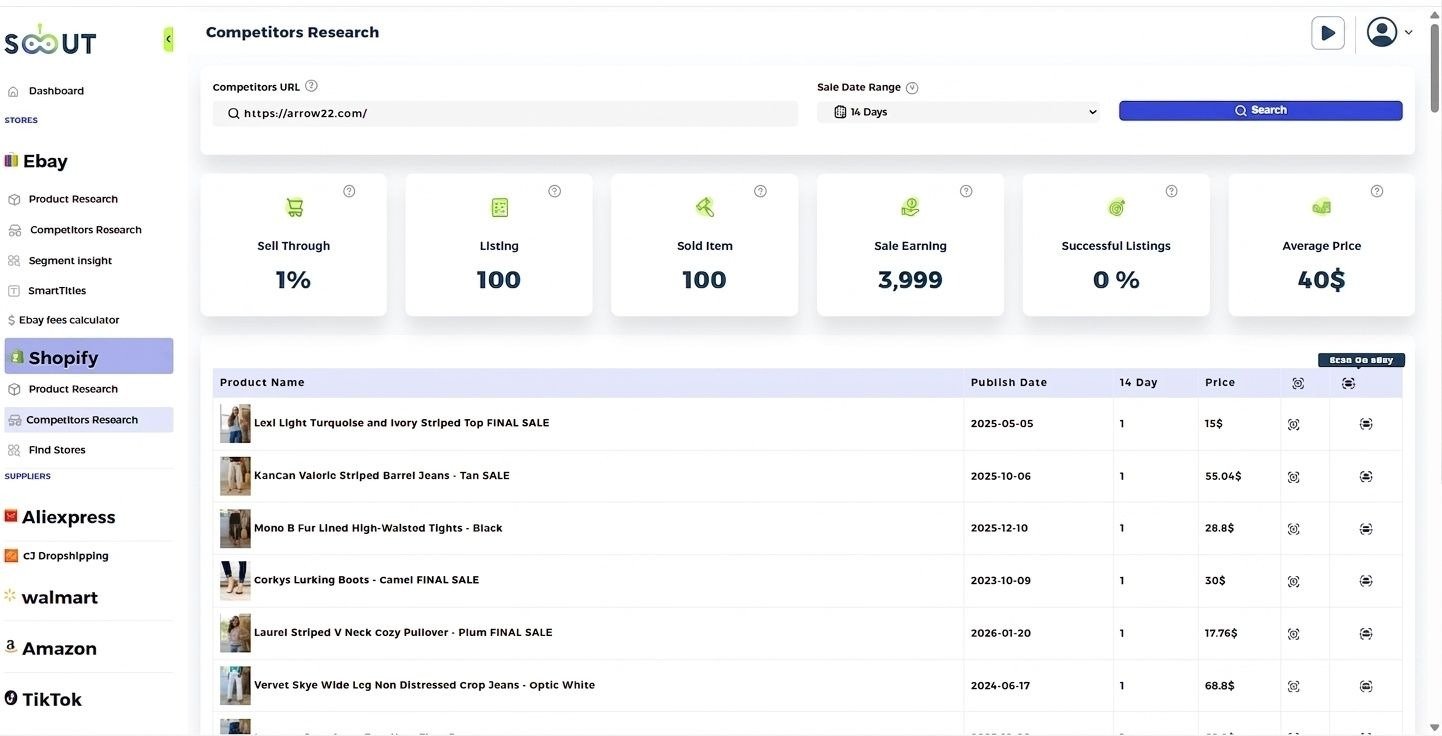
Understanding where competitor Shopify stores are winning their traffic helps here too, the Shopify Competitor Research tool breaks down what a specific competitor's store is actually selling and how their listings perform, which is far more useful for positioning than guessing. For a fuller framework on doing this without crossing into anything unethical, see Ethical Shopify Competitor Research.
What Mistakes Sink Most eBay-to-Shopify Migrations?
-
Copy-pasting eBay titles and descriptions verbatim, they were written for a different search algorithm and read as thin, generic content to Google. Pair your migration with a proper Shopify SEO Checklist for Beginners before launch, not after traffic stalls.
-
Cutting eBay off completely before Shopify has any traction, this is the single most common cause of a multi-month revenue dip.
-
Ignoring inventory sync between both channels, overselling a product that's live on eBay and Shopify simultaneously damages your standing on both.
-
Migrating margin problems, not just products, if a product barely broke even on eBay after fees, it needs re-pricing before it goes live on Shopify, not the same price tag. This is exactly the gap The Profit Anatomy is built to catch before it repeats itself on a new platform.
To find genuinely new store models worth studying, not just your direct competitors, the Shopify Find Stores lets you filter live stores by category, price range, and sales activity, which is a faster way to validate positioning than browsing manually. While you're still selling on eBay in parallel, don't let that channel go stale either, the eBay Competitors Research tool keeps you aware of what direct eBay competitors are doing during the transition period, and the eBay Segment Insight tool helps you spot categories worth expanding into on eBay while your Shopify store is still ramping up.
Ready to Stop Renting Your Business From Someone Else?
An eBay to Shopify migration isn't a weekend project, and it isn't a switch you flip overnight, it's a phased move from a rented audience to one you own. Start with the decision framework in Section 2, protect your eBay revenue with a hybrid approach while your new store builds traction, and treat every migrated listing as a rebuild opportunity, not a copy-paste job.
Start your $1, 14-day full-access trial with TS Scout and get the product, competitor, and pricing data to make every step of this migration a data-backed decision instead of a guess.
FAQ
-
Can you transfer eBay reviews and feedback to Shopify?
No. eBay seller feedback and reviews are tied to your eBay account and do not migrate to Shopify in any form. You'll need to start building Shopify-native reviews from your first sale.
-
How much does it actually cost to migrate from eBay to Shopify?
The migration itself (CSV import) is free through Shopify's own tools. Your ongoing cost shifts from eBay's 13.6%+ per-sale fee to a Shopify Basic subscription of $39/month ($29/month billed annually) plus 2.9% + 30¢ per online transaction.
-
What's the safest way to run an eBay shopify integration during the transition?
Connect eBay as a sales channel inside Shopify (or use a listed integration app) so inventory and orders sync automatically between both stores, this keeps eBay's revenue flowing while your Shopify store builds traction.
-
Can you sell on eBay and Shopify at the same time?
Yes, and for most sellers this hybrid approach is the safest way to migrate, it keeps eBay's traffic flowing while your Shopify store builds its own audience and SEO.
-
What's the best way to import eBay listings to Shopify without losing SEO value?
CSV export/import is the officially supported method, but titles and descriptions should be rewritten for Shopify's SEO context rather than copied directly from eBay, a straight copy rarely ranks.
-
Does eBay's supplier-sourcing policy still apply once you move to Shopify?
The platform rule itself doesn't carry over, but the underlying practice does, fulfilling from a legitimate wholesale supplier relationship rather than another retailer protects you on any platform, and it's worth confirming before you migrate, not after.
like?


Table of Contents
- Why Are eBay Sellers Hitting a Ceiling in 2026?
- Should You Migrate, Diversify, or Stay on eBay? (Decision Framework)
- What's the Real Cost Difference Between eBay and Shopify?
- Is Your Current Sourcing Model Ready for Your Own Store?
- How Do You Actually Migrate an eBay Store to Shopify?
- How Do You Keep Your eBay Buyers From Disappearing After the Move?
- What Mistakes Sink Most eBay-to-Shopify Migrations?
- Ready to Stop Renting Your Business From Someone Else?
- FAQ