

eBay Auction vs. Buy It Now: The Format Choice That's Quietly Costing Sellers More Than They Think
- 2026-06-28
-
 0
0
88% of active eBay listings are fixed price. Auctions sit at just 12%. Easy choice, right?
Wrong.
Volume doesn't mean profit. In specific niches, a well-timed auction triggers bidding wars that blow past any fixed price listing you'd dare set. The real question isn't which format is more popular, it's which eBay listing format puts more money in your pocket for the exact item you're listing right now.
No filler. Just the data, the decision framework, and the tools that stop the guessing.
Already selling? Jump to Which eBay Listing Format Is Right for Your Item?
Just starting out? Make sure your eBay account is set up correctly first; it takes five minutes and saves hours of listing headaches later.
Does the 88% Fixed Price Listing Statistic Actually Tell You Where the Profit Is?
No. The 88% figure reflects what's listed, not what earns the most. According to Statista's eBay marketplace data, most items on the platform phone cases, kitchen gadgets, household replenishable suit a fixed price listing naturally. Buyers know the rate, want instant checkout, and move on.
The shift happens with rare, unique, or hard-to-value items. A fixed price listing caps your earnings there you’re guessing the ceiling. A well-run auction lets buyers compete, and bidding wars routinely push the final price above any number you'd have set yourself. Auction listings for collectibles consistently outperform their fixed-price equivalents when two conditions are present: genuine scarcity and competing bidders. Remove either and the advantage disappears.
The rule is simple: format follows the item, not the seller's habit.
eBay Auction vs. Buy It Now: What Does Each Listing Format Do to Your Margins?
Before choosing a format, know what actually moves in your category. A quick scan of the eBay Best Items tool reveals a consistent pattern across UK and US markets:
-
High-volume, stable-price products: electronics, fashion basics, home essentials → fixed price listing territory
-
Low-volume, unpredictable-price products: vintage watches, coins, art, collectibles → auction listing territory
That split doesn't just tell you what to source. It tells you how to list it.
Is a Buy It Now Fixed Price Listing Right for Your Product?
Where it earns its place:
1. Full price control. You set the number. No hoping for bids, no last-second disappointment.
2. Instant payment. Buyers pay immediately unpaid orders are virtually eliminated.
3. Compounding visibility.GTC listings build sales history with each transaction, progressively boosting search rank. Fee note: GTC renews once per calendar month (not every 30 days), and each renewal incurs a new insertion fee or consumes a free allowance based on:eBay Selling Fees. Track this when scaling.
4. Built-in promotions. eBay's Markdown Manager lets you create time-limited sales and urgency without touching your listing format.
Where it works against you:
-
No countdown pressure. Buyers can browse indefinitely without committing.
-
Constant pricing exposure. Competitors can undercut you quickly and active market monitoring becomes non-negotiable.
Is an Auction Listing Right for Your Product?
Where it earns its place:
1. Built for scarcity. When supply is thin and demand is genuine, bidding competition pushes the final price past any fixed price listing estimate.
2. Fast outcome. Your item sells within the duration or you know fast it isn't moving. eBay auction listings run for 1, 3, 5, 7, or 10 days.
3. Live price discovery. Unsure what an item is actually worth? The market tells you precisely and without guesswork.
Where it works against you:
-
Non-paying bidders remain a real issue: days lost, sometimes nothing to show.
-
No momentum carries forward: An unsold auction resets to zero no accumulated listing history to build on.
-
More active management. Timing the end, fielding buyer questions, chasing payment it takes consistent effort.
eBay Auction vs. Buy It Now: Side-by-Side Comparison
|
|
Buy It Now (Fixed Price) |
Auction |
|
Best for |
New, mass-market, replenishable items |
Rare, unique, collectible, hard-to-value items |
|
Price control |
Full you set the number |
Bidders determine the final price |
|
Speed of sale |
Slower but predictable |
Ends in 1–10 days |
|
Buyer behaviour |
Instant, "Amazon-style" checkout |
Emotional, competitive bidding |
|
Payment timing |
Immediate |
Risk of non-paying bidders |
|
Listing duration |
Good Until Cancelled (renews every 30 days) |
Short burst restart if unsold |
|
Urgency created |
Low |
High countdown clock |
|
Effort required |
Low |
Higher timing, Q&A, follow-up |
Which eBay Listing Format Is Right for Your Item? Which format?
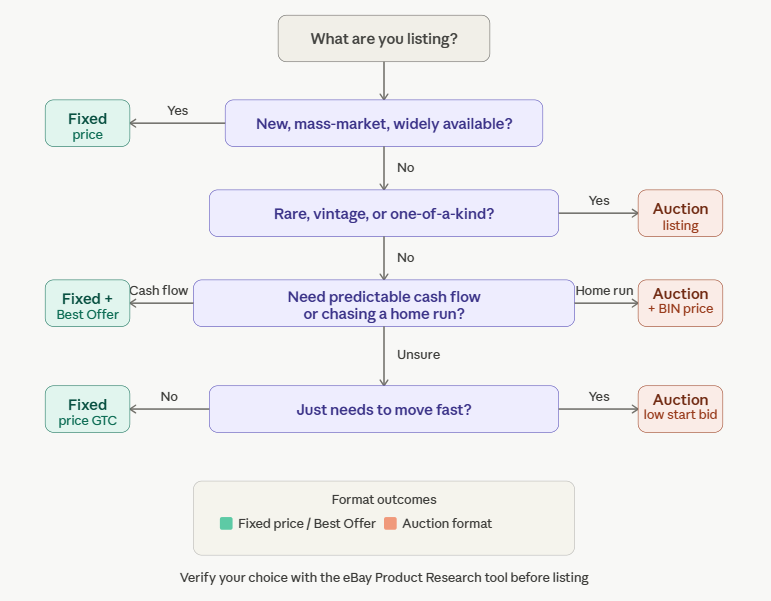
Work through these four questions in order:
1. Is the item new, mass-produced, and widely available?
→ Fixed price listing. Buyers know the market rate and want instant checkout.
2. Is the item rare, vintage, or one-of-a-kind?
→ Auction listing. Scarcity triggers emotional bidding and frequently a higher final price.
3. Do you need predictable cash flow, or are you chasing a home run?
→ Predictable cash flow = fixed price listing. Home run potential = auction listing.
4. Does the item just need to move fast?
→ Auction with a low starting bid. The countdown creates urgency even for reluctant buyers.
Quick data check before you decide:
Thirty seconds of research eliminates most format mistakes. Scan the eBay product research tool for three numbers:
-
Average sold price: stable or volatile across recent sales?
-
Total listings vs. units sold: how competitive is the current supply?
-
Sell-through rate: what percentage of listings actually converted into a sale?
Stable prices and high volume? Fixed price is safe. Wild price swings and thin supply? Auction can capture the upside.
What If the Best Answer to eBay Auction vs. Buy It Now Is Neither Alone?
Refusing to commit to a single format is sometimes the smartest play. eBay gives you two hybrid approaches that combine the strengths of both listing formats.
Strategy 1: Auction Listing with a Buy It Now Price
You run an auction but attach a fixed Buy It Now price. An impatient buyer skips the wait and pays immediately. Once the first bid lands, the Buy It Now option disappears unless you've set a reserve price.
How to use it:
-
Set your starting bid and your Buy It Now price on the same listing
-
Price the Buy It Now at least 30–40% above your starting bid this rewards patient bidders while giving the "I want it now" buyer a clean exit
-
Works best for items with uncertain value where you want a guaranteed price floor, and high-interest products where buyers may pay a premium to skip the competition
Strategy 2: Fixed Price Listing with Best Offer
A standard fixed price listing with the negotiation door left open. Buyers see your price but can submit a lower offer. You set a hidden minimum lowball offers that never reach you.
Why it converts:
· Preserves price stability while inviting active buyer engagement
· Buyers who need to feel they won a deal still complete the purchase
· Consistently lifts conversion rates in competitive categories where public price cuts would trigger a race to the bottom
How Do You Know Which Hybrid Fits Your Niche?
Both strategies look appealing in theory. The right one depends on buyer behavior inside your specific category. The eBay niche finder tool surfaces three signals:
-
Demand pattern: steady demand favors fixed price blends; irregular spikes favor auction hybrids
-
Competition density: crowded markets reward Best Offer; thin-supply markets reward Auction with Buy It Now
-
Growth trajectory: rising niches attract bargain hunters first, making hybrids particularly effective at the category's early stage
A quick scan before you list tells you which blend aligns with how buyers already behave in your segment before you commit a single listing to the wrong approach.
How Do eBay's Selling Fees Differ Between Auction and Fixed Price?
Strategy means nothing if fees eat the margin. Here's the breakdown, sourced directly from eBay's official selling fees page.
The two fees that apply to every listing:
1. Insertion fee (listing fee): Charged when you create a listing (auction or fixed price).
-
First 250 listings per month are free for most sellers across both formats
-
After that: $0.35 per listing (US); UK rates differ, check eBay UK's selling fees page
-
Store subscribers receive significantly more free listings monthly
2. Final value fee (commission): Charged only when an item sells. This shapes your real margin.
-
Calculated as a percentage of the total sale amount (item price + shipping), plus a flat $0.30 per order (US)
-
For most categories (US, no store or Starter Store): The Final Value Fee is 13.6% of the total transaction amount, plus a per-order fee of $0.30 for orders $10.00 or under, or $0.40 for orders over $10.00. Rates vary by category, books and media run higher at around 15.3%, while guitars and heavy equipment are lower. Sellers with a Basic Store subscription or above pay reduced rates. UK and other international rates differ, so always verify your specific category's rate through eBay's official fee schedule.
-
The rate is set by the item's category, not by your chosen listing format
Quick cost example (US, $100 item + $10 shipping, no store):
Final value fee: 13.6% of $110 = $14.96
Per‑order fee: $0.40 (order exceeds $10.00)
Total fee: $14.96 + $0.40 = $15.36
Where auction costs quietly creep up
The base fees are the same across both formats. But auction listings tempt sellers into extras that quietly compress margin:
-
Reserve price fee: If you set a hidden minimum to protect the item from selling too cheaply, eBay charges the greater of $5 or 7.5% of that reserve before the item even sells
-
Short duration surcharge: Running a 1- or 3-day auction costs an extra $1.00
A seller using both features on the same auction will pay meaningfully more than a fixed price seller moving the identical item.
One check that pays for itself:
Because final value fee percentages vary significantly by category from 3.5% for musical instruments to over 15% for clothing, checking your specific category rate before listing is non-negotiable. The eBay product research tool shows typical selling fees alongside pricing data, so you know your actual margin before you set the price.
How Does eBay's Cassini Algorithm Read Your Listing Format Choice?
Cassini is eBay's internal search engine. It matches buyers with listings most likely to result in a sale, and it reads your format signals directly. According to eBay's Seller Center guidance on Best Match and widely documented seller experience, three key signals shape how your format choice is interpreted:
-
Momentum: Fixed price GTC listings that sell consistently accumulate positive history with every transaction. Over time, this lifts search visibility steadily and sustainably one of the most underrated advantages of the fixed price format.
-
Freshness: Newly created auction listings receive a temporary visibility spike, as Cassini actively surfaces fresh opportunities. But if the auction ends unsold, that history vanishes. You reset to zero on the next listing.
-
Engagement: Views, watchers, and buyer questions signal to Cassini that an item is in demand. Auction listings generate these signals naturally as the clock counts down. Fixed price listings must earn them through strong titles, competitive pricing, and accurate item specifics.
In short: one format builds slowly and compounds. The other spikes fast and fades. Knowing which you're choosing, and why, is the difference between a strategy and a habit.
Which Tools Help You Nail Your eBay Listing Format Decision Before You List?
You've chosen your format. Now nail two things: visibility and competitive positioning.
Build a title that gets clicks
A weak title kills auction and fixed price listings equally. The eBay Title Builder tool feeds you keyword suggestions backed by real search volume so your title mirrors exactly what buyers’ type. Lead with the main keyword, add brand, model, and condition, and strip anything that doesn't serve the buyer's search. Strong titles earn higher click-through rates and signal relevance to Cassini from the moment the listing goes live.
Know what your competitors are winning with
Setting a price without checking the market is the fastest route to leaving money on the table. The eBay competitor analysis tool shows you what successful sellers in your niche are doing their top listings, formats, pricing patterns, and shipping setups. If competitors consistently win with fixed price and Best Offer, that's your data signal. If rare goods regularly close at auction above estimated value, follow the numbers. Five minutes of competitive research before listing pays off every single time.
Can You Really Test Every Format Decision for Less Than a Coffee?
Every format decision in this guide can be backed by real data before you list a single item. TS Scout gives UK and US eBay sellers product research, niche analysis, competitor intelligence, and a title builder all built specifically to remove the guesswork from every listing you create.
The sellers who consistently win on eBay aren't guessing their format. They're working from numbers. Every listing, every time.
Try the full suite for $1 for 14 days. That's less than the cost of one wrong listing decision and it takes 60 seconds to start.
Frequently Asked Questions
1. What is the main difference between eBay auction vs. Buy It Now listing formats?
A Buy It Now fixed price listing lets you set a firm price that buyers pay immediately. An auction listing opens the price to competition buyers bid and the highest offer wins when the timer ends. The right choice depends on whether your item has a known market value or benefits from competitive bidding to find its true price.
2. Can I change a fixed price listing to an auction listing later?
Yes, but you lose the accumulated sales history attached to that listing the moment you do. In most cases it's more effective to end the original listing and create a fresh one in the format you want particularly if the existing listing has meaningful sales history worth protecting.
3. What's the best day and time to end an eBay auction listing?
Sunday evenings consistently outperform other slots more buyers are actively browsing and willing to bid. Mid-week endings during working hours tend to underperform. UK-based sellers should factor in GMT/BST when scheduling endings aimed at US buyers.
4. Do auction listings still work for brand new items?
They can but only when the item is in short supply or experiencing a genuine demand spike. Most new, mass-produced items perform significantly better as a fixed price listing. The exception is limited-run or newly released products where demand briefly outpaces available supply.
5. How do I reduce non-paying bidders on auction listings?
Enable immediate payment requirements where eBay allows it. For standard auctions, use eBay's buyer requirement settings to automatically block users with a history of unpaid items or recent policy violations. This filters low-intent bidders before they reach your listing.
6. Is free shipping worth offering on eBay listings?
In most categories, yes. eBay's algorithm favors listings with free shipping, and buyers convert at higher rates when the total price is visible upfront. It's particularly effective on a fixed price listing in competitive categories: build the shipping cost into your item price and present it as free.
7. Should I use a reserve price on an eBay auction listing?
Only when the item's floor value genuinely needs protecting high-value collectibles, antiques, one-off items. For most sellers, reserve prices deter bidders and add a fee of the greater of $5 or 7.5% of the reserve. A carefully chosen starting bid typically achieves the same protection without the friction or the added cost.
like?


Table of Contents
- Does the 88% Fixed Price Listing Statistic Actually Tell You Where the Profit Is?
- eBay Auction vs. Buy It Now: What Does Each Listing Format Do to Your Margins?
- Is a Buy It Now Fixed Price Listing Right for Your Product?
- Is an Auction Listing Right for Your Product?
- Which eBay Listing Format Is Right for Your Item? Which format?
- What If the Best Answer to eBay Auction vs. Buy It Now Is Neither Alone?
- How Do You Know Which Hybrid Fits Your Niche?
- How Do eBay's Selling Fees Differ Between Auction and Fixed Price?
- Where auction costs quietly creep up
- How Does eBay's Cassini Algorithm Read Your Listing Format Choice?
- Which Tools Help You Nail Your eBay Listing Format Decision Before You List?
- Can You Really Test Every Format Decision for Less Than a Coffee?
- Frequently Asked Questions