
SEO for Shopify: The Complete Guide to Ranking Without Owning Inventory
- 2026-09-17
-
 0
0
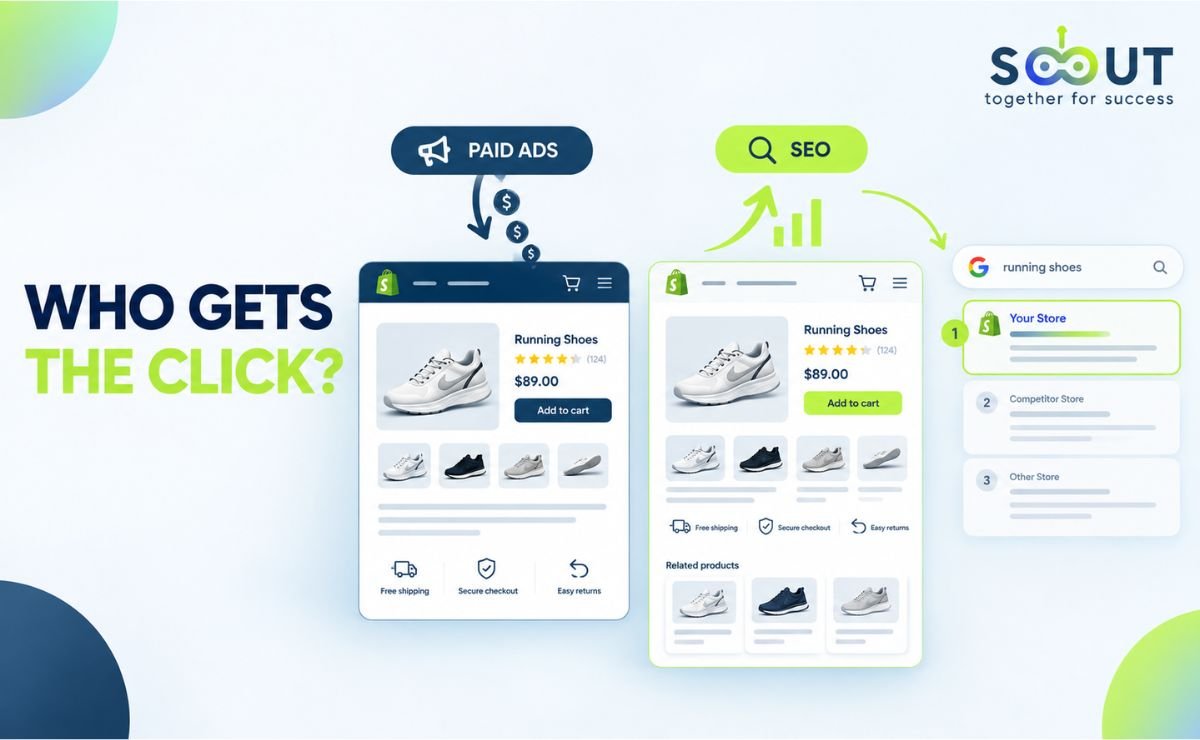
If you don't hold inventory, you're selling the exact same products as dozens of other stores on the exact same platform. Price wars eat your margin, and paid ads get more expensive every quarter. The one lever your competitors usually ignore is SEO for Shopify, and that gap is exactly where non-inventory sellers can win.
This guide walks through every layer of Shopify search engine optimization that actually moves the needle in 2026: keyword strategy, store architecture, technical fixes, content, and the newer AI-search layer that's starting to decide which stores get cited by tools like ChatGPT and Perplexity. None of it requires guesswork. Shopify already gives you a strong technical foundation, HTTPS, automatic sitemaps, and clean URLs are built in, but the platform stops there and leaves the rest to you. This shopify SEO guide follows the order most successful non-inventory stores actually work through, from the first keyword you target to the schema markup that helps you get cited by AI search tools. By the end, you'll know exactly where to start and what to fix first.
What Is Shopify SEO, and Why Does It Matter More for Dropshippers?
Shopify SEO is the practice of optimizing your store's content and technical structure so it ranks organically in search results, without paying for clicks. Per Shopify's own Help Center, ranking factors include the number of natural links pointing to your store, the authority your site has built over time, and how well your content matches what shoppers are actually searching for.
For a dropshipper or a non-inventory seller, this matters more than it does for a brand with exclusive products. You can't out-differentiate a competitor on the product itself if you're both sourcing from the same supplier, so the differentiation has to happen in your content, your site structure, and your search visibility. A store that ranks organically for "best [product] for [use case]" converts that traffic without paying a cent per click, which is the single biggest cost advantage available to a non-inventory business model.
Is Shopify Good for SEO, or Is It Actually Holding You Back?
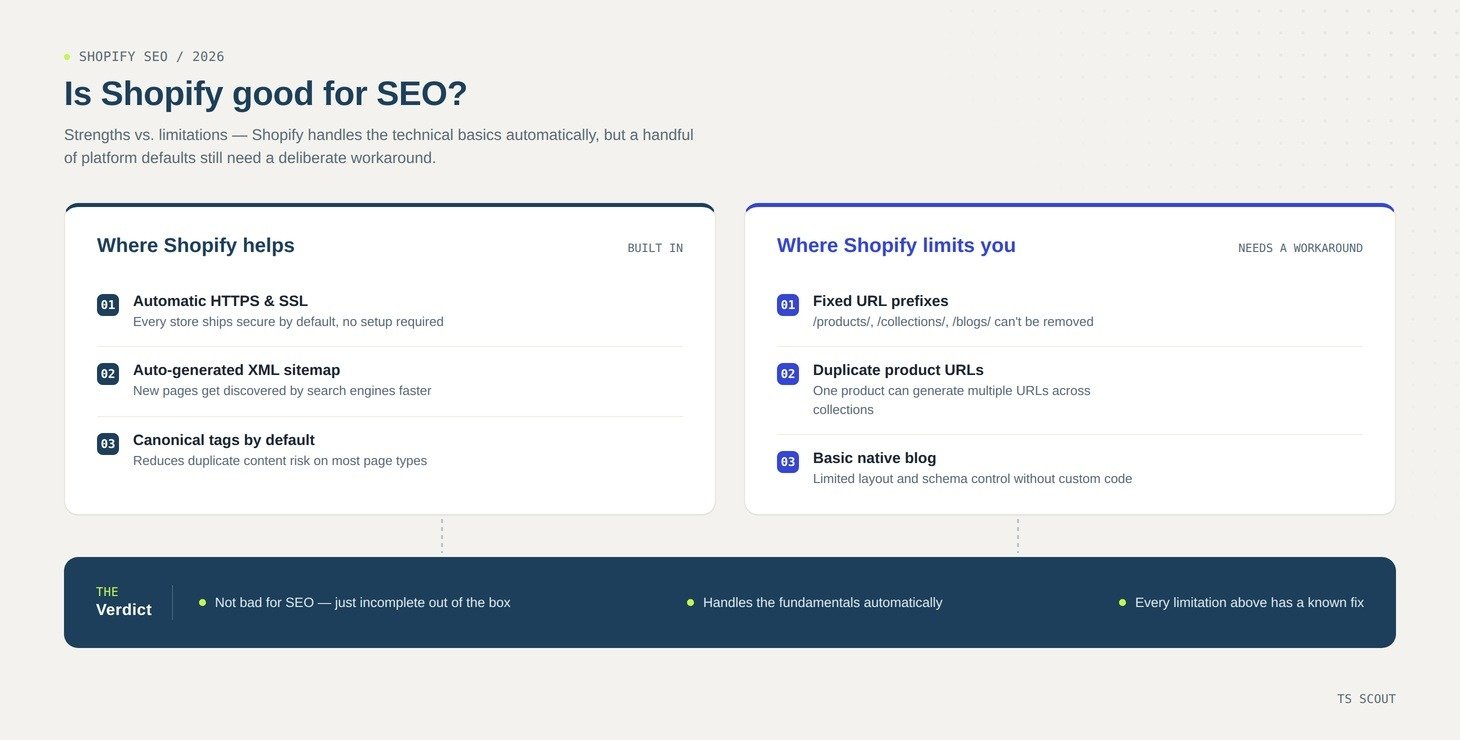
This question splits opinion constantly, and the honest answer is: it depends on what you compare it to. The direct answer to "is Shopify good for SEO" is yes, conditionally, the platform handles the fundamentals automatically, but it won't do the rest of the work for you.
|
Where Shopify helps |
Where Shopify limits you |
|
Automatic HTTPS and SSL on every store |
Fixed /products/, /collections/, /blogs/ URL prefixes you can't remove |
|
Auto-generated XML sitemap |
Can generate duplicate URLs for the same product across collections |
|
Mobile-responsive themes by default |
Native blog editor is basic, limited layout and schema control without custom code |
|
Canonical tags applied automatically on most pages |
Less flexibility than an open CMS for advanced structured data |
The platform doesn't block rankings. It simply makes several decisions for you, and those decisions matter more once a store scales past a small catalog. If you're asking "is Shopify bad for SEO" because you hit a specific wall, usually duplicate URLs or limited blog schema, the fix is almost always a workaround, not a platform switch.
How Do You Build a Keyword Strategy for Shopify SEO?
The right shopify SEO keywords aren't the ones with the highest search volume, they're the ones proven to actually convert for stores in your niche. Start by splitting every keyword into intent buckets:
-
Informational: "how to clean leather boots" (blog content)
-
Commercial: "best leather boots for winter" (comparison/buying guide)
-
Transactional: "buy leather chelsea boots" (product/collection page)
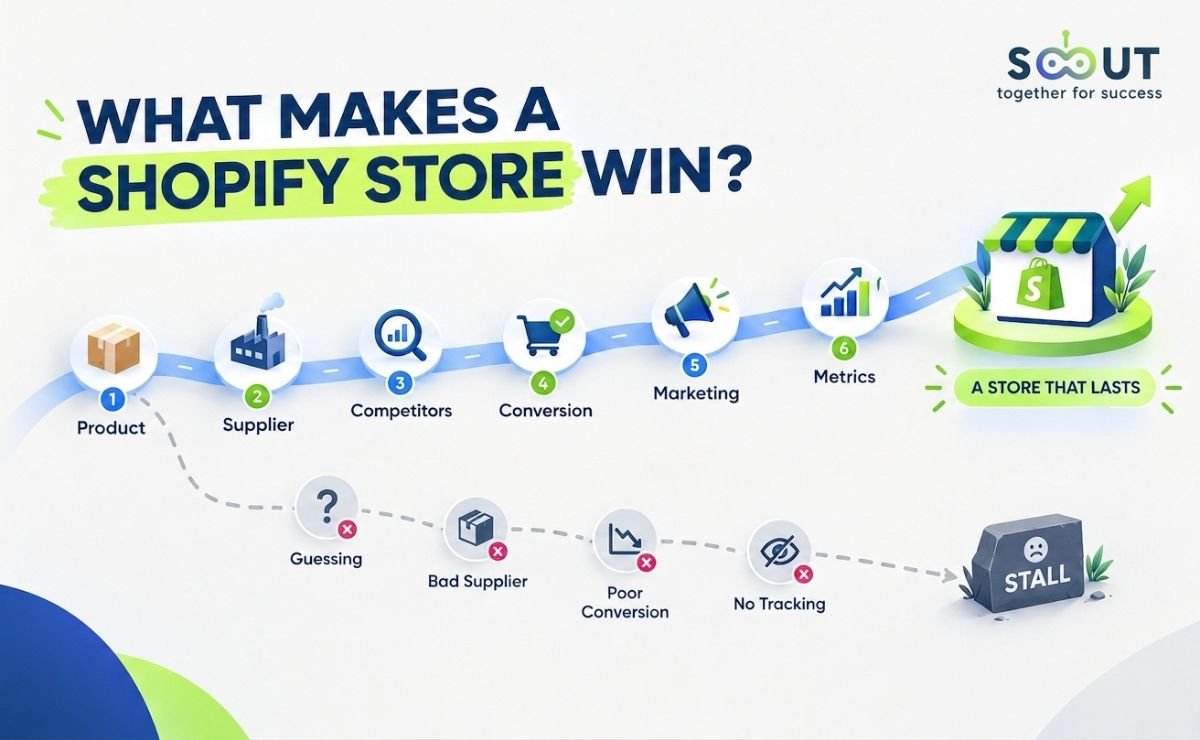
A free tool like Google Keyword Planner gives you search volume, but it can't tell you which keywords are actually converting into sales for stores in your niche right now. That's the gap TS Scout's Shopify Find Stores was built to close, it lets you pull up real, currently-active Shopify stores ranking and selling in your niche, so your keyword list is based on what's proven to work rather than what a volume tool guesses might work. Once you've got that list, map every keyword to one specific page on your site before you write a single word of content, a keyword with no assigned page never gets targeted content, and that's the single biggest reason keyword research doesn't turn into traffic.
How Should You Structure Your Store Architecture for SEO?
Search engines need a clean path from your homepage to every product. The standard structure that works is:
Home → Category collection → Sub-collection (if needed) → Product page
Every product should be reachable in three clicks or fewer from your homepage. Orphaned products, ones with no internal links pointing to them, rarely get indexed properly, let alone ranked. If you're starting from zero, our Shopify SEO Checklist for Beginners walks through the exact order to set this up before you touch anything else.
What Does Homepage SEO Look Like on Shopify?
Nailing homepage SEO Shopify basics starts with treating this page like any other, not the default theme template. Your homepage carries more authority than any other page on your store, so it deserves deliberate optimization.
-
Title tag: keep it under 55 characters, lead with your primary category, not just your brand name
-
Meta description: under 150 characters, written for click-through, not keyword-stuffing
-
One clear H1 that states what you sell and who it's for
-
Above-the-fold content that answers "what is this store" in under two seconds
-
Organization schema so search engines (and AI tools) know exactly who you are
Homepage SEO on Shopify is frequently skipped because merchants assume the homepage "just works." It doesn't, it's a page like any other, and it should be treated as your highest-value piece of real estate.
How Do You Optimize Product and Collection Pages So They Rank and Convert?
This is where most non-inventory stores lose the SEO battle before it starts. Publishing the manufacturer's product description means your page is identical to every other store selling that item Google has no reason to rank you over a competitor with more authority. That's the core of Shopify SEO optimization at the page level: giving search engines unique content they actually have a reason to prefer. Every high-revenue product deserves a rewritten description that answers real buyer questions instead of listing specs. Our guide on how to write Shopify product descriptions that rank and convert breaks down the exact framework for this, and it pairs directly with the broader approach in SEO for Shopify products.
Beyond the copy itself:
-
Write unique, descriptive alt text for every product image, not the filename Shopify auto-generates
-
Add Product structured data so search engines can display price, availability, and ratings directly in results
-
Give collection pages their own intro copy, a blank collection page with just a product grid is a missed content opportunity
What Does Shopify Technical SEO Involve in 2026?
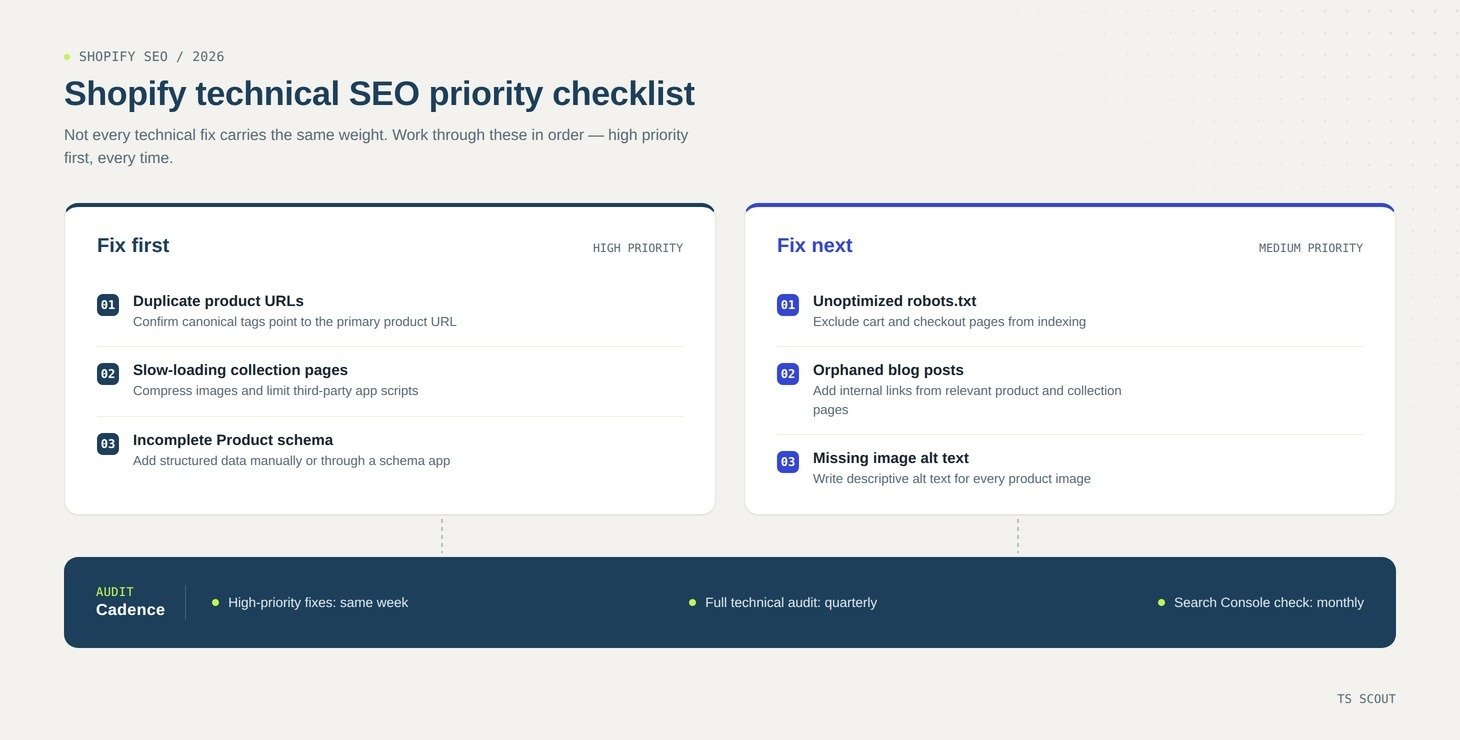
Technical SEO is the foundation everything else sits on. If search engines can't crawl and understand your store, no amount of content will save it.
|
Issue |
Fix |
Priority |
|
Duplicate product URLs across collections |
Confirm canonical tags point to the primary product URL |
High |
|
Slow-loading collection pages |
Compress images, limit third-party app scripts |
High |
|
Missing or incomplete Product schema |
Add structured data manually or via a schema app |
High |
|
Unoptimized robots.txt |
Review what's blocked; exclude cart/checkout pages from indexing |
Medium |
|
Orphaned blog posts |
Add internal links from relevant product/collection pages |
Medium |
Structured data deserves special attention in 2026. Google's own Search Central documentation confirms that adding product structured data lets your listings show price, availability, and review information directly in search results, which is exactly the kind of rich result that increases click-through rate without any additional ranking work. Shopify's default themes include basic Product schema, but it's frequently incomplete, so it's worth auditing manually rather than assuming the theme has it covered.
How Can You Analyze Competitor Shopify Stores to Find Real Content and Keyword Gaps?
Guessing what your competitors are doing wastes time you don't have. TS Scout's Shopify Competitors Research tool lets you look directly at what's working for competing stores in your niche, the collections driving traffic, the content formats they're publishing, the keywords they're ranking for that you haven't touched yet. This is a faster and more accurate starting point than manually browsing competitor sites, and it pairs well with the principles covered in our guide to ethical Shopify competitor research, which sets the boundary between smart benchmarking and copying.
Picture a non-inventory seller in the home fitness niche. Using Store Finder, they pull up five competitor stores that are actively ranking, then run each one's top collection pages through the Competitors Research Tool. What comes back is telling: none of the five have a buying guide comparing resistance band types by use caseو a commercial-intent keyword every one of them is leaving on the table. Publish that single guide, link it to the right collection page, and you've closed a gap none of your competitors even noticed.
How Do You Create Content That Actually Drives Organic Traffic to a Shopify Store?
If you've been searching for how to get organic traffic to your Shopify store without relying on paid ads, content is the answer, but only content mapped to real, validated intent. A 12-month content calendar built around buying guides, comparisons, and FAQs, each linking to at least one commercial page compound over time in a way paid traffic never does.
Geographic and niche-specific content is an underused lever here too. If you're targeting a specific market, a piece like our breakdown of Shopify eCommerce in the UK shows how localized content can capture search intent that generic global content misses entirely, the same logic applies to any region or vertical you're targeting.
Keep every piece of content mapped to a real, validated keyword rather than a topic you assume people search for, this is where the keyword work from Section 3 pays off directly.
What Are the Best Practices for Off-Page SEO and Link Building on Shopify?
On-page and technical SEO get you crawlable and rankable. Off-page SEO, links from other sites, is what tells Google your store is trustworthy enough to rank above competitors with similar content.
Practical ways to build this for a non-inventory store:
-
Encourage reviews on third-party platforms; many pass backlinks along with social proof
-
Pitch relevant journalists through outlets like HARO when your niche has a timely story
-
Partner with complementary (non-competing) brands on co-branded content
-
Get listed in legitimate, niche-relevant directories, not link farms
Off-page SEO is slower to show results than on-page fixes, which is exactly why starting it early matters more than perfecting it immediately.
How Is AI Search Changing Shopify SEO in 2026?
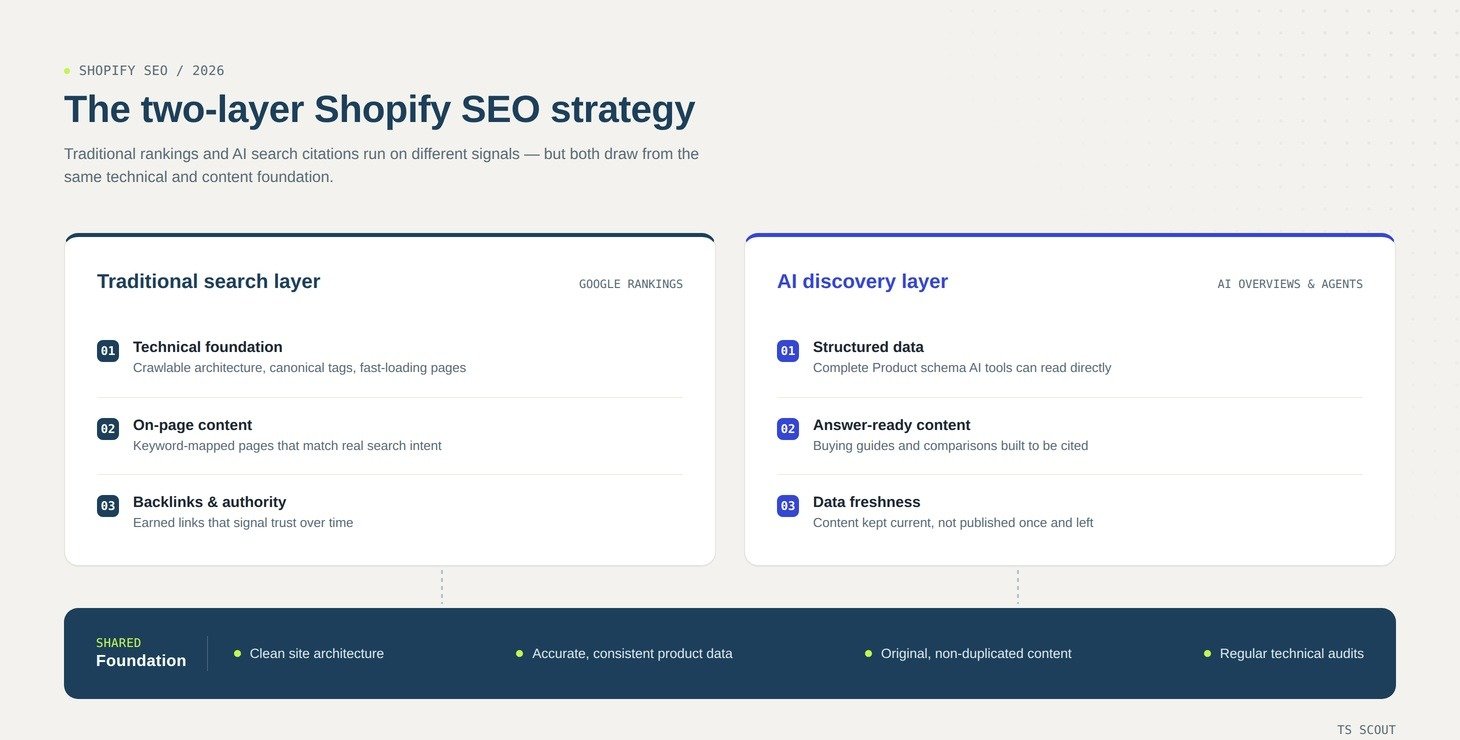
Shopify SEO in 2026 runs on two layers that reinforce each other. The traditional layer, technical foundation, on-page content, backlinks, still drives standard Google rankings. The newer layer is AI discoverability: shopping-focused AI tools increasingly pull answers directly from structured data rather than crawling a page the way a human would read it.
Practically, this means:
-
Complete, accurate Product schema is no longer optional polish, it's part of how AI tools decide what to cite
-
Buying guides and product comparisons tend to get cited by AI tools more often than generic product listings
-
Keeping content updated (not just published once and left alone) matters more for AI citation than it historically has for traditional rankings
What Are the Most Common Shopify SEO Mistakes Non-Inventory Sellers Make?
-
Publishing the same manufacturer description used by every other store selling the same product
-
Leaving collection pages with zero intro copy, just a product grid
-
Installing too many apps, which slows load times and hurts Core Web Vitals
-
Changing URL structure "for SEO" on an already-ranking store this frequently tanks traffic instead of improving it
-
Treating the blog as an afterthought instead of a mapped, intent-driven content engine
-
Skipping alt text on product images, which quietly costs both accessibility and image-search visibility
Each of these is fixable in an afternoon. None of them require a developer.
How Do You Measure Whether Your Shopify SEO Is Actually Working?
Consistent measurement is what separates real Shopify search engine optimization progress from vanity metrics.
|
Metric |
Where to check it |
What good looks like |
|
Organic sessions |
Google Search Console / Shopify Analytics |
Steady month-over-month growth, not spikes |
|
Keyword rankings for mapped pages |
Search Console Performance report |
Movement toward page 1 over 3–6 months |
|
Click-through rate |
Search Console Performance report |
Improves after title/meta updates |
|
Pages "Discovered, currently not indexed" |
Search Console Coverage report |
Trending toward zero |
Run a full audit at least quarterly, and check Search Console monthly in between. If you're not sure where to start this process, our Shopify SEO Checklist for Beginners lays out the setup in the order it should actually happen.
How Should Shopify SEO Priorities Change Based on Store Size and Budget?
Matching effort to the right stage is one of the most overlooked Shopify SEO best practices, a store with 20 products and no team should not be chasing the same priorities as a store with 2,000 SKUs and a content team.
-
Under 50 products: Fix technical foundations first (schema, canonical tags, homepage SEO), then focus content effort on 3–5 high-intent buying guides rather than spreading thin across dozens of topics
-
50–500 products: Prioritize collection page content and internal linking, this is where most stores at this size leave the most traffic unclaimed
-
500+ products: Off-page authority and AI-search schema consistency start mattering more, since technical and content basics are usually already handled
Getting this sequence wrong is the most common failure mode: spending months on link building before the technical foundation can even support the traffic it would bring.
Ready to Stop Guessing and Start Ranking Your Shopify Store?
This is what SEO for Shopify looks like when it's built on evidence instead of assumptions, real competitor keywords, real gaps, real proof of what's already ranking in your niche. That's exactly what TS Scout is built for. Try full access for $1 for 14 days and start building your Shopify SEO strategy on evidence, not guesswork.
FAQs
-
How long does Shopify SEO take to show results?
Most stores start seeing meaningful movement in 3–6 months, and it compounds from there, SEO is a slow start followed by accelerating returns, unlike paid ads which stop the moment you stop paying.
-
Do I need an SEO app, or can I do it manually on Shopify?
For a small catalog, most of this guide can be done manually inside Shopify's native settings. Apps become useful once you're managing schema or redirects at a scale that's too time-consuming to handle by hand.
-
Does changing my Shopify URL structure hurt my rankings?
Yes, frequently. If a URL structure is already generating traffic, changing it "for SEO" without proper redirects is one of the fastest ways to lose rankings you've already earned.
-
Can a dropshipping store rank as well as a store with exclusive products?
Yes, ranking is driven by content quality, technical health, and authority, not by whether you manufacture the product. Non-inventory stores that invest in original content routinely outrank brands that rely on manufacturer copy.
-
Is Shopify's native blog good enough for content marketing?
It's functional but basic, no advanced layout options and limited native schema control. For most stores, it's sufficient; only high-volume publishers tend to outgrow it.
-
How often should I run a full Shopify SEO audit?
At minimum quarterly, with lighter Search Console checks monthly so nothing slips for three months before you catch it.
-
Does Shopify support schema markup out of the box?
Partially. Most themes include basic Product schema, but it's often incomplete, and blog/article schema usually depends on your theme or a dedicated app rather than being handled automatically.
like?


Table of Contents
- What Is Shopify SEO, and Why Does It Matter More for Dropshippers?
- Is Shopify Good for SEO, or Is It Actually Holding You Back?
- How Do You Build a Keyword Strategy for Shopify SEO?
- How Should You Structure Your Store Architecture for SEO?
- What Does Homepage SEO Look Like on Shopify?
- How Do You Optimize Product and Collection Pages So They Rank and Convert?
- What Does Shopify Technical SEO Involve in 2026?
- How Can You Analyze Competitor Shopify Stores to Find Real Content and Keyword Gaps?
- How Do You Create Content That Actually Drives Organic Traffic to a Shopify Store?
- What Are the Best Practices for Off-Page SEO and Link Building on Shopify?
- How Is AI Search Changing Shopify SEO in 2026?
- What Are the Most Common Shopify SEO Mistakes Non-Inventory Sellers Make?
- How Do You Measure Whether Your Shopify SEO Is Actually Working?
- How Should Shopify SEO Priorities Change Based on Store Size and Budget?
- Ready to Stop Guessing and Start Ranking Your Shopify Store?
- FAQs