
Shopify Product SEO: Turn Every Product Page Into a Search Magnet
- 2026-09-20
-
 0
0
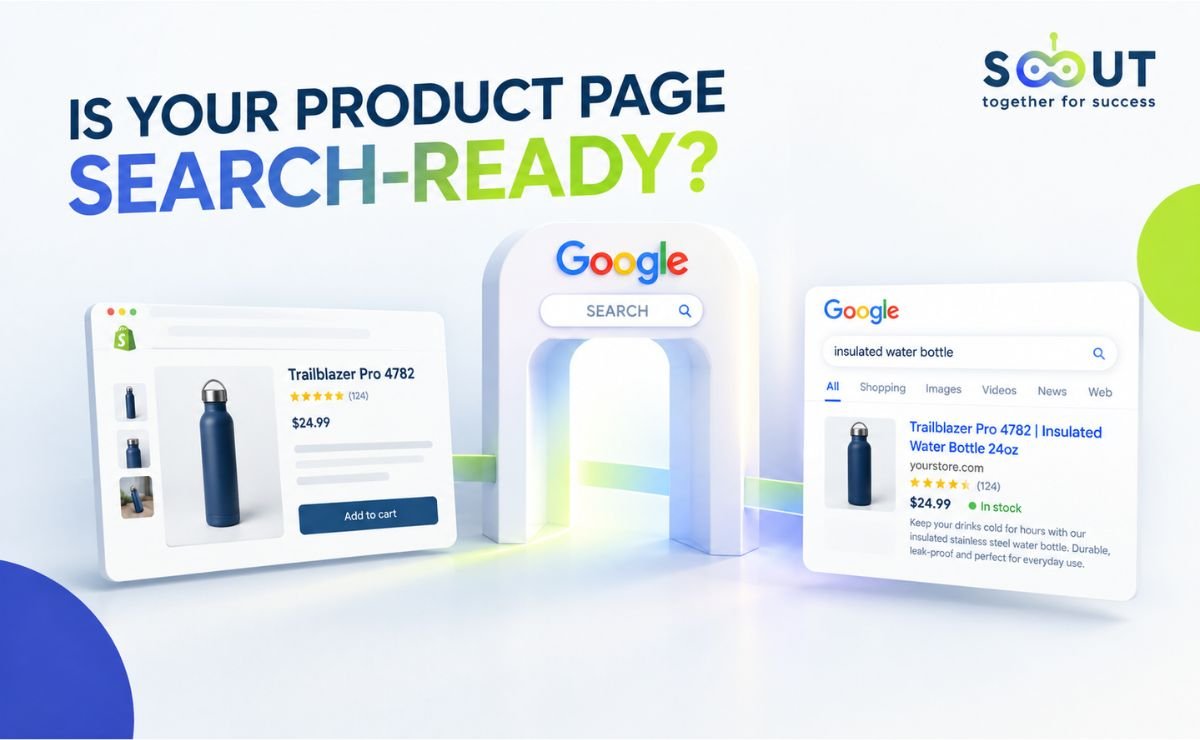
You built a good product. The photos are clean, the description is honest, the price is fair, and Google still won't send anyone to look at it. That's the quiet frustration behind most product seo shopify questions: the store looks fine, but the traffic never shows up, because product pages are judged by a different set of rules than blog posts or homepages. A product page has to prove relevance, trust, and technical health all at once, in front of a shopper who is often seconds away from buying, if the page gives them a reason to.
This guide breaks that process into the exact levers that move a Shopify product page from invisible to indexed, ranked, and clicked: titles, descriptions, metadata, schema, images, stock status, reviews, and the internal structure that ties it all together. Every section below answers one specific question a seller or an AI search engine would ask about that page, in the order a search engine actually evaluates them. By the end, the goal isn't just a page that ranks, it's one that converts the traffic it earns.
What Is Shopify Product Page SEO, and How Is It Different From General Shopify SEO?
General Shopify SEO covers the whole store: homepage structure, blog content, collection pages, site speed. Product page SEO is narrower and more transactional, it's about the exact page where a browser becomes a buyer. Someone searching "waterproof hiking boots men's size 10" isn't researching; they're one click from a decision, which is why a well-optimized product page tends to convert organic visitors far better than a blog post covering the same topic.
That distinction matters because product pages get judged on relevance to a specific query, not general authority. If you're just getting your SEO foundation in place, the broader Shopify SEO Checklist for Beginners is worth reading alongside this guide,but this one stays focused on the page where the sale actually happens.
What Should a Fully Optimized Shopify Product Title Include?
Shopify appends your store name to every product title by default, which can push your actual keyword past the point search engines display in results. Shopify's own SEO documentation confirms that the platform uses the product's page title as its H1 tag automatically for products created through Shopify, which is exactly why that title needs to carry the real keyword, not a generic label.
What Does a Strong Product Title Actually Look Like?
-
Leads with the specific product name and primary attribute (material, size, color, model)
-
Includes the exact phrase a buyer would type, not a marketing tagline
-
Stays under roughly 60 characters before the store name gets appended
-
Matches the H1 exactly, since Shopify's own SEO documentation confirms this is the platform default
"Men's Waterproof Hiking Boots, Size 10" will outperform "Trailblazer Pro 4782" every time, because it answers the query instead of the internal SKU system.
How Do You Write Shopify Product Descriptions That Actually Rank?
Copy-pasting the manufacturer's spec sheet is the single most common reason product descriptions never rank, it's the same text sitting on dozens of other stores, so Google has no reason to prefer yours. Write Shopify Product Descriptions That Rank and Convert goes deeper into this, but the core rule is simple: write for the person reading it first, and let the keyword, including seo for shopify products phrasing, appear naturally inside real sentences, not a bolted-on keyword list.
What Does a Description That Ranks Do Differently From a Spec Sheet?
-
Opens with the specific problem the product solves, not a generic feature list
-
Answers the two or three questions buyers ask before purchasing this exact item (fit, durability, use case)
-
Uses scannable formatting, short paragraphs, a bullet list for specs, instead of one dense block
Quick example: A seller listing a stainless-steel water bottle switched from a manufacturer's copy-pasted spec block to a description built around one specific use case, "stays cold on 6-hour hikes", with the same specs moved into a bullet list underneath. No other page-level changes were made. Within a few weeks, the page started ranking for long-tail searches it had never appeared for, simply because the content finally answered a real question instead of repeating a spec sheet identical to a dozen competing listings.
What Metadata and URL Structure Should Every Product Page Have?
Shopify generates meta titles and descriptions automatically from the product title and description, but the defaults are rarely optimized for search intent. Shopify's SEO guide recommends keeping titles under roughly 55 characters and meta descriptions under 150, so neither gets truncated on the results page.
|
Element |
Best practice |
|
Meta title |
Under 55–60 characters, primary keyword near the front |
|
Meta description |
Under 150 characters, written to earn the click, not just to include a keyword |
|
URL slug |
Short, keyword-relevant, no auto-generated numbers or dates |
|
Canonical URL |
Should point to /products/[handle], never a collection-nested path |
Getting this right is foundational to product seo shopify work, it's the layer search engines read before they ever reach your description, and it's usually the cheapest fix on this entire list.
Why Do Shopify Product Variants Create Duplicate Content, and How Do You Fix It?
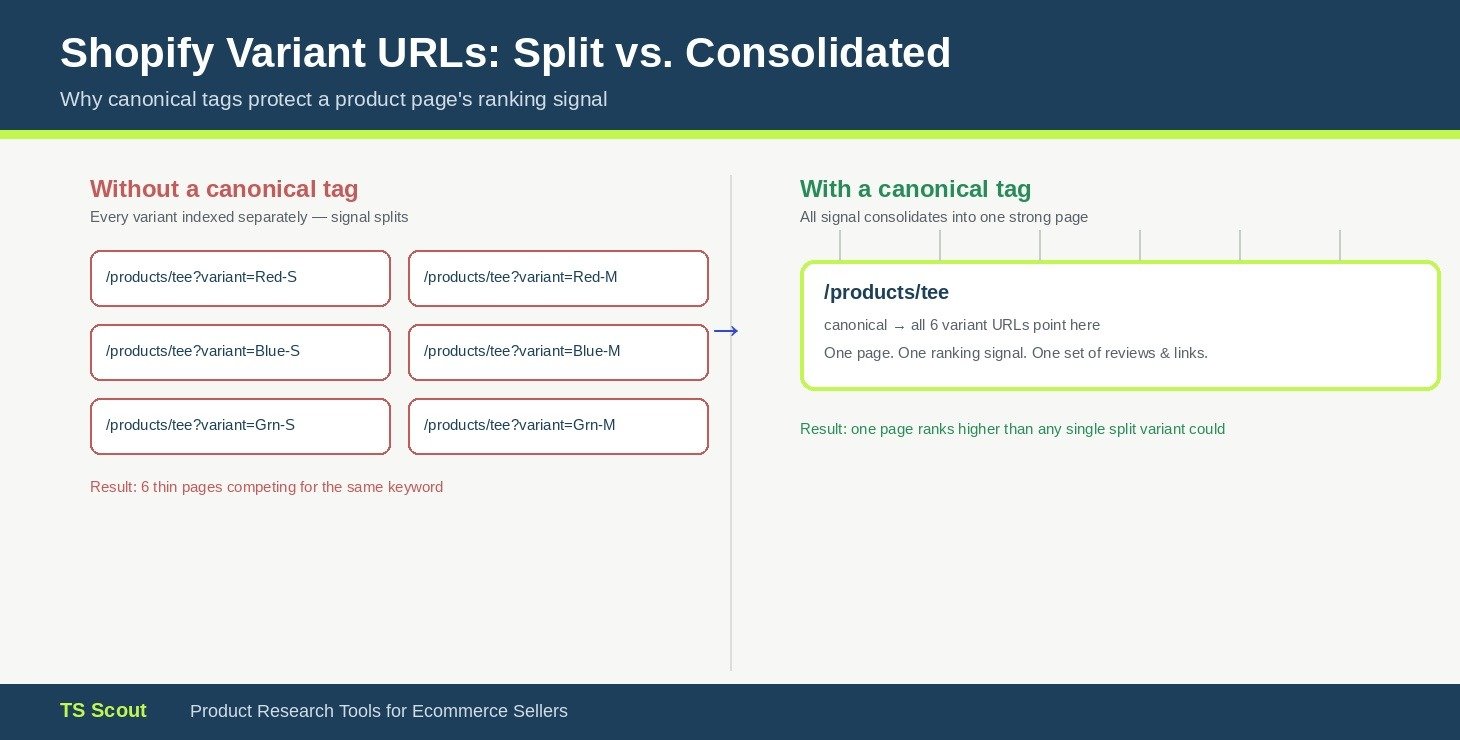
Every color or size selection on a Shopify product page can generate its own URL tagged with a ?variant= parameter. A shirt with 5 sizes and 8 colors can quietly produce 40 near-identical URLs, and if search engines index them separately, your ranking signals split across pages that are all competing with each other instead of building one strong page.
Shopify's default theme behavior points every variant URL back to the base product page through an automatic canonical tag, which is the correct setup for most stores and prevents this from becoming a duplicate content problem, worth double-checking on customized or heavily modified themes, since manual edits can override it. The exception: if one specific variant (say, a color) has real standalone search demand and enough unique content to justify it, that's when a separate product page makes sense, not for cosmetic size differences.
Quick example: A store selling a jacket in 6 colors had every color indexed as a separate product page with identical copy, splitting its ranking signal six ways. Consolidating them into one product with variant selectors, keeping only the one color with genuinely distinct search demand as its own listing, let the remaining page absorb the combined signal and outrank where any single color page had been sitting before.
What Structured Data Should a Shopify Product Page Have Right Now?
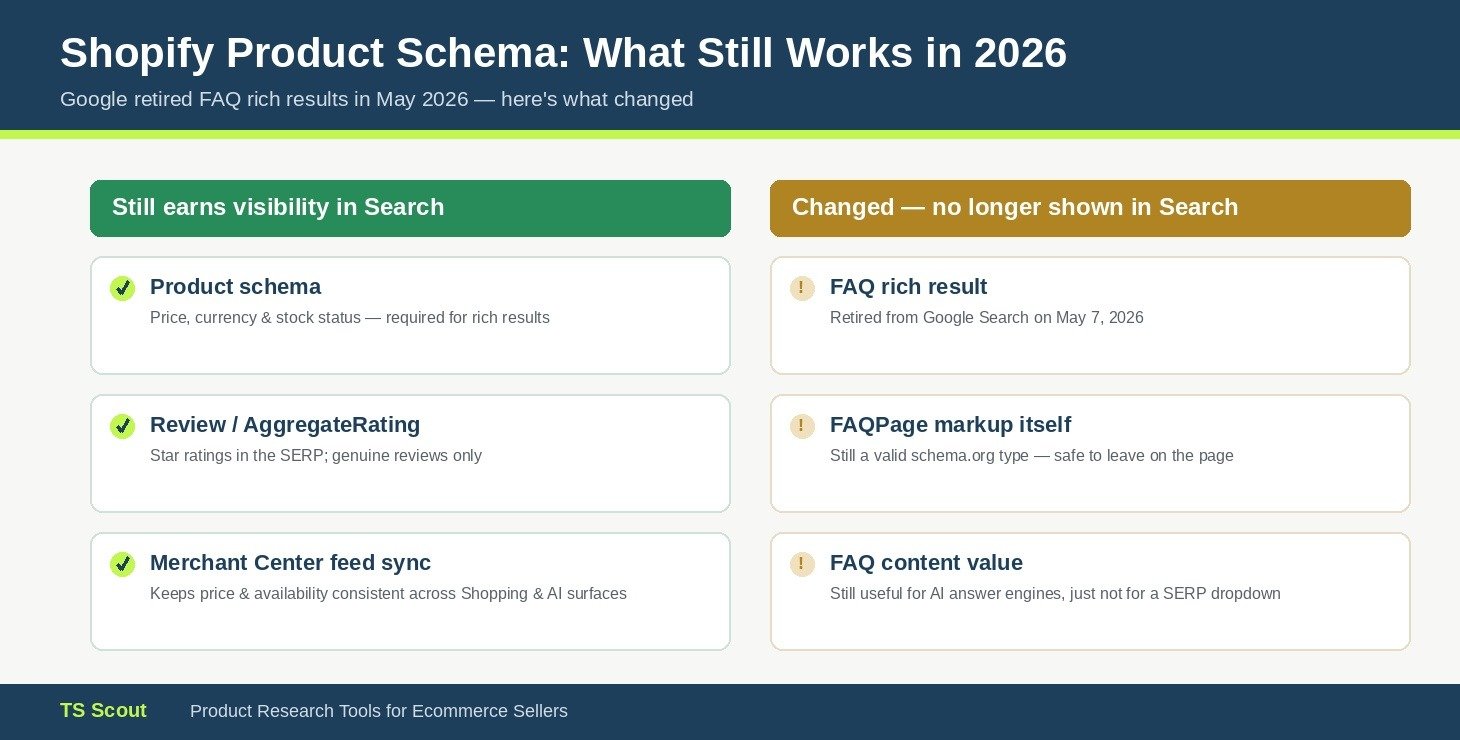
Product schema, price, availability, and review data marked up in a format search engines can parse directly, is what unlocks rich results like star ratings and price display in the SERP, and it's increasingly what AI-driven search answers pull from to decide which product to cite. One update worth knowing: Google's own structured data documentation confirms that FAQ rich results stopped appearing in Google Search as of May 2026, though the FAQPage schema type itself remains valid and can still be left in place without causing issues. In practice, that means FAQ content on a product page should be written for the reader and for AI answer engines, not chased as a rich-snippet tactic.
Which Schema Elements Should You Prioritize First?
-
Product schema with accurate price, currency, and stock status fields
-
Review/AggregateRating schema, pulled from genuine customer reviews only
Shopify stores connected through the built-in Google & YouTube sales channel can also sync their product feed directly into Google Merchant Center, which keeps price and availability data consistent across organic results, Shopping listings, and AI shopping surfaces — one setup step that pays off across several channels at once.
How Do Product Images and Alt Text Affect Product Page SEO?
Product images do double duty: they're a ranking factor through Google Images and page speed, and they're a conversion factor because shoppers decide fast on what they see first. Shopify serves WebP automatically to supporting browsers, but oversized source images still slow the page down before that optimization kicks in.
What Should You Check on Every Product Image?
-
Compress before upload rather than relying only on Shopify's automatic conversion
-
Write alt text that describes the actual product, with the keyword appearing only where it fits naturally, never a repeated keyword string across every image
-
Add at least one image showing the product in use, not just on a plain background, since it helps both conversion and dwell time
How Should You Handle Out-of-Stock Products Without Losing SEO Value?
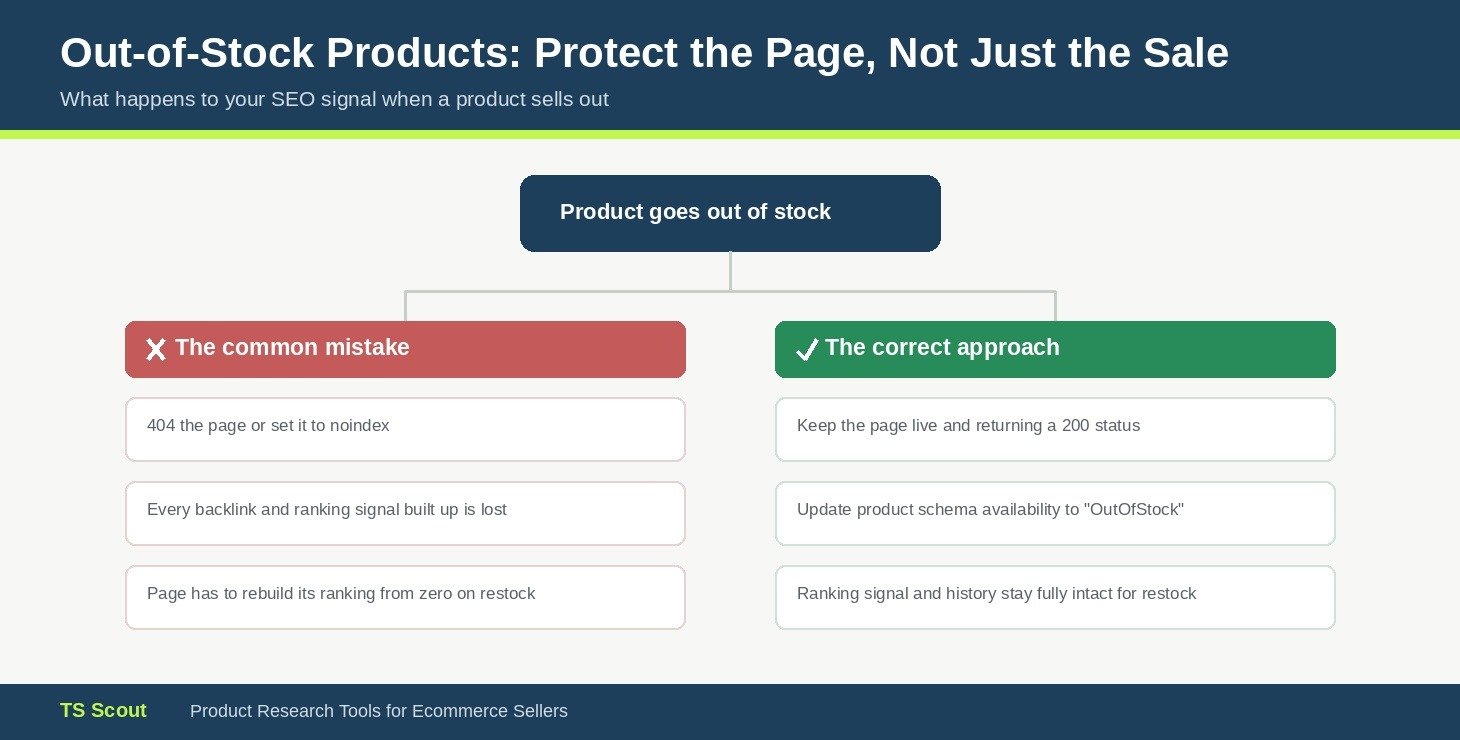
This is the mistake that quietly costs sellers the most: taking down a page or setting it to noindex the moment stock runs out. That erases every ranking signal the page has built, and you rebuild from zero when stock returns.
The correct approach: keep the page live, return a normal 200 status, and update the product schema's availability field to "OutOfStock" instead of removing or hiding the page. For sellers restocking regularly, a common reality for non-stockholding sellers, this single habit protects months of ranking progress that a 404 or noindex tag would otherwise throw away.
Do Reviews and User-Generated Content Improve Product Page Rankings?
Reviews serve three functions at once on a product page: they build trust for the shopper, they add unique, page-specific content search engines can't find anywhere else, and they feed the review schema markup covered above. A product page with genuine reviews reads as more credible to both a human visitor and a search algorithm, which is a core piece of Google's E-E-A-T evaluation for commercial pages.
The one rule that matters here: reviews have to be real customer submissions, never written in-house. Fabricated review content is both a trust risk and, if discovered, a policy risk for the schema markup itself.
Should You Display Your Return Policy on the Product Page?
A visible, specific return policy directly on the product page, not buried in a separate footer link measurably reduces hesitation at the exact moment a shopper is deciding whether to buy. The Shopify Return Policy Gap covers where most stores get this wrong, but the SEO angle is straightforward: pages that keep visitors engaged instead of bouncing back to search results send a positive signal, and a return policy is one of the fastest ways to earn that extra time on page.
How Can Competitor Research Help You Build a Stronger Product Page?
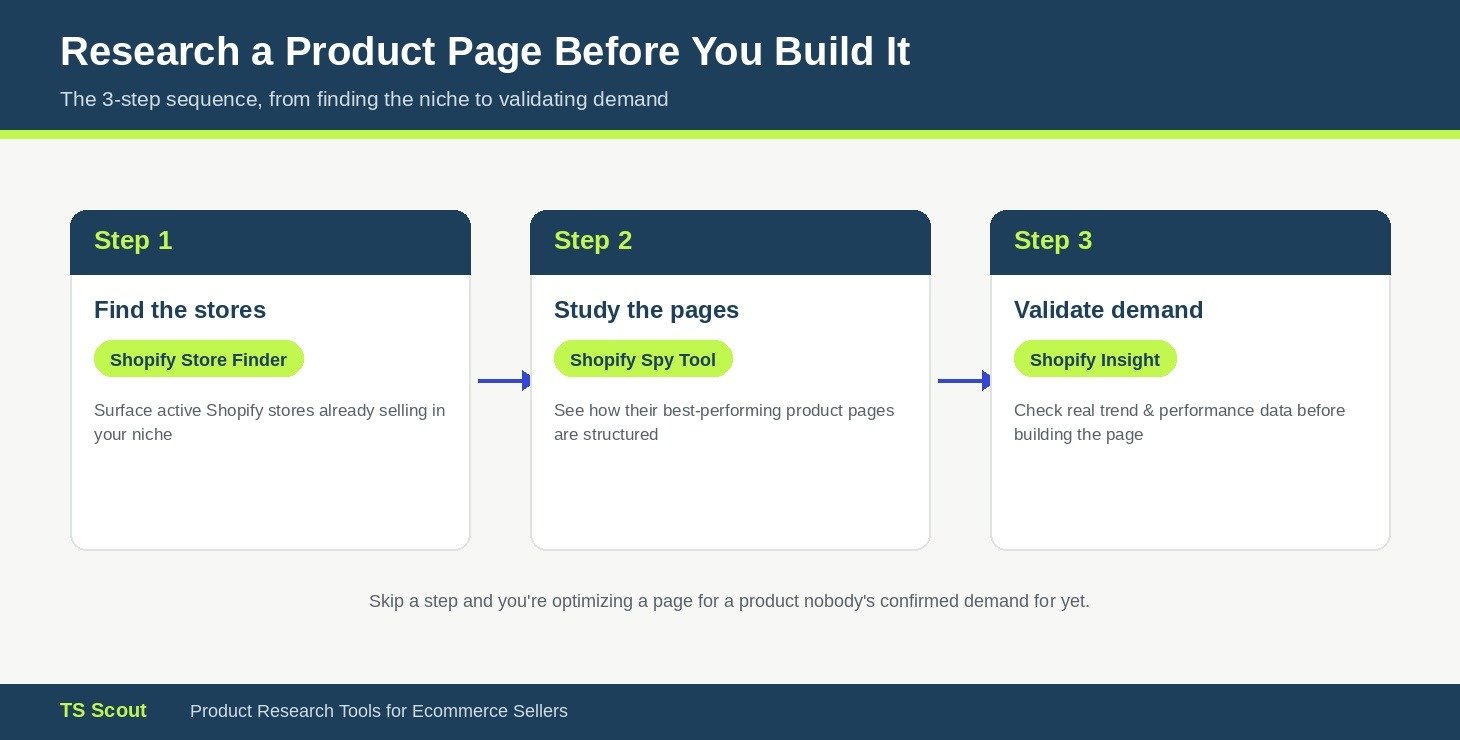
The fastest way to know what a winning product page in your niche actually looks like isn't guessing, it's studying the pages already ranking and converting for the same query. Ethical Shopify Competitor Research lays out the framework for doing this without stepping into gray areas.
Manually digging through competitor stores one by one, though, doesn't scale past a handful of examples. This is exactly the gap the Shopify Find Stores was built to close, it surfaces active Shopify stores selling in your niche in seconds, instead of hours of manual searching. Once you've identified the stores worth studying, the Shopify Competitors Research tool shows how their best-performing product pages are actually structured, pricing, positioning, and product angles, which turns competitor research from a vague browsing session into a repeatable, data-backed step in your content process.
Which Type of Shopify Product Ranks Best for SEO?
Not every product deserves the same SEO investment, and this is where best shopify product for seo as a question actually gets interesting: the products worth optimizing fully are the ones with staying power, not this season's trend. An evergreen product, something with steady, non-seasonal demand, earns back the time spent on titles, schema, and content because the page keeps ranking and converting for years instead of one quarter.
Some Evergreen Product Categories, home organization, basic apparel, pet supplies, everyday accessories, consistently hold demand better than trend-driven inventory, which is exactly why they're worth the extra hour spent on a product page instead of a bare-minimum listing. Before committing that hour, though, it's worth checking Shopify Insight for actual demand data on the category rather than assuming steady demand from instinct alone, the same tool covered in more depth further down.
Are High-Ticket or Digital Products Better for Long-Term SEO?
Both can work, but they earn their ranking differently. Evergreen High-Ticket Product Ideas tend to attract fewer but higher-intent searches, buyers who research heavily before purchasing, which rewards a page with detailed specs, comparison content, and trust signals like reviews. Evergreen Digital Product Ideas for 2026, by contrast, often compete on search volume with lower purchase friction, so page speed and a frictionless path to checkout matter more than long-form persuasion.
Neither category is automatically "better", the right pick depends on whether your store's strength is trust-building content or fast, high-volume conversion.
How Do You Validate a Product Before Fully Optimizing Its Page?
Building a complete SEO-optimized product page, schema, custom photography, long-form description, review generation — takes real time. Doing that for a product that turns out to have no real demand is wasted effort, which is why validation has to come before optimization, not after.
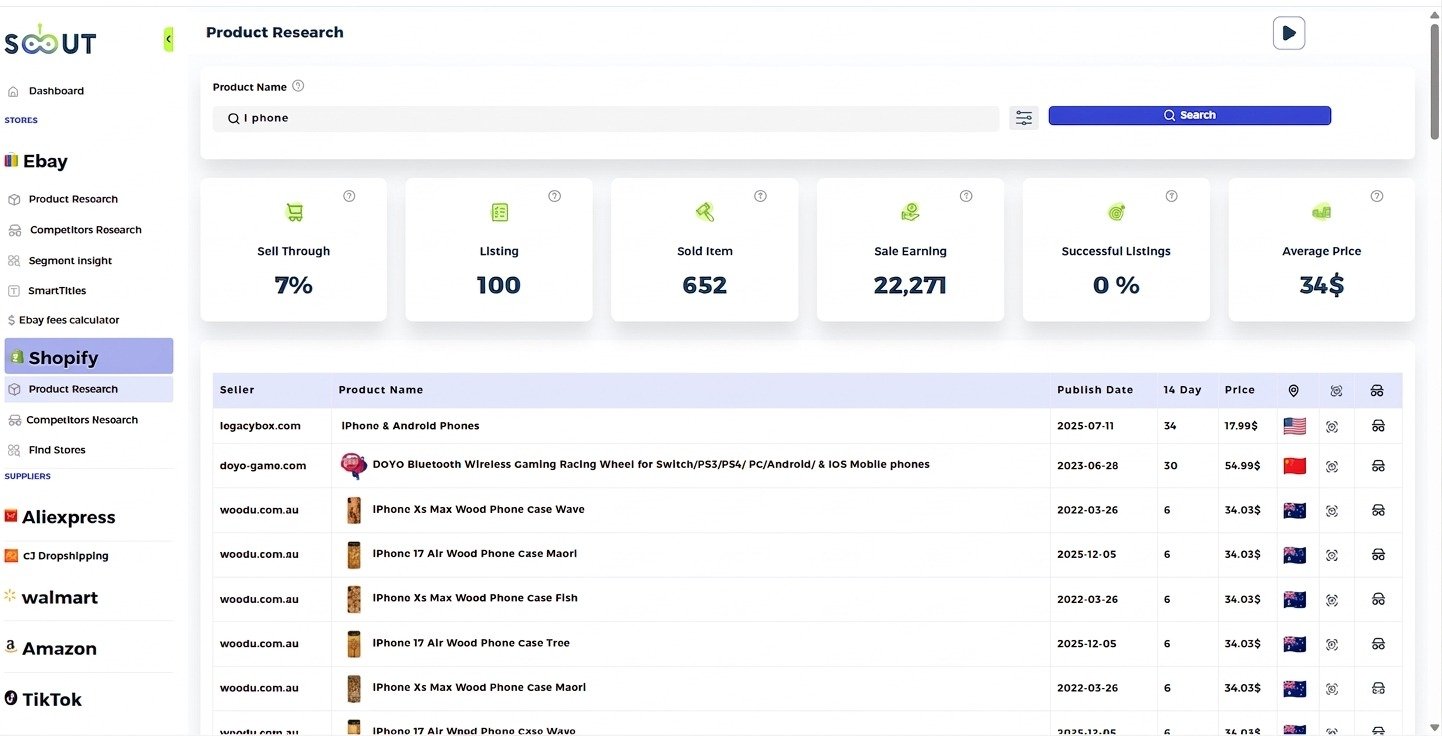
Test an Evergreen Product walks through this staged approach, and the science of product research covers the data side of why some products hold demand and others don't. This is also where the Shopify Insight tool earns its place in the process, instead of guessing at demand from gut feel, it gives sellers actual trend and performance data on a product before they commit hours to building out its page, which is a more reliable starting point than relying on a store's own limited sales history.
How Do Breadcrumbs and Internal Links Strengthen a Product Page?
Breadcrumb navigation does two jobs at once: it shows a shopper exactly where they are in your store's hierarchy, and it hands search engines a clear signal of how that product fits into your broader catalog both of which tend to reduce bounce rate. A product page with no breadcrumb trail and no inbound internal links is effectively an island; search engines have a harder time understanding its context, and shoppers have no easy path back to browse similar items.
The fix is simple and often overlooked: link to product pages from relevant blog content and collection pages using descriptive, keyword-relevant anchor text, not "click here", and make sure your theme's breadcrumb trail reflects the real collection hierarchy rather than a generic "Home > Products" path.
Ready to Turn Your Product Pages Into Your Best-Converting Asset?
None of this works as a one-time fix, it's a sequence: a title and description that match intent, metadata and schema that let search engines read the page correctly, images and stock handling that protect what you've built, and internal links that tie the page into the rest of your store. Get those layers right on even your top ten products, and you'll feel the difference in organic traffic before you touch the eleventh.
Start with the product research side, since it decides everything downstream: try TS Scout for $1 and get full access to every tool for 14 days.
FAQS
-
What is Shopify product page SEO?
It's the set of practices, titles, descriptions, schema, images, and technical fixes, that help a specific product page rank for the exact terms a buyer searches, as opposed to optimizing the store as a whole.
-
How long does it take a Shopify product page to rank?
It varies by competition and domain history, but most sellers start seeing meaningful movement within a few months of consistent on-page and technical fixes, not overnight.
-
Do product variants hurt Shopify SEO?
Only when variant URLs get indexed separately instead of canonicalizing back to the base product page, which Shopify's default theme setup handles automatically in most cases.
-
Which type of Shopify product ranks best for SEO long-term?
Evergreen products with steady, non-seasonal demand tend to earn back the time invested in full page optimization better than trend-driven items.
-
Should I write a unique meta description for every product?
Yes, a default or duplicated meta description gives search engines no reason to prefer that specific page over a near-identical one elsewhere on your site.
-
Does Shopify product page SEO also help with AI search results?
Yes. Clear structured data, complete answers to buyer questions, and genuine reviews are the same signals AI-driven search features pull from when deciding which product to surface.
-
Can I use AI to write product descriptions without hurting SEO?
It can speed up a first draft, but descriptions still need to be edited into unique, specific copy — generic AI output that reads like every other store's description won't outrank pages built around real product detail.
like?


Table of Contents
- What Is Shopify Product Page SEO, and How Is It Different From General Shopify SEO?
- What Should a Fully Optimized Shopify Product Title Include?
- How Do You Write Shopify Product Descriptions That Actually Rank?
- What Metadata and URL Structure Should Every Product Page Have?
- Why Do Shopify Product Variants Create Duplicate Content, and How Do You Fix It?
- What Structured Data Should a Shopify Product Page Have Right Now?
- How Do Product Images and Alt Text Affect Product Page SEO?
- How Should You Handle Out-of-Stock Products Without Losing SEO Value?
- Do Reviews and User-Generated Content Improve Product Page Rankings?
- Should You Display Your Return Policy on the Product Page?
- How Can Competitor Research Help You Build a Stronger Product Page?
- Which Type of Shopify Product Ranks Best for SEO?
- Are High-Ticket or Digital Products Better for Long-Term SEO?
- How Do You Validate a Product Before Fully Optimizing Its Page?
- How Do Breadcrumbs and Internal Links Strengthen a Product Page?
- Ready to Turn Your Product Pages Into Your Best-Converting Asset?
- FAQS