

Christmas Dropshipping Suppliers: Who Actually Delivers Before December 25?
- 2026-11-01
-
 0

You pick a Christmas product, find a supplier with decent reviews, and list it in October. Orders start rolling in around Black Friday, the supplier ships them, and customers open their gifts on December 25. That is the version most sellers plan for.
Then the first “where is my order?” email lands. Your customer never sees your supplier, so the delivery date is your promise, not theirs. A late parcel in December is not just a bad review; it is a refund on a gift that has already lost its purpose.
So which Christmas dropshipping suppliers will actually get the parcel there in time, and what do they cost you once everything is counted?
This guide compares the main Christmas dropshipping suppliers, shows which ones are genuinely free, and gives you a way to calculate your last order date instead of guessing. It also follows one real product from first search to final cost, so you can see how your supplier choice moves your net profit. If you are still choosing what to sell, start with Christmas Dropshipping Products.
What Are Christmas Dropshipping Suppliers, and Why Does Your Choice Decide in December?
Christmas dropshipping suppliers are the companies that hold, pack and ship the seasonal products your store sells, so you never touch stock. For most of the year, a slow supplier costs you a few complaints. In December, the supplier’s shipping origin and handling speed decide whether an order becomes a sale or a refund.
Suppliers fall into three types, and each one trades speed against cost differently.
Is a Direct-from-China Marketplace Fast Enough for Christmas?
AliExpress is the best-known example: a very wide range of seasonal products and no subscription fee. Speed depends on the shipping method you pick. Its Choice programme works closely with Cainiao logistics, and Alibaba Group describes delivery guarantees in selected countries. That list changes over time, so check whether your market is covered.
If you are weighing it against other cheap marketplaces, the AliExpress vs Temu comparison shows how the two models differ.
What Changes When a China Agent Has Overseas Warehouses?
CJdropshipping sells products from China but also stocks them in warehouses abroad. According to CJdropshipping’s fee page, those include Germany, the UK, Poland and the US. Your product travels in bulk first, then ships locally, which shortens the last leg.
The trade-off is timing and cash. You move stock in advance, and that stock has to land before December gets busy.
Are Regional Suppliers Worth the Higher Price?
Regional suppliers ship from inside or near your customer’s market. Spocket, for example, works with US and EU suppliers, and regional hubs such as Avasam in the UK and Dropshipzone in Australia serve their home markets. Shorter distance means fewer surprises, but the base price is usually higher and some charge a subscription.
That makes them a strong fit for last-minute orders, as long as the supplier actually ships to your customer’s country. Confirm that before you list anything.
Now that you know the three supplier types, let’s compare the ones worth your time.
Who Are the Best Christmas Dropshipping Suppliers for Time, Shipping and Product Selection?
We compared suppliers on three things: the delivery information the platform itself publishes, how it charges, and how well it covers seasonal products. We did not rank by reviews alone, because reviews don’t tell you whether a parcel arrives before a hard deadline.
|
Supplier |
Ships from |
Delivery signal |
Cost model |
Best for |
Watch out |
|
AliExpress (incl. Choice) |
China |
Estimated delivery on the listing; Choice guarantee in selected markets |
No subscription |
Widest range, lowest cost |
Peak-season slowdowns; no single Christmas cutoff |
|
CJdropshipping |
China, plus Germany, UK, Poland and US warehouses |
Air stock transfer to Europe about 12–18 days (reference) |
Per-service fees, no subscription listed |
Pre-stocking hero products |
Stock must land weeks earlier |
|
Spocket |
US and EU suppliers |
Supplier-specific |
39.99–299.99 per month |
Faster EU delivery |
Subscription cost |
|
Zendrop (US suppliers) |
US-based partners, plus China fulfilment |
Supplier-specific; US suppliers ship within the US only |
Free plan is browse-only; paid plans from $29 per month (usage-based billing) |
Fast domestic delivery for US customers |
US-only shipping; processing can take up to 5 business days at peak |
|
Printful (print-on-demand) |
Own facilities in the US, Spain, Latvia and other regions |
Production time plus carrier transit; publishes its own holiday order-by dates |
$0 Free plan; Growth plan $24.99 per month |
Personalised Christmas products |
Earlier cutoffs than stocked items; $0.40 holiday surcharge on US-bound orders |
|
Regional hubs (UK, AU) |
Local |
Confirm each hub’s own cutoff |
Varies |
Last-minute local fulfilment |
Confirm they ship to your market |
Is AliExpress Still Worth It for Christmas Orders?
Yes, if you work backwards from its delivery estimates and not from the best case. It gives the widest range at the lowest cost, which matters for testing several Christmas products cheaply. The risk is Q4 congestion, and Choice commitments vary by country and by listing, so read the delivery panel on every product you plan to sell.
When Does CJdropshipping Beat Shipping Direct From China?
When you can move stock early. CJdropshipping’s fee page shows air transfer to European warehouses at roughly 12–18 days and sea transfer at roughly 45–65 days, so sea freight is too slow for Christmas. The page lists reference rates that change in real time, so check the live figure before you commit.
Is Spocket Worth Its Monthly Fee?
It can be, if your customers are in the EU and you want shorter delivery. Spocket’s pricing page lists four plans from $39.99 to $299.99 per month, with a free trial. Do not assume the cheapest plan unlocks every supplier; the page does not say.
Do Regional Hubs Solve the Last-Minute Problem?
Often, yes, because local dispatch removes most of the transit risk. The catch is their own holiday cutoffs, which differ from hub to hub and are usually set well before Christmas. Ask for the written cutoff before you list anything.
Are US Suppliers and Print-on-Demand Worth It for Christmas?
For US customers, a US-based supplier removes the China transit leg entirely. Zendrop’s support pages explain that its US suppliers ship within the United States only, and that processing can take up to five business days in peak season, so build that into your cutoff. Its free plan only lets you browse; you need a paid plan to link products and process orders.
Print-on-demand works differently. Printful and Printify print the item after the order arrives, so production time sits on top of carrier transit. Printful publishes holiday order deadlines by region and product; use those as your cutoff, since they include production time that carrier dates do not.
Once the parcel leaves the supplier, the carrier’s own last-ship date applies. USPS, UPS and FedEx publish their 2026 recommendations for the contiguous US:
|
Carrier |
Service |
Last recommended ship date |
Delivery target |
|
USPS |
Ground Advantage and First-Class Mail |
Thursday, December 17 |
Before December 25 |
|
USPS |
Priority Mail |
Friday, December 18 |
Before December 25 |
|
USPS |
Priority Mail Express |
Saturday, December 19 |
Before December 25 |
|
UPS |
Ground |
Depends on route; check UPS time in transit |
By December 24 |
|
UPS |
3 Day Select |
Monday, December 21 |
By December 24 |
|
UPS |
2nd Day Air |
Tuesday, December 22 |
By December 24 |
|
UPS |
Next Day Air |
Wednesday, December 23 |
By December 24 |
|
FedEx |
Ground Economy |
Tuesday, December 15 |
By December 24 |
|
FedEx |
Ground and Home Delivery |
December 17 (5-day transit) to December 23 (1-day transit) |
By December 24 |
|
FedEx |
Express Saver |
Monday, December 21 |
By December 24 |
|
FedEx |
2Day |
Tuesday, December 22 |
By December 24 |
|
FedEx |
Overnight services |
Wednesday, December 23 |
By December 24 |
These are carrier recommendations, not guarantees, and your supplier needs processing time before the parcel reaches the carrier. Alaska, Hawaii and international destinations follow different dates, so check each carrier’s page for those.
Before you compare suppliers on price, it helps to know what you will actually be selling. Browsing AliExpress listing by listing shows you products but not demand. Express Product Research lets you search by product name, filter by price, category and sales, and read each listing’s price and total units sold side by side. That tells you whether a Christmas product has real buyers before you spend anything on samples. The demand logic behind it is covered in Finding High-Demand Products Without the Headache.
To keep this practical, we follow one real product through the rest of this guide, using TS Scout’s own tools. It starts with this search, a real example run on “christmas dog sweater”. Among the first ten listings, prices ran from $1.08 to $37.46 and only four showed sales: 700, 540, 127 and 4 units. The three best sellers sat at 1.08–1.09, while the $37.46 result was a 10-piece lot, about $3.75 per sweater. The top seller, a Christmas deer sweater with about 700 units sold, is the one we carry forward.
Real example from TS Scout: "christmas dog sweater" results with price and total units sold.
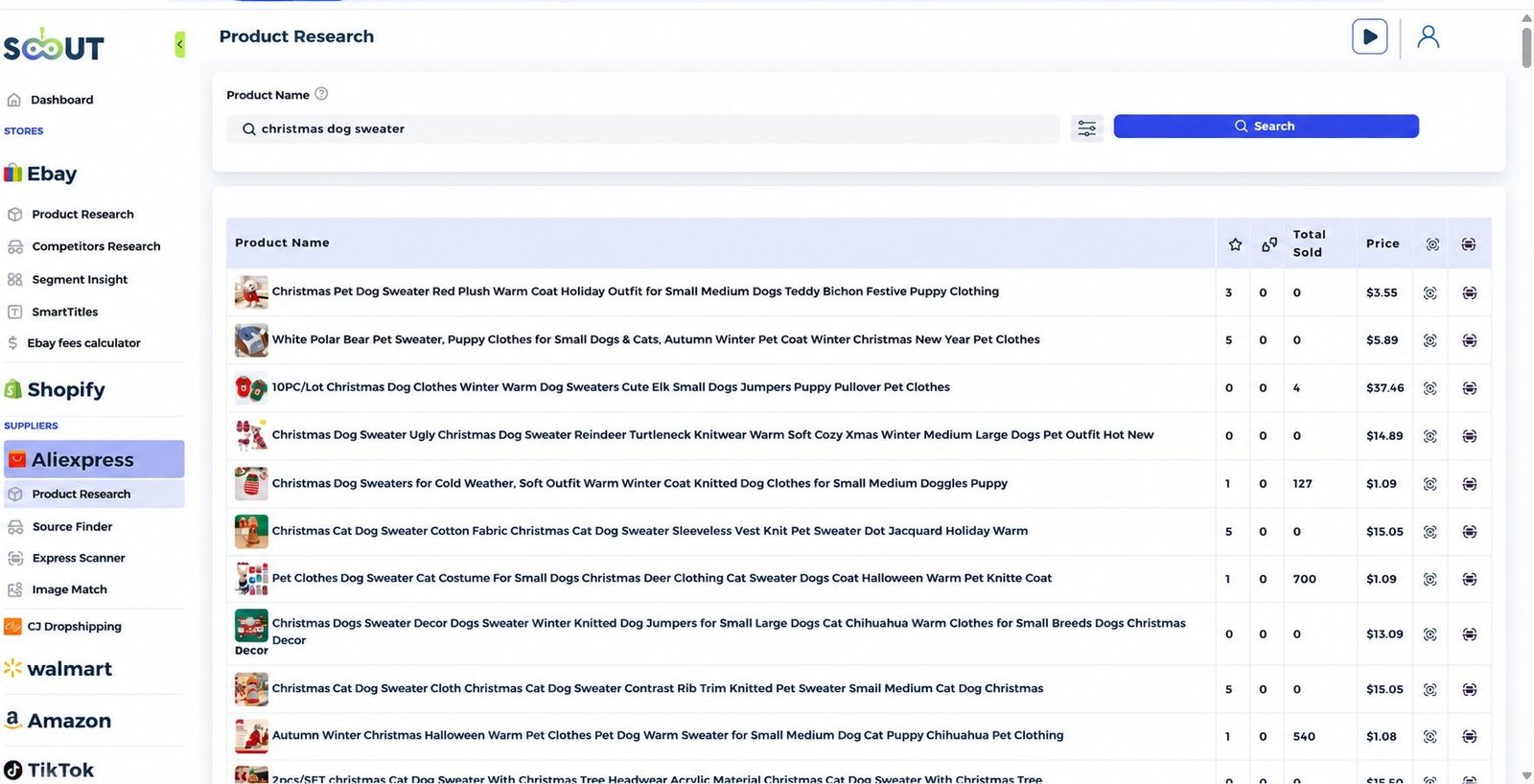
Express Product Research results for christmas dog sweater showing price and total sold per listing
Next, the question every beginner asks: what can you get for free?
Are There Free Christmas Dropshipping Suppliers, and What Do They Really Cost?
Free Christmas dropshipping suppliers exist, but “free” usually means no subscription, not no cost. You still pay for the product, shipping and, with some suppliers, storage. The honest comparison is total cost per order, not the monthly fee.
AliExpress, CJdropshipping, Printful and Printify charge no subscription on their basic plans. Zendrop’s free plan only lets you browse, so treat it as a trial rather than a working free option, and Spocket is paid after its free trial.
|
Supplier |
Subscription |
What you still pay |
Note |
|
AliExpress |
None |
Product, shipping, any import charges |
Check the AliExpress Hidden Fees breakdown before pricing |
|
CJdropshipping |
None listed |
Shipping, inbound, outbound, stocking |
European storage is free for the first 30 days, then charged daily; US warehouse storage is free for 60 days |
|
Printful (print-on-demand) |
$0 Free plan |
Product, printing and shipping, charged per order |
Growth plan costs $24.99 per month; $0.40 holiday surcharge on US-bound orders from October 15, 2026 to January 17, 2027 |
|
Printify (print-on-demand) |
$0 Free plan |
Product and shipping, charged per order |
The paid Premium plan lowers product costs |
|
Zendrop |
Free plan (browse only) |
A paid plan is needed to process orders |
Paid plans start at $29 per month |
|
Spocket |
From $39.99 per month |
Product and shipping |
Free trial only |
The storage line is where a “free” supplier can quietly turn into a cost. CJdropshipping’s fee page lists European stocking at 0.40–0.54 per CBM per day for days 31–60, after the free first 30 days, and outbound handling for a first item up to 0.5 kg at about 0.33–1.01 per order, depending on the warehouse. From October 1 to December 31, CJ adds a peak-season warehouse fee of roughly 0.25–0.29 per CBM per day in its European warehouses on top of the stocking fee, and rates rise the longer stock stays (from day 61 in Poland and Germany, from day 91 in the UK). Check the live fee page. Order too much too early and unsold Christmas stock keeps billing you into January.
Free is where you start, but choosing well comes next.
How Do You Choose the Best Christmas Dropshipping Supplier?
Choosing the best Christmas dropshipping supplier comes down to three checks: where it ships from, how long it really takes, and what its store data says. Do them in this order, because each one removes options before you spend time on the next. We keep following the same sweater from the search above, so each screenshot below is part of one real run.
Step 1: How Do You Match the Supplier’s Origin to Your Customer’s Country?
List your three biggest customer countries, then enter each as the destination in the supplier’s checkout or shipping calculator and read the estimated delivery. The most common mistake is picking on price before checking where the customer lives.
Option 1: China-direct
Cheapest, but the longest transit. The AliExpress Product Sourcing Guide covers how to read listings and shipping options.
Option 2: China agent with a local warehouse
Faster last leg, but you pay to move stock early. It works only if the stock travels by air and lands in time.
Option 3: Regional supplier
Shortest delivery, highest base cost.
Best for Christmas whenever the product exists locally. Its timing holds up longest into December. When it doesn’t exist locally, Option 2 by air is the next best.
Step 2: How Do You Test Delivery Time Before December?
Log four dates for any supplier you consider: order, dispatch, customs clearance and delivery. The common mistake is trusting the best-case number on the listing. You have three ways to test.
Option 1: Sample order
Order one tracked sample to a real address in your target country. It gives real data, but it takes the longest.
Option 2: The delivery panel on the listing
Clicking a product in the research results opens its AliExpress listing, with the delivery panel beside the price. It shows the shipping cost, an estimated delivery window, a late-delivery coupon, refund commitments and the returns policy, all before you order. This is a real example from the sweater we carried forward. We will use its delivery window when we work out the last order dates.
The price block matters too. The headline $0.99 on our sweater is a welcome deal for new shoppers; the price before that deal is $3.84, and a repeat buyer should plan around that pre-deal price.
Option 3: Reviews with photos
They show quality, rarely timing.
Best: the sample order for the final decision, with the listing panel as the fast first filter. Only the sample tells you how this supplier behaves in your customer’s country.
Real example from our run: the delivery panel on the listing of the sweater we carried forward.
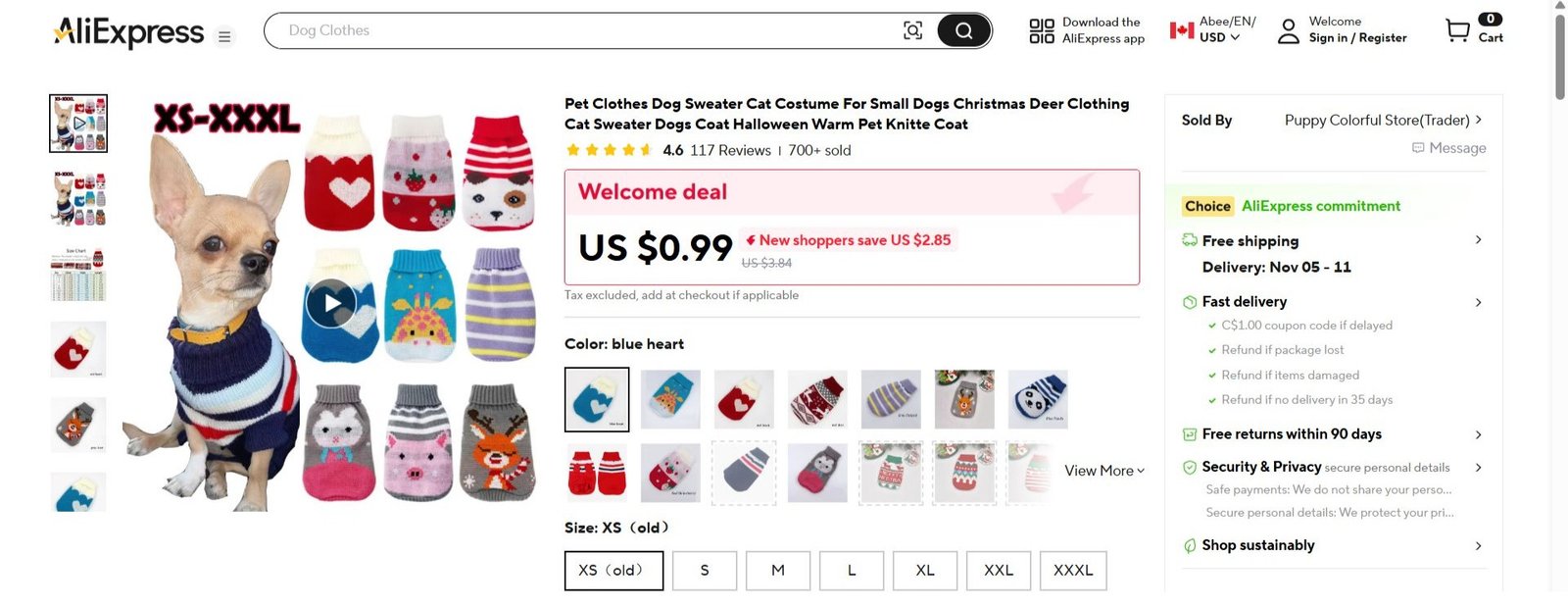
AliExpress Choice delivery panel showing free shipping, estimated delivery window and refund commitments for a Christmas dog sweater
Step 3: How Do You Vet a Supplier's Store With Data?
Express Source Finder takes a seller’s shop link or store number and returns a report on that store: its listings, prices and total units sold. You can see whether the store sells Christmas products steadily or lives off one hit. The store link sits on the same listing page from Step 2, so the journey continues without a new search.
This is a real example from TS Scout. We ran two stores side by side: the store behind our 700-unit sweater and a second store selling similar winter dog clothing. In the first, five of the first eleven listings sold more than 200 units, including four Christmas sweaters at 800, 700, 497 and 236 units, with prices starting at $1.09. In the second, no listing passed four units sold, at prices from $14.29 to $42.90. Same niche, very different stores: one has a range that sells, the other a catalogue nobody is buying from.
The pattern to look for is steady sales across several Christmas listings. The common mistake is judging a store by a single best-seller, because one strong product proves little if the rest barely sell.
Real example from TS Scout: the store behind our best-selling sweater compared with a store that sells almost nothing.
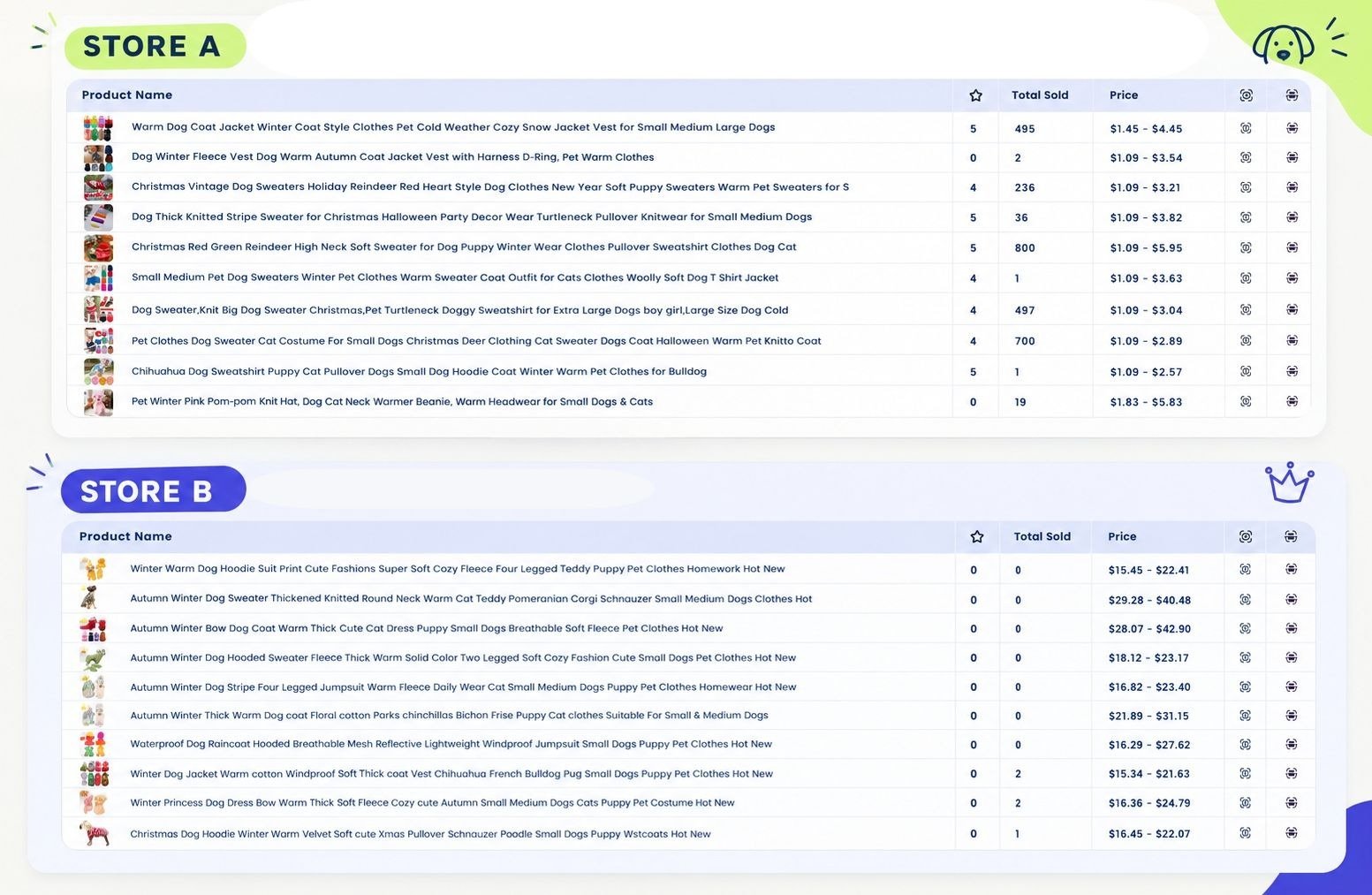
Express Source Finder reports comparing two AliExpress stores selling winter dog clothing, with total units sold and price ranges
You now have a supplier and a store you can trust, so the next question is when each order must be placed.
What Is the Dropshipping Christmas Shipping Deadline for China-Sourced Orders?
We found no platform-wide Christmas cutoff published by AliExpress, so the safest approach is to calculate your own. Your dropshipping Christmas shipping deadline is not one date but one per shipping method, and each is worked out the same way:
Target arrival date − (processing time + worst-case transit + buffer) = last order date
Christmas Day 2026 falls on a Friday, which makes Wednesday, December 23 the last realistic delivery day, since many carriers wind down on Christmas Eve. Using that as the latest possible arrival, with two days of processing and a five-day buffer, the dates look like this. The transit times are planning assumptions, not platform promises.
|
Shipping method |
Assumed worst-case transit (approx.) |
Approx. last order date |
|
Standard |
~30 days |
~Nov 16 |
|
Choice |
~16 days |
~Nov 30 |
|
Express courier |
~8 days |
~Dec 8 |
|
CJ air stock transfer to Europe |
12–18 days |
Stock leaves China ~Nov 22 to land by ~Dec 10 |
The CJ row works differently from the other three because it is a stock-transfer date rather than a customer-order date: stock leaving China around November 22 needs up to 18 days to land by about December 10, which leaves about 13 days to sell it and deliver it locally before December 23.
How do these assumptions compare with a real listing? The delivery panel we opened for our sweater showed an estimated window of up to about two weeks from the order date. We round that up to 16 days for Choice and keep the five-day buffer on top. The panel changes by destination, so read it for your own target country.
Black Friday lands on November 27, after the Standard cutoff in this model, so a Standard order placed that weekend will most likely miss Christmas. A Choice order placed that weekend still fits, with about three days to spare. If you are running promotions then, the Black Friday Dropshipping Products guide helps you plan which items to push. For customers in the Gulf, AliExpress Shipping to Saudi Arabia and the UAE covers the delivery times and customs rules that change the picture there.
There is a legal side too. Under Directive 2011/83/EU, Article 18, unless you agree otherwise, the seller must deliver within 30 days of the contract. A consumer can end the contract if delivery by a specific date was essential or they told you so beforehand. The UK sets the same 30-day default in the Consumer Rights Act 2015, section 28. In practice, do not promise “arrives by Christmas” unless you have calculated it.
Knowing the dates is only useful if the numbers still leave you a profit, which brings us to the next question.
Can Your Supplier Change Your Net Profit?
Yes, and in four ways: shipping cost, late-delivery refunds, import duty and fee model. The result first: on a product this cheap, fixed costs outweigh the product itself. A €3 duty, if it applies, can cost close to the sweater’s pre-deal price, and in the example below the agent route adds roughly 60–70% to landed cost.
How Do Shipping Methods and Origin Change Your Margin?
The Choice listing we checked offered free shipping, so on that route freight adds nothing to the product price. Moving stock through an agent is different. CJdropshipping’s fee page lists reference air rates for ordinary goods of about $10.39 per kg to its UK warehouse and $11.50 per kg to its German one, so a 200 g item adds roughly 2.1–2.3 per unit before outbound handling (illustrative weight). Poland sits at $11.70 per kg and the US at $12.13. On a product that costs a few dollars at the supplier, that is a large share of the price.
What Does a Late Parcel Really Cost You?
A refund to your customer, plus a product and shipping you may not recover. The refund commitments on the listing panel protect the money you paid the supplier, not the sale your customer expected. The no-delivery refund window was 30 days in one market we checked and 35 in another, so it is not a universal figure.
If your market has a 30-day default delivery rule, as the EU and UK do, a 35-day supplier window means you may have to refund your customer before AliExpress refunds you. Do not wait for the supplier before contacting your customer. If the wrong item shows up instead, Supplier Shipped the Wrong Item? covers the next steps.
Does the EU €3 Duty Change the Maths?
If your customers are in the EU, a temporary €3 customs duty has applied since July 1, 2026 to parcels worth up to €150, according to the European Commission, and it is set to run until July 1, 2028. It is charged per item type (tariff classification), not per piece, and the seller or importer declares and pays it. The Commission’s own example: five identical T-shirts carry one €3 charge.
Against a sweater whose price before the welcome deal is $3.84, €3 comes close to the full price of the product, and it is several times the $0.99 welcome-deal price. A 10-piece lot, like the $37.46 listing in our search, would carry the same single charge if the pieces share a classification, so multi-packs spread the duty. Whether the duty lands on you depends on how the order is imported, including whether the parcel is declared through the Import One-Stop Shop (IOSS). Some sources say parcels outside IOSS may fall under the regular tariff instead, so confirm with your supplier how each order is declared.
Selling to US customers instead? A different set of low-value parcel rules applies there, and the Black Friday and Cyber Monday guide explains the US de minimis changes.
Which Fee Model Protects Your Margin?
Fee models differ across Christmas dropshipping suppliers, and the difference shows up in your margin. A subscription is a fixed cost you must cover. Illustratively, a $39.99 plan spread over 100 orders adds about $0.40 to every order, roughly 10% on top of a $3.84 product. A per-service model like CJdropshipping’s costs nothing until you move stock, but its storage fees start after the free period.
What Did Our Sweater Really Cost From Two Supplier Routes?
So far we have followed one sweater: found in the search, delivery and price checked on its listing, store vetted. One question is left: does the price we saw hold up from a second angle? Image Match answers it. A right-click on any product image and the pasted image URL return look-alike listings with price and units sold, so you can see the going supplier price and which versions really sell.
This is a real example from TS Scout. We pasted the main image of the grey deer sweater from the listing we had been following. The sweater itself came back at $2.95 with 712 units sold, in line with the “700+ sold” on its listing. The look-alikes with real sales sat close by: $3.09 with 497 sold, $3.59 with 471 and $3.25 with 130. Image Match also returns the odd unrelated item (a pack of kids’ socks appeared twice), so read the product names before trusting a row.
The same deer sweater shows $1.09 in the first search and $2.95 here, and the listing’s own price before the welcome deal is $3.84. Search prices can drift with the variant and the promotion, so we budget with the highest, the $3.84 pre-deal price, and confirm it at checkout.
Real example from TS Scout: look-alikes of the sweater we followed, with supplier price and units sold.
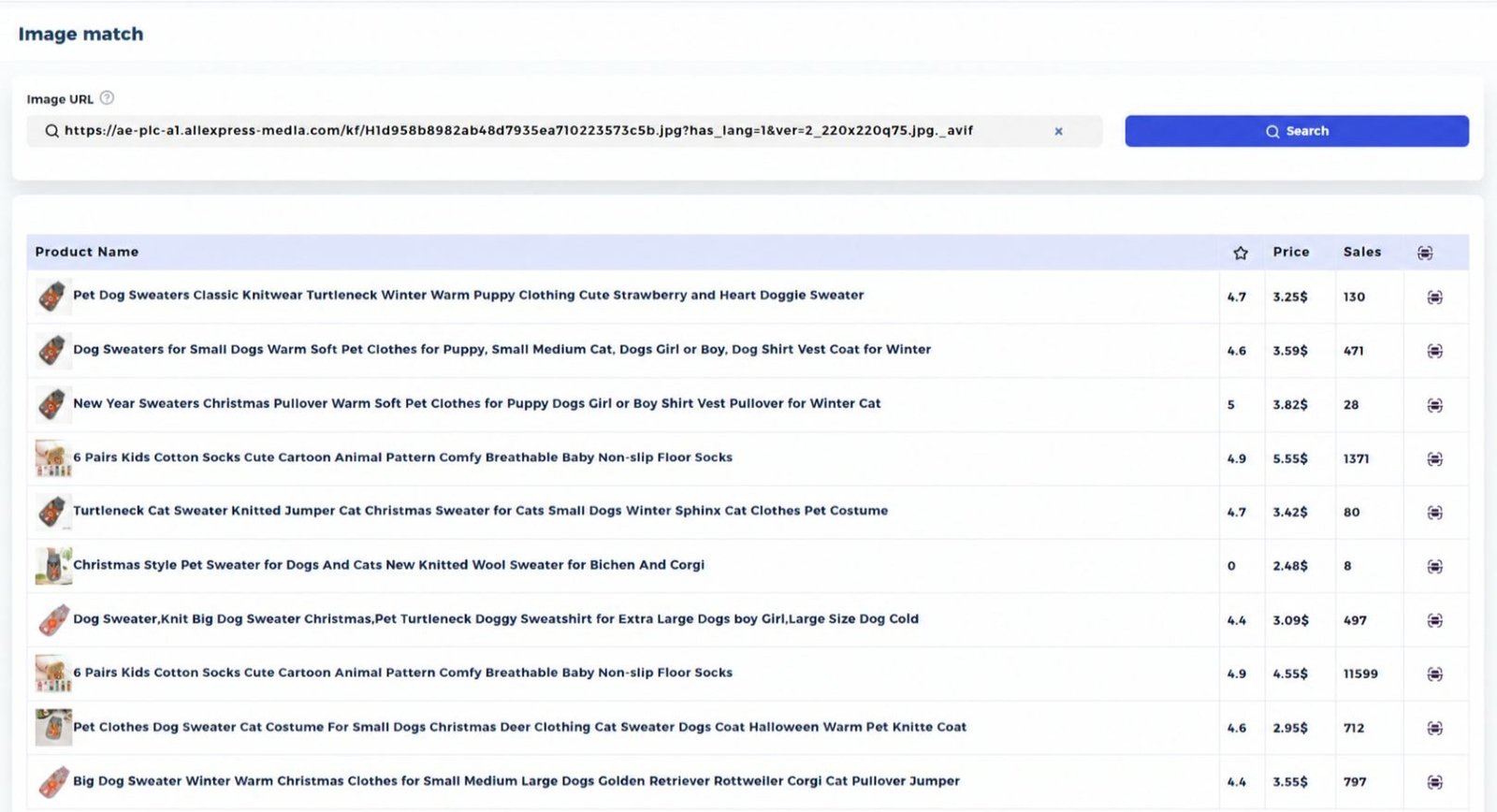
Image Match results for a Christmas deer dog sweater showing price and sales of similar AliExpress listings
Now we can compare the same sweater across two routes. The agent route reuses the $3.84 figure for illustration, since its own price may differ.
|
Cost line |
Choice-direct route |
Agent-stock route |
Where it comes from |
|
Product cost |
$3.84 (price before the welcome deal) |
$3.84 (illustrative) |
Listing price block |
|
Shipping |
$0 (free shipping on the Choice listing) |
~2.1–2.3 air freight per 200 g (UK/DE warehouse, illustrative weight) |
Listing panel; CJdropshipping’s fee page |
|
Outbound handling |
$0 |
~0.33–0.34 (UK/DE warehouse, first piece, up to 0.5 kg) |
CJdropshipping’s fee page |
|
Landed cost before duty and fees |
$3.84 |
~6.2–6.5 (about 60–70% higher) |
Calculated |
|
EU duty |
€3 per item type, if it applies |
Same question applies |
European Commission |
|
Fixed cost per order |
$0 |
Storage after the free period |
CJdropshipping’s fee page |
Every extra dollar of landed cost has to be recovered in your price or it comes out of your margin. To turn this into net profit, subtract your payment fee, platform fee and a refund allowance from your selling price, using your own rates. On a very cheap product, fixed costs like duty and storage do most of the damage, so the supplier that looks cheapest on the listing is not always the one that leaves you the most profit.
With the numbers in hand, the last question is how to run all of this day to day.
What Are the Best Practices for Managing Christmas Suppliers?
These habits keep your Christmas dropshipping suppliers honest when December volume hits.
-
Order a tracked test parcel before you announce the product. It is the only way to learn how your supplier actually performs in your customer’s country, and it takes one order.
-
Keep a backup supplier for every hero product. If your main supplier runs out or slows down in December, a second one with a different origin keeps the listing alive.
-
Publish your own cutoff earlier than the supplier’s. Add the date to your homepage and product pages, using the calculated last order date for each shipping method.
-
Use one supplier per order. Split parcels arrive on different days and cost more to ship, so group items by supplier at checkout.
-
Check late-delivery signals daily in December. Flag any order with no tracking movement for several days and contact the customer before they contact you.
Now that you know how to manage your suppliers, here is how it all comes together.
How Do You Protect Your Christmas Profit Before the Supplier Deadline Hits?
A supplier that looks cheap on the listing can quietly cost you the season through late parcels, refunds and fees you never priced in. Compare origin, delivery time and store data before you list, and you will know exactly which order date each product can still meet. Every week you wait removes a shipping option, so the best moment to check is before the deadline passes.
Run your next supplier through TS Scout and let real sales data decide who earns your Christmas orders.
FAQs About Christmas Dropshipping Suppliers
-
What is the last day to order from China for Christmas?
There is no single date, because it depends on the shipping method. Work backwards from December 23 using your method's worst-case transit time, processing time and a buffer. In the model above, Standard is around mid-November and Express around the second week of December.
-
Are there free Christmas dropshipping suppliers?
Some suppliers charge no subscription, such as AliExpress and CJdropshipping. You still pay for products, shipping and, with CJdropshipping, warehouse services like storage after the free period.
-
Can I promise Christmas delivery?
Only if you have calculated it for that customer's country. Under Directive 2011/83/EU, Article 18 and the Consumer Rights Act 2015, a delivery date that was essential to the customer can let them end the contract if you miss it.
-
Does the EU €3 duty apply to my store?
It applies to low-value parcels entering the EU, and the European Commission says the seller or importer declares and pays it. Whether it lands on you depends on how the order is imported, so confirm it with your supplier or an adviser.
-
Which supplier is best for beginners?
A regional supplier if the product exists locally, because it removes most transit risk. If it doesn't, start with AliExpress using its estimated delivery dates, or CJdropshipping if you can move stock by air in time.
-
What if the parcel is late?
Check the estimated delivery date on the order, contact the supplier, and open a dispute if needed. The listing's own panel shows the refund commitments for that product. On the listings we checked, the refund window for non-delivery was 30 days in one market and 35 in another, so read the terms for your own market.
Sources
like?


Table of Contents
- What Are Christmas Dropshipping Suppliers, and Why Does Your Choice Decide in December?
- Who Are the Best Christmas Dropshipping Suppliers for Time, Shipping and Product Selection?
- Are There Free Christmas Dropshipping Suppliers, and What Do They Really Cost?
- How Do You Choose the Best Christmas Dropshipping Supplier?
- What Is the Dropshipping Christmas Shipping Deadline for China-Sourced Orders?
- Can Your Supplier Change Your Net Profit?
- What Are the Best Practices for Managing Christmas Suppliers?
- How Do You Protect Your Christmas Profit Before the Supplier Deadline Hits?
- FAQs About Christmas Dropshipping Suppliers
- Sources


