

Black Friday Dropshipping Products in 2026: Why a 30% Discount Can Wipe Out Your Profit
- 2026-10-20
-
 0

You picked a product, built the ads, and decided that a 30% Black Friday discount will double your orders. On paper the plan is clean: more traffic, more volume, a few extra thousand dollars before December. Most sellers never check what sits underneath that plan.
Here is the reality check. Since the de minimis exemption was suspended, every cheap overseas parcel carries duty and entry costs it did not carry two years ago. A 30% discount on a product with a 30% margin doesn't shrink your profit; it erases it. The orders arrive, but the cash doesn't.
So which Black Friday dropshipping products can survive a 30% discount, and how do I know before I spend a cent on ads?
Adobe forecasts Cyber Week 2026 at roughly $47.5 billion in US online spend. This guide shows how to claim a share of it without losing money: which niches to shortlist, how to calculate landed cost, what your break-even ROAS really is, and which deadlines hit first.
What Is Black Friday and Cyber Monday Dropshipping, and How Big Is the 2026 Opportunity?
Black Friday and Cyber Monday dropshipping means selling through the Thanksgiving-week window without holding stock yourself. Your supplier ships after the customer pays. The window is harder than a normal week because demand, ad costs, carrier surcharges and customer expectations all peak at once.
When Are Black Friday and Cyber Monday in 2026?
Thanksgiving falls on November 26, Black Friday on November 27, and Cyber Monday on November 30. Green Monday, the second-chance day for late shoppers, lands on December 14. Some calendars list Black Friday as November 28, which is wrong.
What Do Adobe and Shopify Data Say About Demand?
Keep last year's results and this year's forecasts apart in your own planning.
|
Metric |
2025 actual |
2026 forecast |
|
US online Cyber Week |
$44.2B (+7.7%) |
$47.5B (+7.4%) |
|
US online Black Friday |
$11.8B (+9.1%) |
$12.9B (+9.2%) |
|
US online Cyber Monday |
$14.25B (+7.1%) |
$15.1B (+6.2%) |
|
Holiday season (Nov–Dec) |
n/a |
$275.1B (+6.7%) |
On the merchant side, Shopify reported $14.6 billion in global Black Friday Cyber Monday sales (+27%) and a $114.70 average cart. More than 94,900 merchants had their best sales day ever.
Adobe expects discounts of up to 30% during Cyber Week 2026. For category depth, its 2025 Cyber Monday data showed peak discounts of 31% on electronics, 28% on toys, 25% on apparel and 17% on sporting goods. Those are the price points your competitors will be matching.
Cyber Monday vs Black Friday: Which Day Deserves Your Budget?
Cyber Monday is still the biggest online day, but Adobe data shows Black Friday has grown faster for the second year running. Adobe attributes part of that to Black Friday carrying the season's deepest discounts on TVs, apparel and appliances.
The practical answer is one Cyber Week campaign instead of two separate days. Put apparel, toys and home items up front on Friday, and push electronics accessories hardest on Monday.
What Makes Cyber Monday Dropshipping Different?
Cyber Monday is the biggest single online day of the season, with Adobe forecasting $15.1B in US spend. Electronics accessories carry the steepest discounts, peaking at 31% off in 2025. For dropshippers, that means the products you push hardest on Monday are the ones competitors will undercut hardest, while the duty exposure on electronics (see the niche table below) leaves less room to match them. Run landed cost and break-even ROAS before you match a competitor’s price, and lead with bundles instead of a flat cut.
Now that you know how big the window is, the next question is which products deserve a place in it.
How Do You Pick Black Friday Dropshipping Products and Niches That Survive a Discount?
The top dropshipping niches for Black Friday are not simply the ones with the most searches. They are the ones that still earn money after a 20–30% price cut, the return rate and the duty bill. Work through three steps.
Step 1: Pull Demand Signals From Real Sales Data
Start with what actually sold. Shopify's 2025 data lists cosmetics, clothing tops and pants, activewear, and fitness and nutrition as its hottest categories. Adobe's 2026 forecast adds clothing basics (+210% vs September) and personal hygiene (+150%) during Cyber Week.
Category data tells you where to look, not what to sell. Choose where to start:
Option 1: Category reports (Shopify, Adobe)
Good for confirming a niche is hot. They never name a specific product.
Option 2: Marketplace product data
Amazon Scanner tracks trending and high-demand products on Amazon. Enter a keyword, pick a category such as Sports & Outdoors, and set a price range to see what shoppers are already buying.
Option 3: Your own store data
The most reliable signal, but only if you already have sales history.
Best choice: Option 2 for most sellers heading into Cyber Week, with Option 1 as a sanity check on the category. It also fits the Black Friday dropshipping Amazon searches your customers run.
Common mistake: trusting a product's popularity without checking when the sales happened. A spike from last year's viral video says nothing about this November.
Step 2: Filter Categories by Discount Depth and Return Risk
A niche only works if its margin can absorb the Cyber Week price cut. Score each shortlisted niche on four columns before committing. Return and duty ratings are editorial estimates based on category patterns, not published statistics
|
Niche |
Demand signal |
Discount depth (Adobe, Cyber Monday 2025) |
Return risk |
Duty exposure |
|
Fitness gear |
Shopify top category |
Sporting goods peaked at 17% off |
Medium |
Varies by HTS code |
|
Cosmetics |
Shopify top category |
Not broken out by Adobe |
Low–medium |
Low–medium |
|
Activewear |
Shopify top category |
Apparel peaked at 25% off |
High (sizing) |
Medium–high (textiles) |
|
Electronics accessories |
Strong on Cyber Monday |
Electronics peaked at 31% off |
Medium |
Often high (China origin) |
Return risk matters more than most sellers assume. NRF estimated a 15.8% overall return rate for 2025, 19.3% for online sales, and 17% for holiday sales. Our guide to dropshipping product returns covers how to price that in.
Common mistake: treating duty as one number. It depends on the product's HTS code, which you can look up in the USITC HTS Search.
Step 3: Validate the Niche Before You Commit Budget
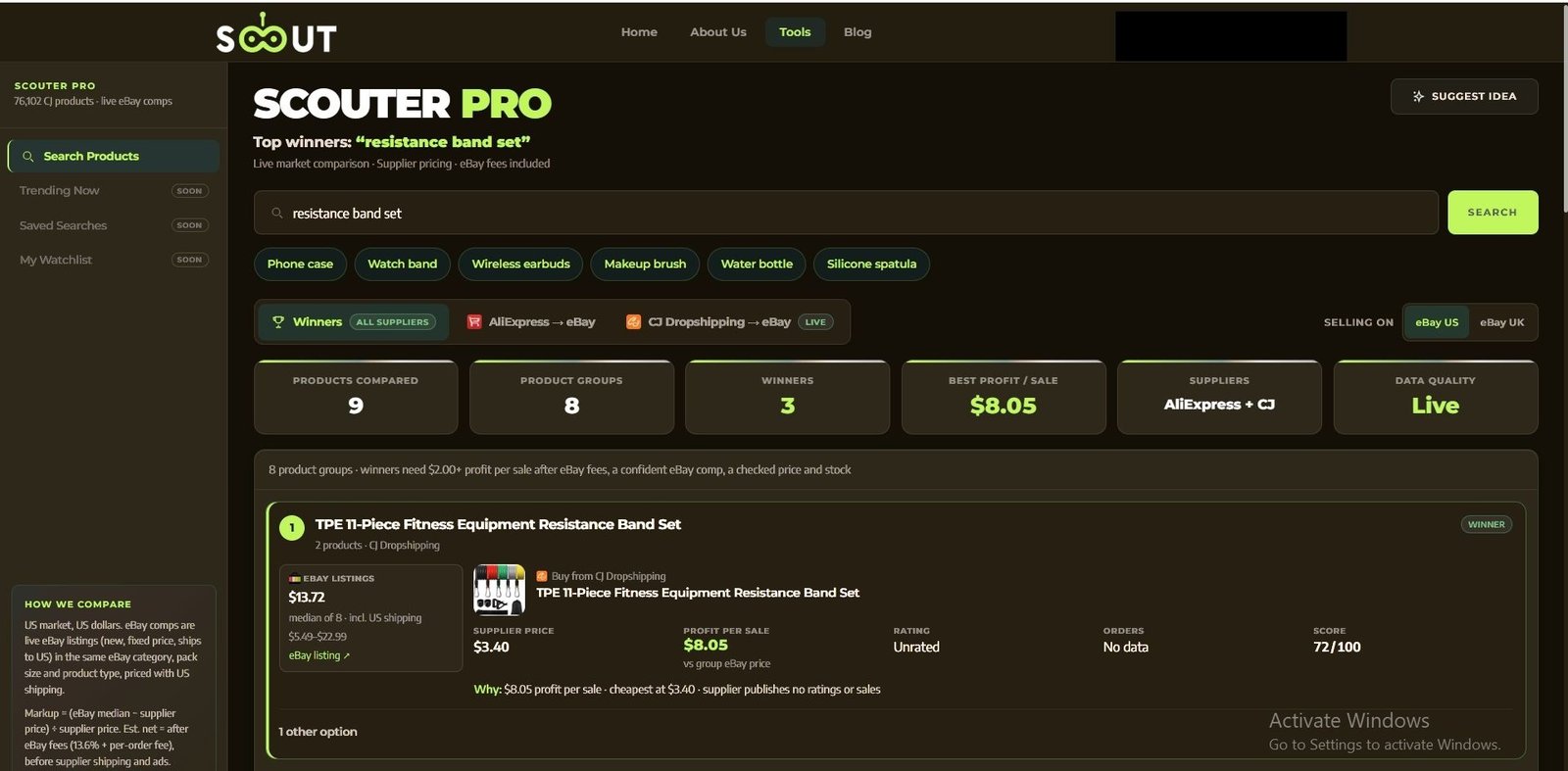
Once a product passes the filter, you need two answers fast: can you sell it above your cost, and can the supplier deliver? Scouter Pro, our AI-powered tool, compares supplier prices from AliExpress and CJ Dropshipping against live eBay US listings. It then ranks the results as Winners, with profit per sale after eBay fees and a score for each product.
Here is what it returned in October 2026 for "resistance band set":
Results are a snapshot from October 2026 and will differ when you run the same search.
-
The tool compared 9 products across 8 product groups and flagged 3 Winners, with a best profit of $8.05 per sale.
-
The top Winner, a TPE 11-piece resistance band set from CJ Dropshipping, has a supplier price of $3.40. The eBay median is $13.72 (median of 8 listings, range $5.49 to $22.99, including US shipping).
-
It scored 72/100. The supplier shows no ratings or sales, which is a flag to check before you scale.
A product only qualifies as a Winner when it clears $2.00 profit per sale after eBay fees, has a confident eBay comparison, and has a checked price and stock. Read these numbers as a first filter, not a final answer: the profit figure excludes supplier shipping and ads. On a $13.72 sale, $4 to $5 of shipping, duty and fees would cut that $8.05 by about half or more, which is exactly what the next two sections calculate.
Common mistake: treating the Winner's profit as final. Run every shortlisted product through landed cost and break-even ROAS before you set a discount.
With a shortlist ready, you need to know what each unit costs once it reaches your customer.
How Do You Calculate Landed Cost for a Black Friday Product in 2026?
Landed cost is the total you pay to get one unit to the customer, before payment fees. Rules changed sharply in the last year, so the number you remember from 2024 is probably wrong.
Step 1: Understand What Changed in US Import Rules
US Customs and Border Protection (CBP) has suspended the $800 de minimis exemption since August 29, 2025. Non-postal low-value shipments are now generally entered through informal entry (Entry Type 11) with all applicable duties, taxes and fees, according to the June 24, 2026 Federal Register rule on mail shipments. The statutory termination is set for July 1, 2027.
One more rule is coming. On October 8, 2026, CBP proposed in the Federal Register to require a customs bond on every informal entry. It is a proposal, not yet in force, so watch for the final rule.
China-origin goods face an extra layer. A new Section 301 duty of 12.5% applies from July 24, 2026 under 91 FR 47318, stacked on the normal MFN duty and any older Section 301 tariff on that HTS code. The temporary 10% Section 122 tariff expired the same day. The same action also sets 10% or 12.5% on products from dozens of other economies, so check your supplier's country of origin.
Entry fees changed too. Per the FY2027 customs user fee notice, informal entries carry a flat $2.77 fee from October 1, 2026, and formal entries have a $34.58 minimum. A small set of 178 China product exclusions is scheduled to lapse after November 9 unless USTR extends it again, so check whether your HTS line is one of them.
Common mistake: assuming "DDP" means "no duty." It means the duty is paid on your behalf and billed to you.
Step 2: Build the Landed-Cost Formula
Use this line-by-line structure for every product on your shortlist:
-
Supplier price
-
International or inbound shipping
-
Duty (MFN plus any Section 301)
-
Entry fee or DDP handling
-
Fulfilment (3PL pick and pack, if used)
-
Last-mile postage
-
Peak surcharge: UPS lists $0.75 on Ground Residential from November 22 to December 26, and FedEx lists $0.80 from November 23 to December 27 (both start at $0.50 in late October). These come from published carrier schedules, so confirm them in your own carrier account.
-
Payment fee: Shopify Basic charges 2.9% + $0.30 on a standard domestic card online, and more on premium or international cards.
Supplier costs drift too. Our breakdown of aliexpress hidden fees shows where small charges sneak in, and the AliExpress price increases playbook covers what to do when a supplier reprices mid-season.
Step 3: Compare Three Fulfilment Routes
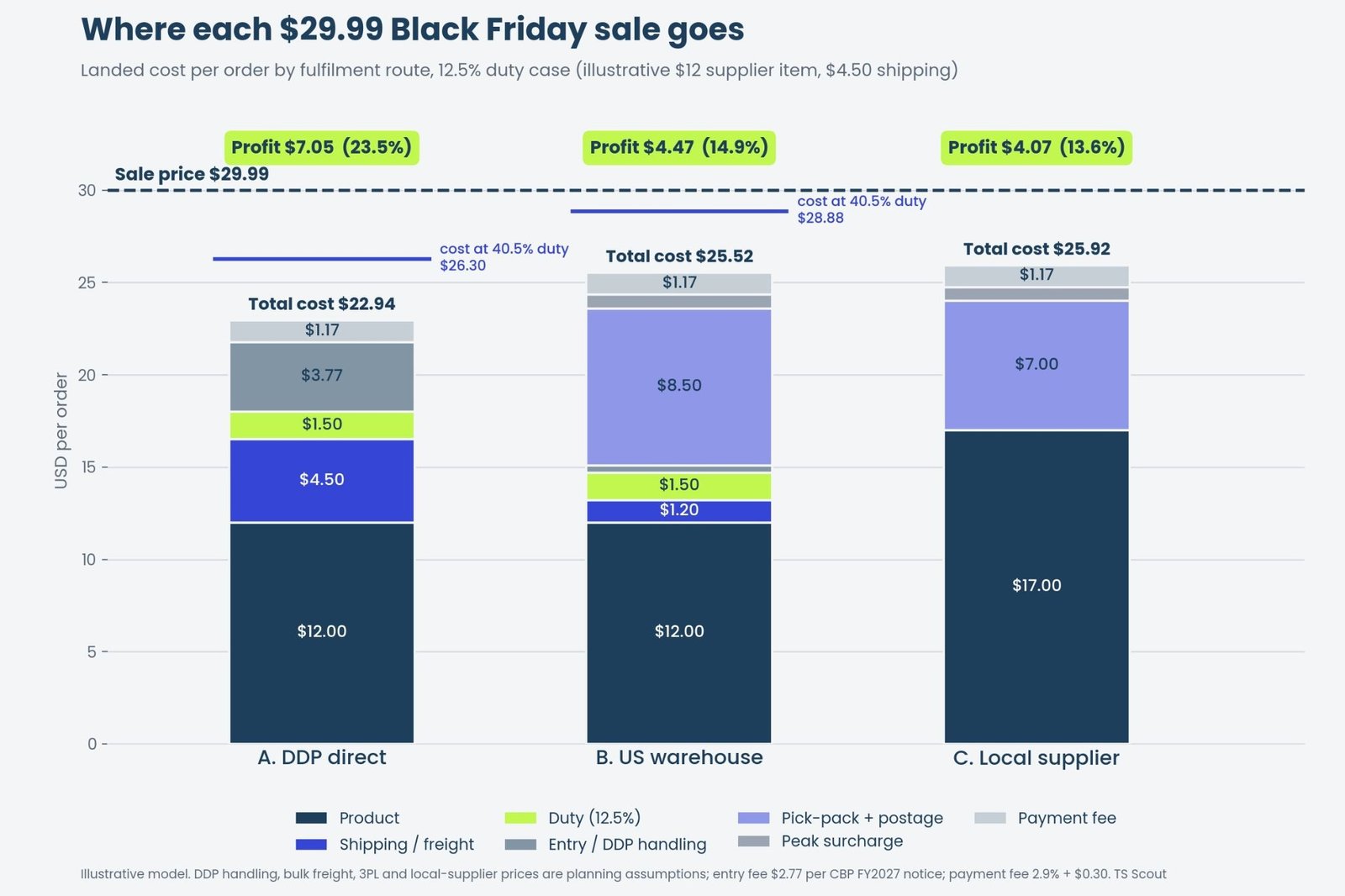
Take one worked example (illustrative, not a real product): a $12 supplier item with $4.50 shipping, sold at $29.99. It sells for more than the resistance-band Winner above, so fixed costs weigh less here. Duty is shown at two levels: 12.5% (new Section 301 only) and 40.5% (3% MFN + 25% older Section 301 + 12.5%).
|
A. DDP direct |
B. US warehouse |
C. Local supplier |
|
|
Product |
$12.00 |
$12.00 |
$17.00 |
|
Shipping |
$4.50 |
$1.20 (bulk) |
Included |
|
Duty at 12.5% |
$1.50 |
$1.50 |
None |
|
Entry / DDP handling |
$2.77 + $1.00 |
$0.40 |
None |
|
Pick-pack + postage |
Included |
$3.00 + $5.50 |
$1.50 + $5.50 |
|
Peak surcharge |
None |
$0.75 |
$0.75 |
|
Landed cost (12.5% duty) |
$21.77 |
$24.35 |
$24.75 |
|
Landed cost (40.5% duty) |
$25.13 |
$27.71 |
n/a |
|
Margin after 2.9% + $0.30 (12.5%) |
23.5% |
14.9% |
13.6% |
|
Margin after 2.9% + $0.30 (40.5%) |
12.3% |
3.7% |
n/a |
Assumptions: DDP handling, bulk freight, per-unit entry cost, 3PL fees and the local supplier's price are planning estimates, so replace them with real quotes. The $2.77 entry fee comes from the CBP FY2027 notice; duty rates depend on your HTS code.
Three decisions follow from the table:
Option 1: DDP direct
Highest margin here, but only while duty stays low. At 40.5% duty it drops to 12.3%.
Option 2: US warehouse
Faster delivery, but pick-pack and postage take $8.50 per order. At the higher duty rate it barely clears 3.7%. The Walmart Fulfillment Services comparison against 3PLs and the CJ Dropshipping TikTok Shop connection walkthrough show how US stock plugs into marketplaces.
Option 3: Local supplier
No duty risk and simpler compliance, at a steadier but thinner margin.
Best choice: for a first Black Friday, route A for low-duty products and route C for anything on a heavy tariff line. Route B only pays when the selling price can absorb the fixed handling costs. For margin benchmarks, our average profit margin in dropshipping guide helps set expectations.
Common mistake: running the numbers at list price. Most units sell at the discounted price, and the next section shows what that does.
Landed cost sets the floor; ad performance decides whether you stay above it.
What Is Break-Even ROAS, and Why Does a 30% Discount Kill a 30% Margin?
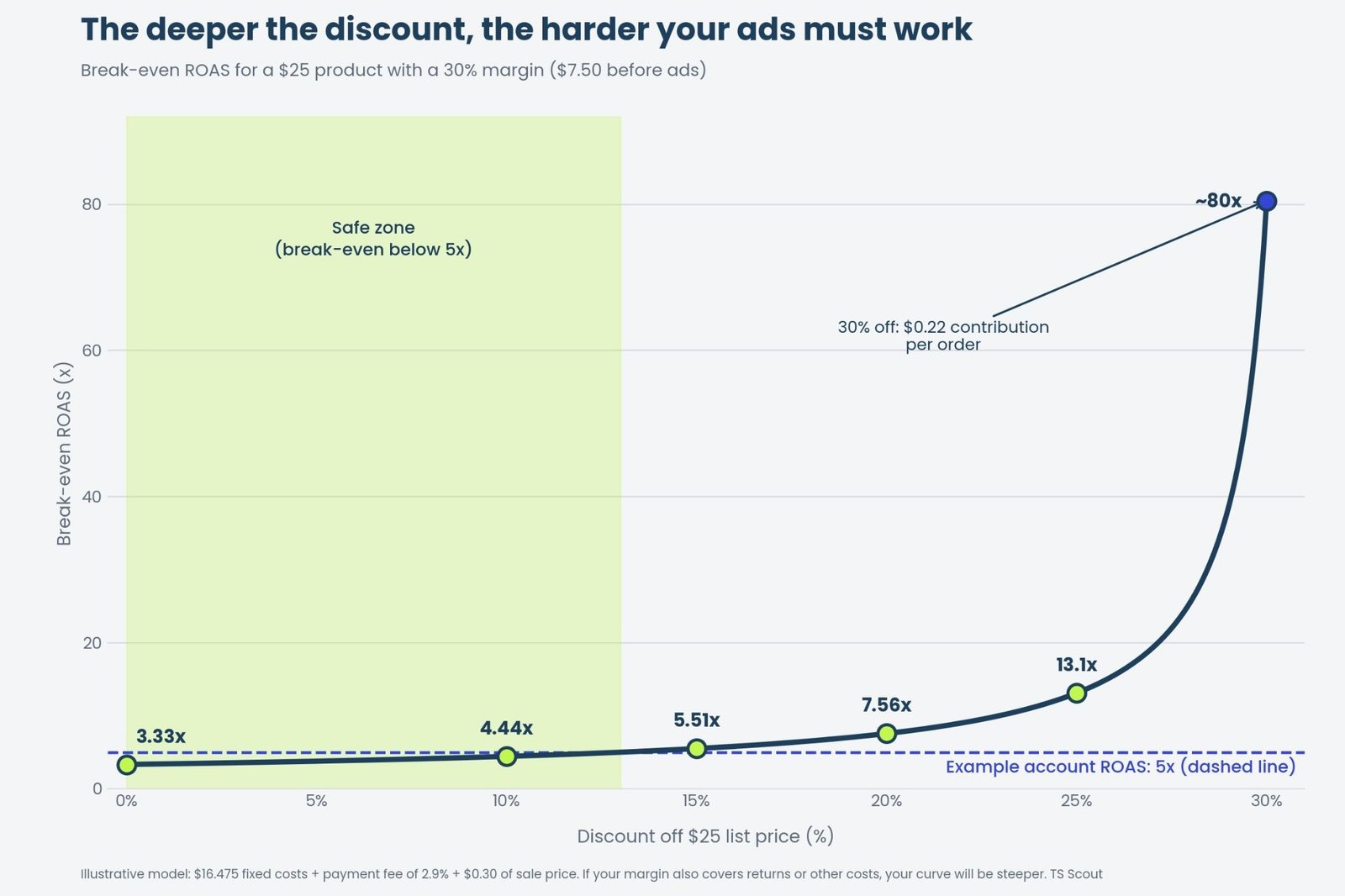
Break-even ROAS is the minimum return on ad spend at which an order pays for its own advertising. Calculate it as selling price ÷ contribution per order. When costs are fixed, a discount comes straight out of the margin.
How Do You Calculate Break-Even ROAS?
Take a $25 product with $17.50 in all-in costs (product, shipping, duty, fulfilment and a 2.9% + $0.30 payment fee). That leaves a $7.50 contribution, a 30% margin, and a break-even ROAS of 25 ÷ 7.50 = 3.33×. Every $1 of ad spend must bring back $3.33 just to break even.
What Does Each Discount Level Do to Your Break-Even?
|
Discount |
Sale price |
Contribution |
Margin |
Break-even ROAS |
Units to match $7.50 profit |
|
0% |
$25.00 |
$7.50 |
30.0% |
3.33× |
1.0 |
|
10% |
$22.50 |
$5.07 |
22.5% |
4.44× |
1.5 |
|
15% |
$21.25 |
$3.86 |
18.2% |
5.51× |
1.9 |
|
20% |
$20.00 |
$2.64 |
13.2% |
7.56× |
2.8 |
|
25% |
$18.75 |
$1.43 |
7.6% |
13.1× |
5.2 |
|
30% |
$17.50 |
$0.22 |
1.2% |
~80× |
~34 |
Payment fees are modelled as 2.9% + $0.30 of the sale price. If your 30% margin also covers returns or other costs, your numbers will differ.
At 30% off, you keep 22 cents per order. You would need roughly 34 sales to earn what one full-price sale earns, and no ad account delivers an 80× return.
What Discount Ceiling Should You Set Before Cyber Week?
Work backwards. Check your last 30 days of ROAS, then pick the deepest discount whose break-even sits below it. If your account averages 5×, the model puts the ceiling at about 13%. At 7.5×, it is about 20%.
If you want more room, change the offer rather than the price. Bundles, free-shipping thresholds and gifts with purchase protect margin better than a flat percentage cut. Our how to calculate shipping costs for dropshipping guide helps you price a threshold correctly.
With the discount ceiling set, you can decide where to sell.
How Do You Sell More on Black Friday Across Amazon, eBay, Shopify and TikTok Shop?
Each platform has its own deadlines, fees and rules, and missing one can cost you the season.
What Does Black Friday Dropshipping on Amazon Allow, and What Does It Ban?
Black Friday dropshipping on Amazon works only if you stay the seller of record. According to Amazon's Seller Central drop shipping rules, you can't buy from a third party and ship it directly under another supplier's name, and the packing slip must carry your name.
Deadlines were tight. Amazon's Best Deal and Lightning Deal submission window for Black Friday Week and Cyber Monday closed on October 20, 2026. Those deals cost $100 upfront per promotion plus 1.5% of promotional sales, capped at $5,000. Holiday peak fulfillment fees run from October 15, 2026 to January 14, 2027, with the same per-unit increase as last year, per Chain Store Age. If you missed the deal window, shift to coupons and other promotions once Amazon announces event dates. Our eBay and Amazon hidden fees breakdown shows how these charges stack.
Before you list, Amazon Scanner helps you check which products in your category are trending on Amazon, so you are not competing blind.
What Should eBay Sellers Prepare?
eBay hasn’t published official Black Friday 2026 promotion dates yet, so check the promotions tab in Seller Hub regularly and plan around the Nov 27 to Nov 30 window. Until dates are confirmed, prepare these four things:
-
Price against live listings. Compare your price with current eBay sold and active listings, as in Step 3, before choosing a discount.
-
Model eBay fees at the sale price. Final value fees and any promoted listing rate come out of a discounted price, so rerun your break-even ROAS using your actual fee percentage.
-
Set up your offers early. Prepare markdowns, volume discounts and coupons in Seller Hub so they’re ready the moment the promotion window opens.
-
Confirm handling time. Only promise dispatch dates your supplier can meet (see the FTC rule below). Our [eBay seasonal selling guide] covers listing timing.
How Does Shopify's BFCM Data Shape Your Store?
With a $114.70 average cart in 2025, set your free-shipping threshold just above that figure rather than far below it. Shopify's data also shows cosmetics and fitness categories leading, which fits Step 1 above. Before you scale ads, check the hidden costs of Shopify so payment and app fees don't erode margin.
What Does a TikTok Shop Require?
TikTok Shop's 2026 BFCM seller guide sets the campaign from November 11 to November 30 (Pacific Time). It recommends an Account Health Rating ideally above 150 and a Late Dispatch Rate below 20%, and says campaign applications take 5–14 business days to review. Applying now matters. If you advertise with video, TikTok Shop vs TikTok Ads explains which channel suits a Black Friday push.
|
Platform |
Key deadline |
Key fee |
Key rule |
|
Amazon |
Deals closed Oct 20 |
$100 + 1.5% per deal; peak fees from Oct 15 |
Seller of record; packing slip in your name |
|
eBay |
not yet announced |
final value fee plus optional promoted listings |
accurate handling time and listing accuracy |
|
Shopify |
None (your store) |
2.9% + $0.30 (Basic, standard card) |
You set shipping promises |
|
TikTok Shop |
Campaign Nov 11–30 |
Check Seller Center |
AHR ideally above 150; LDR below 20% |
The platform is chosen; now protect the orders themselves.
What Operational Risks Break Black Friday Dropshipping Orders?
Most November losses come from shipping and payment problems, not from bad products.
Can Your Supplier Ship in the Time You Promise?
The Federal Trade Commission (FTC) Mail, Internet, or Telephone Order Merchandise Rule requires a reasonable basis to ship by the stated date, or within 30 days if none is stated. If you're late, you must get the customer's consent to wait or refund them. A supplier with no published ratings or sales, like the one in our Section 2 example, is exactly where that rule bites. Our AliExpress supplier ghosting warning belongs on your pre-launch checklist.
How Much Do Carrier Surcharges Add?
UPS lists $0.50 per Ground Residential package from October 25, rising to $0.75 from November 22 to December 26. FedEx lists $0.50 from October 26, rising to $0.80 from November 23 to December 27. It looks small until you multiply it by thousands of orders.
What Do Chargebacks and Returns Do to Your Numbers?
NRF estimates 19.3% of online sales get returned, which cuts deeper than any single order's margin. On chargebacks, industry reports say Visa lowered its VAMP merchant threshold to 1.5% in April 2026 for several regions, so confirm how it applies to your processor. Ship on time, answer tickets fast, and keep delivery proof.
Are AI Shopping Agents Changing How Products Get Found?
Adobe forecasts AI-driven traffic to US retail sites rising 159% on Thanksgiving, 95% on Black Friday and 88% on Cyber Monday versus last year. Salesforce reported that AI and agents influenced 20% of Cyber Week 2025 orders globally. Clean titles, accurate specs and honest pricing on your product pages help those agents recommend you.
Risks covered, time to put dates on the calendar.
What Is Your Black Friday 2026 Countdown: Key Dates and Deadlines?
|
Date |
What happens |
|
Oct 20 |
Amazon Black Friday Week and Cyber Monday deal submissions close |
|
Oct 25–26 |
UPS and FedEx residential demand surcharges begin ($0.50) |
|
Nov 11 |
TikTok Shop BFCM campaign begins |
|
Nov 22–23 |
UPS and FedEx peak surcharges rise ($0.75 / $0.80) |
|
Nov 27 |
Black Friday |
|
Nov 30 |
Cyber Monday; TikTok Shop campaign ends |
|
Dec 14 |
Green Monday |
What Are the Best Practices for Black Friday and Cyber Monday Strategies?
These Black Friday strategies and Cyber Monday strategies protect profit as well as revenue.
-
Set your discount ceiling from break-even ROAS, not from competitors. If your account averages 5×, the model caps you near 13%. Anything deeper needs a better ad return or a lower landed cost.
-
Lead with bundles and thresholds before percentage cuts. Black Friday offers ideas that work: a two-pack at a small discount, free shipping above your average cart, or a free add-on. They lift order value without touching the base price.
-
Price duty before you price the product. Look up the HTS code first, then choose the route. One wrong code can move you from route A to a loss.
-
Advertise "was" prices honestly. The FTC Guides Against Deceptive Pricing say a reference price should be one you genuinely charged. A fake "was" price is a legal risk, not a trick.
-
Start early and pace the week. Black Friday dropshipping products compete with every big retailer from mid-November, and Adobe reports October is now a holiday shopping month too. Warm audiences before Thanksgiving and save your steepest offer for the day your category peaks.
-
Green Monday. Plan a second-chance offer for Green Monday (December 14). Shoppers who missed Cyber Week are still buying, so retarget cart abandoners and past visitors with a smaller offer, such as free shipping or a gift with purchase, plus a clear delivery cutoff. Don’t repeat your deepest discount.
-
Review your model's trade-offs before scaling. Our dropshipping pros and cons guide helps you decide how much of your season to commit.
Which of Your Black Friday Products Would Still Make Money at 30% Off?
Cyber Week rewards sellers who know their numbers and punishes everyone else. A product that looks profitable at list price can lose money once duty, entry fees, surcharges and a deep discount stack up. Running each shortlisted product through landed cost and break-even ROAS takes minutes, and it shows which items deserve your ad budget.
Check demand, supplier and competitor data in one workflow before your ads go live. Start your $1 trial at TS Scout, get 14 days of full access, and finish your shortlist before the Black Friday window opens.
FAQs
-
When is Black Friday 2026?
Black Friday is on November 27, 2026, the day after Thanksgiving on November 26.
-
Is Cyber Monday bigger than Black Friday?
Yes. Adobe forecasts $15.1B for Cyber Monday 2026 versus $12.9B for Black Friday, though Black Friday is growing faster.
-
Is the de minimis exemption still in effect?
No. CBP has suspended it for shipments valued at $800 or less since August 29, 2025, and termination is set for July 1, 2027.
-
Can you dropship on Amazon on Black Friday?
Yes, if you stay the seller of record and your packing slip carries your name. The Best Deal and Lightning Deal submission window closed October 20.
-
What discount is too deep?
Any discount whose break-even ROAS exceeds your actual ad return. In the $25 example, a 5× account tops out near 13%, and a 7.5× account near 20%.
-
What is break-even ROAS?
It is the selling price divided by your contribution per order, or roughly 1 ÷ margin.
-
How long can a supplier take to ship?
Under the FTC rule, you need a reasonable basis to ship by your stated date, or within 30 days if you gave none.
-
What are the best Black Friday offers ideas?
Bundles, free-shipping thresholds and gifts with purchase protect margin better than a flat percentage discount.
Sources
-
Federal Register: Mail de minimis suspension (June 24, 2026)
-
Federal Register: Low-Value Shipments proposed rule (Oct 8, 2026)
like?


Table of Contents
- What Is Black Friday and Cyber Monday Dropshipping, and How Big Is the 2026 Opportunity?
- How Do You Pick Black Friday Dropshipping Products and Niches That Survive a Discount?
- How Do You Calculate Landed Cost for a Black Friday Product in 2026?
- What Is Break-Even ROAS, and Why Does a 30% Discount Kill a 30% Margin?
- How Do You Sell More on Black Friday Across Amazon, eBay, Shopify and TikTok Shop?
- What Operational Risks Break Black Friday Dropshipping Orders?
- What Is Your Black Friday 2026 Countdown: Key Dates and Deadlines?
- What Are the Best Practices for Black Friday and Cyber Monday Strategies?
- Which of Your Black Friday Products Would Still Make Money at 30% Off?
- FAQs
- Sources


