

eBay Hidden Costs and Amazon FBA Hidden Fees: Where Your Profit Quietly Disappears
- 2026-10-13
-
 0
0

A $40 item, $18 of product cost, a $6 shipping label. On paper that's a 55% margin, and it feels like a good listing. After eBay takes its cut, the same sale leaves you with about 24%, and that's before one ad click or one return. eBay and Amazon both hide costs, just in different places. eBay hides them in what it charges its fee on, and Amazon hides them in how many separate fees stack up after the sale. These ebay hidden costs and amazon fba hidden fees rarely show on the listing page, which is why many sellers only notice them in the monthly statement.
This guide shows where each platform takes its share, using figures current as of October 2026, and how to calculate your real profit before you commit stock or budget. We'll also cover sellers who never hold inventory, UK differences and tax. We start with the gap between the margin you see and the margin you keep.
Why Does Your Profit Disappear Even When the Price Looks Healthy?
Most sellers calculate margin as selling price minus product cost. That's "paper margin," and it ignores everything the platform, the carrier and the tax office add afterwards.
Real margin is what's left once every layer is paid. The two platforms add those layers differently:
|
eBay |
Amazon |
|
|
Where the cost hides |
The fee base: the percentage applies to more than the item price |
Stacked layers: referral, fulfillment, surcharge, storage, returns |
|
When it hits |
At sale |
At shipment, monthly (storage), and conditionally (penalties) |
|
What surprises sellers |
A percentage charged on shipping and sales tax |
Many small fees that each look harmless |
Splitting revenue into cost layers is the core of the profit anatomy, and it's the habit that separates sellers who scale from sellers who stay busy and stay broke.
How Does eBay Hide Costs?
What Is eBay Actually Charging Its Fee On?
The visible number is the final value fee. The hidden part is the base it's applied to. According to eBay's Selling fees page, the total amount of the sale includes the item price, handling charges, the shipping service the buyer selects, sales tax and any other applicable fees.
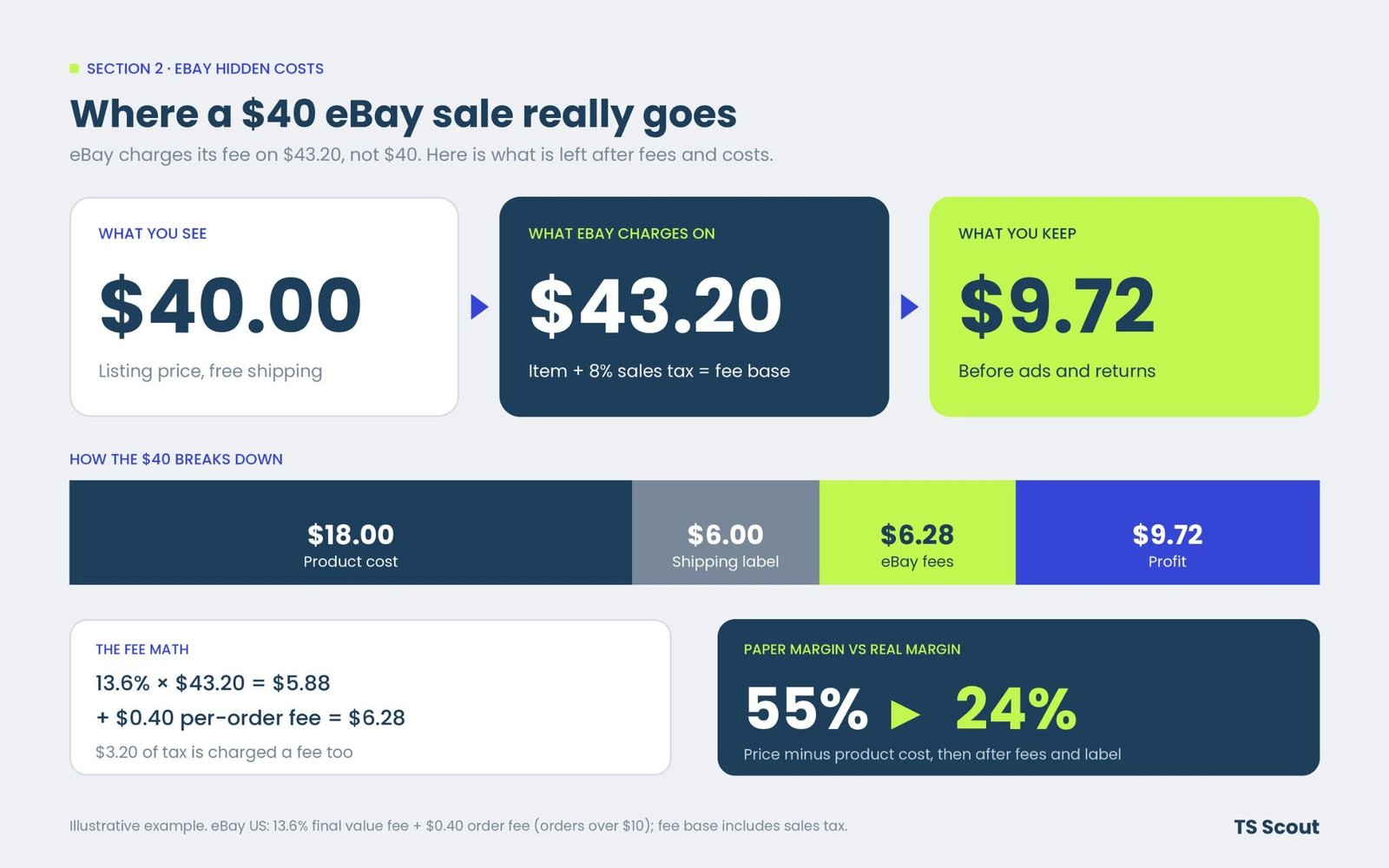
In practice, you pay a percentage on money you never keep. On a $40 item with free shipping and 8% sales tax, the fee base is $43.20, so $3.20 of fee-bearing money belongs to the tax authority. There's also a fixed per-order fee: $0.30 for orders of $10 or less and $0.40 above that.
One nuance: if you offer a cheaper domestic shipping option next to 1-day or international shipping, eBay uses the cheapest domestic option for the fee base. Because shipping feeds the fee base, work out your real carrier cost first, and how to calculate shipping costs for dropshipping walks through that math.
How Much Does the Final Value Fee Change by Category?
The headline 13.6% applies to most categories, but plenty differ. Per eBay Selling fees:
|
Category |
Final value fee |
|
Most categories |
13.6% up to $7,500, then 2.35% above |
|
Books, Movies, Music |
15.3% |
|
Jewelry & Watches |
15% up to $5,000, then 9% above |
|
Women's Bags & Handbags |
15% up to $2,000, then 9% above |
|
Select collectibles and trading cards |
13.25% |
|
Athletic shoes ($150 and above) |
8% |
A two-point gap between categories can decide whether a product is worth sourcing. A 30% gross margin item in a 15.3% category behaves very differently from the same margin at 8%. eBay Segment Insight helps here by showing demand, competition and growth at niche level, so you can rule out segments where the category fee leaves no room before you spend on stock.
What Penalty Fees Can Hit Your Account?
These costs depend on how you perform, not what you sell, so few sellers budget for them. eBay Selling fees lists:
-
Below Standard performance: +6% on the final value fee, rising to +7% after four or more consecutive months.
-
Very High "item not as described" rate: +5%, rising to +6% after four months.
-
Dispute fee: $20 per dispute.
A 6-point surcharge on a 13.6% fee is a 44% increase in your fee rate. If your numbers only work at the standard rate, one bad month can turn profit into loss. Account health problems can also escalate beyond fees, and eBay Account Suspension covers what recovery looks like.
What Do International Sales and Currency Conversion Add?
Selling abroad adds two charges. The international fee is 1.65% of the total sale when you’re not using eBay International Shipping. The currency conversion charge is currently 3%, and eBay has announced it rises to 3.25% effective October 14, 2026. If a meaningful share of your sales is cross-border, that quarter-point comes straight off your margin.
What Optional Costs Creep In?
Everything below is "optional," yet few sellers avoid all of it:
-
Listings: 250 free per month, then $0.35 each.
-
Listing upgrades: paid whether or not the item sells.
-
Promoted Listings Standard: the ad fee is charged only when the item sells, but it sits on top of the final value fee.
-
Shipping labels and packaging.
Promoted Listings is where margin leaks quietly, because a small ad percentage feels harmless until you add it to everything else. eBay's own Seller Hub reports show what you've already sold, but they can't show the market you haven't entered yet. eBay Product Research fills that gap with average price, listing volume and total units sold, filtered by price, marketplace and seller feedback, so you model fees against real selling prices instead of optimistic ones. eBay Competitor Research shows top sellers' best-performing listings, pricing and store-level trends, including whether they absorb shipping or charge for it, which changes their fee base.
Is an eBay Store Worth It?
It depends on volume, and the cheapest tier isn't the one that saves money. eBay's Seller Center explains that Store subscriptions come with their own final value fee schedule. As an approximate guide on annual billing, US plans run from about $5 a month for Starter to about $300 for Anchor, with Basic around $22. A Starter Store generally doesn't lower your final value fee, while Basic and above pay a lower rate in most categories, roughly 12.7% against the standard 13.6%. Check the current rate for your category before deciding.
Here's a quick, illustrative break-even using those approximate figures. Suppose your average fee base is $54. A 0.9-point saving is about $0.49 per order, so a Basic subscription of about $22 pays for itself at roughly 45 orders a month, before any other Store benefits. eBay Store Subscription Plans compares each tier's trade-offs.
How Does Amazon Hide Costs?
What Does the Basic Fee Stack Look Like?
Amazon’s costs begin before the first sale. The Professional plan is $39.99 a month, and the Individual plan is $0.99 per item sold, per Amazon Seller Central pricing. On top of that comes the referral fee, which varies more than “15%” suggests:
|
Category (US) |
Referral fee |
|
Home & Kitchen |
15% |
|
Consumer Electronics |
8% |
|
Clothing & Accessories |
5% up to $15, 10% from $15 to $20, 17% above $20 |
|
Jewelry |
20% on the first $250 |
There’s a $0.30 minimum, and the fee base includes shipping and gift-wrap charges. Then comes the FBA fulfillment fee, which depends on size tier, weight and price band. A single large referral fee is less dangerous than the fulfillment fee sitting quietly beside it.
What Is the Fuel and Logistics Surcharge?
This is the clearest example of why "no fee increases this year" claims go stale. Starting April 17, 2026, Amazon applies a 3.5% fuel and logistics-related surcharge to fulfillment fees for FBA in the US and Canada, per Amazon's Seller Central announcement. Three details matter:
-
It's calculated on the fulfillment fee, not the sale price, so it hides from price-based margin math.
-
Amazon's stated average is $0.17 per unit for US FBA.
-
It reached Buy with Prime and Multi-Channel Fulfillment on May 2, 2026.
Amazon describes the surcharge as temporary and says it will keep evaluating it, but hasn't given an end date. Plan as if it stays until Amazon says otherwise. In the UK and other European stores the surcharge is 1.5%, per Amazon's European pricing page.
What Are the 2026 Holiday Peak Fees?
From October 15, 2026 to January 14, 2027, Amazon applies peak fulfillment fees averaging $0.32 per unit above non-peak rates, the same increase as last year, with the 3.5% surcharge on top, according to Amazon’s 2026 holiday fee announcement as reported by Supply Chain Dive. The timing rule matters: fees are charged when a shipment leaves the fulfillment center, so stock that arrived in September still pays peak rates on units that ship after October 15. ebay seasonal selling explains how to plan inventory and pricing around the same Q4 demand.
How Do You Use an eBay Profit Margin Calculator Without Fooling Yourself?
A calculator is only as honest as its inputs. The most common mistake is entering the item price as the fee base and forgetting sales tax. Here’s the $40 example from the intro, illustrative figures:
|
Line |
Amount |
|
Item price (free shipping) |
$40.00 |
|
Sales tax (8%) |
$3.20 |
|
Fee base |
$43.20 |
|
Final value fee (13.6%) |
$5.88 |
|
Per-order fee |
$0.40 |
|
Total eBay fees |
$6.28 |
|
Product cost |
$18.00 |
|
Shipping label |
$6.00 |
|
Profit before ads and returns |
$9.72 |
|
Real margin |
~24% (vs. 55% paper margin) |
Add a 10% Promoted Listings rate and one return, and that $9.72 shrinks fast. The only reliable defence is running every candidate product through the formula before you buy it. To skip the manual math, the TS Scout Profit Calculator lets you enter your product cost, shipping, platform fees and ad spend, so you can see your true margin before you commit to stock.
When Does Slow Stock Start Costing You?
Storage is monthly, and it gets worse the longer a unit sits. Amazon's aged inventory surcharge applies to US inventory stored more than 181 days, charged monthly on top of standard storage fees, and the rates escalate with age. Exact tiers change, so check your Fee Preview report. A product that ties up cash for six months can cost more to hold than it earns.
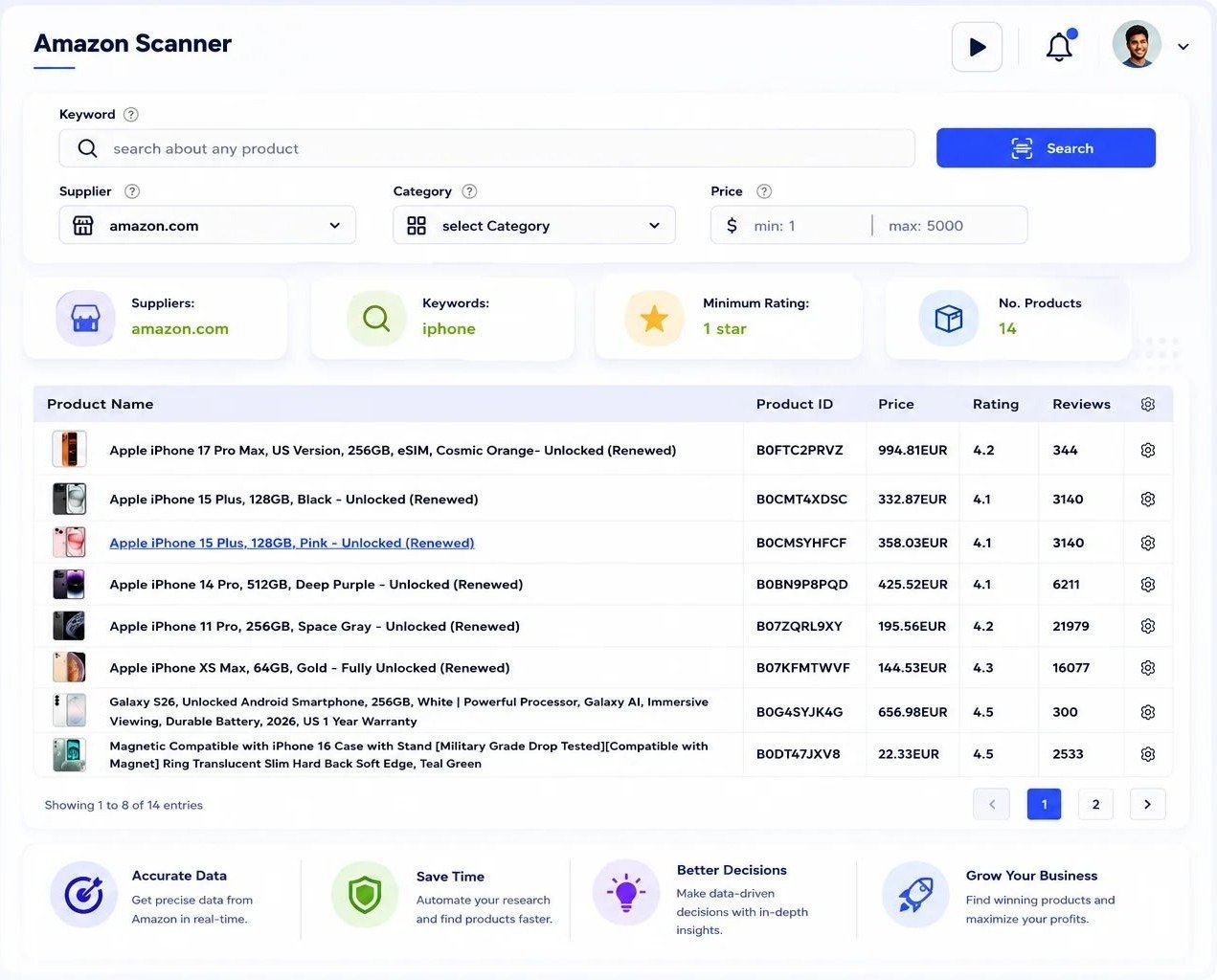
That makes product selection a fee decision. Amazon Scanner tracks trending and high-demand products, so you favour steady movers over items that risk the surcharge.
What Are the Smaller Fees That Add Up?
Individually small, collectively not:
-
Inbound placement fee: can apply depending on how you split inventory across fulfillment centers.
-
Low-inventory-level fee: now assessed at FNSKU level rather than per parent ASIN.
-
Returns processing fee: charged when Amazon provides the customer with free return shipping.
-
Refund administration fee: on a refund, Amazon returns the referral fee minus an admin fee, which on the UK store is reported as the lesser of £5 or 20% of the referral fee.
Returns are the least predictable of these, and dropshipping product returns covers how to budget for them. A high return rate can erase the margin on the next ten sales.
Which Marketplace Takes More: eBay or Amazon?
Neither, in general. It depends on what you sell.
|
Factor |
eBay |
Amazon |
|
Fee base |
Item + shipping + handling + sales tax |
Sale price + shipping/gift-wrap (referral); size and weight (fulfillment) |
|
Timing |
At sale |
At shipment, monthly storage, conditional penalties |
|
Penalties |
+6% / +5% performance surcharges, $20 disputes |
Aged inventory, returns processing, low-inventory fees |
|
Optional costs |
Promoted Listings, upgrades, Store |
Advertising, inbound placement |
Light, fast-selling, higher-priced products tend to tolerate Amazon's fulfillment fees better. Heavy, slow or low-priced products can drown in them, while eBay's single percentage is easier to predict. Anyone claiming one marketplace is always cheaper is skipping the product-level math.
How Do You Calculate eBay Profit?
What Is the Step-by-Step Formula?
Use this order every time:
-
Total sale: item price + buyer-charged shipping + handling + sales tax.
-
Fee base: the same total.
-
Fees: fee base × final value fee rate + per-order fee ($0.30 or $0.40).
-
Add international fee, currency conversion and Promoted Listings if they apply.
-
Subtract product cost, shipping label, packaging and a returns buffer.
How Do You Use an eBay Profit Margin Calculator Without Fooling Yourself?
A calculator is only as honest as its inputs. The most common mistake is entering the item price as the fee base and forgetting sales tax. Here's the $40 example from the intro, illustrative figures:
|
Line |
Amount |
|
Item price (free shipping) |
$40.00 |
|
Sales tax (8%) |
$3.20 |
|
Fee base |
$43.20 |
|
Final value fee (13.6%) |
$5.88 |
|
Per-order fee |
$0.40 |
|
Total eBay fees |
$6.28 |
|
Product cost |
$18.00 |
|
Shipping label |
$6.00 |
|
Profit before ads and returns |
$9.72 |
|
Real margin |
~24% (vs. 55% paper margin) |
Add a 10% Promoted Listings rate and one return, and that $9.72 shrinks fast. The only reliable defence is running every candidate product through the formula before you buy it.
What Does an Amazon FBA Fee Breakdown Look Like?
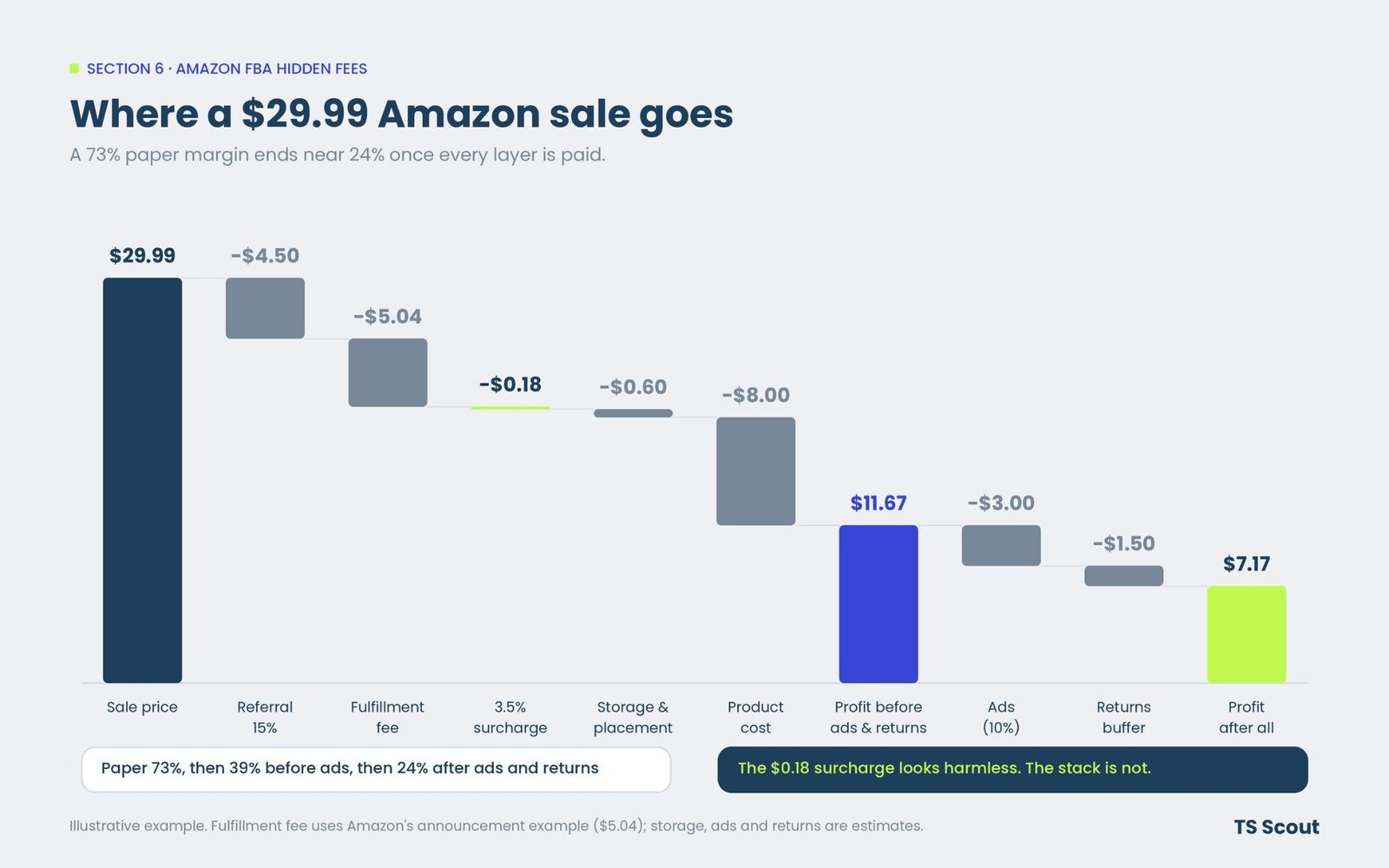
Take a $29.99 product, illustrative figures. The $5.04 fulfillment fee is the example Amazon gave when announcing its surcharge, so your own product's fee will differ. Storage, ads and returns are rough estimates:
|
Line |
Amount |
|
Sale price |
$29.99 |
|
Referral fee (15%) |
$4.50 |
|
Fulfillment fee |
$5.04 |
|
Fuel and logistics surcharge (3.5% of $5.04) |
$0.18 |
|
Storage and placement (estimate) |
$0.60 |
|
Product cost |
$8.00 |
|
Profit before ads and returns |
$11.67 (~39%) |
|
Advertising (10% of price) |
$3.00 |
|
Returns buffer |
$1.50 |
|
Profit after ads and returns |
$7.17 (~24%) |
The paper margin was 73%. The surcharge itself was only $0.18, which is exactly why it goes unnoticed: no single line looks alarming, but the stack removes nearly two-thirds of the margin. For a fast sourcing sanity check, Express Product Research searches AliExpress products by name and filters by price, category and sales performance, so you can see the cost side before committing to the margin side.
What About UK Sellers?
UK fees differ enough that US figures shouldn't be reused. The figures below are for business sellers, and the Amazon numbers are approximate.
eBay UK, per eBay UK's business seller fees:
-
Final value fees vary by category and exclude VAT. Music is 9.9% and Musical Instruments & DJ Equipment is 10.9%.
-
Transaction fees also include a regulatory operating fee and a per-order fee, with 20% VAT added to eBay's fees.
-
Below Standard sellers pay an extra 6 percentage points, so a 9.9% fee becomes 15.9%.
Amazon UK, per Amazon's European pricing page:
-
The FBA fuel and logistics surcharge is 1.5%, not 3.5%.
-
The Professional plan is about £25 a month excluding VAT, and the Individual plan is under £1 per item.
-
Aged inventory surcharges start later than in the US (reported at around 241 days), and storage rates rise in the final quarter, so check your Fee Preview before planning Q4 stock.
-
Some UK-established sellers also see a separate digital services fee on Amazon fees, reported at around 2%. Check whether it applies to you.
UK fees also carry VAT, which VAT-registered sellers can often reclaim and non-registered sellers cannot. That single difference changes who feels the pain most.
What If You Don't Hold Stock?
FBA's storage, aged inventory and placement fees mostly don't apply if you never touch inventory. But fulfillment risk and policy risk do, and both cost money.
On eBay, drop shipping where you fulfill orders directly from a wholesale supplier is allowed, but you stay responsible for safe delivery and the buyer's satisfaction, per eBay's drop shipping policy. Listing an item and then buying it from another retailer or marketplace that sends it straight to your customer is not allowed. On Amazon, third-party fulfillment is only acceptable when you're clearly the seller of record, with no other seller's name on packing slips, invoices or external packaging, per Amazon's Drop Shipping Policy. Violations can restrict your selling privileges.
This is a profit issue, not just a compliance one. Policy-driven "item not as described" and late-delivery defects trigger the surcharges in Sections 2.3 and 7, and a suspension freezes income entirely. The sourcing side deserves the same scrutiny: aliexpress hidden fees shows what AliExpress adds before an order ships, and When Your AliExpress Price Increases at Checkout explains why the number you modelled isn't always the number you pay.
AliExpress works best as a research and sourcing-analysis layer. Express Source Finder analyzes an AliExpress store from its shop URL, showing product listings, prices, ratings and total units sold, so you judge a supplier's track record with data instead of a star rating. Before relying on any supplier for fulfillment, check their delivery record, and Spot a Reliable Amazon Seller applies the same discipline from the buyer's side. If you'd rather have inventory handled for you, Walmart WFS vs 3PL Fulfillment compares the alternatives to FBA.
What Costs Do Neither Fee Page Show?
Beyond platform fees, three costs sit outside them:
-
Shipping: carrier surcharges move independently of marketplace fees. Recalculate whenever rates change (see how to calculate shipping costs for dropshipping).
-
Refunds: eBay credits back some fees on refunds and cancellations, but not your outbound shipping, and Amazon's refund administration fee works in the opposite direction.
-
Platform comparisons: the same hidden-cost pattern appears elsewhere, as hidden costs of shopify shows.
Tax is the biggest blind spot. In the US, the federal Form 1099-K reporting threshold is more than $20,000 and more than 200 transactions, as reinstated by the One, Big, Beautiful Bill, according to the IRS Form 1099-K FAQs. That only decides whether a platform sends you a form. Sales income is generally taxable whether or not you receive one, and some states or platforms use different thresholds. The Dropshipping taxes explains how to set money aside before the bill arrives.
In the UK, digital platform reporting rules started on 1 January 2024, so platforms now report seller information to HMRC, per GOV.UK. Being reported doesn't automatically mean you owe tax, because trading allowances and VAT registration thresholds are separate tests with their own limits. Check the current figures on GOV.UK before assuming you're under any of them.
What Does a Healthy Margin Look Like After Every Fee?
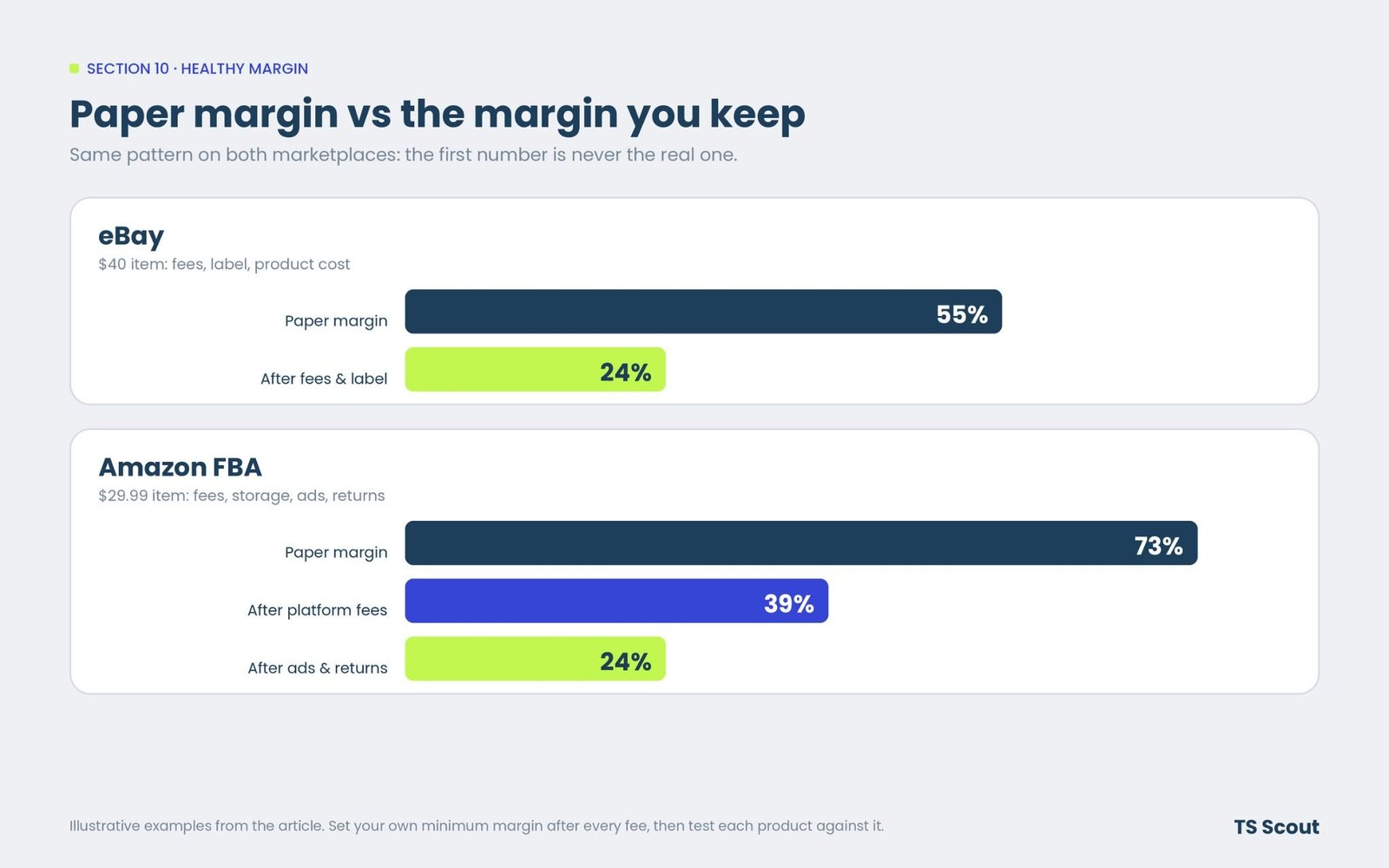
Take the Amazon example from Section 6 and the eBay example from Section 5, both illustrative:
|
Stage |
eBay ($40 item) |
Amazon ($29.99 item) |
|
Paper margin (price − product cost) |
55% |
73% |
|
After platform fees (and label) |
~24% |
~39% |
|
After ads and returns buffer |
not modelled |
~24% |
A 73% product ended at 24%, and that's a normal outcome, not a bad one. The mistake was only in judging it by the first number. What counts as healthy depends on your category, order volume and cash cycle, so average profit margin in dropshipping gives realistic benchmarks to compare against. Set your own minimum after every fee and reject anything that fails it.
How Can You Protect Your Margin on Both Platforms?
Four moves protect profit more than any single fee trick:
-
Choose categories where the fee leaves room. eBay Segment Insight compares niches before you commit to one.
-
Price against real competitors. eBay Competitor Research shows how top sellers price and handle shipping, so you don't underprice into the fee base.
-
Lower your dependence on paid promotion. eBay Smart Titles builds titles from keyword suggestions and real search volume data, so organic visibility does some of the work Promoted Listings would otherwise charge for.
-
Pick steady-demand Amazon products. Amazon Scanner surfaces trending, high-demand items so stock moves before storage fees climb.
If a product's numbers still fail after all four, that's a signal rather than a failure, and the profit pivot explains how to move to a better product instead of defending a bad one.
What Would Your Best-Selling Product Really Earn If Every Fee Was Counted Today?
You've seen both sides: eBay charging on tax and shipping, Amazon stacking small fees until the margin thins. The only way to know your real number is to run it product by product. Start a $1 trial for 14 days with full access to TS Scout and test your best seller against real market data before the next fee change lands.
FAQs
-
Does eBay charge fees on shipping and sales tax?
Yes. eBay calculates the final value fee on the total amount of the sale, which includes the item price, handling, buyer-selected shipping, sales tax and other applicable fees.
-
How much does eBay take from a $100 sale?
In most US categories, 13.6% of the total sale plus $0.40. If the buyer pays $8 in tax, the fee base is $108, giving about $15.09 in fees before ads and optional costs.
-
Did Amazon raise FBA fees in 2026?
Yes. A 3.5% fuel and logistics surcharge on fulfillment fees started April 17, 2026 for US and Canada FBA, and holiday peak fees apply from October 15.
-
Is Amazon's fuel and logistics surcharge permanent?
Amazon describes it as temporary but has given no end date, and says it will continue to evaluate it.
-
When do Amazon's 2026 holiday peak fees apply?
From October 15, 2026 to January 14, 2027, averaging $0.32 per unit above non-peak rates, with the 3.5% surcharge on top.
-
Is an eBay Store worth it?
Only if your monthly sales in discounted categories save more than the subscription costs. A Starter Store generally doesn't reduce final value fees.
-
What fees do UK sellers pay on eBay and Amazon?
Business sellers on eBay UK pay category-based final value fees plus a regulatory operating fee and a per-order fee, with 20% VAT on fees. Amazon UK sellers pay a monthly plan (about £25 excluding VAT for Professional), referral fees and, if using FBA, a 1.5% fuel and logistics surcharge.
-
Do I owe tax if I don't receive a 1099-K?
Yes. Income is generally taxable whether or not a form arrives. The threshold only decides whether the platform must report it.
-
Can I sell on eBay or Amazon without holding stock?
Yes, but both platforms restrict how third-party fulfillment works, and you stay responsible for delivery and buyer satisfaction.
like?


Table of Contents
- Why Does Your Profit Disappear Even When the Price Looks Healthy?
- How Does eBay Hide Costs?
- How Does Amazon Hide Costs?
- Which Marketplace Takes More: eBay or Amazon?
- How Do You Calculate eBay Profit?
- What Does an Amazon FBA Fee Breakdown Look Like?
- What About UK Sellers?
- What If You Don't Hold Stock?
- What Costs Do Neither Fee Page Show?
- What Does a Healthy Margin Look Like After Every Fee?
- How Can You Protect Your Margin on Both Platforms?
- What Would Your Best-Selling Product Really Earn If Every Fee Was Counted Today?
- FAQs


