

How Much Profit Margin in Dropshipping Do You Really Keep? Every Hidden Cost That Turns 40% Into 8%
- 2026-10-04
-
 0
0

The margin on a product page and the money in your bank account are measured at different points. To show the gap, we'll follow Lena, a hypothetical seller, through one $50 product.
Lena's supplier page says the product costs $30 and sells for $50. That's a 40% margin, so her first 100 orders should leave $2,000. Her bank balance shows about $400 before tax. If you've ever wondered how much profit margin in dropshipping you can really expect, that gap is the answer nobody puts on the supplier page.
Search for the average profit margin in dropshipping and you'll find confident percentages with no source. No regulator or platform publishes one, so this guide gives you a method instead.
We follow Lena's product through nine costs, using official fee schedules, tax and customs rules, and retail research rather than guesses. Along the way the same $50 product loses 32 points of margin, from 40% down to 8%. You'll get a dropshipping profit margin calculator template, a reverse formula for your minimum price, and one number to check before you list anything. Every illustrative number is labeled as such. First, the difference between revenue and profit.
Dropshipping Revenue vs Profit: Why Does the Same Sale Tell Two Different Stories?
Revenue is what the customer pays you. Profit is what remains after every cost of earning that revenue. In dropshipping the two drift apart faster than in most models, because you pay platform, payment, refund, dispute and advertising costs on top of the product. That's why a dropshipping profit margin means little until you say which margin you mean.
Four terms keep the story straight:
|
Term |
What it measures |
Lena's product |
|
Revenue |
Customer payment |
$50.00 |
|
Gross margin |
Revenue minus landed cost |
$20.00 (40%) |
|
Contribution margin |
Gross margin minus per-order variable costs |
Calculated in the Lena walkthrough below |
|
Net margin |
What's left after every cost, ads included |
Calculated in the Lena walkthrough below |
Illustrative example:The 40% on Lena's supplier page is a gross figure. It's also worth separating markup from margin. Lena's $20 profit is a 67% markup on her $30 cost, but only a 40% margin on her $50 price. A 100% markup gives just a 50% margin, which is why a "double the price" rule of thumb overstates what you keep.
What Is a Good Profit Margin for Dropshipping in 2026?
A good dropshipping profit margin is one that survives stress-testing, because no official figure exists to measure it against. No regulator or platform publishes the average profit margin in dropshipping, and many articles quote a single range without tracing it to a primary source or saying whether it's gross or net. The same goes for the average net profit margin dropshipping stores earn: it isn't published anywhere official, so we don't quote one.
So how much profit margin in dropshipping is realistic? It depends on the product, the platform and the nine costs below, which is why two tests do the work:
-
The stress test: net profit per order stays above zero when returns rise and ad costs climb 20%. The Lena walkthrough below shows how thin that room can be, even when the paper margin looks generous.
-
The ROAS test: your break-even return on ad spend, calculated on fully loaded costs, sits below the ROAS you can realistically achieve.
In our model, a 40% paper margin ends at 8% net. Any figure below your paper margin is normal, and how far it falls depends on the costs you control.
How Do You Calculate True Dropshipping Profit, Cost by Cost?
Dropship net profit is your selling price minus nine costs, and most sellers track only the first. This section gives the rule and the official figure for each cost. The worked numbers live in the Lena walkthrough, so you see them once, together.
What Is Your Real Base Cost, Beyond the Listing Price?
Landed cost is what one order costs you delivered to your customer: the item, the chosen variant, and any shipping the supplier bills separately. Supplier prices also move, and a cost you locked in at listing can be higher by the time the order arrives. A fixed selling price absorbs all of that. AliExpress hidden fees are a common reason a supplier's advertised cost and your real landed cost don't match.
Before you commit to a margin, check whether the supplier's price has been stable and whether the product actually sells. Express Product Research shows price consistency and units sold for an AliExpress product, so you price against a cost that has been held rather than one screenshot. If price changes are already hurting you, the AliExpress price increases and margin protection playbook covers what to do next.
How Much Do Shipping and Fixed Per-Order Fees Really Cost You?
Free shipping is a cost you fund, not a feature that's free. Fixed per-order fees also hit low-ticket items hardest. eBay's selling fees page lists a $0.30 per-order fee on orders of $10 or less and $0.40 above that. Amazon's seller pricing page shows a $0.30 minimum referral fee, $0.99 per item on the Individual plan, and $39.99 a month for the Professional plan. Shopify's pricing page lists 30¢ per online card transaction. The eBay and Amazon hidden costs breakdown goes deeper on the smaller charges that don't show up in a headline rate.
A $0.40 fee is 0.8% of a $50 order but 3.3% of a $12 order. The cheaper the product, the more a fixed fee matters. One more detail: eBay's selling fees page says the final value fee is calculated on the total sale amount, including item price, handling charges, shipping collected from the buyer and sales tax. Amazon's seller pricing page also notes that an item's total price for referral fees includes list price, shipping costs and gift-wrapping charges. Your fee base is bigger than your item price on both marketplaces.
What Do Platform Fees Take From Each Sale?
Platforms charge in three ways: a commission, a fixed per-order fee, and a subscription. On marketplaces the commission also pays for buyer traffic. On your own store it doesn't, and you buy traffic separately (see ad waste below). The platform comparison later in this guide puts all three on one product, and the hidden costs of Shopify cover the app and subscription layer that store owners tend to underestimate.
Subscriptions and apps become a per-order cost when you divide the monthly total by your monthly orders. Shopify's pricing page lists the Basic plan at 39amonthonmonthlybilling(29 if paid yearly), before any apps. If you pay $60 a month across your store plan and apps and ship 100 orders, that's $0.60 per order. The same $60 across 20 orders is $3.00.
How Much Do Payment Processing Fees Cost?
On Shopify, the Basic plan's online card rate is 2.9% + 30¢, with an extra 2% third-party transaction fee if you use another payment provider, per Shopify's pricing page. On eBay and Amazon, processing is folded into the platform's own fees, so you don't pay it as a separate line.
If you sell in a currency different from your payout currency, expect a conversion cost on top, and payout holds can delay when the money reaches you. eBay's selling fees page says its seller currency conversion charge for US-registered sellers is 3% and rises to 3.25% from October 14, 2026, when eBay converts your funds for an item listed or sold on another eBay site. The exact charge on other platforms depends on your provider, so check it in your own account. If you list for buyers abroad, Change eBay Currency explains how the currency you choose affects what you receive.
The wider freight picture, including carrier choice by route, is broken down in international shipping dropshipping cost.
How Big Should Your Returns Buffer Be?
Use a buffer for returns, not a hope that they won't happen. The NRF and Happy Returns 2025 Retail Returns Landscape estimated that 19.3% of online sales would be returned in 2025, and that 9% of all returns were fraudulent. This is a survey of retailers in general, not dropshippers, so treat it as context rather than a rate for your store, and a realistic dropshipping profit margin starts from your own return data.
Dropshipping adds a twist. Sending a return back to an overseas supplier is rarely economical, so many refunds become a total loss. Your buffer should be the net cost of returns after whatever you recover. Setting a return policy that protects you is covered in dropshipping product returns.
What Do Chargebacks and Disputes Cost Beyond the Refund?
A dispute costs you the refund plus fees, and on eBay it can also raise your future fees. Per eBay's selling fees page, eBay charges a $20 dispute fee when you're found responsible for the disputed amount. It also adds 6% to final value fees when your account is Below Standard (7% after four consecutive months). A "Very High" rate of "item not as described" requests adds 5% (6% after four months), but if both apply, only the Below Standard surcharge is charged.
On Shopify, card-network monitoring matters at scale. The Shopify Help Center lists Visa's "Excessive" VAMP ratio threshold for merchants at 1.5% in most regions since April 1, 2026 (it was 2.2% before), with 2.2% staying in place for Central Europe, the Middle East and Africa. It only applies once you reach a monthly minimum of combined disputes and fraud reports, so check the current figures for your region.
The formula for budgeting it is:
Dispute rate × (revenue refunded + dispute fee)
You don't add product cost again, because it's already in your landed cost. Platforms don't all publish a single chargeback fee, so in our example we use an assumed $15 and label it as an assumption. If a supplier goes silent after you've been paid, disputes follow, which is why the guide on what to do when an AliExpress supplier is unresponsive matters here.
What Is Customer Service Time Worth?
Your time is a cost even when nobody invoices it. Multiply the minutes each order takes (tracking questions, refund handling, messages) by what an hour of your time is worth. It's a small number per order, and a large one across a month.
How Does Tax Liability Change What You Keep?
Sales tax collected from a customer is pass-through money, not profit. Income tax applies to what you earn. For a US sole proprietor, the IRS states that the self-employment tax rate is 15.3%, made up of 12.4% for Social Security and 2.9% for Medicare. We use "up to 15.3%" in our model because the exact base depends on your situation.
Who ultimately owns the bill once the parcel is yours is covered in The Tax Liability.
Import rules changed sharply. The Federal Register shows that the US $800 de minimis exemption has been suspended for all countries since August 29, 2025 (China and Hong Kong since May 2, 2025). CBP's rule making the suspension indefinite for all modes other than the postal network means those shipments must use formal or informal entry procedures, and it took effect on June 24, 2026. A companion postal rule extends the suspension to shipments through the international postal network, effective July 24, 2026, and gives certain shipments a 120-day delayed compliance window that ends on October 22, 2026. A statute ends the exemption entirely on July 1, 2027. We don't quote a duty rate here. The amount depends on the product's tariff classification and country of origin.
For UK customers, GOV.UK says the £135 low-value import relief will be removed, with the measure coming into force by October 2028 at the latest. VAT already applies to these goods following reforms in 2021, per GOV.UK's consultation page. UK sole traders should verify their own obligations there.
What Is Ad Waste, and How Do You Find Break-Even ROAS?
Ad waste is spend that doesn't return its cost. The threshold is your break-even ROAS, and it tells you whether your dropshipping profit margin survives advertising:
Break-even ROAS = selling price ÷ contribution before ads
Contribution before ads is what you keep after the first eight costs. If it's $12 on a $50 sale, you need $4.17 of revenue for every $1 of ad spend just to break even. We quote no third-party ROAS statistics, because none are officially published. This formula uses only your own numbers. Count ad spend on orders that later get refunded, because you paid for the click either way.
Which Formula Gives You a Dropshipping Profit Margin Calculator You Can Trust?
The dropshipping profit margin calculator that matters is the one you can audit line by line. Copy this template into a spreadsheet and fill in your own numbers:
|
Line |
How to fill it |
Your number |
|
1. Selling price |
What the customer pays, excluding sales tax |
|
|
2. Landed cost |
Item + supplier shipping |
|
|
3. Paper margin |
Line 1 − line 2 |
|
|
4. Payment fees |
Platform or processor rate on line 1 |
|
|
5. Returns |
Net cost after recovery, per order |
|
|
6. Disputes |
Dispute rate × (revenue refunded + fee) |
|
|
7. Support |
Minutes × hourly value |
|
|
8. Overhead |
Monthly subscriptions and apps ÷ monthly orders |
|
|
9. Contribution before ads |
Line 3 − lines 4 to 8 |
|
|
10. Ads |
Blended ad cost per order |
|
|
11. Net profit |
Line 9 − line 10 |
|
|
12. Net margin |
Line 11 ÷ line 1 |
|
|
13. Break-even ROAS |
Line 1 ÷ line 9 |
Master formula: Net profit = price − landed cost − payment fees − returns cost − dispute cost − support − overhead − ads. Whatever this returns per order is your dropship net profit.
Reverse formula (your minimum price for a target margin):
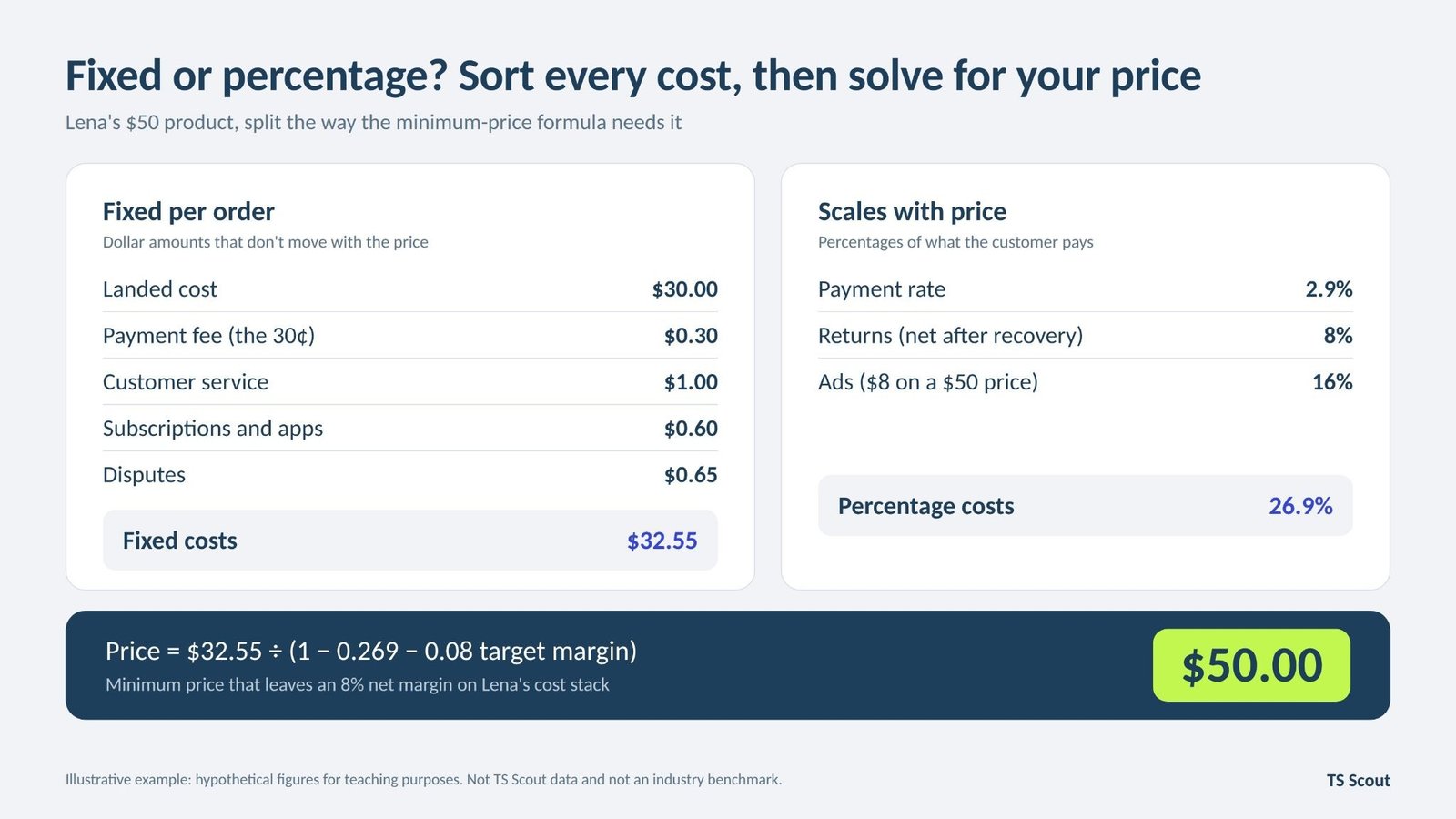
Price = (landed cost + fixed per-order costs) ÷ (1 − percentage costs − target net margin)
Fixed costs are dollar amounts per order, such as the 30¢ payment fee, support, overhead and (for simplicity) disputes. Percentage costs are those that scale with price, such as the payment rate, returns and ads. Check it with Lena's numbers: fixed costs of 32.55(30 landed cost + $0.30 + $1.00 + $0.60 + $0.65), divided by (1 − 0.269 − 0.08), gives $50.00. The 0.269 is her 2.9% payment rate, 8% returns and 16% ads (her $8 ad cost as a share of a $50 price). That's the price where her cost stack leaves an 8% dropshipping profit margin.
How Do eBay, Amazon and Shopify Margins Compare on the Same Product?
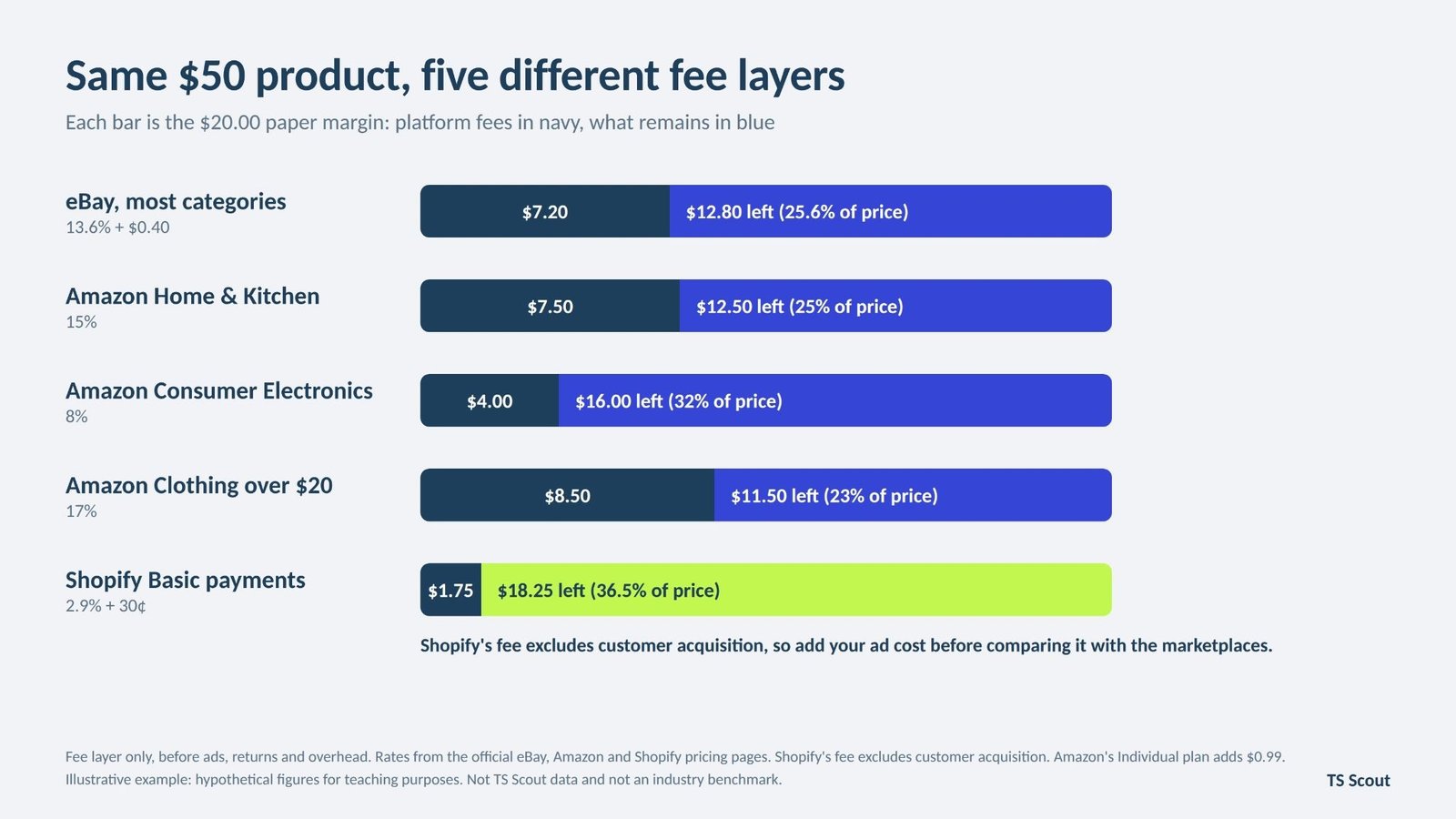
On the same $50 product with a $30 landed cost, fees alone leave anywhere from $11.50 to $18.25, depending on the platform. This compares the fee layer only, before ads, returns and overhead. The fee rates are official, while the $50 product is hypothetical.
|
Platform and category |
Fee on $50 |
Left of the $20 paper margin (% of price) |
|
eBay, most categories (13.6% + $0.40) |
$7.20 |
$12.80 (25.6%) |
|
Amazon, Home & Kitchen (15%) |
$7.50 |
$12.50 (25%) |
|
Amazon, Consumer Electronics (8%) |
$4.00 |
$16.00 (32%) |
|
Amazon, Electronics Accessories (15% on the first $100) |
$7.50 |
$12.50 (25%) |
|
Amazon, Clothing over $20 (17%) |
$8.50 |
$11.50 (23%) |
|
Shopify Basic (2.9% + 30¢) |
$1.75 |
$18.25 (36.5%) |
The referral rates come from Amazon's seller pricing page. Note the gap inside electronics: Consumer Electronics is 8%, but Electronics Accessories is 15% on the portion up to $100, so a phone case and a phone are treated very differently. eBay's number goes higher if sales tax sits in the fee base, and Amazon's Individual plan adds $0.99. On eBay, if your registered address is in the US and you don't ship through eBay International Shipping, an international order adds 1.65% of the total sale amount, according to eBay's selling fees page.
Shopify looks cheapest because its fee doesn't include customer acquisition. Marketplace fees do, so a Shopify margin is only comparable once you add your ad cost. The Amazon Revenue Calculator lets you search a product or define its dimensions, weight, category, price and shipping, then estimates fees, costs and revenue for Amazon's fulfillment or your own. It answers what Amazon will take. It can't tell you whether the product sells at your price or whether the supplier's cost holds, and that's the part that decides your margin. To see which Amazon products are trending before you run the fee math, Amazon Scanner tracks high-demand items and emerging opportunities.
eBay Product Research covers that side on eBay: average selling price and units sold, so you can check that the price in your fee math is one buyers actually pay. eBay Segment Insight then adds niche demand and competition, which tells you whether a segment can carry a fee layer this size. On the Shopify side, Shopify Competitor Research shows what a competing store charges for the same product, which is the price check your margin needs since Shopify gives you no built-in traffic.
The policy gate most margin guides skip
A cheaper marketplace margin doesn't help if your sourcing isn't allowed there.
-
eBay: eBay's dropshipping policy allows dropshipping from a wholesale supplier, and says listing an item and then buying it from another retailer or marketplace that ships directly to your customer is not allowed. eBay's guidance for cross-border sellers adds that you must own the item before listing or have an agreement with a wholesale supplier, and that a user agreement from another retailer or marketplace doesn't count. You remain responsible for delivery within the time stated in your listing. The eBay Dropshipping Guide 2026 walks through how to set that up compliantly.
-
Amazon: per Amazon's drop shipping policy, you must be clear to the customer as the seller of record, and buying from another online retailer and having it ship directly to customers is strictly prohibited without exception if anyone other than you appears on packing slips, invoices or external packaging. You also handle returns.
So for stock sourced from AliExpress, the "cheaper" marketplace margin in the table is often unavailable to you, and a breach risks suspension. The guide on recovering from an eBay account suspension covers the way back. For AliExpress-sourced products, your own store is usually the compliant route.
What Dropshipping Profit Margins Should You Expect in Electronics, Fashion and Home Goods?
The margins below are modelled scenarios, not benchmarks. We changed only the landed cost and returns assumptions and held everything else at Lena's stack (Shopify-style payment fees, $8 ads, $1 support, $0.60 overhead, $0.65 disputes).
|
Category |
Assumed landed cost |
Assumed returns cost |
Modelled net |
Amazon referral fee (official) |
Main driver |
|
Electronics |
$36 |
$3.00 (6%) |
−$1.00 (−2%) |
8% consumer electronics, 15% accessories |
Thin markup, fast price competition |
|
Fashion |
$22 |
$7.50 (15%) |
$8.50 (17%) |
17% clothing over $20 |
Size and fit returns |
|
Home goods |
$31, bulky shipping |
$4.00 (8%) |
$3.00 (6%) |
15% Home & Kitchen |
Shipping weight |
Electronics goes negative because a thin markup can't absorb a fixed ad cost. Fashion has the most room but is the most exposed to returns: each extra 5 points of returns costs $2.50 on this product. Home goods sit in the middle until shipping weight grows.
To replace our assumptions with market data, pull the average selling price for your category from eBay Product Research, then use Shopify find stores to see what competing stores charge and whether your price point is realistic before you fill in the template. Find Profitable Shopify Stores in Your Niche shows how to pick which of those stores are worth benchmarking against.
What Does a 40% Dropshipping Profit Margin Look Like When It Really Makes 8%?
It looks like $4.00 on a $50 order. This is Lena's product, one order at a time.
Illustrative example: hypothetical figures for teaching purposes. Not TS Scout data and not an industry benchmark. Your numbers will differ.
|
Item |
Per order |
|
Price |
$50.00 |
|
Landed cost |
−$30.00 |
|
Paper margin (40%) |
$20.00 |
|
Payment fees (2.9% + 30¢) |
−$1.75 |
|
Ads (assumed blended cost per order) |
−$8.00 |
|
Returns (assumed 8%, net after recovery) |
−$4.00 |
|
Disputes (1% × ($50 + assumed $15 fee)) |
−$0.65 |
|
Customer service (4 minutes at $15/hour) |
−$1.00 |
|
Subscriptions and apps ($60 ÷ 100 orders) |
−$0.60 |
|
Total hidden costs |
−$16.00 |
|
Net profit (8%) |
$4.00 |
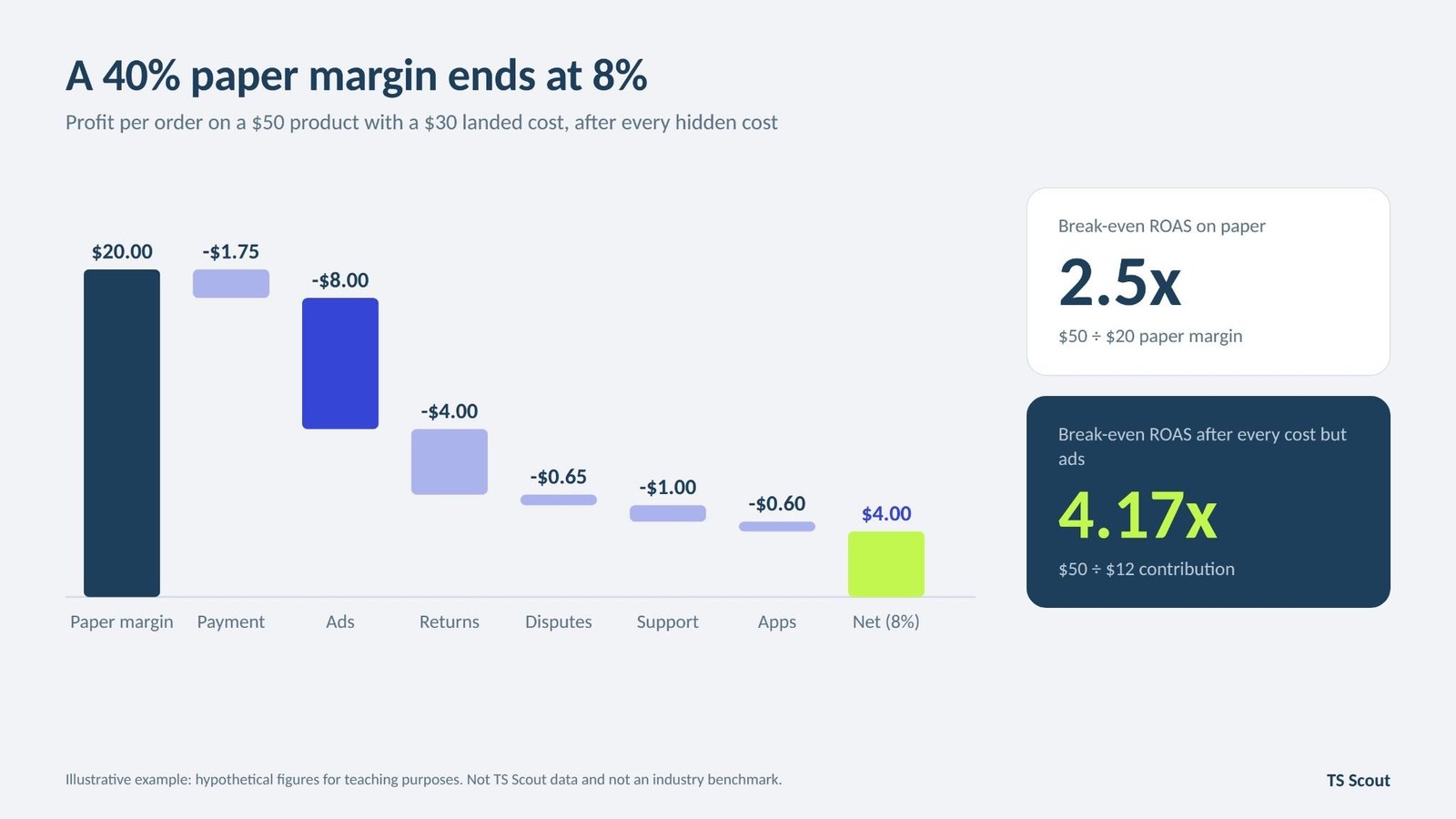
Across 100 orders, that's the $400 Lena saw instead of $2,000. After self-employment tax of up to 15.3% (about $0.61 per order), she keeps roughly $3.39 before income tax.
Three assumptions deserve honesty. The $8 ad cost assumes a strong share of organic and repeat orders, so it's optimistic for a new store. The 8% returns figure is an assumed net cost after recovery, well below the general online rate in the NRF report. The $15 dispute fee is our assumption, not a quoted platform figure.
The break-even ROAS tells the same story. On paper it's 2.5x ($50 ÷ $20). After every cost except ads, contribution is $12, so it's 4.17x ($50 ÷ $12). Lena's ads need to return $4.17 for every dollar just to break even.
Now change one thing at a time: Illustrative example: hypothetical figures, one variable changed at a time.
|
Change |
New net per order |
Net margin |
|
Base case |
$4.00 |
8% |
|
Ads cost 20% more ($9.60) |
$2.40 |
4.8% |
|
Supplier price up 10% ($33) |
$1.00 |
2% |
|
Returns rise from 8% to 15% |
$0.50 |
1% |
Each of these moves cuts deep into the margin, and the last two leave almost nothing. That's what an honest answer to "how much profit margin in dropshipping" looks like. It's a number that depends on the costs you control, not an average net profit margin dropshipping blogs can hand you.
Which Red Flags Show a Product Is Profitable on Paper Only?
Six checks catch most of the gap between a paper dropshipping profit margin and a real one:
-
The margin is quoted on the supplier price only. Recompute it with all nine costs before you trust it.
-
Your break-even ROAS is higher than the ROAS you can achieve. Lena's 4.17x is the kind of number that fails here.
-
Your price sits near the floor. Run the reverse formula from the calculator section for your target margin. If the result is close to what buyers pay, fixed fees leave no room for error.
-
Returns can't be recovered. Bulky, fit-dependent or overseas-shipped products turn refunds into full losses.
-
Import duty or VAT sits with you. With the US $800 exemption suspended, cross-border cost is now a pricing input.
-
The supplier is unreliable. Late or missing deliveries create disputes, and on eBay a high rate of "item not as described" requests adds to your final value fees. See the guide on unresponsive AliExpress suppliers.
When a product fails these checks, the fix is usually a Profit Pivot toward a product or price point with more room, not more ad spend. The levers that move a thin margin are the ones in the sensitivity table: the selling price, the landed cost, the share of returns you can recover, and how efficiently your ads convert.
Is Dropshipping From AliExpress Profitable?
Yes, when the unit economics survive the nine costs, and in practice mostly on your own store, given the marketplace policy limits above. The question isn't the source. It's whether the dropshipping profit margin on a specific product at a specific price still clears break-even ROAS.
Two checks help before you commit. Express Product Research gives product-level data, including units sold and price consistency, so you know a supplier's number has held up. It's the same habit behind The Science of Product Research: decide with sales data, not with a single listing. Express Source Finder takes a seller's shop URL and shows prices, ratings and units sold, which helps you vet who you're relying on before you build a margin around them. For the wider picture, read Dropshipping Pros and Cons in 2026, the AliExpress product sourcing guide and the pros and cons of Shopify dropshipping.
Which One Number Decides Whether Your Next Product Is Worth Listing?
Break-even ROAS on fully loaded costs. It folds the landed cost, fees, returns, disputes and overhead into one figure you can compare with what your ads can realistically deliver. If it's out of reach, the product isn't a bargain at any paper margin, and no dropshipping profit margin on a supplier page can change that.
Start with your best-selling product: copy the template from the calculator section, fill in your real costs, and read the break-even ROAS at the bottom. Then test the next product before you spend on ads. If you're still deciding on a business model, Start Your Own Online Business in 2026 helps you choose, and once your numbers hold, Build a Successful Dropshipping Empire in 2026 covers scaling. To check prices, demand and suppliers with real data instead of estimates, start the $1, 14-day full-access trial of TS Scout.
FAQS
-
What is the average profit margin in dropshipping, and is 40% good?
No regulator or platform publishes an average. A 40% figure is usually a paper margin, before payment fees, returns, disputes, support, overhead and ads. In our model it ends at 8%, so judge a margin by the stress test above.
-
What net margin should you reach before scaling ad spend?
There's no official target. Scale only when net profit stays positive if ad cost rises 20% and returns rise, and your break-even ROAS is below the ROAS you can achieve.
-
Can you dropship from AliExpress to eBay or Amazon?
Both platforms restrict it. eBay doesn't allow buying from another retailer or marketplace that ships directly to your customer, and Amazon prohibits shipments where another seller appears on the packing slip, invoice or packaging.
-
How do you calculate profit per order after returns?
Subtract the net cost of returns, after whatever you recover, along with the other eight costs from your selling price, using the template above.
-
Do dropshippers pay tax on profit or on revenue?
On profit for income tax. Sales tax collected from customers is passed on, not kept. US sole proprietors also pay self-employment tax of up to 15.3% on net earnings, per the IRS.
-
What is break-even ROAS?
Selling price divided by contribution before ads. It's the revenue each ad dollar must return just to cover costs.
-
How often should you recalculate your dropshipping profit margin?
Whenever a supplier price, platform fee or ad cost changes, and at least monthly. Fee schedules and import rules have both changed within the past year.
like?


Table of Contents
- Dropshipping Revenue vs Profit: Why Does the Same Sale Tell Two Different Stories?
- What Is a Good Profit Margin for Dropshipping in 2026?
- How Do You Calculate True Dropshipping Profit, Cost by Cost?
- Which Formula Gives You a Dropshipping Profit Margin Calculator You Can Trust?
- How Do eBay, Amazon and Shopify Margins Compare on the Same Product?
- What Dropshipping Profit Margins Should You Expect in Electronics, Fashion and Home Goods?
- What Does a 40% Dropshipping Profit Margin Look Like When It Really Makes 8%?
- Which Red Flags Show a Product Is Profitable on Paper Only?
- Is Dropshipping From AliExpress Profitable?
- Which One Number Decides Whether Your Next Product Is Worth Listing?
- FAQS


