

Dropshipping Product Returns: The Quiet Leak That Turns Winning Products Into Losers
- 2026-10-11
-
 0
0

A product can sell 400 units a month, top your revenue chart, and still be the reason your store loses money. That's the hidden danger of dropshipping product returns: the sale lands on day one, while the refund arrives weeks later, usually after you've already reinvested the profit in ads. Whatever average dropshipping profit looks like in your niche, refunds eat into it faster than most sellers expect.
In this guide to dropshipping product returns, you'll calculate the exact refund rate each product can survive, test it in 30 days, and learn when to walk away. The numbers are unforgiving: in our worked example, a $40 product earning about 21% per order turns unprofitable once refunds pass roughly 21%, and a hero product refunding at 35% on four times the volume erases the profit of three healthy ones. It isn't an edge case, either: the National Retail Federation (NRF) estimates that about 19.3% of online sales would be returned in 2025, which makes the leak normal rather than rare. The fix starts with measuring returns per product instead of per store. Along the way you'll also see how eBay judges your refunds and which rules tell you when to cut a product. Let's start with the number most dashboards never show you.
How Much Do Dropshipping Product Returns Really Cost You Per Order?
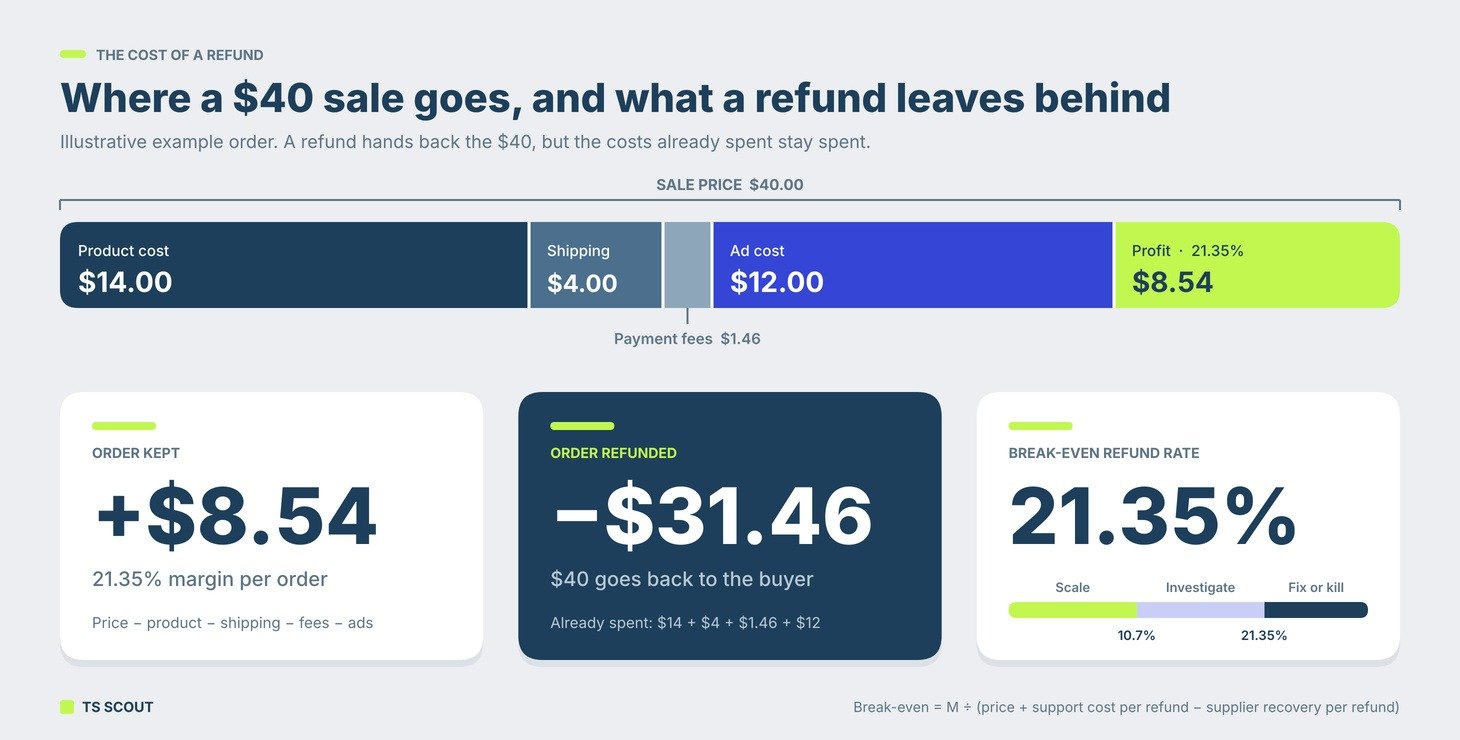
A refunded order costs you the full sale price, not just your margin: the customer gets their money back, while the product, shipping, ad spend, and usually the payment fee are already spent. Picture a store selling a $40 organizer (an illustrative example, not a real store). It nets about $8.54 per order and has its best month yet, right up until the refunds post.
What do dropshipping product returns leave behind after a refund?
Four costs survive every refund:
-
Product and shipping: Your supplier has already been paid, and on cross-border orders the item often never comes back, because the international shipping cost of retrieving it can exceed what the item is worth.
-
Advertising: The click that produced the order is spent whether the order stays or not.
-
Processing fees: Stripe states that payment processing fees from the original charge aren't returned when you refund a payment, so check your own processor's terms before assuming otherwise.
-
Marketplace extras: Charges differ by channel, so audit eBay + Amazon Hidden Fees line by line before you call any order profitable.
How do you calculate loss from returns and your break-even refund rate?
Start with your profit per order before refunds (call it M): price minus product cost, shipping, payment fees, and ad cost per order. Include every per-order charge, including the app and transaction costs listed in hidden costs of Shopify. Then apply one formula:
Break-even refund rate = M ÷ (price + support cost per refund − supplier recovery per refund)
With no support cost and no supplier recovery, your break-even refund rate simply equals your pre-refund margin percentage. Here is the example order (illustrative numbers):
|
Item |
Per order |
|
Price |
$40.00 |
|
Product cost |
$14.00 |
|
Shipping |
$4.00 |
|
Payment fees (2.9% + $0.30) |
$1.46 |
|
Ad cost |
$12.00 |
|
Profit before refunds (M) |
$8.54 (21.35%) |
The break-even sits at 21.35%. Any refund rate above it makes this product a net loser.
Now scale it to a month. With 200 orders, 10% refunds, and $3 of support time per refund, the store's profit falls from $1,708 to $848. A refund rate that sounds modest removed half the profit.
Two adjustments move the line. Adding $3 of support per refund drops the break-even to 19.9%. A supplier that reimburses an average of $9 per refund lifts it to 27.5% on its own. That second lever is why return terms belong in your supplier negotiation, not just your store policy.
What Is an Acceptable Return Rate for Dropshipping?
There is no audited benchmark built for dropshipping, so the acceptable rate is the one that stays well below your own break-even. Public numbers measure different things, which is why no single figure works as a target.
What do the benchmarks say about dropshipping product returns?
NRF puts total US returns at about 15.8% of sales in 2025, or $849.9 billion, and estimates online returns at 19.3%. Its retailer survey, however, covers large merchants with over $500 million in revenue, so read it as context, not as your target. The sources below count different things again (shoppers, orders), so they rank categories rather than set targets:
|
Category |
Data point |
Caveat |
|
Clothing |
Statista: 25% of US online shoppers returned clothing bought online in the past 12 months |
Counts shoppers, not orders |
|
Shoes |
Statista: 17% of US online shoppers returned shoes |
Counts shoppers, not orders |
|
Accessories |
Statista: 12% of US online shoppers returned accessories |
Counts shoppers, not orders |
|
US online apparel |
Coresight Research put the average return rate of online apparel orders at 24.4% for the 12 months to March 2023, based on a survey of 100 apparel brands and retailers |
Seller-side survey, not a dropshipping benchmark |
Statista's rows show the share of respondents who returned each category, so they rank categories without giving you a rate. Definitions differ between sources, so treat the table as bands, not promises.
How do you set a safe refund rate for your own product?
Use a rule of thumb we apply here, not an industry standard: keep the safe refund rate at roughly half your break-even rate. Half leaves room for ad costs that rise, refunds that arrive late, and small samples that flatter you. For the example product, that's about 10.7%.
|
Zone |
Refund rate (example product) |
Action |
|
Green |
Below 10.7% |
Keep scaling |
|
Amber |
10.7% to 21.35% |
Investigate causes, cap ad spend |
|
Red |
Above 21.35% |
Fix or kill |
Which niches have the lowest return rate?
Public data consistently ranks fit-driven categories highest, but no source reliably names the lowest return rate dropshipping products niches, so treat any list as a hypothesis you test. Look for products where the buyer can't be surprised: fixed specs, no sizing, durable build, and steady demand. A steady seller also forecasts better, and What Is an Evergreen Product? covers the logic.
You can screen for those traits before spending on ads. eBay Segment Insight compares segments by demand, competition, and growth, so you can drop thin or crowded ones early. eBay Product Research then filters by price, marketplace, and seller feedback and shows listing volume, average price, and units sold, which tells you whether a price point leaves room for a refund cushion. eBay's own dashboards, by contrast, only report your return numbers after you've sold, so screening niches this way costs hours instead of ad budget.
Can One High-Return Product Really Wipe Out Three Profitable Ones?
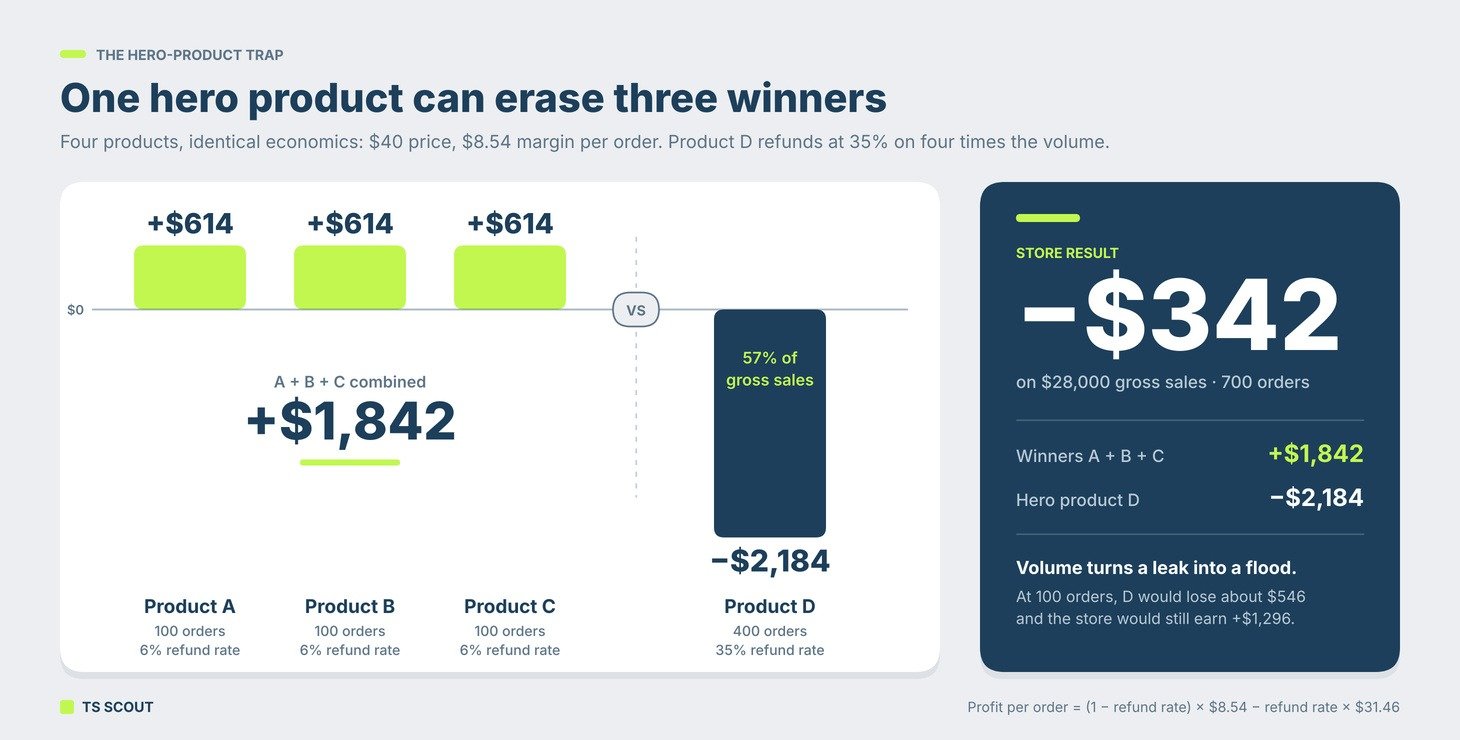
Yes, because a refund subtracts the full sale price while a sale adds only the margin. Take a store running four products with identical economics. Three refunds at 6%, and one, the "hero" ad winner, refunds at 35% on four times the volume.
|
Product |
Orders |
Refund rate |
Gross sales |
Profit |
|
A |
100 |
6% |
$4,000 |
+$614 |
|
B |
100 |
6% |
$4,000 |
+$614 |
|
C |
100 |
6% |
$4,000 |
+$614 |
|
D |
400 |
35% |
$16,000 |
−$2,184 |
|
Store |
700 |
$28,000 |
−$342 |
Product D produces 57% of gross sales and loses more than the whole store does: −2,184against-342, while A, B, and C earn $1,842 between them. Volume does the damage here. At 100 orders, the same 35% refund rate would lose about $546, which hurts but doesn't erase the other three. The dashboard calls D the best seller, and the bank balance says otherwise. Returns destroying profit margins rarely set off an alarm, because dashboards lead with gross sales while refunds sit in a separate report.
Dropshipping stores often keep high return rate products for months, and those products tend to share a trait: they convert well because the ad promises more than the item delivers. That's an inference from the pattern, not a measured law, but it's worth testing against your own creatives.
Rebuild your dropshipping product returns view per SKU:
-
Export the last 60 to 90 days of orders and refunds by product.
-
Divide refunded orders by delivered orders, not orders placed.
-
Calculate profit per order after refunds using the break-even formula above.
-
Rank products by that number and pause ads on anything negative.
What Is an Acceptable Return Rate on eBay?
eBay sets no fixed cap on item-not-as-described returns; it benchmarks you against comparable sellers, and it enforces hard limits on defects. That distinction matters because old advice often mixes the two.
Which eBay limits can actually restrict your account?
eBay's Seller standards policy sets the thresholds:
|
Metric |
Limit |
|
Transaction defect rate |
2% or lower (0.5% or lower to qualify as Top Rated) |
|
Cases closed without seller resolution |
2, or 0.3% of transactions, whichever is higher (the same limit applies to Top Rated sellers) |
A defect means a seller-canceled order or a case closed without your resolution, not simply an opened return. Slipping to Below Standard is the outcome to avoid, so keep the defect rate under 2%.
How does eBay rate your item-not-as-described returns?
eBay's Service metrics policy rates your item-not-as-described return rate as Low, Average, High, or Very High against peers with similar listings, prices, and return policies. It counts every opened case, even one you resolve promptly. A rating under 1% of transactions is adjusted to Average (the cutoff is 1.5% in a few categories, so check yours), and a Very High rating only affects your account when it involves at least 10 reports from 10 unique buyers. At Very High, eBay can charge higher final value fees from the first of the following month and stop you from deducting from the refund on used or damaged returns, so the practical target is to stay out of the High and Very High bands.
Case study: eBay's own example involves a Jewelry & Watches seller who sourced stock from a new supplier, received defective batteries, and logged 78 problem returns on 1,000 transactions, a 7.8% rate against a 1.3% peer benchmark. That's six times the benchmark, caused by one sourcing decision, which is why a case that opens deserves a fast, documented response, as covered in A Buyer Opened an eBay Item Not as Described Case.
Do free returns pay off for Top Rated Plus?
eBay's Top Rated Seller program requires same- or one-day handling and 30-day free returns (14 days in Jewelry & Watches and most Collectibles & Art categories) for the Top Rated Plus badge, in exchange for a 10% discount on final value fees. The discount doesn't cover the per-order portion of the fee. Compare the fee you'd save per order against the extra return shipping you'd absorb per order, because the impact of returns policies on profitability depends on your refund rate, not on the badge.
Since "item not as described" starts when the listing and the item disagree, eBay Smart Titles builds titles from keyword suggestions and real search volume data, so feed it accurate specs such as size, material, and compatibility to keep the visibility gain from creating a mismatch.
How Do You Test Dropshipping Product Returns in the First 30 Days?
Measure refunds against delivered orders, not placed orders, and watch leading signals while parcels are still in transit. Cross-border parcels can take weeks, so data on day 30 reflects only the earliest deliveries. If you ship to the Gulf, the lead times in AliExpress Shipping to Saudi Arabia and the UAE make this even more important.
What should you track before the refunds arrive?
|
Phase |
Days |
What you do |
Pass signal |
|
Pre-launch |
−7 to 0 |
Order a sample, read the supplier's return terms, calculate break-even, write your kill rule |
Sample matches the listing; break-even is workable |
|
Early signals |
1 to 10 |
Log "where is my order" tickets, damage photos, and 1 to 3 star reviews |
No repeating complaint |
|
Delivered cohort |
10 to 25 |
Track refunds divided by delivered orders |
Rate inside your safe zone |
|
Decision gate |
25 to 30 |
Compare your range to break-even and safe rate |
Scale, keep testing, or kill |
Pre-launch is where research tools earn their cost. Express Product Research searches AliExpress by name and filters by price, category, and sales performance, and the listed price is only the start, as AliExpress hidden fees shows. Browsing listing by listing shows one product at a time, while Express Source Finder analyzes a seller's whole store from its URL, with listings, prices, ratings, and units sold, which is the evidence behind How to Find Reliable eCommerce Suppliers.
How do you read a small sample without fooling yourself?
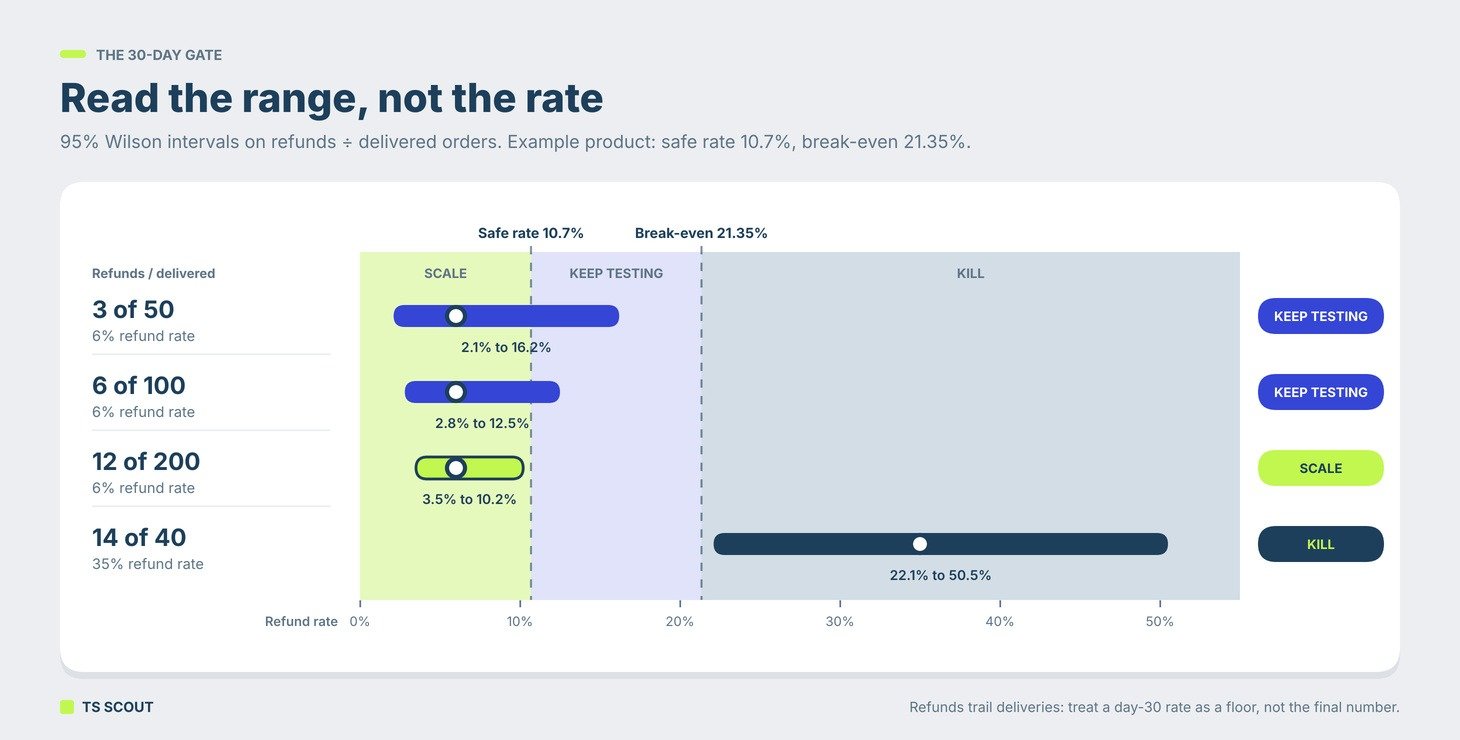
Convert your refund rate into a range. The table uses the 95% Wilson interval, a standard way to bound a proportion.
|
Refunds / delivered |
Rate |
Likely range |
|
3 / 50 |
6% |
2.1% to 16.2% |
|
6 / 100 |
6% |
2.8% to 12.5% |
|
12 / 200 |
6% |
3.5% to 10.2% |
|
14 / 40 |
35% |
22.1% to 50.5% |
The decision rule has three outcomes:
-
Kill when the bottom of the range sits above your break-even, as with the 14 refunds from 40 deliveries.
-
Scale when the top of the range sits below your safe rate, as with 12 from 200.
-
Keep testing in every other case. The same 6% rate is inconclusive at 100 deliveries because its upper edge reaches 12.5%, and How to Test an Evergreen Product Before Committing shows how to extend a test without burning budget.
One caution: refunds trail deliveries, so a day-30 rate is a floor, not the final number. A "scale" verdict deserves a recheck as the cohort ages.
When Should You Stop Selling a Product Because of Returns?
Stop when the data shows a structural loss: the low end of your range exceeds break-even, or the cause can't be fixed. Define your rule for dropshipping product returns before launch, since a product you already love is harder to cut.
Use this order of questions:
-
Are refunds concentrated in one reason? Size, color, or transit damage can be fixed with a listing, packaging, or sizing change. Retest for 14 days.
-
Are reasons scattered across quality, wrong items, and "not as described"? That usually signals a product or supplier problem, so cut it, and treat wrong-item reports as a supplier conversation (Supplier Shipped the Wrong Item? walks through it).
-
Is the supplier slow to respond or refusing recoveries? Replace the supplier before the product, and AliExpress Supplier Unresponsive? covers the escalation path.
-
Is your break-even thin? As a rule of thumb, below roughly 15% means ordinary refund noise can push you under, so lift the price or choose another product.
-
Is ad spend still running? Pause it during any investigation, because traffic to a leaking product multiplies the loss.
When your product return rate is too high for the numbers to work, line up the replacement first. Express Scanner scans AliExpress for trending, consistent sellers, so a substitute is ready before you pull the plug. Marketplace terms differ, so compare sources through AliExpress vs Temu before you switch.
How Does Your Returns Policy Change Profitability?
Your policy decides who pays for returns and how many refunds you attract, so a wrong default can turn a viable product negative. Product returns put dropship sellers in an awkward spot: buyers expect generosity, but you pay for it.
Should you offer free returns, returnless refunds, or exchanges?
Buyers care. NRF reports that 82% of consumers say free returns are an important consideration when shopping online, and it estimates that about 9% of returns are fraudulent, which is a reason to define clear conditions. Model three levers before you write a word of policy:
-
Returnless refunds: If retrieving the item costs more than the product plus the shipping you'd recover, refund the buyer or part of the price and let them keep it.
-
Exchanges: In the $40 example order, a refund leaves the store $31.46 down, while an exchange that ships an $18 replacement (cost and shipping) leaves it $9.46 down. The exchange saves $22 when the replacement fixes the problem.
-
Written supplier terms: To manage returns across a dropshipping store consistently, align your store policy with your supplier's terms. The Shopify Return Policy Gap shows where the two commonly drift apart.
What does the law require?
The European Consumer Centres Network (ECC-Net) states that EU consumers have 14 days to withdraw from a distance purchase without giving a reason, and that the seller must refund within 14 days of being informed, including standard delivery costs. How refunds interact with sales tax or VAT depends on your setup, which dropshipping taxes unpacks. This isn't legal advice, so check the rules in each market you sell to.
Can Returns Turn Into Chargebacks That Threaten Your Store?
Yes. When dropshipping product returns are slow or denied, buyers go to their bank, and the bank acts first.
What happens when a buyer disputes the charge?
The Shopify Help Center explains that when a bank issues a chargeback, it takes the disputed amount and a chargeback fee right away, and that Shopify might refund the fee if you win, depending on your country or region. A high chargeback rate can also affect your Shopify Payments store status.
Where does Visa draw the line?
Visa's Acquirer Monitoring Program fact sheet lists the Excessive Merchant threshold at 150 basis points (1.5%) in the US, Canada, EU, and Asia Pacific from 1 April 2026, with a minimum of 1,500 monthly fraud and dispute counts. Most small stores sit far below that count, but Visa holds acquirers to stricter ratios (50 and 70 basis points), so your processor may apply tighter limits of its own. Answer return requests in hours, not days, and refund clear-cut cases before they become disputes.
Which Product in Your Store Is Quietly Losing Money Right Now?
Open your dropshipping product returns report tonight, even if you dread what's in it. Divide each product's refunds by the orders that actually arrived, hold that number up against its break-even, and see which one has been borrowing from the others. It might be the product you're proudest of, and that's fine: the math doesn't care how much you like it.
Cutting a leaker is the easy half; finding its replacement is the work. That's where TS Scout's $1 trial, 14 days of full access, comes in handy, since the product and supplier tools in this guide are all inside it.
FAQs
-
What is an acceptable return rate for dropshipping?
Any rate comfortably below your break-even; we suggest staying near half of it, roughly 10% for a product with a 21% break-even.
-
What is an acceptable return rate on eBay?
eBay publishes no fixed cap on item-not-as-described returns. It rates you against similar sellers and holds you to a transaction defect rate of 2% or lower.
-
How to calculate loss from returns in dropshipping?
Subtract your actual profit from the profit you'd have earned at zero refunds, then use M ÷ (price + support − recovery) to find the refund rate where profit hits zero.
-
How much do dropshipping product returns hurt profit?
Each percentage point of refund rate costs 1% of your selling price per order, so $0.40 on a $40 product.
-
Which are the lowest return rate dropshipping products niches?
Categories with fixed specs and durable builds are better candidates than fit-driven ones such as clothing and shoes; validate any niche with your own 30-day cohort.
-
How do I manage dropshipping product returns when I never touch the product?
Get the supplier's return and recovery terms in writing, set a returnless-refund threshold, and track refunds by SKU.
-
When should I stop selling a product because of returns?
When the low end of your refund range exceeds break-even, or when the causes are scattered and unfixable.
-
Does Stripe return processing fees when I refund a customer?
Stripe states that fees from the original charge aren't returned on refunded payments, so include them in your per-order costs.
Sources:
like?


Table of Contents
- How Much Do Dropshipping Product Returns Really Cost You Per Order?
- What Is an Acceptable Return Rate for Dropshipping?
- Can One High-Return Product Really Wipe Out Three Profitable Ones?
- What Is an Acceptable Return Rate on eBay?
- How Do You Test Dropshipping Product Returns in the First 30 Days?
- When Should You Stop Selling a Product Because of Returns?
- How Does Your Returns Policy Change Profitability?
- Can Returns Turn Into Chargebacks That Threaten Your Store?
- Which Product in Your Store Is Quietly Losing Money Right Now?
- FAQs


