
The Hidden Costs of Shopify: Why Your Subscription Isn't Your Only Expense
- 2026-10-06
-
 0
0

Most sellers do the math on a Shopify plan in thirty seconds: pick a tier, divide by 30, call it overhead. Then the first month of real orders arrives, and the payout is smaller than the spreadsheet promised. The hidden costs of Shopify are rarely hidden on purpose. They're scattered across billing pages, payment settings, app invoices and customs rules, so no single screen ever shows the total.
This guide pulls those charges into one map, using figures from Shopify Pricing, the Shopify Help Center, the Federal Register and GOV.UK, all checked against October 2026. You'll see what each fee costs, when it applies, and where the exceptions are, including a few that other articles get wrong. Then we'll dissect a single $50 order and look at practical ways to protect your margin. If you're still planning your Shopify eCommerce Store, this is the part of the budget that decides whether your numbers hold up.
Let's start with why these costs catch so many sellers off guard.
What Are the Hidden Costs of Shopify, and Why Do They Catch Sellers Off Guard?
The hidden costs of Shopify are the charges that sit outside your monthly plan price: payment processing, third-party gateway surcharges, currency conversion, app subscriptions, domains, duties, chargebacks and payout reserves. Nothing is concealed. The problem is that each charge lives in a different place, so most sellers never see them added together.
That's why Shopify hidden fees surprise even careful owners. Here's where each one shows up:
|
Cost type |
Where you'll see it |
|
Plan subscription, POS Pro |
Billing |
|
Card fees, third-party transaction fees, FX |
Settings > Payments and the order's transaction details |
|
Chargeback fees, reserves |
Payouts |
|
App subscriptions |
A separate app billing cycle |
If you're weighing the platform overall, Shopify eCommerce Pros and Cons in 2026 sets these costs beside the benefits. For now, the key point is that the plan price is the only number visible on day one.
How Much Does a Shopify Subscription Really Cost After the Trial?
The headline offer is 3 days free, then $1 a month (£1 in the UK) for three months. After that, the regular price applies. Annual billing is charged upfront, and plan subscriptions are generally non-refundable, so a cheap first quarter says little about your true cost. Any honest look at Shopify subscription hidden fees starts at month four.
According to Shopify Pricing, the US plans cost:
|
Plan |
Annual billing (per month) |
Monthly billing |
|
Basic |
$29 |
$39 |
|
Grow |
$79 |
$105 |
|
Advanced |
$299 |
$399 |
The UK tiers on Shopify's UK pricing page are £19, £49 and £259 per month on annual billing, or £25, £65 and £344 billed monthly. Many comparison articles still quote $39 as the annual Basic price. That's the current monthly figure.
Some costs are optional but common. POS Pro is $89 per month per location. Orders synced from marketplaces carry a 1% fee, capped at $99 per month, after your first 50 synced orders each month. Basic also lacks calculated shipping rates, which can push you to a higher plan sooner than planned. There's also an Agentic plan: $0 a month, with card fees from 2.9% + 30¢ on sales made through AI channels. It's a different model from a standard store.
If you're selling into Britain, Shopify eCommerce in the UK covers how the local setup differs.
What Does Shopify Actually Cost at Different Revenue Levels?
The plan price is only one line of your monthly bill. Here is what the platform itself costs at four revenue levels, combining the subscription, card processing and a typical app stack. All figures use annual-billing prices and each plan's own US online card rate.
|
Monthly revenue |
Subscription |
Payment processing |
Apps estimate |
Total platform cost (% of revenue) |
|
$5,000 |
Basic: $29 |
$175 (100 orders at 2.9% + 30¢) |
$70 |
$274 (5.5%) |
|
$10,000 |
Basic: $29 |
$350 (200 orders at 2.9% + 30¢) |
$100 |
$479 (4.8%) |
|
$25,000 |
Grow: $79 |
$825 (500 orders at 2.7% + 30¢) |
$150 |
$1,054 (4.2%) |
|
$50,000 |
Advanced: $299 |
$1,550 (1,000 orders at 2.5% + 30¢) |
$250 |
$2,099 (4.2%) |
Note: These are platform costs only. They exclude product costs (COGS), shipping, ads, returns, refunds, currency conversion, duties, chargebacks and profit, so the table measures overhead, not what you keep. Payment processing uses the US online card rate for each plan, per Shopify Pricing, applied to an illustrative $50 average order value. That works out to $1.75 per order on Basic, $1.65 on Grow and $1.55 on Advanced. Your actual figure will change with your average order value and order volume: the smaller the order, the more the flat 30¢ weighs. The calculation assumes Shopify Payments is your primary gateway, so no third-party transaction fee applies. Apps are a planning assumption, not a market average, because app pricing varies widely.
The share of revenue drops from 5.5% at $5,000 a month to about 4.2% at $25,000 and $50,000, then flattens. Card processing is the biggest line at every level, so your average order value affects your platform cost more than your plan choice does.
Which Payment Fees Does Shopify Take on Every Order?
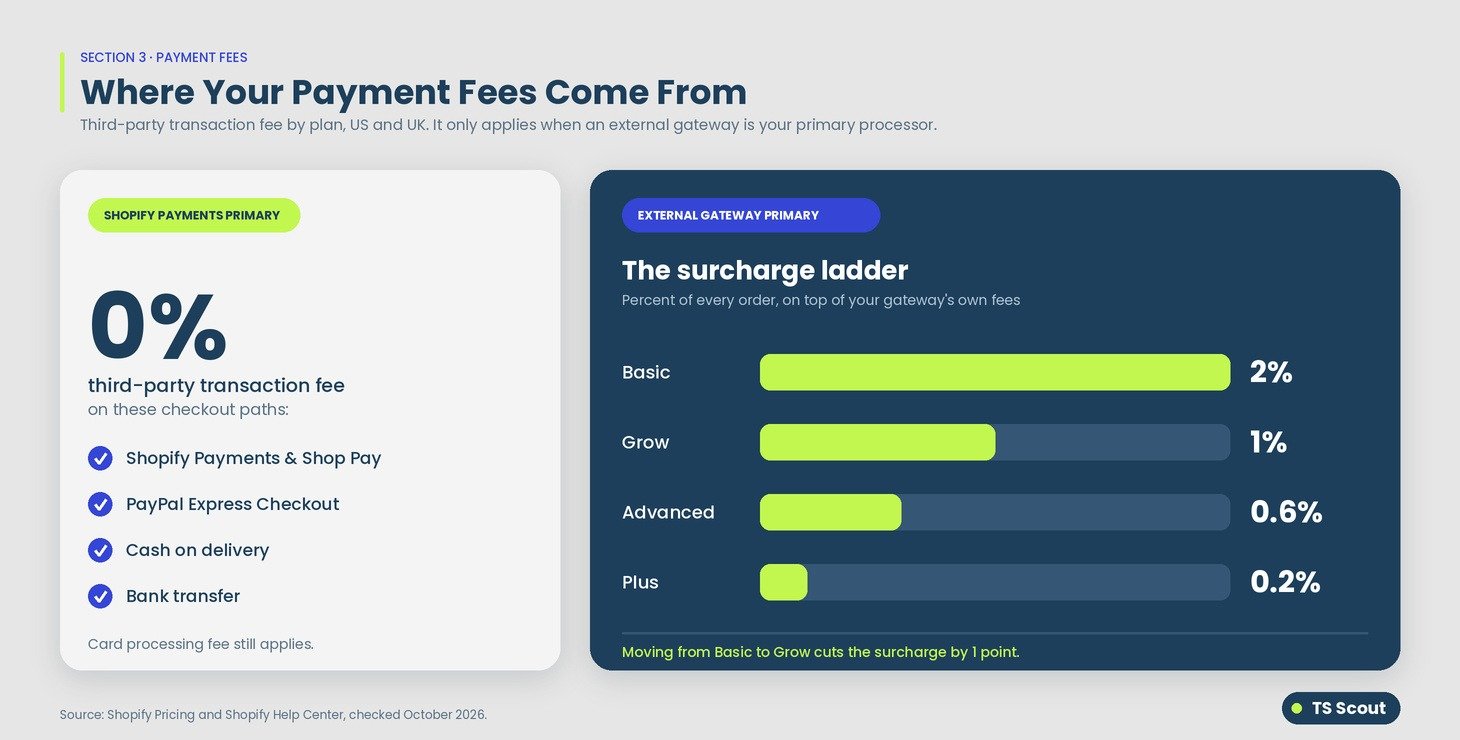
Every order carries a card processing fee, plus, depending on your setup, a third-party transaction fee. The second one is the biggest source of avoidable Shopify hidden fees. According to the Shopify Help Center's billing cycles page, it applies when you use an outside payment provider, and it comes on top of that provider's own card rates. It shrinks as you move up plans:
|
Plan |
Third-party transaction fee |
|
Basic |
2% |
|
Grow |
1% |
|
Advanced |
0.6% |
|
Plus |
0.2% |
Several competitors still list Advanced at 0.5%. Shopify Pricing shows 0.6%.
Does PayPal trigger the surcharge? Not always. Per the Shopify Help Center, when Shopify Payments is active you aren't charged third-party transaction fees on orders processed through Shopify Payments, Shop Pay or PayPal Express. Manual methods like cash on delivery and bank transfer are exempt too. The surcharge appears when an external gateway is your primary processor. Many articles flatten this into "PayPal costs more," which is wrong.
One more wrinkle for UK sellers: after Brexit, cards issued in the EU count as international. On Basic, the UK international card rate is 3.1% + 25p.
Why Does the Fixed Fee Hurt Low-Priced Orders the Most?
Because the flat part of the fee doesn't scale with the order. At the official US Basic rate of 2.9% + 30¢, a $50 order costs $1.75 in processing, an effective 3.5%. A £30 order on UK Basic at 2% + 25p costs £0.85. These are my calculations from published rates. The cheaper your average order, the bigger that flat slice gets.
Does Shopify Refund Fees on Refunded Orders?
No. The Help Center states that third-party transaction fees, currency conversion fees and credit card fees aren't returned when you refund an order. Every refund costs you the sale and the fee together.
When Does Upgrading Your Plan Cut Your Fees?
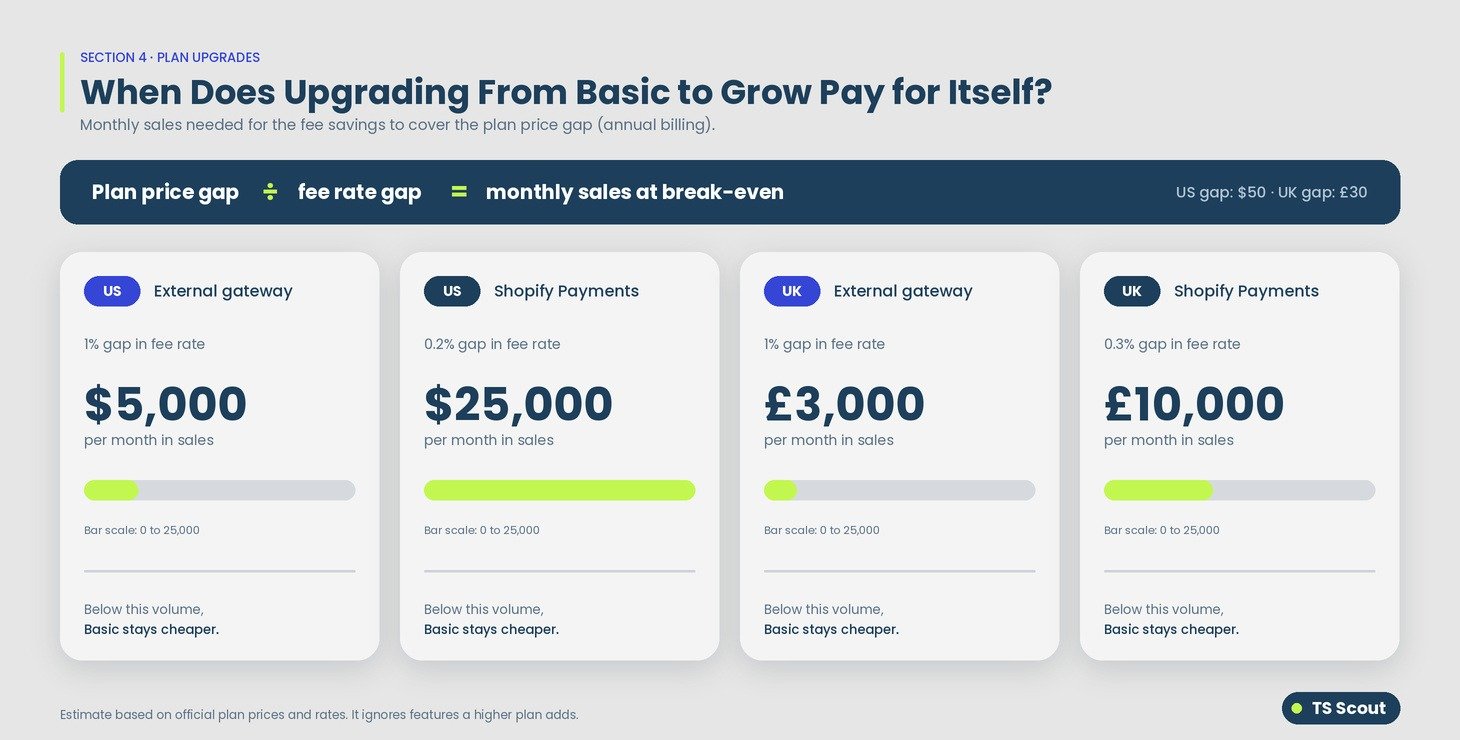
A plan upgrade pays for itself when fee savings exceed the price difference:
Plan price difference ÷ fee rate difference = monthly sales at break-even
Using annual-billing prices:
-
US, Basic to Grow: $50 more per month. On a third-party gateway the gap is 1%, so break-even is $5,000 in monthly sales. With Shopify Payments the rate gap is only 0.2%, so break-even jumps to $25,000.
-
UK, Basic to Grow: £30 more per month. On a third-party gateway that's £3,000 a month. With Shopify Payments (a 0.3% gap), it's £10,000.
These are my estimates from official rates and ignore features a higher plan adds, such as better reporting, so treat them as a floor, not a verdict. The practical takeaway: if you're stuck on an external gateway, upgrading early is often cheaper than waiting.
How Do Currency Conversion, Customs and Import Rules Add Cost?
Selling in other currencies adds a conversion fee on top of normal processing. According to the Shopify Help Center's fees and costs page, it's 1.5% for the US and 2% in all other countries and regions with Shopify Payments, and the exact rate for each order appears in its timeline. Since April 6, 2026, the fee is calculated on the gross order total rather than the net amount. Check Settings > Payments for your own rate before trusting any blog's number, ours included.
Customs rules are shifting too, and timing matters:
-
US: The Federal Register shows CBP's rule indefinitely suspending the de minimis exemption took effect on June 24, 2026 for non-postal shipments, with mail following on July 24. The suspension has applied to all countries since August 29, 2025, so low-value parcels that once entered duty-free can now be taxed. That pushes up your international shipping dropshipping cost on every cross-border parcel.
-
UK: GOV.UK confirms the £135 customs duty relief will be removed under new arrangements, published on July 13, 2026. Legal commentators point to October 2028 as the latest start, so confirm the date on GOV.UK before planning around it.
If your supply chain runs through British suppliers, see Top UK Suppliers for Shopify Stores in 2026. If you source from AliExpress, aliexpress hidden fees shows how duties change the picture, and AliExpress Shipping to Saudi Arabia and the UAE in 2026 covers a regional case.
What Do Apps, Themes and Domains Cost Once Your Store Grows?
Apps bill on their own cycle, separate from your Shopify plan. That's also why they linger: if you pause or close your store, you must cancel each app subscription yourself or the charges continue. Check real prices in the App Store before committing, because app pricing varies too widely for any average to help.
Domains start at roughly $9 a year, but renewal prices can differ from the first-year price, so read the renewal line before buying. If you add search-focused apps, do the foundations first: SEO for Shopify, Shopify Product SEO and Shopify SEO for Beginners cover what you can do before spending anything on tools.
How Do Returns, Chargebacks and Payout Reserves Drain Your Margin?
Returns, disputes and reserves hit cash flow as well as margin.
Returns: As covered above, fees aren't returned on refunds. A loose policy compounds the gap, which is exactly what The Shopify Return Policy Gap digs into.
Chargebacks: Per Shopify's chargebacks guide, when a cardholder's bank files a chargeback, it takes the disputed amount right away along with a fee. If you win, you get the amount back, and Shopify might refund the fee depending on your country or region. The fee is $15 in the US and £10 in the UK, but winning doesn't remove the dispute from your chargeback rate, so high volumes can still raise flags.
Reserves: According to Shopify's reserves overview, a reserve is a temporary hold on a portion of your Shopify Payments transactions, either a fixed amount or a percentage, designed to cover disputes and refunds. High chargeback activity, a high refund rate and sudden volume spikes are among the listed triggers. When the reserve expires and no extension is needed, the amount is included in upcoming payouts. The real cost is working capital: money you can't reinvest in stock or ads while it's held.
Which Hidden Costs Hit Sellers Who Don't Hold Stock the Hardest?
Dropshippers face everything above plus costs that start at the supplier:
-
Supplier price changes at checkout. A listing can reprice between research and order, as covered in Your AliExpress Price Increases at Checkout.
-
Split shipments. One order can arrive in two parcels, doubling the support load.
-
DDP duties. Delivered-duty-paid rules put the tax on you when a parcel crosses a border, so The Tax Liability lands on your side of the ledger.
-
-
Dropshipping product returns your supplier won't accept. You refund the customer and absorb the cost.
-
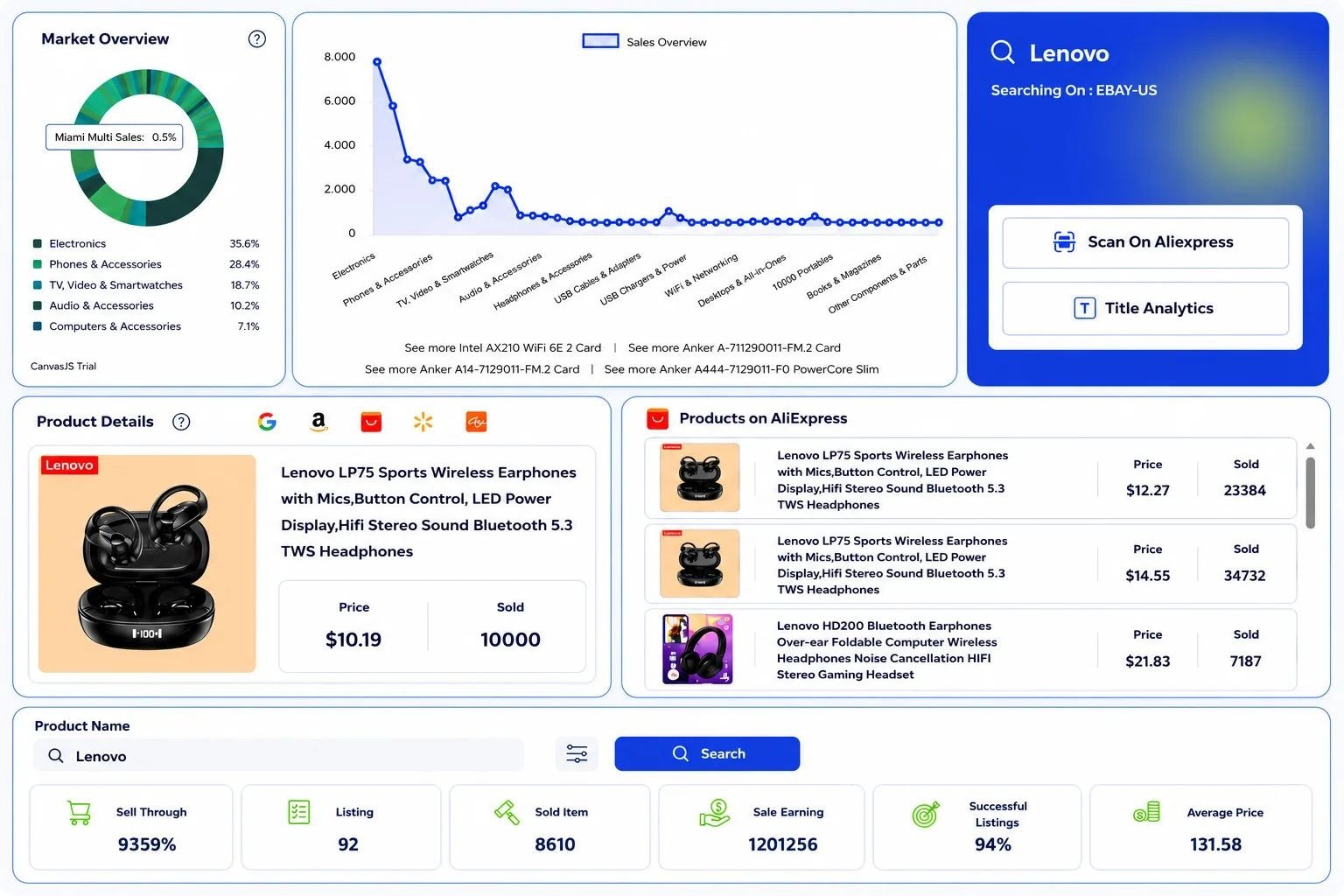
Research is where you control most of this. With Express Product Research, you can search AliExpress products by name and filter by price, category and sales performance, so your margin rests on actual cost and units sold instead of a guess. When a product looks promising, Express Source Finder lets you drop in the seller's shop URL and see their listings, prices, ratings and total units sold, a faster way to judge whether a supplier is stable. For more on spotting demand before you commit, Finding High-Demand Products Without the Headache is a good companion, and how much profit margin in dropshipping shows what realistic returns look like.
How Do You Use a Shopify Profit Margin Calculator to Find Your Real Margin?
A Shopify profit margin calculator is only as honest as the costs you feed it. The real formula:
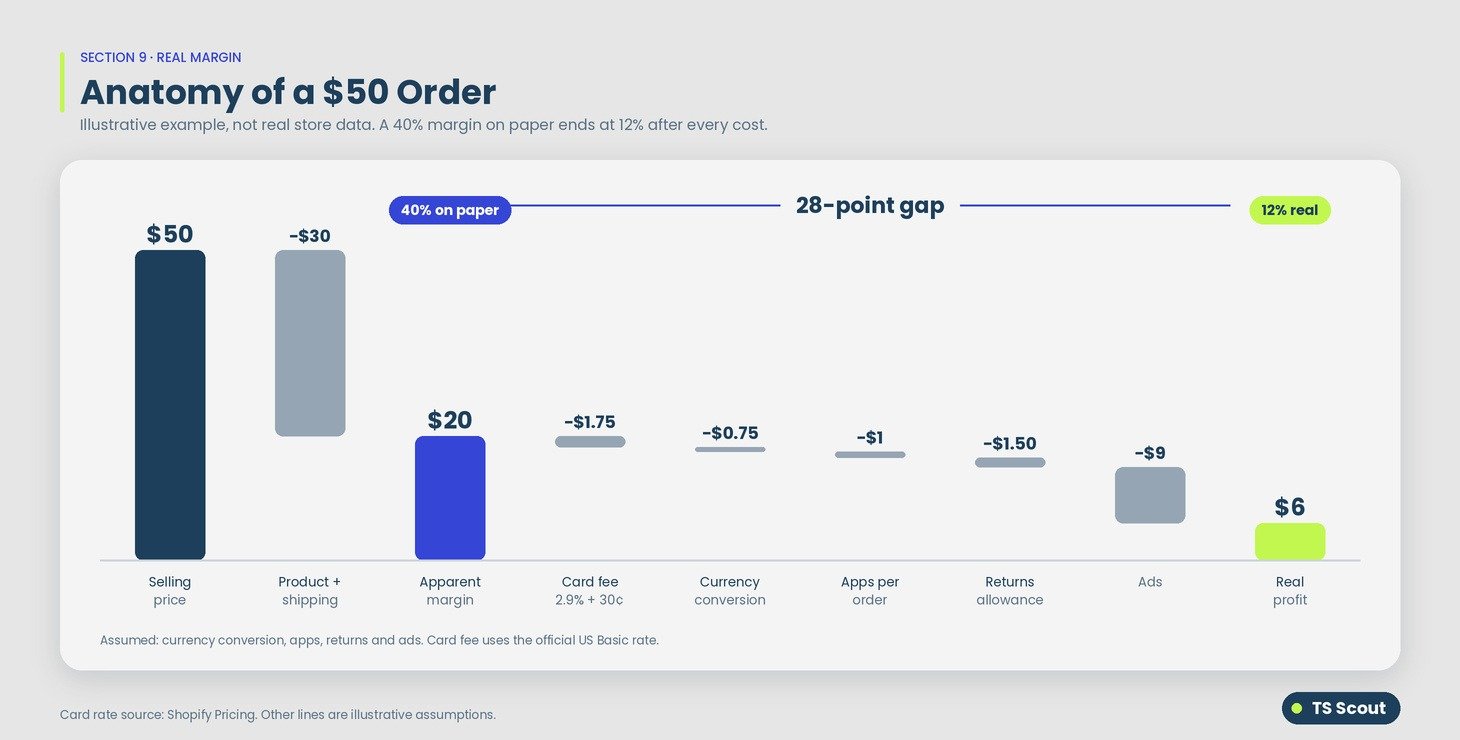
Selling price − (product + shipping + payment fees + FX + apps per order + returns + ads) = true profit
Here's an illustrative case, not real store data. A $50 product looks like a 40% margin once you subtract $30 for product and shipping:
|
Line item (assumed unless noted) |
Amount |
|
Selling price |
$50.00 |
|
Product and shipping |
−$30.00 |
|
Apparent margin |
$20.00 (40%) |
|
Card fee (2.9% + 30¢, official US Basic rate) |
−$1.75 |
|
Currency conversion |
−$0.75 |
|
Apps, per order |
−$1.00 |
|
Returns allowance |
−$1.50 |
|
Ads |
−$9.00 |
|
Real profit |
$6.00 (12%) |
The 28-point gap is the story of most first-year stores. To anchor your inputs in reality, Shopify Competitor Research lets you enter a rival store's URL and see its products, prices and sales performance, which makes it much easier to set a realistic average order value before you finalize your numbers. Shopify's own reports cover your data, but they can't show you a competitor's.
How Does Shopify's Total Cost Compare With WooCommerce and Marketplaces?
A fair comparison counts the hidden costs of both sides. WooCommerce software is free, but you pay for hosting, extensions, security and often a developer. Marketplaces trade lower setup cost for listing, referral and advertising fees, plus less control over your customers.
For a side-by-side, WooCommerce vs Shopify compares the two platforms, and eBay and Amazon hidden costs covers what marketplace selling includes beyond the sticker price. The right choice depends on volume, technical skill and how much of the stack you want to own.
How Can You Cut the Hidden Costs of Shopify Without Slowing Growth?
Six moves tackle the biggest leaks from the sections above:
-
Run Shopify Payments as your primary gateway if it's available to you. That removes the third-party surcharge, and PayPal Express and Shop Pay stay exempt.
-
Use the break-even formula quarterly. Your volume moves, and so does the right plan.
-
Audit app billing monthly. Cancel anything unused, and cancel every app if you pause the store.
-
Raise prices or bundle low-AOV products, where the flat card fee does the most harm.
-
Reduce refunds before they happen with clearer product pages and size guides, since refunded fees are gone for good.
-
Watch your dispute and refund rates so a reserve doesn't catch you by surprise.
One caution on VAT: sources disagree on how VAT applies to Shopify's own fees (reverse charge, Irish VAT or UK VAT), and I found no official page that settles it. Check your invoice and ask your accountant before assuming.
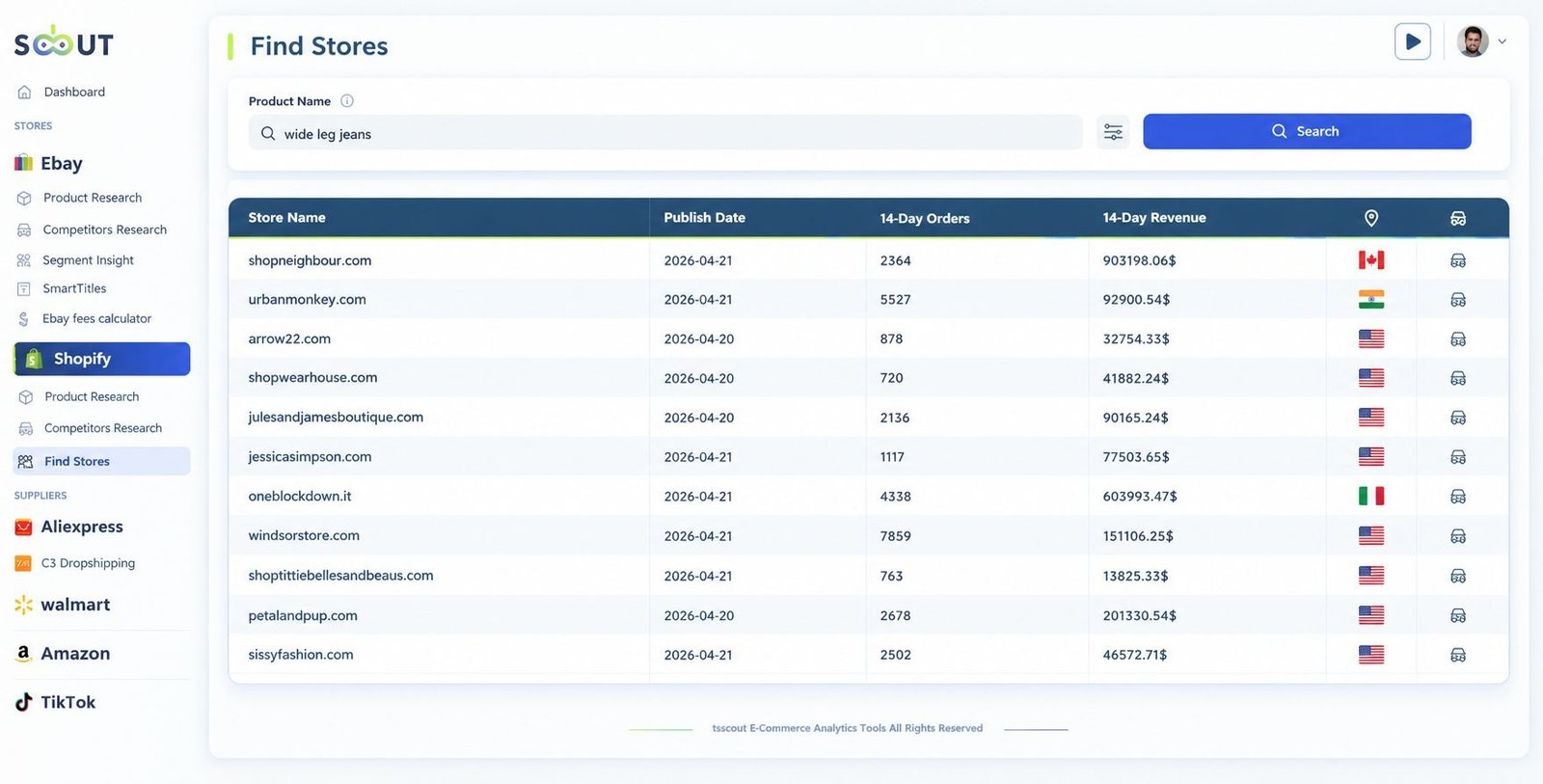
Pricing power also comes from knowing the market. Shopify find stores lets you pick a product or niche and discover who's selling in it, so you can map competitors and price ranges before you launch. Pair it with Find Profitable Shopify Stores in Your Niche for the method and Ethical Shopify Competitor Research for doing it the right way.
What Would Your Margin Look Like If Every Cost Were Visible Before Launch?
Probably thinner than you expected, but far easier to fix. Sellers who list every fee, duty and refund up front price correctly from day one instead of discovering the gap in month three.
Start by running your own product through the formula in section 9, then validate it with real market data. Try TS Scout for $1 for 14 days with full access and research products, suppliers and competitors before you spend on stock.
FAQS
-
Does Shopify take a percentage of every sale?
Yes, through card processing fees on each order, plus a third-party transaction fee if an external gateway is your primary processor.
-
Do I pay Shopify's extra fee if customers pay with PayPal?
Not if Shopify Payments is active. PayPal Express Checkout, Shop Pay and manual methods like cash on delivery are exempt. The surcharge applies when an external gateway is your primary processor.
-
Does Shopify refund processing fees when I refund an order?
No. The Help Center states that card, conversion and third-party transaction fees aren't returned on refunds.
-
What is the Shopify chargeback fee in the US and UK?
$15 in the US and £10 in the UK. Shopify might refund it if you win, depending on your country, and winning doesn't remove the dispute from your chargeback rate.
-
Why would Shopify hold part of my payouts?
A reserve can follow high chargeback activity, a high refund rate or sudden volume spikes. It's a temporary hold, and the amount joins upcoming payouts once the reserve expires without an extension.
-
Is a Shopify store still profitable after all the hidden costs of Shopify?
It can be, but only if you price with every cost included. In the example above, a 40% apparent margin dropped to 12% once fees, returns and ads were counted.
like?


Table of Contents
- What Are the Hidden Costs of Shopify, and Why Do They Catch Sellers Off Guard?
- How Much Does a Shopify Subscription Really Cost After the Trial?
- What Does Shopify Actually Cost at Different Revenue Levels?
- Which Payment Fees Does Shopify Take on Every Order?
- When Does Upgrading Your Plan Cut Your Fees?
- How Do Currency Conversion, Customs and Import Rules Add Cost?
- What Do Apps, Themes and Domains Cost Once Your Store Grows?
- How Do Returns, Chargebacks and Payout Reserves Drain Your Margin?
- Which Hidden Costs Hit Sellers Who Don't Hold Stock the Hardest?
- How Do You Use a Shopify Profit Margin Calculator to Find Your Real Margin?
- How Does Shopify's Total Cost Compare With WooCommerce and Marketplaces?
- How Can You Cut the Hidden Costs of Shopify Without Slowing Growth?
- What Would Your Margin Look Like If Every Cost Were Visible Before Launch?
- FAQS