

Dropshipping Taxes: The Liability Nobody Calculates (Until the Government Does)
- 2026-10-18
-
 0
0

You priced the product, the shipping and the ads. You did not price the tax. Dropshipping taxes arrive in layers (income tax, self-employment tax, sales tax and, on a China-sourced order, import duty), and none of them show up in your store dashboard. Because you never touch the product, tax feels like someone else's job, yet as the seller the liability is yours. Sales tax alone averages 7.53% across US states, according to the Tax Foundation, enough to erase a thin margin.
This guide answers the question every new seller eventually asks, do you have to pay taxes on dropshipping, and shows which taxes apply where you live and sell. You'll get a simple way to estimate your bill, a worked example of after-tax profit, and action steps that turn each rule into a to-do. Start with the question that decides everything else.
Do You Have to Pay Taxes on Dropshipping, Even if Your Profit Is Tiny?
Yes. Dropshipping is a retail business, so dropshipping taxes start with the profit it produces, which is taxable income wherever you live, and sales tax and import duty may apply on top.
The most common misunderstanding is that no tax form means no tax. The IRS confirmed in IR-2025-107 that payment platforms only have to file Form 1099-K when payments pass $20,000 and 200 transactions. That threshold decides when a platform sends a form. It does not decide whether your income counts.
The UK works the same way. The GOV.UK trading allowance exempts up to £1,000 of trading income a year, and once your gross income passes it you register for Self Assessment by 5 October of the following tax year.
Action step: run the four-question check.
-
Where do you live and file taxes?
-
Where do your buyers live?
-
Which channels do you sell on (a marketplace, your own store, or both)?
-
Where does your supplier ship from?
Write the four answers down. Every later section starts from them.
Which Dropshipping Taxes Land on Your Desk, and Who Collects Them?
Dropshipping taxes fall into four layers, and each has a different collector.
|
Tax |
Who it hits |
Who collects or when it's due |
|
Income tax (federal and state) |
You, on profit |
You, annually, with estimated payments during the year |
|
Self-employment tax |
You, once net earnings reach $400 |
You, with your return |
|
Sales tax |
Your buyer pays it |
A marketplace, or you if you sell through your own store |
|
Import duty |
The importer of record |
Customs, at entry |
These dropshipping business taxes don't overlap, so paying one layer never cancels another. The next sections take them in the order they bite.
How Does Dropshipping Income Tax Hit Your Profit?
Dropshipping income tax is charged on profit, not revenue, which is why the margin math in average profit margin in dropshipping matters before any return is filed. In the US, tax on dropshipping profit comes in two parts.
-
Self-employment tax. The IRS self-employment tax guidance sets the rate at 15.3% (12.4% Social Security plus 2.9% Medicare) once net self-employment earnings reach $400. You can deduct the employer-equivalent portion when figuring adjusted gross income.
-
Income tax. Eligible sole proprietors may also deduct up to 20% of qualified business income, subject to the limits on the IRS QBI deduction page.
Nobody withholds either of these dropshipping taxes, so you pay during the year. The IRS estimated tax rules say sole proprietors generally pay if they expect to owe $1,000 or more when they file, in four payment periods. The dates are on Form 1040-ES. You avoid the underpayment penalty by paying at least 90% of this year's tax or 100% of last year's, whichever is smaller.
In the UK, you choose between the £1,000 trading allowance and deducting actual expenses, and you pay through Self Assessment.
Action step: build the habit before the bill.
-
Open a separate savings account and label it "tax".
-
After every payout, move your estimated tax share into it (the method is later in this guide).
-
Put the four payment dates from Form 1040-ES in your calendar.
When Does Dropshipping Sales Tax Become Your Problem?
Dropshipping sales tax becomes yours when you sell through your own store into a state where you have nexus, because nothing else collects it for you.
What Is Nexus, and When Does It Start?
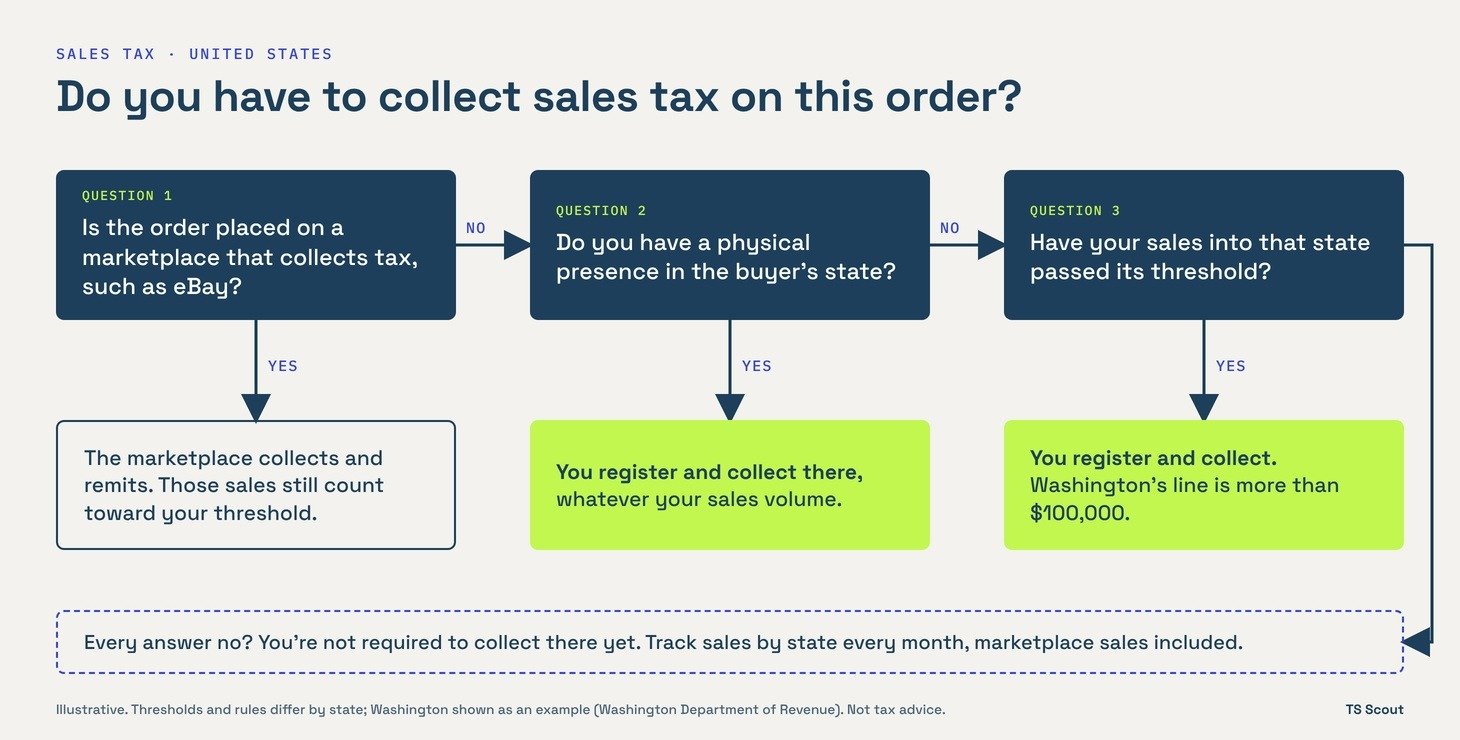
Nexus is the connection that obliges you to collect a state's sales tax. Dropshipping sales tax follows the buyer's address, so the rules change with every state you sell into, and nexus starts two ways: physical presence, or economic activity.
Economic nexus began with South Dakota v. Wayfair in 2018, when the US Supreme Court held that states may require out-of-state sellers to collect tax without a physical presence. Each state then set its own line. Take Washington: the Washington Department of Revenue says remote sellers must register after more than $100,000 in gross receipts, counting sales through marketplaces and your own website alike. A seller based in Washington must register whatever their volume. Once the line is crossed, Washington requires collection for the rest of that year and the next.
These dropshipping business sales tax requirements differ by state, so check each state where your sales add up.
Action step: run the nexus check every month.
-
Export your orders and total sales by buyer state.
-
Compare each total to that state's published threshold.
-
If you've crossed one, register with the state.
-
Switch on tax collection for that state in your store.
-
File on the schedule the state assigns.
Why Does Your Supplier Ask for a Resale Certificate?
A resale certificate tells your supplier you are buying to resell, so they shouldn't charge you tax. The Mississippi Department of Revenue's drop shipment fact sheet says a supplier delivering into the state must charge Mississippi tax unless the retailer provides a valid resale certificate. It adds that if neither you nor the supplier collects, the customer owes use tax directly.
Rules are easing in places. Since 10 January 2022, the Tennessee Department of Revenue accepts another state's resale certificate from an out-of-state dealer for drop-shipped goods.
Action step: ask each US supplier how they accept resale certificates, send one, and file the confirmation.
Do eBay, Amazon, Walmart and Shopify Collect Dropshipping Taxes for You?
Marketplaces collect sales tax on their own sales, and your own store doesn't, which is the gap that catches mixed-channel sellers.
|
Channel |
Who collects sales tax |
What you still handle |
|
eBay |
eBay collects and remits for items shipped to the states it lists, and you can't opt out |
Income tax, and sales tax in states where eBay doesn't collect |
|
Amazon and Walmart |
Marketplace-level collection under state marketplace rules |
Tax settings in your account, income tax, and your own-store sales |
|
Shopify |
Shopify can calculate and collect |
Registering, filing and paying, unless you use Shopify Tax with automated filing |
The eBay Help tax page confirms that eBay calculates, collects and remits for listed states, and that sellers pay income tax and charge sales tax wherever eBay doesn't collect. eBay dropshipping taxes are the clearest case, and the economics of that channel are the question behind eBay Dropshipping Guide 2026. Shopify dropshipping taxes sit with you. The Shopify Help Center states that Shopify doesn't file or remit your taxes unless you use its automated filing, and that filing burden is one of the hidden costs
Marketplace collection doesn’t end your paperwork. The Texas Comptroller says Texas sellers still hold a permit and file returns even when every sale goes through a marketplace. Amazon dropshipping taxes and Walmart taxes on dropshipping orders follow the same logic: on Walmart Marketplace, the platform collects and remits sales tax in most states, but you still need to confirm your tax settings in Seller Center and check whether your state requires you to register and file anyway. Confirm each account’s tax settings before assuming you’re covered. Tax is one more cost marketplaces handle differently from fees, and the fee side is in eBay + Amazon Hidden Fees.
Marketplace sales also count toward a state’s threshold, as the Washington rule shows. A seller with a quiet store but heavy marketplace volume can still owe registration there.
What Does Dropshipping From China Do to Your Tax Bill?
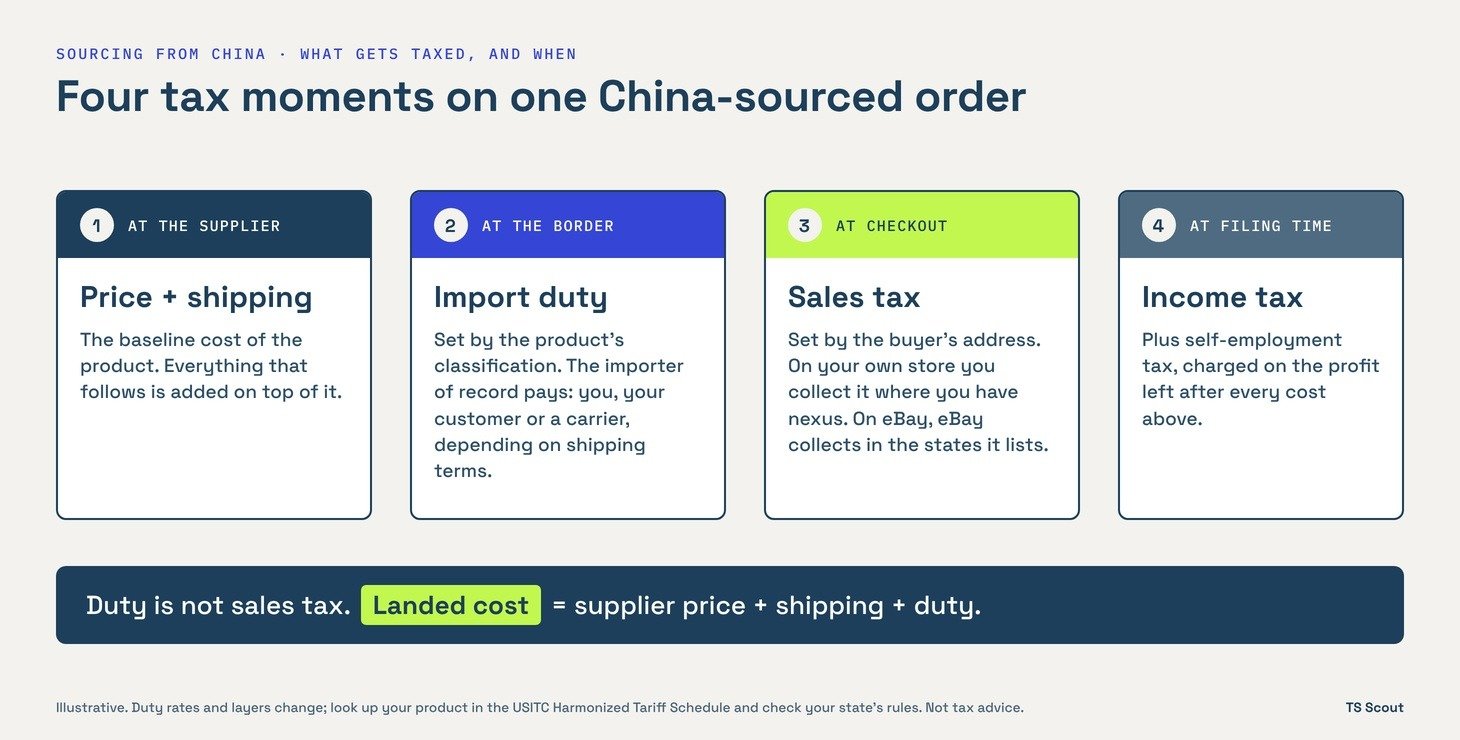
Dropshipping from China adds import duty, which is separate from sales tax, and the 2026 rules changed what a low-value parcel costs.
Is Low-Value Shipping Still Duty-Free?
No. A Customs and Border Protection rule published in the Federal Register on 24 June 2026 suspends the $800 de minimis exemption indefinitely for shipments not sent by mail. Those parcels need formal or informal entry and pay applicable duties. A statute ends the exemption outright on 1 July 2027.
Postal parcels follow a separate CBP rule: the party making entry holds a bond and pays duties by the 7th of the month after arrival, and the compliance date for its formal-entry requirements is 22 October 2026.
What Do You Pay on a China Order Now?
Dropshipping from China to USA customers now carries the standard duty for the product, plus any Section 301 or Section 232 tariffs. The USTR fact sheet adds new Section 301 tariffs of 10% or 12.5% on 60 economies, depending on whether each has a forced-labor import ban. Goods under Section 232 are excluded. The tariff picture has shifted several times this year, so a rate printed here would date quickly. Look up the duty for your product's classification in the USITC Harmonized Tariff Schedule, then confirm the current layers on the USTR notice.
Duty is not sales tax, and dropshipping from China sales tax questions usually blur the two. Your buyer's state sales tax still applies to the retail price wherever you have nexus. The importer of record pays the duty, and your supplier's shipping terms decide whether that's you, your customer or a carrier.
What Changes for UK and EU Sales?
Both are tightening. The GOV.UK policy paper removes the £135 customs duty relief on a date the Treasury appoints, no later than October 2028. The European Commission has charged €3 per item category on parcels up to €150 since 1 July 2026, payable by the seller or importer.
Shipping and duty move together, which is why international shipping dropshipping cost and tax belong in one calculation. The duty side of a supplier's real price is part of what aliexpress hidden fees covers.
Action step: price one product's landed cost.
|
Line |
Where the number comes from |
|
Supplier price |
The supplier's listing |
|
Shipping |
The supplier's quote |
|
Duty |
Product value × the rate for its classification |
|
Landed cost |
Sum of the three |
That baseline needs a real supplier price, and Express Product Research supplies it: search AliExpress by product name, filter by price, category and sales performance, and read product-level data.
Express Source Finder adds the seller's side. Enter a shop URL and it reports listings, prices, ratings and total units sold, so you can see whether a supplier moves enough volume to be worth modelling at all.
Is There an Average Tax Rate for Dropshipping Products?
No single average tax rate exists for dropshipping products, because each of the dropshipping taxes uses a different base.
|
Layer |
What sets it |
Reference point |
|
Sales tax |
Buyer's address |
7.53% average combined state and local rate, up to 10.13% in Louisiana (Tax Foundation) |
|
Import duty |
The product's classification |
Varies by product |
|
Self-employment tax |
Net earnings |
15.3% (IRS) |
|
Income tax |
Your bracket |
Varies by filer |
The sales tax average is population-weighted, so your actual rate depends on the buyer's city and county. Use the average for estimating and the real rate for filing.
Gross Profit vs After-Tax Profit: How Much of Your Margin Survives Tax?
Gross profit is revenue minus product cost. After-tax profit is what remains once fees, ads, returns and every tax are paid. The gap between them is where dropshipping taxes do their damage, and most sellers never calculate it.
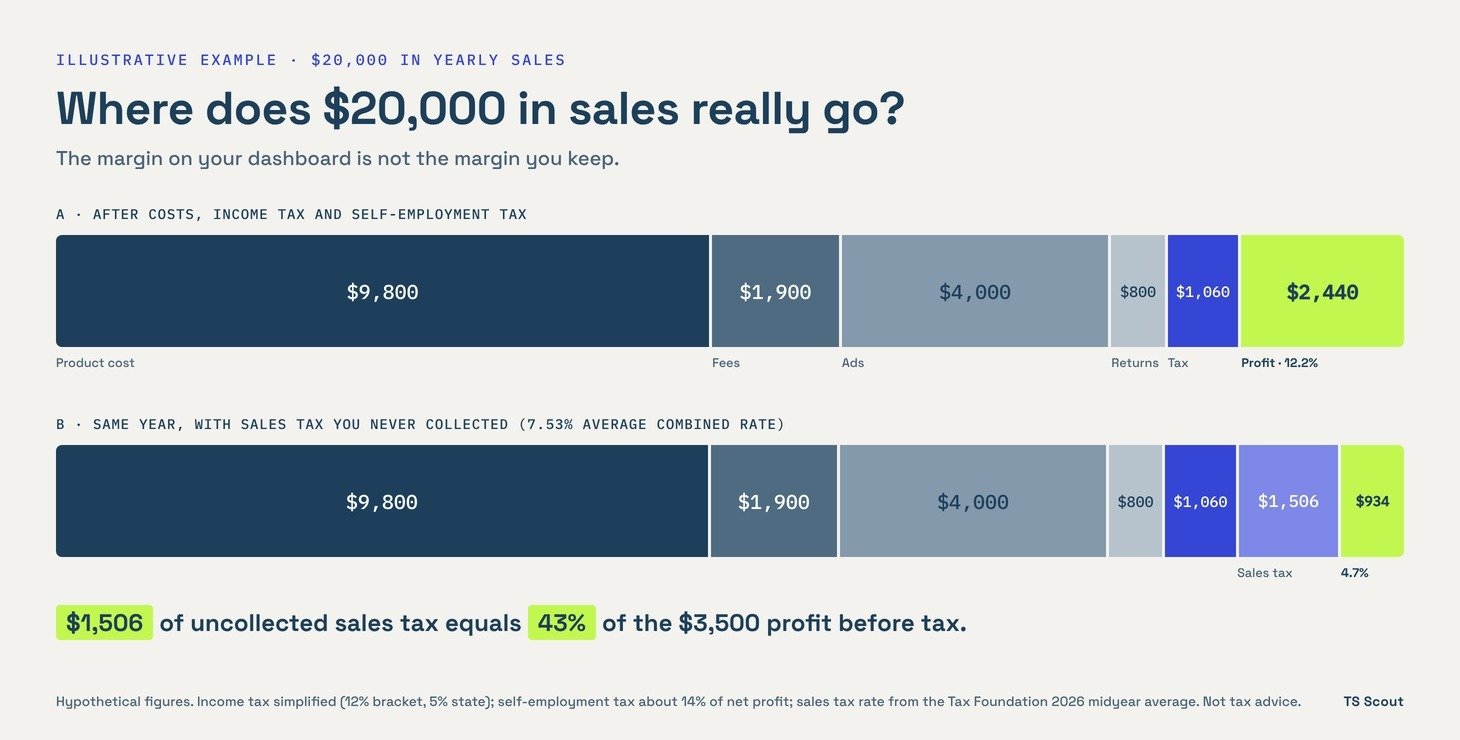
The formula: after-tax profit = revenue − product cost − fees − ads − returns − income tax − self-employment tax − any sales tax you owe.
Case study (hypothetical): a US seller with $20,000 in own-store sales.
|
Line |
Amount |
|
Revenue |
$20,000 |
|
Product cost |
−$9,800 |
|
Platform and payment fees |
−$1,900 |
|
Ads |
−$4,000 |
|
Returns |
−$800 |
|
Net profit before tax |
$3,500 (17.5%) |
|
Self-employment tax (about 14% of net profit) |
−$495 |
|
Income tax (assumed 12% bracket) |
−$390 |
|
State tax (assumed 5%) |
−$175 |
|
After-tax profit |
$2,440 (12.2% of revenue) |
Figures are illustrative and simplified. They assume the seller has other income at a 12% marginal bracket and ignore deductions such as QBI.
Now add the layer nobody planned for. A seller based in a US state generally has a nexus there from the first sale (Washington's rule is one example). If they never collected sales tax on those orders, 7.53% of $20,000 is $1,506, which equals 43% of the $3,500 pre-tax profit. After-tax profit falls to roughly $934, or 4.7% of revenue, before any deduction a tax authority might allow.
The $800 returns line is deliberately modest. A product with a high return rate moves it fast, and dropshipping product returns shows how. Tax is the cost the model's trade-offs rarely price, and Dropshipping Pros and Cons is the right place to weigh those trade-offs against an after-tax number.
How to Build a Dropshipping Tax Calculator Before the Bill Arrives?
Build a dropshipping tax calculator in a spreadsheet with six inputs and five steps. It takes less than an hour, replaces guesswork, and shows your real dropshipping taxes before they're due.
Inputs: revenue by buyer state, product cost, duty paid, fees, ads and returns.
-
Subtract the costs from revenue to get net profit.
-
Multiply net profit by about 14% for self-employment tax.
-
Multiply net profit by your marginal federal rate, then add your state rate.
-
For each state where you collect tax yourself, multiply taxable own-store sales by that state's combined rate.
-
Add steps 2 to 4 and divide by revenue. That's your tax load.
The percentage to set aside comes from your own numbers. There's no official figure to borrow.
Revenue projections improve when they rest on real volume. Express Source Finder shows total units sold for a supplier's listings, so you can model a month's sales from data and not hope. The stakes grow with volume. If you're weighing whether to keep going, as in Why Do Some Stock-Free Sellers Build a Successful Dropshipping Business While Others Quit in Month Three?, the after-tax number is the one to judge by. And when you scale, as in Build a Successful Dropshipping Empire, a small tax error multiplies with every order.
Action step: run last month's real numbers through the five steps this week.
How Do You Pay Taxes on Dropshipping, Step by Step?
Pay the right dropshipping taxes in the right order, and keep the paper trail that proves it.
-
Choose your structure (sole proprietor, LLC or company) and confirm what your tax authority requires for it.
-
Open a business bank account so sales and tax stay separate.
-
Register for a sales tax permit in each state where you have nexus.
-
Collect tax on own-store sales in those states.
-
Pay estimated income and self-employment tax each period.
-
File your sales tax returns and your annual return.
-
Keep records: orders by state, supplier invoices, resale certificates and duty receipts. The Texas Comptroller, for example, asks remote sellers to keep marketplace sales records for at least four years.
UK variant. Register for Self Assessment by 5 October after the tax year once gross trading income passes £1,000. Register for VAT when taxable turnover passes £90,000 in a rolling 12 months, within 30 days of the month end, per GOV.UK VAT registration. Also register if you expect to pass the line in the next 30 days alone.
Who Is Liable When Tax Goes Uncollected?
You are, on your own-store sales, and not the platform or your supplier. Dropshipping liability follows the seller of record, and unpaid dropshipping taxes can add penalties and interest on top of the tax itself, as the IRS underpayment rules show.
|
Mistake |
What it costs |
Fix |
|
Assuming a marketplace covers your own store |
Uncollected tax comes out of your profit |
Track each channel separately |
|
Forgetting marketplace sales count toward thresholds |
Late registration |
Run the monthly nexus check |
|
Paying supplier tax with no certificate |
Tax you could have avoided |
Send a resale certificate |
|
Pricing without duty |
A margin that doesn't exist |
Price landed cost |
|
Spending the full payout |
A cash gap at tax time |
Fund the tax account first |
This guide is general information, not tax advice. Check your state or national tax authority, or an accountant, for your own case.
What Would Your Profit Look Like If You Priced the Tax In Today?
Smaller than your dashboard says, and far more reliable. Every layer of dropshipping taxes in this guide is knowable in advance: the income tax follows your profit, the dropshipping sales tax follows your buyers' addresses, and the duty follows your supplier's parcel. The sellers who get surprised are the ones who never ran the numbers.
If you want to test that on real products, a $1 trial gives you 14 days of full access to TS Scout, long enough to price a few products with real supplier data before your next payment falls due.
FAQs
-
Do I need an EIN or a sales tax permit to start dropshipping?
A sales tax permit is required in states where you must collect tax. Whether you need an EIN depends on your business structure, so confirm it with the IRS or your tax authority before you register.
-
Can a resale certificate get me out of paying sales tax?
It stops your supplier charging you tax on goods you resell. It doesn't remove the sales tax owed on the sale to your buyer. If nobody collects it, the buyer may owe use tax directly.
-
Do I owe tax if I made no profit?
Self-employment tax applies once net earnings reach $400, so a true loss generally leaves no income tax to pay. Sales tax you collect from buyers still has to be remitted regardless of profit.
-
How much should I set aside for taxes?
There's no official percentage. Build it from your own numbers: self-employment tax, your marginal rates and any sales tax you collect, divided by revenue.
-
Do dropshippers pay import tax and duty?
Yes. The de minimis exemption is suspended, so low-value parcels need entry and pay applicable duties. The importer of record pays, and your supplier's shipping terms decide who that is.
-
How do UK sellers pay tax and VAT?
Register for Self Assessment once gross trading income passes £1,000, and for VAT once turnover passes £90,000 in a rolling 12 months.
-
Does Shopify collect sales tax automatically?
Shopify can calculate and collect it, but it files and remits only if you use Shopify Tax with automated filing. Otherwise registration, filing and payment are yours.
-
What records should I keep?
Orders by buyer state, supplier invoices, resale certificates, duty receipts and your tax payments. The Texas Comptroller, for example, asks remote sellers to keep marketplace records for at least four years.
like?


Table of Contents
- Do You Have to Pay Taxes on Dropshipping, Even if Your Profit Is Tiny?
- Which Dropshipping Taxes Land on Your Desk, and Who Collects Them?
- How Does Dropshipping Income Tax Hit Your Profit?
- When Does Dropshipping Sales Tax Become Your Problem?
- Do eBay, Amazon, Walmart and Shopify Collect Dropshipping Taxes for You?
- What Does Dropshipping From China Do to Your Tax Bill?
- Is There an Average Tax Rate for Dropshipping Products?
- Gross Profit vs After-Tax Profit: How Much of Your Margin Survives Tax?
- How to Build a Dropshipping Tax Calculator Before the Bill Arrives?
- How Do You Pay Taxes on Dropshipping, Step by Step?
- Who Is Liable When Tax Goes Uncollected?
- What Would Your Profit Look Like If You Priced the Tax In Today?
- FAQs


